Range, variance, SD, MAD
 Call Kai
 Learn
Learn Practice Test
 Spaced Repetition
 Match
Match Flashcards
 Knowt Play
1/17

There's no tags or description
Looks like no tags are added yet.
Name | Mastery | Learn | Test | Matching | Spaced | Call with Kai |
|---|
No analytics yet
Send a link to your students to track their progress
18 Terms
What is the range
Shows how spread out the data are by comparing smallest and largest values
Simple measure of variation
Needs interval data
How to calculate the range
Identify largest value
Identify smallest value
Subtract max - min = range
Example of range
Data: 3, 4, 4, 5, 5, 6, 6, 6, 8, 10
Range = 10 − 3 = 7
What is the mean absolute deviation MAD
Shows the average distance of each data point from mean, using absolute values (ignores direction)
How to calculate MAD
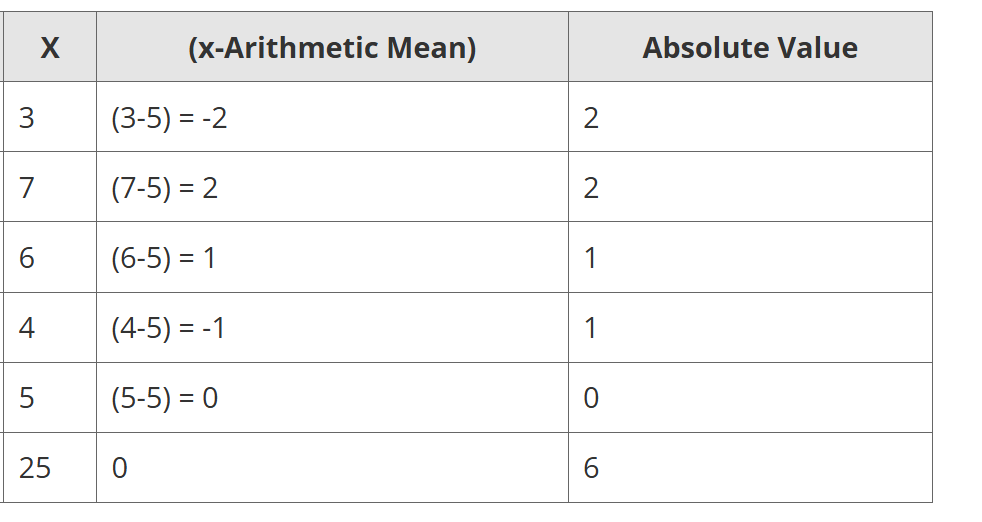
List the data in x
COMPUTE THE MEAN: Add numbers in x column, divide
Subtract values from the mean (x-mean)
Check, must result in 0
Take absolute values
Add absolute values
Divide sum from absolute value by number of data points
Example of MAD
Data: 3, 7, 6, 4, 5
6/5 = 1.2
MAD requries:
Interval data
Can be 0 not negative
Outliers increase MAD
Important for SD
What is Variance
Measure of how far data points are from mean but using squared distances
How to calculate Variance
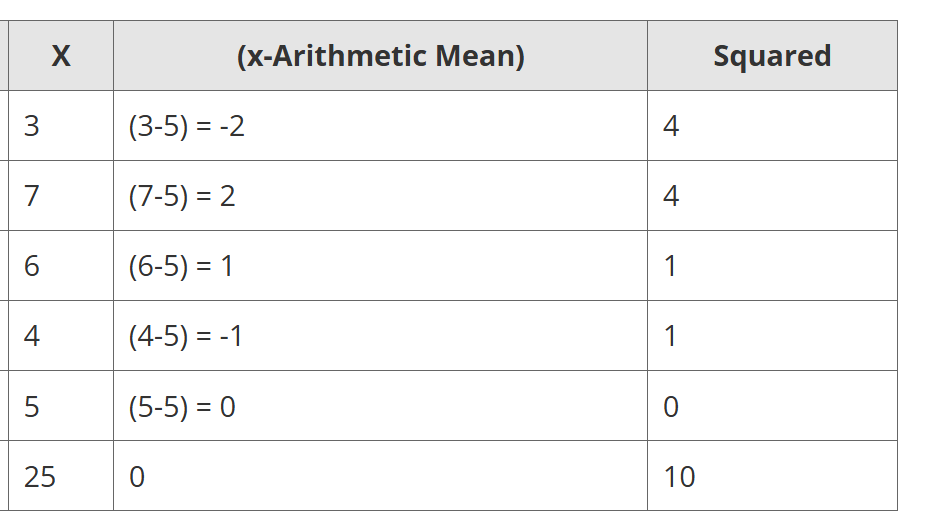
Same steps and chart as MAD
But square each deviation
Add squared values
Divide sum by n-1
Example of Variance
Data: 3, 7, 6, 4, 5
Squared sums 10
10/n-1 .. 10/5-1 = 2.5
Why divide by n-1 for variance
Sample variance uses degrees of freedom dividing by n would underestimate population variance
Formula for Standard deviation
Same as Variance, but added square root

What is standard deviation
The square root of variance, most widely used measure of spread
Shows the distance of data points from the mean
How to calculate Standard Deviation
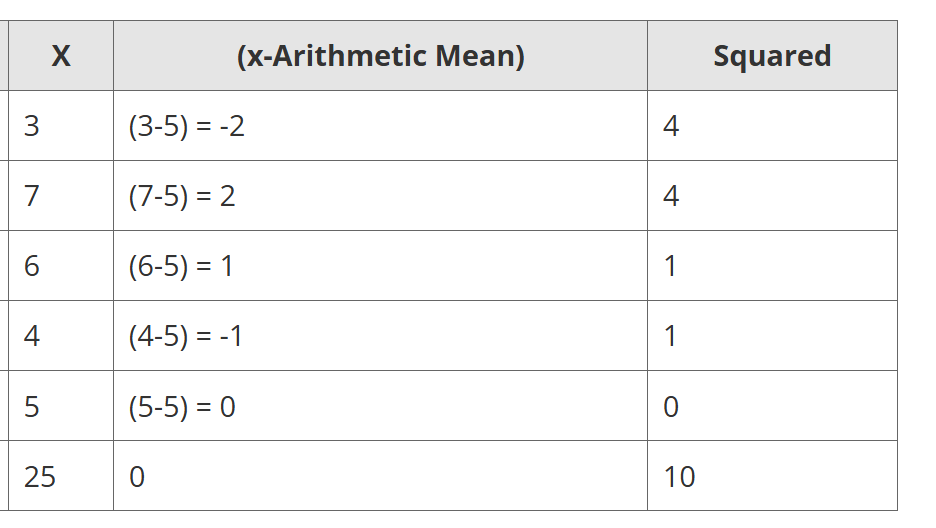
Calculate variance
Take the square root
Example of Standard Deviation
SD = √Variance
= √2.5
= 1.58
Standard Deviation requires
Interval or ratio data
Sensitive to outliers
How are MAD Variance and SD similar?
Same method with the table but for the last column:
MAD uses absolute values, dividing by n
Variance squares values, divides by n-1
SD square root of variance value
What are the differences between SD and MAD
SD
Squared
Very sensitive to outliers
Emphasizes large deviations
Used in statistics
Related to normal distribution
MAD
Absolute deviations
Somewhat sensitive
Doesnt emphasizes large deviations
Rarely used

