Ecosystems and Sampling Techniques
 Call Kai
 Learn
Learn Practice Test
 Spaced Repetition
 Match
Match Flashcards
 Knowt Play
1/60

There's no tags or description
Looks like no tags are added yet.
Name | Mastery | Learn | Test | Matching | Spaced | Call with Kai |
|---|
No analytics yet
Send a link to your students to track their progress
61 Terms
What is a population?
All the individuals of the same species at any one time living in a certain area at a certain time
What is a community?
All of the organisms of all of the species living in an area at one time
What is an ecosystem?
A community and the abiotic factors of it’s environment
What is an abiotic factor?
Non-living factors in an ecosystem
What is a biotic factor?
The living factors in an ecosystem
What is a habitat?
The area in which an organism lives
What is interspecific competition?
Competition between member of different species
What is intraspecific competition?
Competition between members of the same species
What are some example of abiotic factors?
Temperature, pH (of soil/water), conc. of mineral ions, light intensity, salinity, humidity, aspect (gradient of the land)
What are some examples of biotic factors?
Predators, competition and disease
What does carrying capacity mean?
The maximum number of individuals of a population that the ecosystem can support
What are the stages of the growth distribution curve?
Lag phase
Rapid/exponential growth phase
Stationary phase
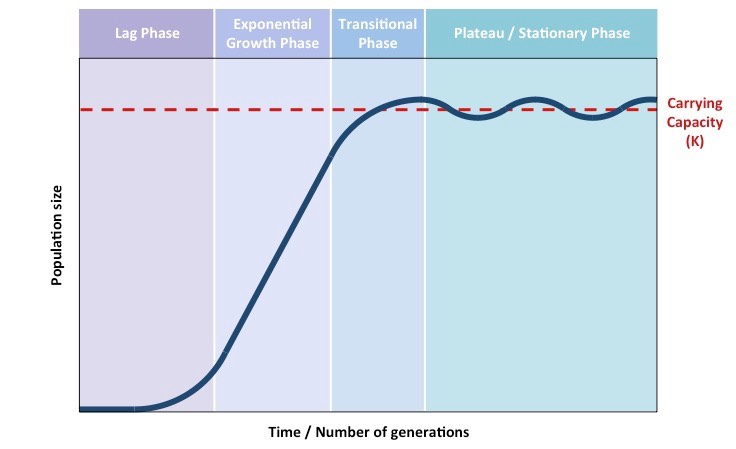
Describe the growth distribution curve
Lag phase- the population size increases very slowly at first
Exponential growth- The population size increases vary rapidly
Stationary phase- the population has reached it carrying capacity
The population size fluctuates due to different abiotic and biotic factors such as predator prey cycles and mating seasons
Explain the lag phase of an population growth curve for asexually in bacteria and sexually reproducing organisms
Asexual
Little growth- bacteria are transcribing genes and synthesising the appropriate enzymes for new conditions
These enzymes may include DNA helicase and DNA polymerase
Sexual
Individuals rarely meet
Long gestation periods so few births
Explain the rapid growth phase of a population growth curve in asexually and sexually reproducing organisms
Asexual
Rapid exponential growth
No limiting factors as bacteria are at relatively low density
Sexual
Rapid growth through not exponential
Few limiting factors and population is low density
Explain the stationary phase of a population growth curve for asexually (bacteria) and sexually reproducing organisms
Asexual
Slow growth due to accumulation of ethanol
Lack of glucose
Limiting factors increase
Sexual
Slow growth due to intraspecific competition for food, territory, predators
Also disease can reduce population size
Why do we use logs for counting the number of bacteria cells in a culture for example?
Logs allow us to deal with very small and very large values
What is a niche?
Where an organism lives and all of the biotic and abiotic factors that influence it
The niche is the organisms role within the ecosystem
Why do niche’s for difference species exist within ecosystems?
Different species can occupy the same area as they require different resources meaning they are not competing
Different species having different niches increases species diversity
Members of the same species always have the same niche and will be well adapted to that niche
What does a narrow niche mean for a population?
It only has a narrow range of resources like food sources that it needs to survive
Therefore it has a lower carrying capacity
There are fewer numbers of this species and they are less likely to cope with environmental change?
What does a broad niche mean for a population?
The population has a greater carrying capacity
This is because it would have a greater range of food sources for example so there is more food available to support the population
What are the names for species with a narrow and broad niche?
Narrow- specialists
Broad- generalists
What is the competitive exclusion principle?
Two species cannot co-exist in the same habitat if they have the same niche
One species will be more successful than the other until there is only one species left
We say that the less successful species is driven to exclusion
How does competition differ between an environment with extreme abiotic factors compared to those with moderate abiotic factors?
In moderate conditions, many different species may survive
Therefore there is a lot of competition
In extreme conditions, only the very best adapted species will survive
Therefore there is very little if any competition from other species tic factors dictate who survives
In extreme environments, abiotic factors dictate who survives. In less extreme environments, biotic factors dictate who survives
What is magnesium used for in plants?
To make chlorophyll
How can seasonal changes affect population sizes?
Abiotic factors vary with seasons, causing a periodic oscillation in the population size
In summer it tends to be warmer, meaning there is more reproduction and less organisms dying of exposure to the cold, with the opposite being true for winter
What kinds of organisms have a population size which is affected by seasonal changes?
Species with short life cycles like insects
Species with long life cycles (longer than a year) do not change with the seasons like this
What do animals compete for?
Food
Mates
Habitat/territory
Water
What do plants compete for?
Light
Mineral ions
Water
Explain the predator-prey cycle
There are a low number of predators so not many prey are eaten
The prey are more likely to survive and reproduce so their numbers increase
This increase in prey numbers means that there is more food for the predators to eat so the ecosystem can support more predators (i.e. their carrying capacity increases)
The predator population increases, meaning that they eat more prey causing prey numbers to decrease
This causes a food shortage for a large predator population- intraspecific competition means that predators are now competing with each other for food meaning the less successful predators will die of starvation, causing predator numbers to decrease
Less prey are eaten, so the prey numbers increase and the cycle begins again
Why is the number of predators normally lower than the number of prey?
The population of the number of predator depends on the number of prey
The population of the prey depends on another food sources, prey often reproduce often, if the predator eats they prey too much, it causes a decrease in the predator population
Why is there a lag time between prey and predator population peaks in a predator-prey cycle?
Time taken for the prey numbers to increase again
Time to find partners, breed and also gestation periods
Why do predator-prey cycles often not lead to the extinction of a prey within an natural area?
In nature, habitats provide a safe place for the reproduction of prey
There is predation of the primary predators so less of they prey would be eaten
Disease can reduce prey numbers
Smaller populations are more difficult to hunt
What is a quadrat and when is it used?
Normally a square frame allowing organisms within the square to be counter
It used to calculate the abundance of organisms and make comparisons between other organisms
They are difficult to use for tall vegetation or uneven ground
Can vary in size and doesn’t have to be a square
How would you estimate the number of dandelions in a field?
Grid the area of the field and split the squares/spaces into coordinates
Use a random number generator to produce two numbers to use as your coordinates
Place the quadrat at the coordinate and count the number of dandelions within the quadrat
Alternatively if the number of dandelions is hard to count because there’s too many, you can calculate % cover
Repeat many times/gain a large sample
Calculate the mean number of dandelions per m2
Assuming that your quadrat is 1m2 - Area of field/area of quadrat x mean number of dandelions gives you the total number on the field
Why do we want large and random samples?
Large- to be representative
Random- to avoid bias
What are the two ways to place a quadrat down to avoid bias?
Systematic sampling - placing a quadrat down every 3rd square for example
Random sampling - using a random umber generator to produce coordinates
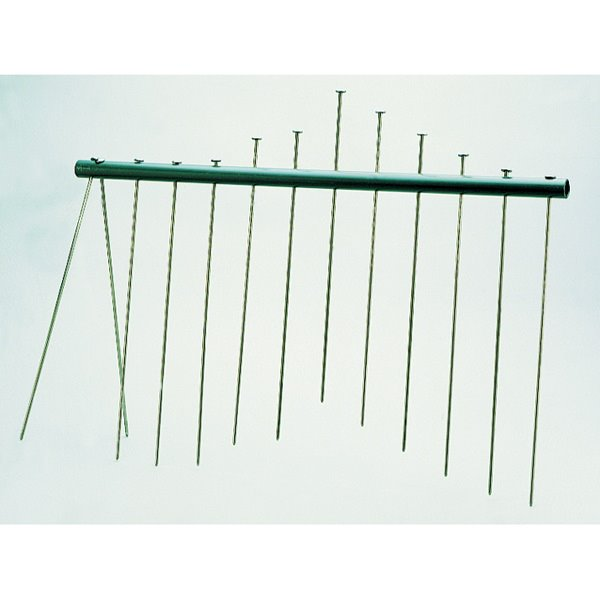
What is a point quadrat and how is it used?
Its a frame shaped like a T
Any species touching the pins stuck in the ground is only counted once
This allows us to also count overlapping vegetation and elevated vegetation
What is a transect and why are they useful?
A line through a habitat along which the species can be sampled
These are useful because it allows us to also study how the change in an abiotic factor affects the distribution of an immobile organism
What are the two types of transect?
Line transect- a tape measure is placed along the transect and the species that touch the line are counted
Belt transect- quadrates are placed at regular intervals along a transect to work out the species frequency/percentage cover along the transect
What is the difference between a continuous and interrupted belt transect and what are the strengths and weaknesses?
A continuous belt transect is where you place a quadrat down, then flip it over to record the space next to it
A strength of this is that you don’t miss any species (along the transect)
A weakness is that it can be very time consuming
A interrupted belt transect is where you place the quadrates at regular intervals
A strength is that it is less time consuming
A weakness is that you may miss some species along the transect between intervals
Method for systematic sampling with a belt transect
Lay out a tape measure along the area of land to sample
Place the start of the transect at random
You need to be clear where you’re placing the tape measure/quadrat and how- for example if you’re measuring plant distribution away from a roadside, place the tape measure perpendicular to the road side
Place quadrats at regular intervals and place a quadrat down, counting the number of organisms or percentage cover
Repeat with many transects across the area of land
What does an organism being sessile mean?
It remains stationary
How can we measure organism abundance for organisms that are mobile?
Mark-release-recapture
This method traps to organism (normally in a pitfall trap for small insects)
Method for mark-release-recapture
Place a trap (trap type depends on the organism) and leave for a long, fixed period of time
Return to the trap and count the number of organisms
Mark the sample in a non-harmful, discrete way (the markings may affect the organism’s ability to survive/likely to be rubbed off)
Release the organisms back into their habitat
Wait for a long, fixed amount of time and place another trap and capture a second sample
Count the number of organisms in total, then count the number marked
Use the formula Total no. in sample 1 x Total no. in sample 2 / No. marked in sample 2
What are the assumptions made when using the mark-release-recapture method?
The sample has had the time and opportunity to reintegrate back into the population
Assumes there are no births or deaths
Assumes there is no immigration or emigration in or out of the population
What is succession?
How an ecosystem changes over a long period of time
Why is bare rock such a hostile environment?
No soil
Extremes of temperature
Lack of water leads to dehydration/desiccation (drying out)
Extremes of pH
In general the abiotic factors are very unfavourable
What are features of a pioneer species that suit them to colonisation?
Tolerance to extreme conditions
Rapid germination of seeds
Production of large quantities of wind-dispersed seeds or spores
The ability to photosynthesis
What are the features of a climax community?
High species diversity
More niches
More habitats
Larger range of food sources
Abiotic factors are constant
Population sizes are stable (at carrying capacity)
Climax community is stable- complex food webs
What are some adaptations of xerophytes that makes them pioneer species?
Thickened cuticle- reduces the evaporation of water- decreased diffusion pathway
Rolled leave, stomata sunk in pits, hairs on leaves- Traps water vapour around stomata which reduces the diffusion gradient meaning less diffusion of water out of the plant
Fewer stomata- less places where transpiration can take place
Spines instead of leaves/smaller leaves- Reduced surface area for the evaporation of water/transpiration
What happens during succession?
The pioneer species colonises the hostile environment
They produce soil and when they die they produce humus (decaying material)
As they die they will also release phosphates and nitrates into the soil
This makes the environment less hostile so new species can colonise the area
The new species are more successful competitors than the pioneer species so they outcompete it
Biodiversity increases until a climax community is reaches
This process can take thousands of years to reach a climax community
What is secondary succession?
Starts with soil unlike primary succession
Often happens following natural disasters like fires or after grazing, ploughing etc.
Soil have already been developed s there is no need for a pioneer species
Seeds are often present and can germinate immediately to give a mixed climax community of trees, grasses, etc.
It can take just decades for a climax community to be reached
What are the differences between primary and secondary succession?
Primary
Starts with bare land
No soil
Slower
Harsher abiotic factors
Requires a pioneer species to make the abiotic conditions less harsh and produce soil
Secondary
Event destroys an area such as a fire
Soil is still present
Faster
Does not need a pioneer species as soil is already present
What is deflective succession?
Humans taking action to prevent succession taking place
Done by using animals to graze and burning
Sometimes done to conserve land or to keep around important species that may be useful for producing medicines
What is conservation?
The protection and management of species and habitats (ecosystems) in a sustainable way
What does sustainable mean?
Enough resources are taken to meet the needs of the people today without reducing the ability of the people in the future to meet their own needs
What are the main reasons for conservation?
Ethical- other species have occupied the Earth far longer than we have and should be allowed to co-exist with us. We should respect living things.
Economical- Living organisms contain a gigantic pool of genes with the capacity to make millions of substances (crucially, medicines)
Cultural and aesthetic- habitats and organisms enrich our lives (ecotourism)
What are some conservation methods?
Management of succession- burning land, animal grazing
Seed banks- keeping seeds stored in a library
Captive breeding- keeping animals in an enclosed space to breed
Fishing quotas- limiting fishing at certain times, limiting fishing of certain species
Protected areas- high species diversity
What are the drawbacks of some conservation methods?
Seed banks- seeds lose their viability after a while
Captive breeding- it may be hard to get the animals to breed
Fishing quotas- limits the income of fishermen
Protected areas- often funded by tourists
When managing succession, what is the artificial climax community called?
Plagioclimax

