AP Pysch Unit 4
 Studied by 0 people
 Call Kai
 Learn
Learn Practice Test
 Spaced Repetition
 Match
Match Flashcards
 Knowt Play
1/115

There's no tags or description
Looks like no tags are added yet.
Name | Mastery | Learn | Test | Matching | Spaced | Call with Kai |
|---|
No analytics yet
Send a link to your students to track their progress
116 Terms
Obedience
Following a direct command, usually from an authority figure.
Example: A student stays after school because a teacher tells them to, even though they don’t want to.
Authority Figure
A person perceived to have power or control over others.
Example: A police officer directing traffic is seen as an authority figure.
Deception (in research)
When participants are misled about the true purpose of a study.
Example: Participants are told they are testing memory when the real goal is to study obedience.
Diffusion of Responsibility
When people are less likely to take action because they believe someone else will.
Example: No one calls 911 during an emergency because everyone assumes someone else will.
Foot-in-the-Door Technique
Getting someone to agree to a big request after a small one.
Example: Someone agrees to sign a petition, then later donates money to the cause.
Collectivism
A cultural value where the group is more important than the individual.
Example: A student chooses a career their family prefers to support the whole family.
Individualism
A cultural value where personal goals are more important than group goals.
Example: A student moves away for college to follow their own dreams.
Multiculturalism
Valuing many cultures within one society.
Example: A school celebrates holidays from different cultures.
Group Polarization
Group discussion leads to more extreme opinions.
Example: After talking together, a group becomes more strongly against school uniforms.
Groupthink
Group members avoid disagreement to keep harmony.
Example: A team agrees to a bad plan because no one wants to speak up.
Bystander Effect
People are less likely to help when others are around.
Example: A person collapses in a crowded mall and no one helps right away.
Social Loafing
Putting in less effort when working in a group.
Example: A student does less work in a group project than when working alone.
Deindividuation
Individuals lose their sense of personal responsibility and self-awareness in a large, anonymous crowd, leading them to engage in vandalism or aggression they wouldn't normally do alone.
Example: People act more aggressively while wearing masks and being in groups at a protest.
Sporting Events: Yelling profanity when other people are yelling too, feeling less self-conscious than they would if they were alone.
Personality
Patterns of thinking, feeling, and behaving.
Example: A person is always calm and organized in stressful situations.
Who created the Psychodynamic Theory, and what is it
Sigmund Freud
Personality is shaped by unconscious thoughts and childhood.
Example: An adult’s fear of authority comes from strict parenting.
Fear of Commitment: Difficulty with long-term relationships may reveal a childhood fear of abandonment, linked to inconsistent parental care.
Psychoanalysis
THERAPY that focuses on unconscious conflicts. Explains WHY people are the way they are.
Example: A person's overwhelming fear of heights might stem from an unresolved childhood trauma, like witnessing a fall, which their unconscious mind links to danger.
Someone with an intense fear of mice (phobia) whose therapist helps them uncover an unconscious, repressed traumatic childhood memory of being trapped in a small space, linking the present fear to past unresolved conflict, demonstrating how unconscious desires and defense mechanisms (like repression) shape behavior
Unconscious Mind
Thoughts outside awareness that affect behavior.
Example: A person avoids dogs without knowing why because of a forgotten childhood bite.
Id
Pleasure-seeking part of personality.
Example: Wanting to eat candy instead of dinner.
Ego
Balances the id and reality.
Example: Eating one piece of candy instead of the whole bag.
Superego
Moral compass of personality.
Example: Feeling guilty for lying to a friend.
Defense Mechanisms
Unconscious ways to reduce anxiety.
Example: Blaming a bad grade on the teacher instead of studying.
Oedipus Complex
Child’s unconscious attraction to opposite-sex parent.
Example: A young boy wants all of his mother’s attention and is jealous of his father.
Archetypes, and who created them
Carl Jung
Universal patterns or roles in the collective unconscious that shape how people think, feel, and act.
You are not one archetype.
You have all of them inside you, and different ones show up in different situations.
Example 1: When someone feels like they need to protect everyone, they’re acting out the “caregiver” archetype.
Example 2: The Hero archetype
Across cultures, stories always have a hero.
A kid who starts off normal
Faces a challenge
Doubts themselves
Grows and succeeds
Examples: Harry Potter, Katniss, Spider-Man
Jung’s point: humans are wired to understand and relate to this pattern, so we keep creating it.
Example 3: The Shadow archetype (this one helps a lot)
This is the dark side of yourself that you don’t like or don’t show.
Someone who acts nice but has angry thoughts
Someone who hides jealousy
Someone who avoids admitting selfish feelings
Jung said everyone has this, even good people. That’s why villains are so easy to understand — they represent parts we all have.
Collective Unconscious
The collective unconscious is the idea that all humans share a set of inborn memories, ideas, and patterns, passed down through generations — even if we’ve never experienced them ourselves.
Example:
1. Fear of the dark
Little kids are often scared of the dark even if nothing bad has ever happened to them. Jung said this fear is part of the collective unconscious because darkness meant danger for early humans.
2. Mother figure
Every culture has some version of:
a nurturing mother
a protector
a life-giver
Even in stories kids hear for the first time, they instantly understand who the “safe” character is. That’s the collective unconscious at work.
Inferiority Complex
Feelings of weakness that motivate success.
Example: A student studies harder to prove they are smart.
Humanistic Theory
Focus on growth and free will.
Example: A therapist helps someone discover their goals instead of analyzing their past.
Self-Actualization
Reaching full potential.
Example: An artist feels fulfilled creating meaningful work.
Hierarchy of Needs
Motivation from basic to advanced needs.
Example: A person focuses on safety before worrying about self-esteem.
Unconditional Positive Regard
Accepting someone no matter what.
Example: A parent supports their child even after they fail a test.
Conditions of Worth
Feeling valued only if expectations are met.
Example: A child feels loved only when they get good grades.
Congruence
Real self matches ideal self.
Example: A person feels confident because they are living the life they want.
Industrial-Organizational Psychology
Studies how people behave in the workplace and how to make work more productive, fair, and less stressful.
Example: A company hires a psychologist to improve employee productivity.
1. Industrial = the job
This part focuses on:
hiring the right people
creating fair interviews and tests
training employees
evaluating performance
Example:
A company uses personality tests to figure out who would be good at customer service vs data work.
2. Organizational = the people
This part focuses on:
motivation
leadership
teamwork
job satisfaction
reducing burnout
Example:
A psychologist helps a company change schedules so workers are less stressed and more motivated.
Real-life examples (AP Psych friendly)
Designing a better interview so it’s fair and not biased
Helping managers learn how to motivate employees
Studying why employees quit and how to keep them
Making workplaces less stressful and more productive
Improving teamwork in companies
Job Satisfaction
How happy someone is at work.
Example: An employee enjoys their job and feels motivated to work.
Burnout
Emotional exhaustion from stress.
Example: A nurse feels drained after long hours and stops caring about work.
Social Facilitation
Better performance on easy tasks when watched.
Example: A runner runs faster during a race than during practice.
Social Inhibition
Worse performance on hard tasks when watched.
Example: A student forgets answers during a presentation.
Altruism
A type of prosocial behavior
Helping others without expecting anything back.
Example: Donating anonymously to charity.
Prosocial Behavior
Any action meant to help others.
Motivations:
Can be diverse, including altruistic, egoistic (self-gain, reputation), social norms, or even relieving personal distress.
Example: Holding the door open for someone.
Social Debt
Feeling the need to return a favor.
The psychological burden of unmet social obligations, unspoken expectations, or violated social norms, often resulting in guilt, anxiety, or strained relationships. Common examples include feeling obliged to return a favor, failing to uphold social etiquette (like bringing a gift), or the pressure to maintain a certain lifestyle to keep up with peers
"Unasked" or "imbalanced" liabilities one person feels toward another after receiving a benefit
Example: You help a friend because they helped you before.
Social Reciprocity Norm
Universal social rule or moral expectation that individuals should return favors and kindness
Example: Feeling obligated to buy lunch for a friend who paid last time
Social Responsibility Norm
Helping those in need.
Example: Helping an injured person even if you don’t know them.
Psychological Construct
A concept that is not directly observable but is used to explain behavior.
Example: Personality and intelligence are constructs used to explain why people act differently.
Womb Envy (Karen Horney)
The neo-Freudian concept that men may feel inferior because they cannot give birth.
Karen Horney focuses on social roles and cultural pressures; this might be why men seek power, success, or control in other areas.
Example: A man overcompensates for his inability to bear children by striving for extreme success in his career.
Physiological Needs (Maslow)
The most basic level of the hierarchy involving survival.
Example: Needing food, water, and sleep before being able to focus on anything else.
Safety Needs (Maslow)
The need for security and protection.
Example: Having a stable home and locks on the doors to feel safe from harm.
Belongingness and Love Needs (Maslow)
The need for intimate relationships and friends.
Example: Joining a club at school to feel like part of a social group.
Esteem Needs (Maslow)
The need for prestige and a feeling of accomplishment.
Example: Feeling proud after winning an award or receiving a promotion at work.
Self-Understanding (Rogers)
The insight a person gains into their own behavior and motives, often promoted by unconditional positive regard.
Example: Realizing through therapy that you avoid conflict because you fear rejection.
Real Self (Self-Image)
How we actually see ourselves currently.
Example: Recognizing that you currently spend four hours a day on your phone.
Ideal Self
The person you want to be.
Example: Wanting to be someone who is disciplined and spends their time reading books.
Incongruence
The state of imbalance when the real self and ideal self do not match, leading to anxiety.
Example: Feeling like a failure because you value fitness but haven't exercised in a month.
Attribution
The process of explaining the causes of behavior and mental processes.
Example: Deciding a friend is late because they are lazy or because traffic was bad.
Internal (Dispositional) Attribution
Attributing behavior to a person’s inherent qualities or personality.
Example: Assuming a classmate failed a test because they aren't smart.
External (Situational) Attribution
Attributing behavior to outside circumstances.
Example: Assuming a classmate failed a test because the room was too loud or the test was unfair.
Internal Locus of Control
The belief that you control your own fate and outcomes.
Example: Believing you got an 'A' because you studied hard.
External Locus of Control
The belief that outside forces (luck, others) determine outcomes.
Example: Believing you got an 'A' simply because the teacher likes you.
Explanatory Style
A predictable pattern of how an individual explains good and bad events in their life.
Example: An optimistic person blames a bad grade on a "one-time" hard test rather than their own intelligence.
Fundamental Attribution Error (FAE)
The tendency to overestimate personality and underestimate the situation when judging others.
Example: Getting angry at a driver who cut you off, thinking they are a "jerk" without considering they might be rushing to the hospital.
Self-Serving Bias
Taking credit for success (internal) but blaming failure on the situation (external).
Example: Saying "I’m a genius" when you win a game, but saying "The game is rigged" when you lose.
Social Comparison
Evaluating oneself by comparing qualities or abilities to others.
Example: Feeling bad about your grades after seeing a classmate's 100%.
Upward Social Comparison
Comparing yourself to those you perceive as better off or more successful.
Example: A beginner runner comparing themselves to an Olympic athlete and feeling frustrated.
Downward Social Comparison
Comparing yourself to those you perceive as worse off to boost self-esteem.
Example: Feeling better about your B- after hearing a friend got a D.
Relative Deprivation
Feeling like you have less because you are comparing yourself to others who have more.
Example: Being happy with your new phone until you see your friend got the even newer, more expensive model.
Stereotype
A generalized concept about a group meant to reduce "cognitive load" (mental effort).
Example: Assuming all athletes are not interested in academics to simplify social categorization.
Self-Fulfilling Prophecy
When an expectation leads to behavior that makes the expectation come true.
Example: A teacher expects a student to fail, so they give them less help, causing the student to actually fail.
Confirmation Bias
Seeking out information that supports your existing beliefs while ignoring contradictory evidence.
Example: Only watching news channels that agree with your political views.
Just-World Phenomenon
The belief that the world is fair and people get what they deserve.
Example: Thinking a homeless person must be lazy, rather than considering economic factors.
Ethnocentrism
Believing your own culture is superior to others.
Example: Judging another country’s traditional food as "weird" because it isn't what you eat at home.
In-group Bias
Favoring members of your own group over others.
Example: Believing your school's football team is the "nicest" while the rival school's team is "mean."
Out-group Homogeneity Bias
Perceiving members of an outside group as all being exactly the same.
Example: Thinking "All people from that city act exactly the same way."
Cognitive Dissonance
Mental discomfort felt when actions and attitudes conflict.
Example: You believe smoking is unhealthy but you smoke anyway; to fix the discomfort, you tell yourself "I'll quit tomorrow."
Social Norms
Unwritten rules shared by a group about how people are expected to behave.
Example: Knowing you should be quiet in a library without being told.
Conformity
Changing your behavior to match the group.
Example: Buying a certain brand of shoes just because everyone else is wearing them.
Solomon Asch’s Line Experiment
A study showing people will give an obviously wrong answer to match the group.
Example: Agreeing that a short line is long because five people before you said it was.
Normative Social Influence
Conforming to be liked or to avoid social rejection.
Example: Clapping at the end of a play you hated because everyone else is clapping.
Informational Social Influence
Conforming because you believe the group has more accurate information.
Example: Following a crowd toward an exit during an alarm because you assume they know the way out.
Zimbardo’s Stanford Prison Experiment
A study showing that social roles (guard vs. prisoner) have a profound effect on behavior.
Example: A normally kind person acting bossy after being assigned the role of "manager."
False Consensus Effect
Overestimating how much others agree with your personal beliefs.
Example: Thinking "everyone" likes the same movie you do.
Stanley Milgram’s Obedience Experiment
Stanley Milgram’s 1961 obedience experiments at Yale University demonstrated that 65% of participants would administer potentially lethal 450-volt electric shocks to a learner when ordered by an authority figure, despite hearing screams.
Purpose: To investigate how far people would follow orders from an authority figure, even when it conflicted with their conscience.
Methodology: Participants (the "teacher") believed they were delivering shocks to a "learner" (a confederate) for incorrect answers on a memory test.
Key Findings: The experiment showed that ordinary people can be induced to commit harmful acts under the direction of an authority figure.
Ethical Issues: The study was highly criticized for deceiving participants and causing them intense psychological distress.
Drive-reduction theory, what are its advantages and disadvantages
Humans are motivated to act in order to reduce internal tension (drives) caused by unmet biological needs.
When the body is out of balance (ex. hunger, thirst, cold), it creates a drive to perform actions that restore homeostasis (a stable, comfortable state)
The goal of behavior is to reduce the tension, bringing the back to equilibrium.
Ex. When you are hungry, you feel tension (drive). You eat food, which reduces the hunger (drive reduction) and returns your body to a balanced state.
Advantage: explains biological motives well
Disadvantage: Less useful for explaining psychological motives, as people sometimes ignore biological needs.
Arousal Theory
People are motivated to behave in ways that maintain an optimal, personal level of physiological alertness and stimulation, not too bored, not too stressed.
Example:
• You listen to music while studying so you’re not bored
• You avoid too much caffeine before a test so you’re not anxious
Sensation-seeking theory
Some people are motivated by the need for exciting, intense, or risky experiences.
Ex. People who enjoy roller coasters, extreme sports, or thrill rides.
Ex. While one person (low-sensation seeker) may be perfectly happy reading a book on a quiet Sunday, a high-sensation seeker might feel bored and crave an intense, adrenaline-filled activity like riding a motorcycle at high speeds or jumping off a cliff.
Four subtypes of the Sensation Seeking Scale
Thrill and Adventure Seeking:Wanting physical danger or adrenaline.
Examples: Skydiving, rock climbing, motocross.
Experience Seeking: Wanting new mental or cultural experiences.
Examples: Traveling alone, trying new foods, going to museums, learning new languages.
Disinhibition: Lower self-control, especially in social situations.
. Examples: Partying excessively, risky behavior when surrounded by friends.
Boredom Susceptibility: Hating routine and repetition.
Examples: Getting restless in repetitive classes or jobs and constantly seeking stimulation.
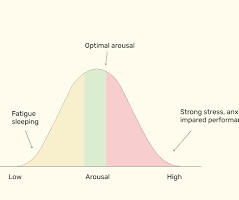
Yerkes-Dodson Law, what type of arousal do you need for Easy and Hard Tasks?
Performance increases with arousal up to a point, then decreases if arousal gets too high.
Example:
• Running a race → more adrenaline helps
• Solving a hard math problem → too much anxiety hurts performance
Easy Tasks: Need higher arousal to stay focused.
Hard Tasks: Need lower arousal to avoid panic.
Intrinsic Motivation
The drive to engage in an activity simply because it is enjoyable, interesting, or personally fulfilling, rather than for external rewards like money or praise. It comes from within, fueling curiosity and personal growth.
Reading a book because you are genuinely curious about the topic.
Exercising because you love the feeling of being active, not to lose weight.
Solving a puzzle for the challenge and fun.
Volunteering because you want to help, not to put it on a resume
Extrinsic Motivation
Doing an activity to earn a reward or avoid punishment, rather than for personal enjoyment. Driven by external factors like money, grades, praise, or fame.
Ex. Work: Finishing a project to get a bonus or avoid being fired.
School: Studying to get an 'A' or satisfy parents.
Life: Cleaning to avoid judgment or following speed limits to avoid tickets
Self-Determination Theory
People are most motivated when they feel:
Autonomy (control over choices)
Competence (feeling capable)
You’re more motivated to study when you choose how to study and feel confident in the material.
Incentive Theory
WHY extrinsic motivation works.
It says that people are motivated to act in certain ways because incentives (rewards or punishments) push or pull them to behave that way.
Example: You study because the reward (good grade, praise) attracts you, or you avoid skipping class because detention pushes you away from it.
It posits that people are "pulled" toward actions that promise rewards like money, praise, or grades.
Work: An employee works overtime to get a bonus.
School: A student studies hard to get an 'A' grade.
Daily Life: A child cleans their room to receive an allowance
Lewin’s motivational conflicts theory
Lewin said that sometimes motivation isn’t just about wanting something — it’s about having to choose between options, and the type of conflict changes how motivated we are.Motivation comes from having to choose between conflicting goals.
Three Types of Conflicts for Lewin’s motivational Conflicts theory
Approach-Approach: Two good options.
Ex. Choosing between two colleges you like. (Least Stressful conflict)
Avoidance-Avoidance: Two bad options.
Ex. Doing homework or getting grounded. (Most stressful)
Approach-Avoidance: One option with both positives and negatives.
Ex. Wanting a high-paying job but hating the long hours.
Lewin believed that as you get closer to a goal, the drive to "avoid" negative aspects often becomes stronger than the drive to "approach" positive ones, leading to stalling or indecision.
Optimal Level of Arousal
Everyone has a sweet spot where they perform best.
Too little arousal → bored
Too much arousal → stressed
Example:
A little nervous before a test = focused
Too nervous = blanking out
Homeostasis
The body’s natural ability to keep internal conditions balanced and stable.
Example:
• You sweat when you’re hot
• You shiver when you’re cold
• You eat when blood sugar drops
AP connection:
Drive-reduction theory exists because the body wants homeostasis.
What is the big picture of the motivation of hunger?
Hunger isn’t just “I feel hungry.” It’s controlled by:
Brain structures
Hormones
Blood sugar levels
Environmental cues (smell, time, culture)
Example:
You might feel hungry at noon even if your body doesn’t need food — because your brain learned “lunch time.”
AP idea:
Hunger is biological + psychological, not just willpower.
Hypothalamus, and what does damage to the hypothalamus lead to?
The hypothalamus is the brain’s command center for hunger and fullness.
It:
Monitors energy levels
Receives hormone messages
Decides whether you should eat or stop eating
Example:
If your hypothalamus doesn’t receive “full” signals and instead recieves hunger signals “Grehlin”, you keep eating even if you’ve had enough.
AP fact:
Damage to the hypothalamus can cause:
Extreme hunger
Or lack of hunger
1st step to hunger in pyschology
Your body is constantly trying to maintain homeostasis (balance).
Your hypothalamus monitors glucose levels (blood sugar).
Glucose = fuel for your body and brain.
🔹 If glucose drops → your hypothalamus realizes your body needs food
Example:
You haven’t eaten all day → your blood sugar drops → hunger begins.
2nd step to hunger in pyschology
Ghrelin kicks in (hunger hormone)
When your stomach is empty, it releases ghrelin.
Ghrelin = “I’m hungry” hormone
Travels to the hypothalamus
Increases appetite
Example:
Your stomach growls before lunch → ghrelin levels rise → you feel hungry.
📌 Ghrelin is high before meals, low after meals.
3rd step to hunger in pyschology
Glucose rises
After eating:
Food is broken down into glucose
Glucose enters the bloodstream
Blood sugar rises
4th step to hunger in pyschology
Insulin is released after eating.
What it does:
Moves glucose from the blood into your cells
Lowers blood sugar
Signals that energy is now available
👉 This tells your brain:
“We’re good on energy.”
This is where hunger starts to shut down.
5th step to hunger in pyschology
Leptin (fullness hormone)
As energy is stored (especially in fat cells):
Leptin is released
Leptin tells the hypothalamus: “Stop eating”
Appetite decreases
📌 Leptin works more on long-term fullness, not immediate “I’m stuffed.”
Set Point Theory
Over time, your body compares your weight to its set point.
Below set point → hunger increases, metabolism slows
Above set point → hunger decreases
This is why dieting is hard long-term.
 Note
Note  Flashcards (29)