CH 6 collision
 Call Kai
 Learn
Learn Practice Test
 Spaced Repetition
 Match
Match Flashcards
 Knowt Play
1/40

There's no tags or description
Looks like no tags are added yet.
Name | Mastery | Learn | Test | Matching | Spaced | Call with Kai |
|---|
No analytics yet
Send a link to your students to track their progress
41 Terms
What is a Collision?
when two objects hit each other
Collision examples
Two cars crash
A ball hits a wall
You bump into someone
Two pool balls hit
Conservation of Momentum
If nothing outside pushes on the system, the total momentum BEFORE equals total momentum AFTER.
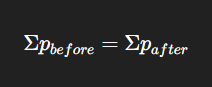
That just means:
Add up all momentum before →
Add up all momentum after →
They MUST be equal.
Momentum is NEVER lost. It just moves around.
Freight car A is moving.
Freight car B is sitting still.
They collide and STICK together.
Inelastic Collision
Inelastic
they stick together after hitting
Since both cars they stick together, they move slower after.
Why?
Because now:
Same momentum
But MORE mass (both cars together)
If mass increases and momentum stays same»»
Speed must go down.
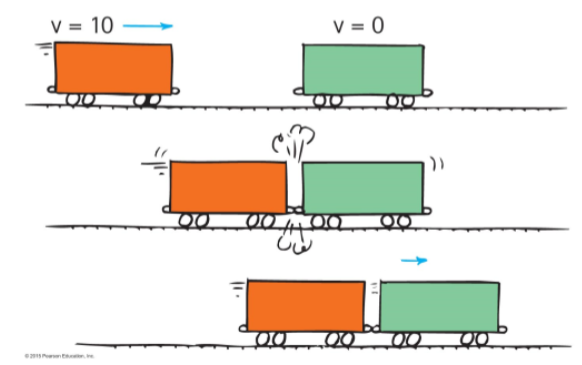
Freight car A is moving toward identical freight car B that is
at rest. When they collide, both freight cars couple together.
Compared with the initial speed of freight car A, the speed
of the coupled freight cars is
A. the same.
B. half.
C. twice.
D. None of the above.
half
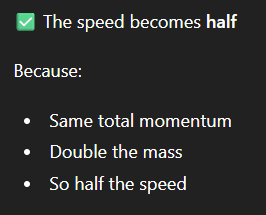
mass and speed are
inverse
Elastic =
bounce
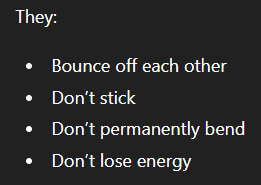
Elastic Collision examples
Pool balls
Super bouncy balls
Inelastic=
stick or squish
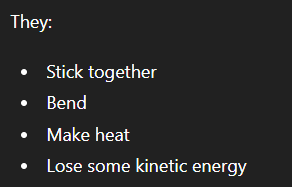
elastic and inelastics, momentum is
conserve/the same
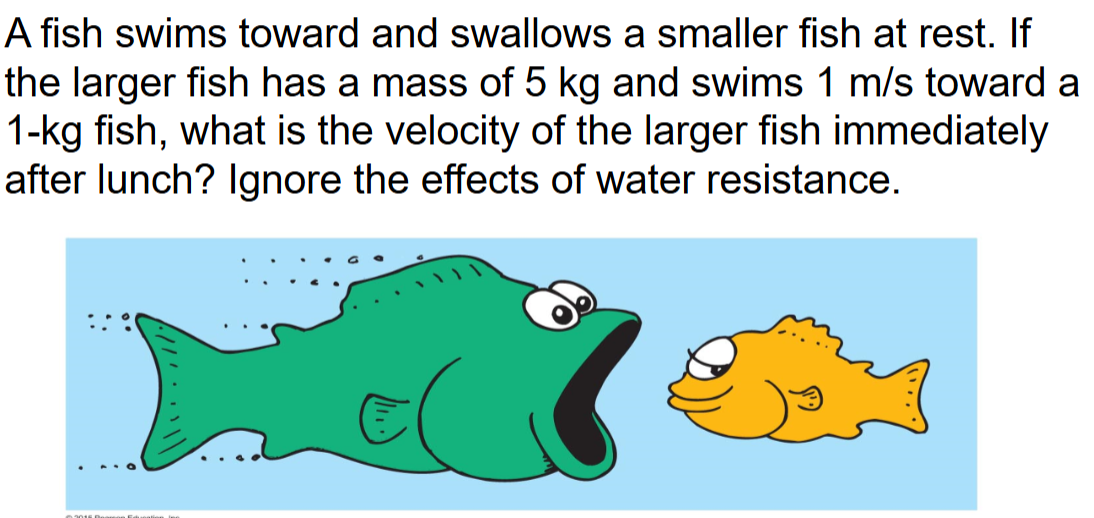
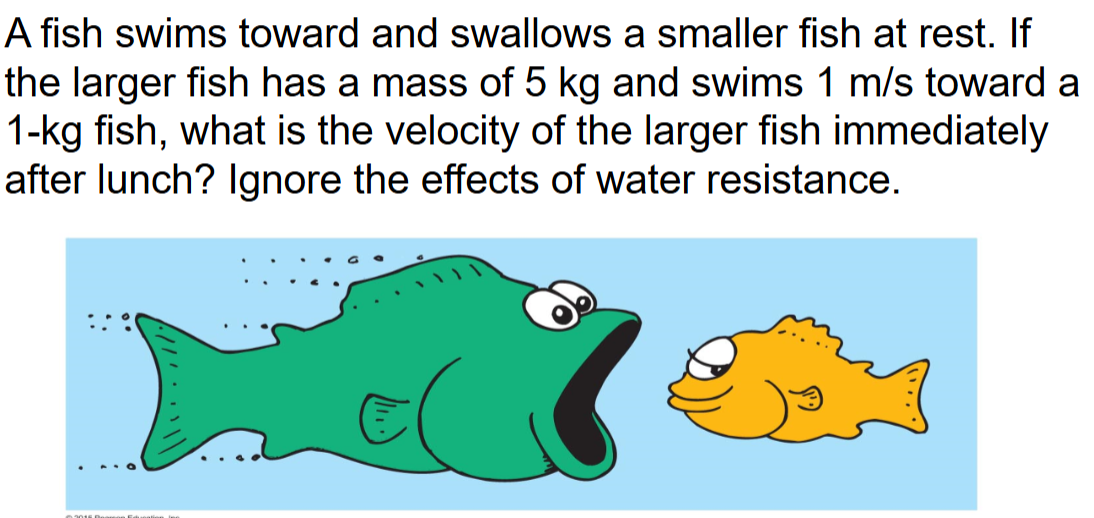
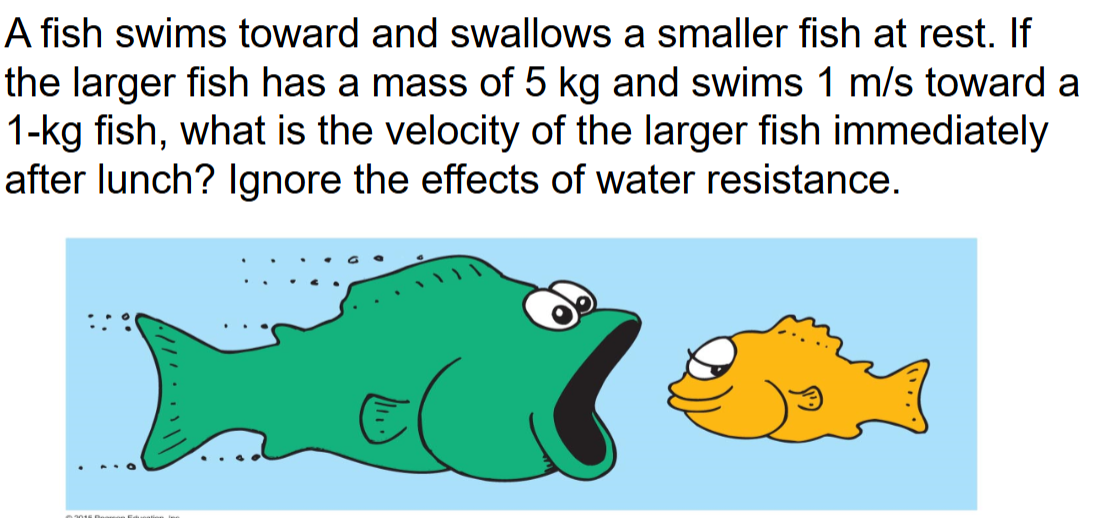
Fish Example
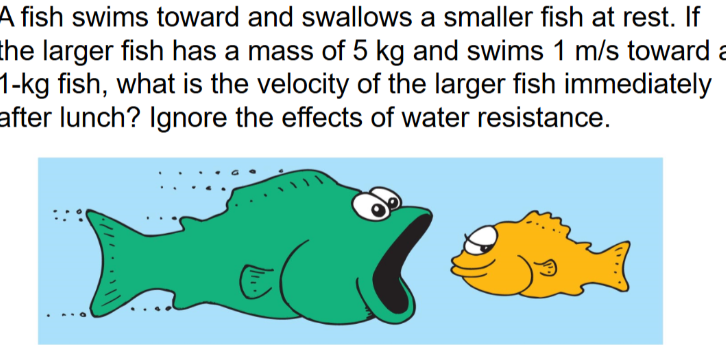
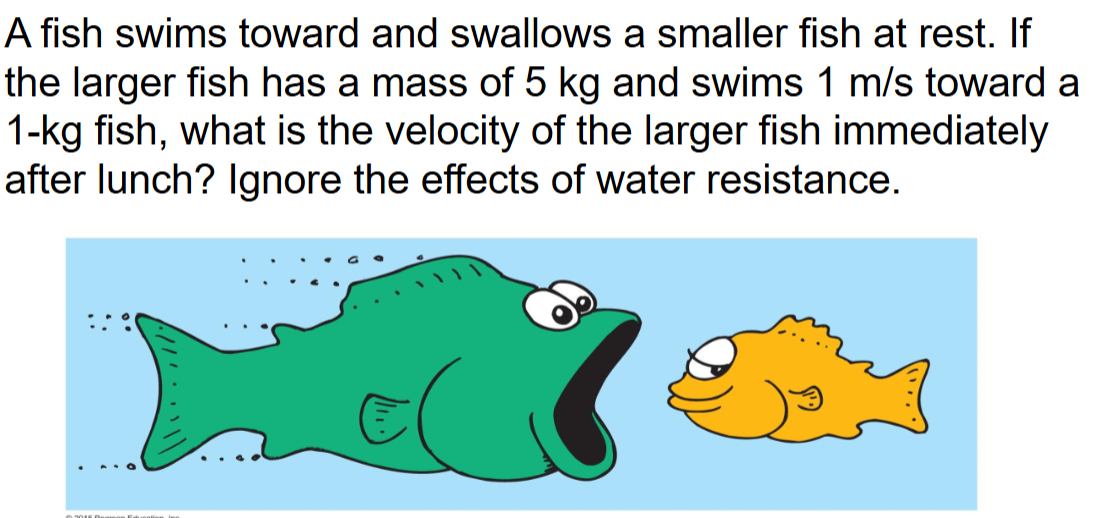
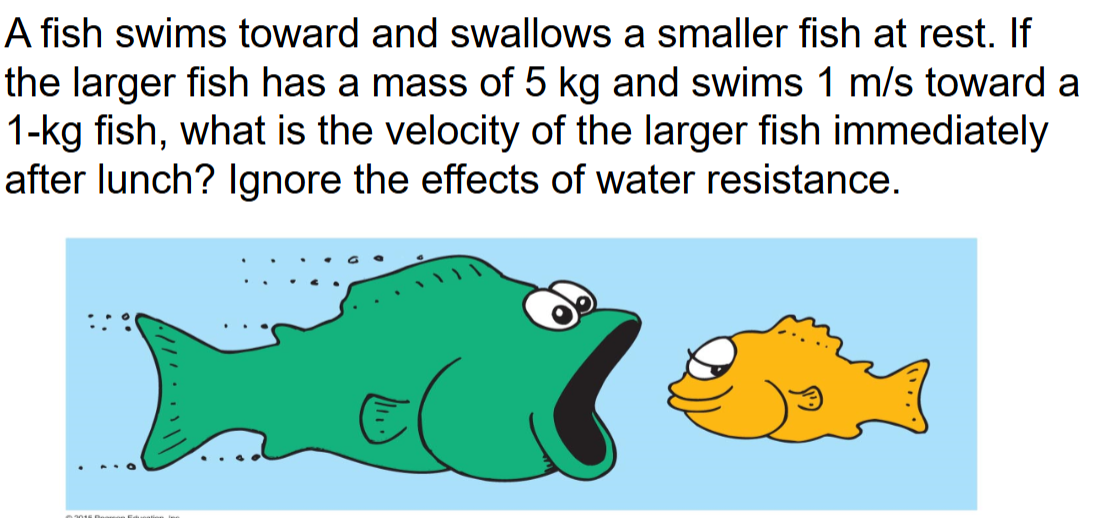
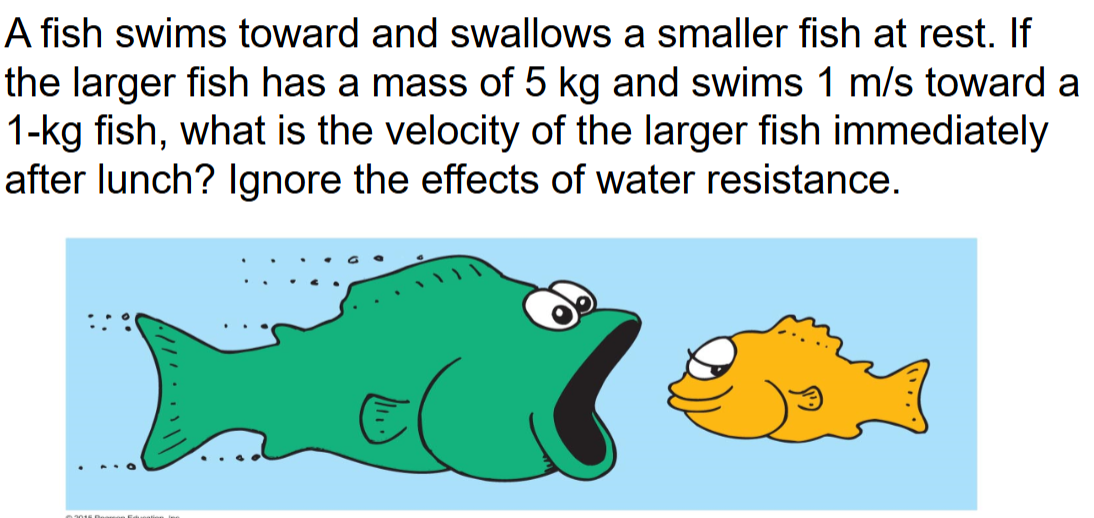
A fish swims toward and swallows a smaller fish at rest. If
the larger fish has a mass of 5 kg and swims 1 m/s toward a
1-kg fish, what is the velocity of the larger fish immediately
after lunch? Ignore the effects of water resistance.
What do we have?
Big fish:
Mass = 5 kg
Speed = 1 m/s
Small fish:
Mass = 1 kg
Speed = 0 (not moving)
Big fish eats small fish
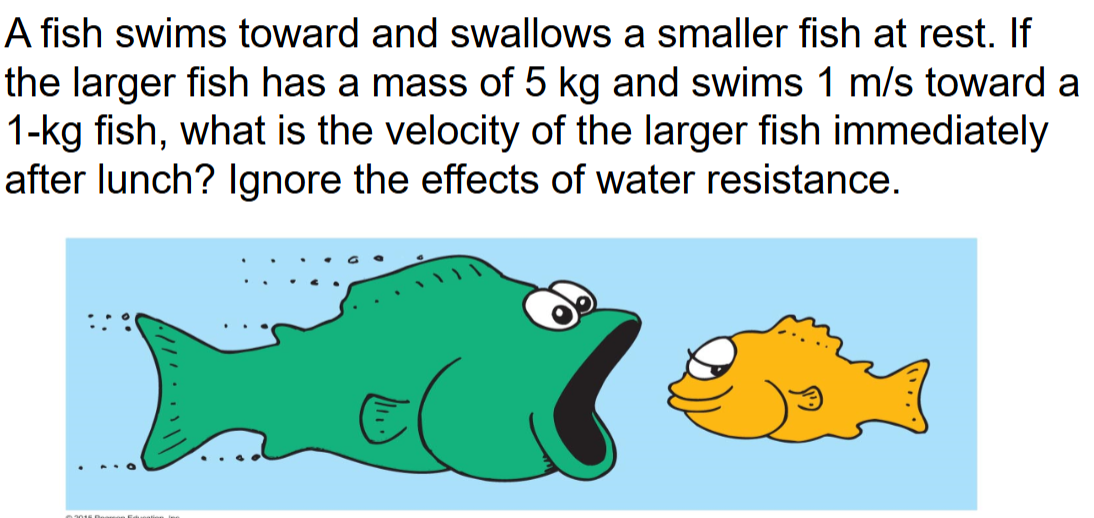
fish example: elastic or inelastic?
inelastic! They stick together
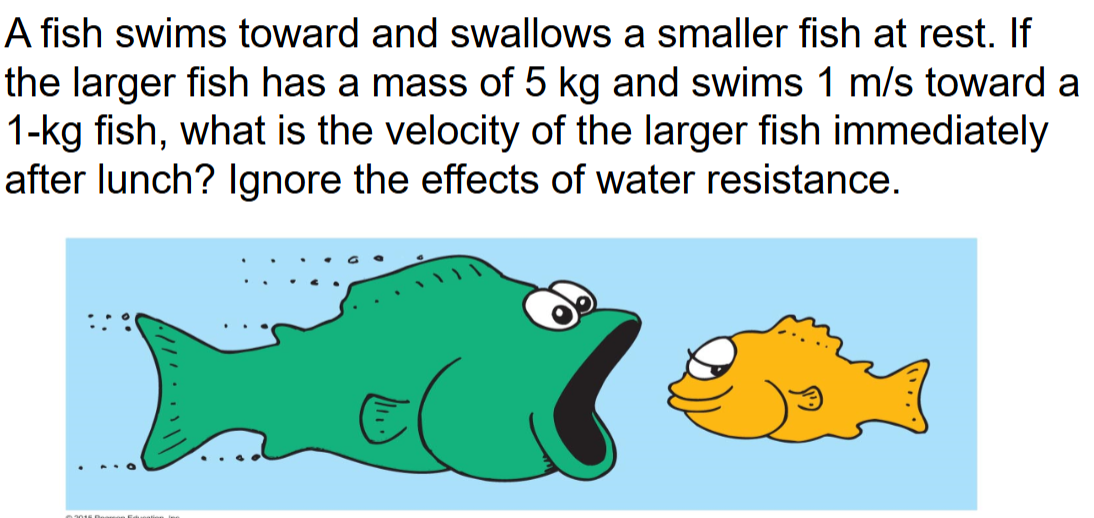
Find momentum BEFORE
Big fish:
p=5×1=5

Find momentum BEFORE
small fish:
p=1×0=0

Fish example
Total momentum before
5+0=5
Momentum after must still be ____
5
Fish example
After eating
Now total mass =
5 kg + 1 kg = 6 kg
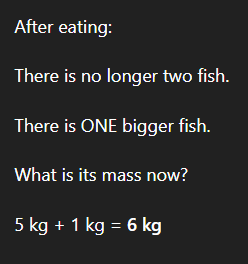
One 6 kg fish moving at some unknown speed.
Let’s call that speed “v”.
We DON’T know it yet.
But we DO know something:
🚨 The total momentum must still be 5.
So after eating:
Momentum = mass × velocity
6 × v = 5
Because momentum must still equal 5.
Now Solve
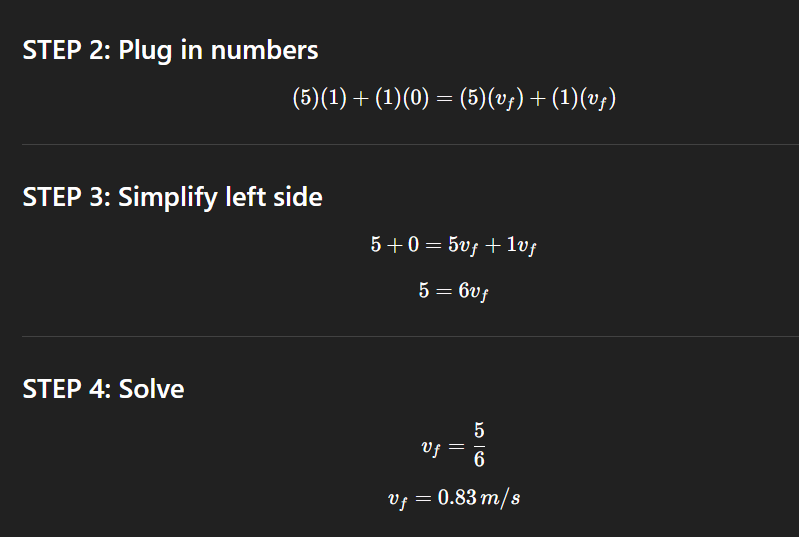
6v = 5
Divide both sides by 6:
v = 5 ÷ 6
v = 0.83 m/s
Before eating:
Light fish + fast-ish
Total momentum = 5
After eating:
Heavier fish
But momentum must stay 5
So speed MUST go down
Because:
If mass goes up…
Speed must go down
To keep momentum the same

m1vi1+m2vi2=m1vf1+m2vf2
vf=0.83m/s
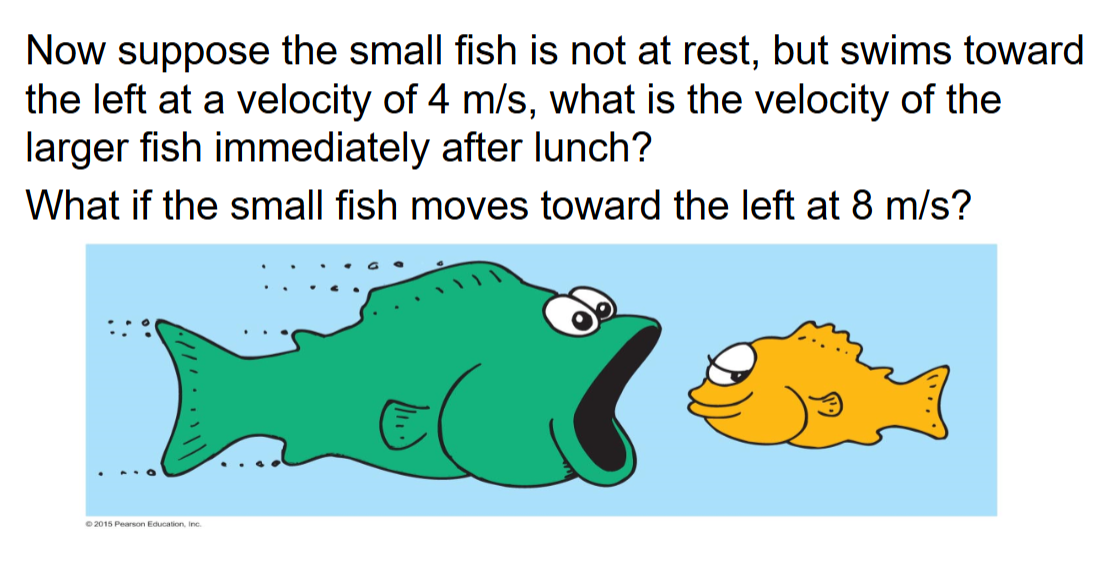
Problem 2: Small Fish Moving Opposite Direction
Small fish swims LEFT at 4 m/s.
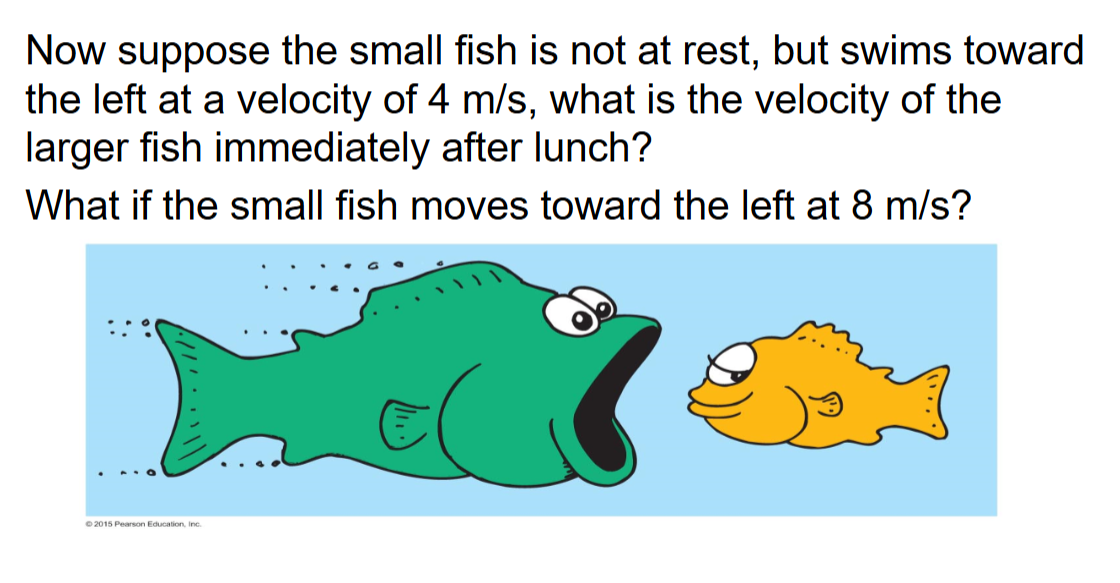
Right =
Left =
positive
negative
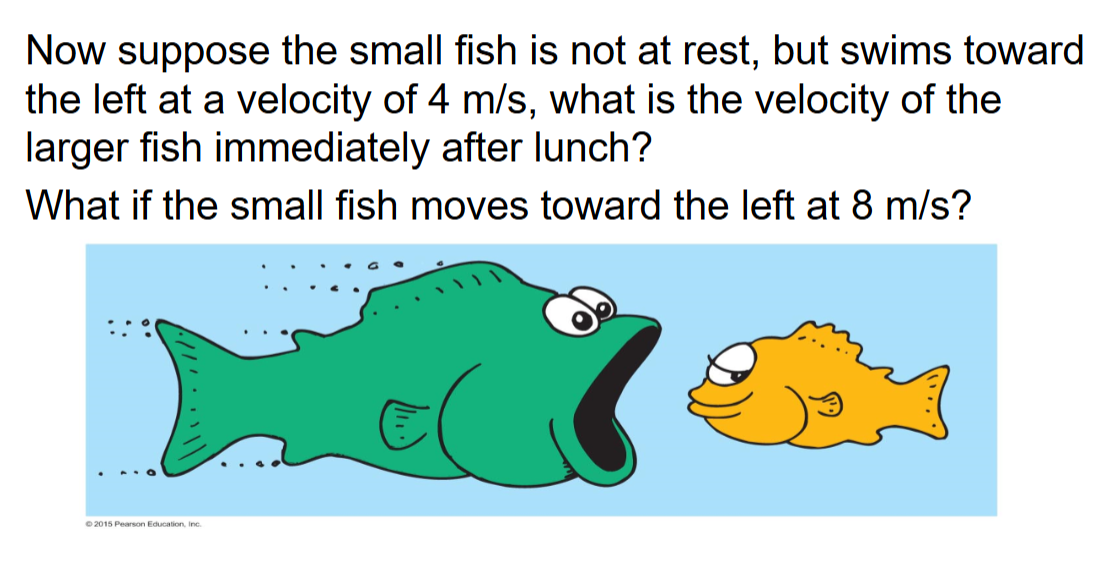
So small fish velocity = -4 m/s
-4 m/s
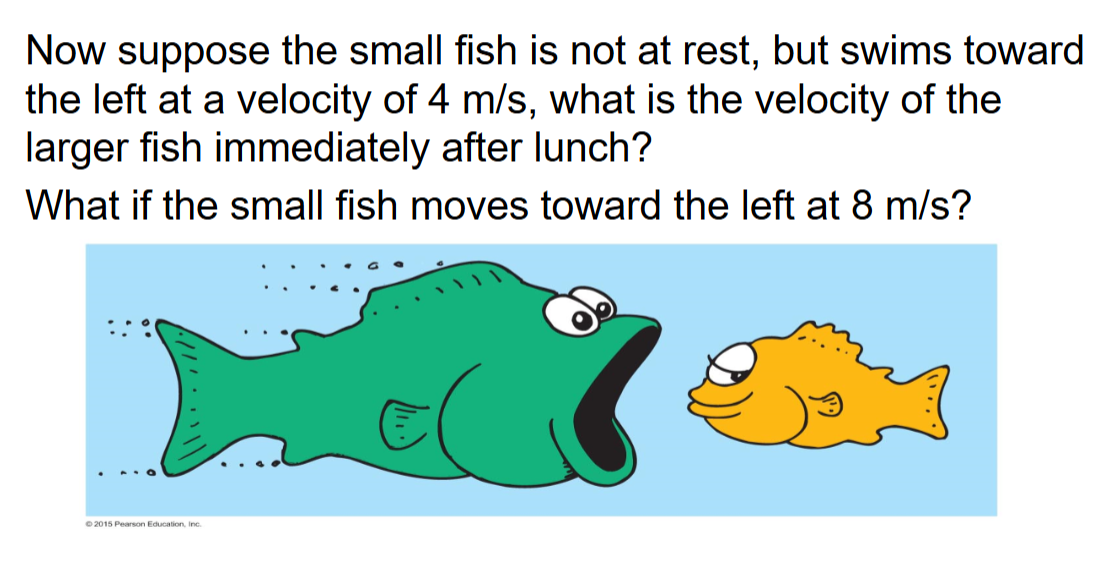
Find total momentum before
Big fish:
5×1=5
Find total momentum before
small fish:
1×(−4)=−4
total momentum before
5+(−4)=1
After they combine
Mass =
Momentum must still =
6 kg; 1
solve
answer
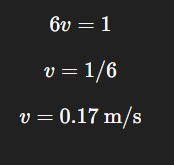
if final velocity is a negative number, that means
The big fish gets pushed backward
In every collision problem:
STEP 1:
Find total momentum before.
In every collision problem:
STEP 2:
Set it equal to total momentum after.
In every collision problem:
STEP 3:
Solve for unknown velocity
long story short
(total mass) × v=(momentum)
Explore top notes

