Marine Bio Unit 3
 Call Kai
 Learn
Learn Practice Test
 Spaced Repetition
 Match
Match Flashcards
 Knowt Play
1/142

There's no tags or description
Looks like no tags are added yet.
Name | Mastery | Learn | Test | Matching | Spaced | Call with Kai |
|---|
No analytics yet
Send a link to your students to track their progress
143 Terms
Intertidal Zone
Zone between tides, littoral zone (at certain part of the day exposed), has immersion and emersion species for different conditions (# of time for each depends on location)
Immersion Species
Species of intertidal adapted to being submerged at high tide
Emersion Species
Species of intertidal adapted to being exposed at low tide
2 types of substrate of intertidal
Rocky and Soft Bottom
Rocky Intertidal
Substrate type of intertidal, common on active margin uplift, more biodiverse, waves and currents bring and carry away sediments, geologically young
Soft bottom intertidal
Substrate type of intertidal, on passive margin, can be sand or mud commonly
Intertidal organisms
epifauna, infauna, meiofauna
Epifauna
Intertidal organism, lives on top of something (mainly rock)
Infauna
Intertidal organism, lives in sediments
Meiofauna
Intertidal organism, very small, live between sediment particles
Challenges for intertidal organisms
Desiccation (water loss), energy of the waves and tides, oxygen levels and CO2 buildup at low tide, limited space, interrupted feeding, temperature and salinity changes (can be extreme, especially in tide pools)
Exposure at low tide
Changes based on location of organism, high tide zone, spring tide (bring highest tides right encompassing the spring tide mark but below splash zone, and lowest low tide)
Zones of intertidal (bottom to top)
Subtidal (always submerged), low tide zone, mid tide zone, high tide zone, splash zone (only hit with spray and wave action), tide pool can be found along low-high zone
Desiccation (water loss)
Intertidal zone adaptation, can either prevent or tolerate, organisms motile (can move) or sessile (cannot move or move slowly), brings trade off
How do snails adapt to desiccation
Snails close up and use their operculum and foot to close up
Barnacle trade off for dessicaton
Close off half the day, cannot feed or get O2, buildup of Co2, comes with adaptation and seen as beneficial
Temperature intertidal zone adaptation
Water changes temp less than air (heat capacity), enzyme and metabolic factors depend on temp, need high heat tolerance (especially for tide pool, which heating depends on amount of water and time out, causing increase O2 leaving and salinity), more heat for ectothermic organisms brings more movement, morphology
Morphology for intertidal organisms to adapt to heat
Color (species can have variation based on where in intertidal zone, with darker retaining more heat) and Shape (more surface area means harder to loose heat, ridges make cooling effect)
Temperature in tide pools
Heating depends on amount of water and time out, causing increase O2 leaving and salinity. Organisms must have high heat tolerance
Salinity intertidal adaptation
In tidepool, rain brings fresh water decreasing salinity, evaporation increases salinity. Species can either clam-up or burrow to a more stable layer. Depends if stenohaline (can’t deal with change) or euryhaline (can deal with change)
Restriction of feeding intertidal zone
Sessile animals filter feeders, predators (in and out of water, starfish and bird beak shape), deposition feeders (rare on rocky common on soft), Grazers and scrapers more common on rocky (suctioned to the surface to reduce water loss, if on food can eat)
Waves
Depending on the shoreline, different amounts of energy impacts what is exposed during the tidal cycle, like refraction from uneven shoreline (areas with less wave energy more biodiverse, hence why rocky so). Also soft bottoms have a coastline shape change depending on storm effect
Wave Energy effects on intertidal organisms
Effects larval settlement, food availability (more wave energy less feeding opportunity), etc. Responsible for variation in rocky intertidal communities
Wave shock
Disruption to organisms based on wave energy
Different organisms response to wave shock
Anemone retract (less surface area), seaweed use holdfast since needs to be close to surface for photosynthesis, barnacles cement themselves to a surface, mussels use bissell thread (attaches to surface and each other), limpet flat so water flows over, blennies remersal (lack swim bladder) so can stay sunk and tuck in rocks, plecos have suction mouths
Space in rocky intertidal
Most limiting resource, competition is dominant factor. If spot empty, depends on who is fastest and first, since man7 sessile larva need space to dock. Wave action removes some organisms and disperses larva, allowing for succession
Vertical zonation intertidal
Common on rocky shore, controlled by biotic/abiotic factors. Has upper, middle, and lower zones, with upper limit and lower limit
Upper limit intertidal
Where a species occurs on zone determined by physical factors (water presence, how long under water, temp, salinity, etc)
Lower limit intertidal
Where a species occurs on zone determined by biological/ecological factors, like predation and competition for space
Upper intertidal
Mostly above high tide mark, splash or spray zone, has organisms (salt tolerant vegetation, lichen, cyanobacteria, filamentous green algae, other algaes in wetter spots, periwinkles, limpets, shore crabs
Middle Intertidal
Highly dependent on combination of physical/biological, regularly uncovered and submerged by tide, some organisms better competitors when submerged and vice versa, many organisms (barnacles, dog whelk, etc), below barnacles (mussel, goosenecks, rockweeds, sea star), more distinct zonation with predation, has tidepools
Pneumatocysts
Bubbles on seaweeds to help them stand up
Mussels and starfish in middle intertidal zone
(1) dominant species, (2) can only exists if waves calm; if waves calm, (2) will eat (1) creating more space for others to take claim. If waves too strong absence of (2), only (1) will take claim. No matter what, (1) above (2) line
Intertidal Succession
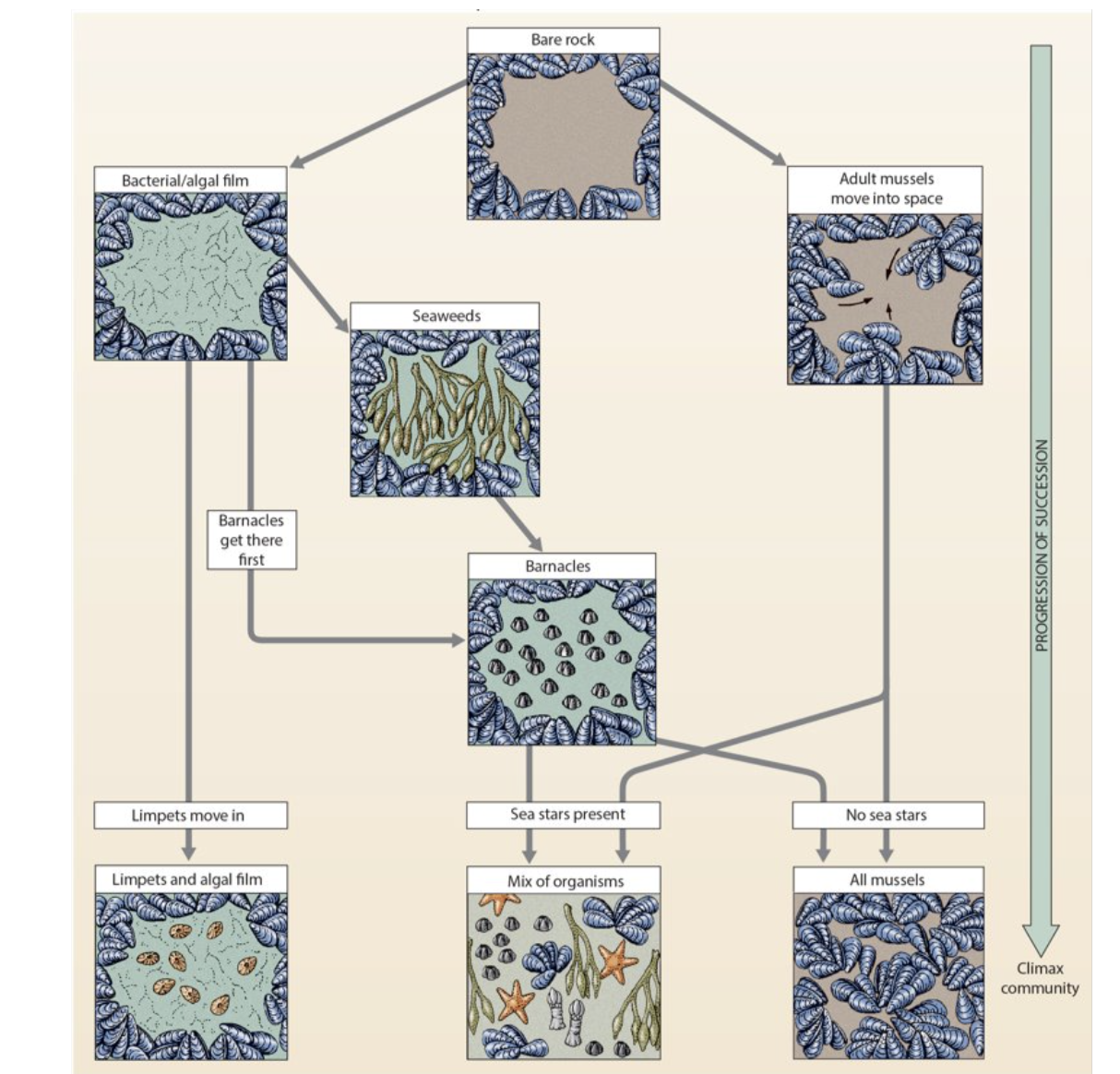
Bare rock brings either mussels or bacteria/algae film. Bacteria/agal film brings either limpets, or seaweeds and barnacles and starfish and more diversity. If mussels, no star fish bring more mussels, if star fish diversity comes. Climax community either limpet and algal, mix of organisms, or all mussel
Tidal Pool
Shallow so experience wide shifts in temp and salinity, freshwater from rain decreases salinity, evaporates water increasing salinity, lower intertidal has fish, higher has them trapped
Lower Intertidal
Submerged most of the time, dominated by seaweeds, grazing and competition important, light and space important resource, preds and detritivores
Soft bottom intertidal communities (biological)
Less diversity than rocky, often sand or mud, many burrowing epifauna, difficult to classify (wave action or sediment size), deposit feeder dominant, organisms lack soil attachment
Sand beaches soft bodied intertidal
Large particles, better oxygen and temp and water flow, wave action and tidal flow
Mudflat soft bodied intertidal
Small particle, buildup of organic matter, little oxygen and water flow, waves but no tide, have plant growth but more on the terrestrial part, redistribution, after first few cm interstitial water is oxygen deficient, anerobic respiration creates hydrogen sulfide (gives dark color), makes bioturbation
Soft bottom intertidal (abiotic)
Shifts in response to wave and tidal and currents, sediment composition directly related to degree of water motion, fine sediment found in calm areas like bays and lagoons, coarse sediements found in places effected by waves and current
Oxygen availability soft bottom intertidal
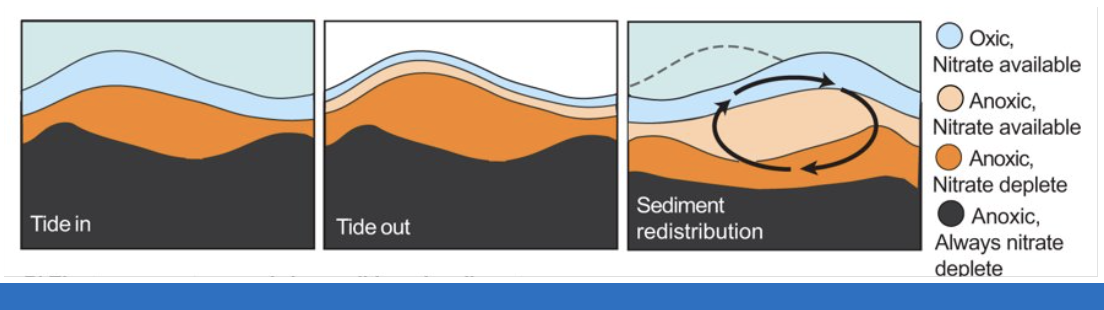
Detritus main food for soft bottom intertidal (deposit feeder), amount determined by grain size, grain size effects oxygen, infauna depend on circulation of water through sediment for oxygen replenishment; lowest anoxic with constant nitrate depletion never circulation, then from top to bottom it goes nitrate available oxic to nitrate available anoxic (only when tide is out) to nitrate depleted anoxic
Soft bottom intertidal sediments
Well-sorted (course) has water drain quickly, well-sorted (fine) has water drain slowly, and poor sorted has water blocked
Bioturbation
Physical movement of sediment by organisms, common in mudflats
Soft bottom animals
Lots of infauna; bivalves with incurrent or excurrent are active filter feeder, worms create deposit feeders, amphipods on rack line (where high tide goes to), animal location depends on water location, most species mobile
Soft bottom zonation
Less obvious than rocky intertidal, sand less obvious than mud since no habitat change in high and low tide
Estuary overview
Semi enclosed, where fresh and salt water meet and mix, wide changes in salinity and temperature due to distance from ocean and exposure to air, soft sediments, low diversity but high biomass (lots of mass but not many species)
4 types of estuaries
Drowned river valley, bar built, tectonic, and fjords
Drowned river valley
Type of estuary, Delaware River and Chesapeake Bay, formed with rising sea levels floods a low valley
Bar built
Type of estuary, like Nj marshes; sand traps water behind coastal islands, inlets allow water to move between bay and ocean, common on passive
Tectonic
Type of estuary, on active, shifting plates
Fjords
Type of estuary, glacier carved, valley steep, carved by fresh water, high tidal range
Passive estuarine continental margin
Broad, well developed, effected by lots of erosion, flat coastal planes with wide shelves, think Atlantic coast of North America
Active estuarine continental margin
Narrow river mouths carved along steep coast restricts estuarine formation, often tectonically created recently, steep and narrow continental shelf
Physical characteristics of estuaries
Salinity, substrate, turbidity, water temp, exposure
Salt wedge
Since salt water denser then fresh water, when join fresh water meets salt, wedge pushes underneath, creates zonation where salinity drops in zones. Goes in and out with tide, so sessile organism must be adapted to deal with fresh and salt water
Estuary salinity
Salt wedge, impacts species location in tidal range (since cycle changes where fresh/salt water is), can get negative estuary when there is high salinity due to evaporation and little runoff
Movement of water in estuaries
Unpredictable; factors that effect behavior of water masses includes shape, bathymetry, wind, evaporation of water from surface, runoff, season changes, and tidal changes / currents (tidal bore); Coriolis effect
Tidal bore
when tide comes in, comes in very fast and all at once, can occur in estuaries
Coriolis effect in estuaries
Happens if bay is large in surface, freshwater deflected to right as it flows in northern hemisphere, left in southern. Causes one side to be saltier than the other, makes it easier for some organisms to swim upstream, can make negative estuary
Negative estuary
High salinity due to evaporation and little runoff
Estuary Substrate
Made by river depositing sediments (lots of sand and mud), velocity of water determines how big particles are, rich in organic material, reduce oxygen in sediments leads to anaerobic and anoxic respiration (why smells funny), high microbial diveristy
Turbidity in Estuaries
High volume of fine sediments → causes high turbidity and little clear water, ocean depends on nutrients transported from river valleys to coastal waters (Role of constant proportions)
Water Temperature and Exposure (estuary)
Shallow with large surface areas, temp can fluctuate drastically daily and seasonally, organisms exposed at low tide have even greater fluctuation, water has high heat capacity so depends on volume (larger fluctuation in bay than ocean)
Osmoregulation in estuary
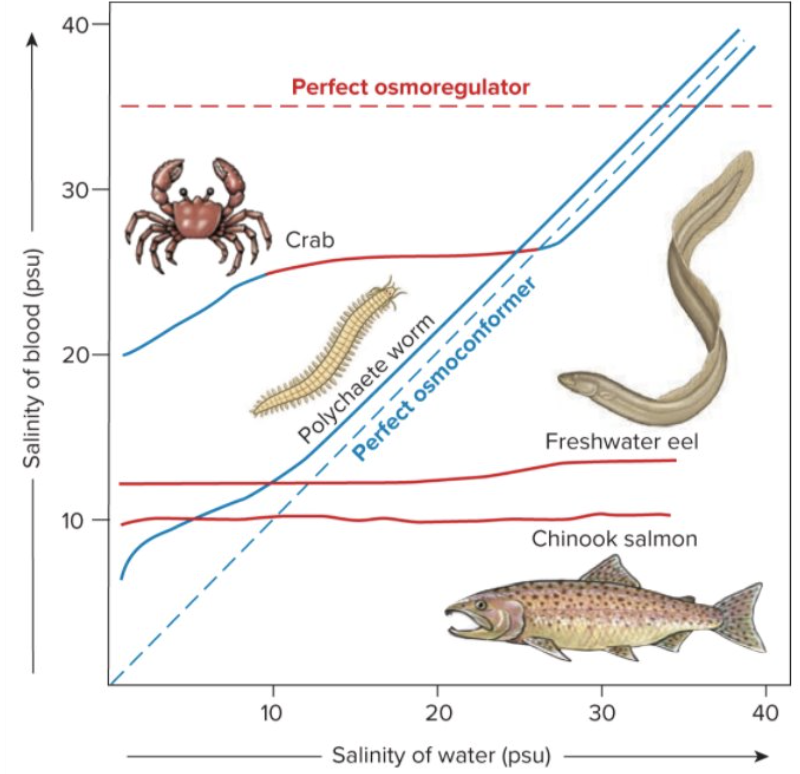
Affects distribution based on levels of tolerance, adapations to reduce water loss in low salinity (conformer and regulator),
Osmoregulation in estuary species salinity
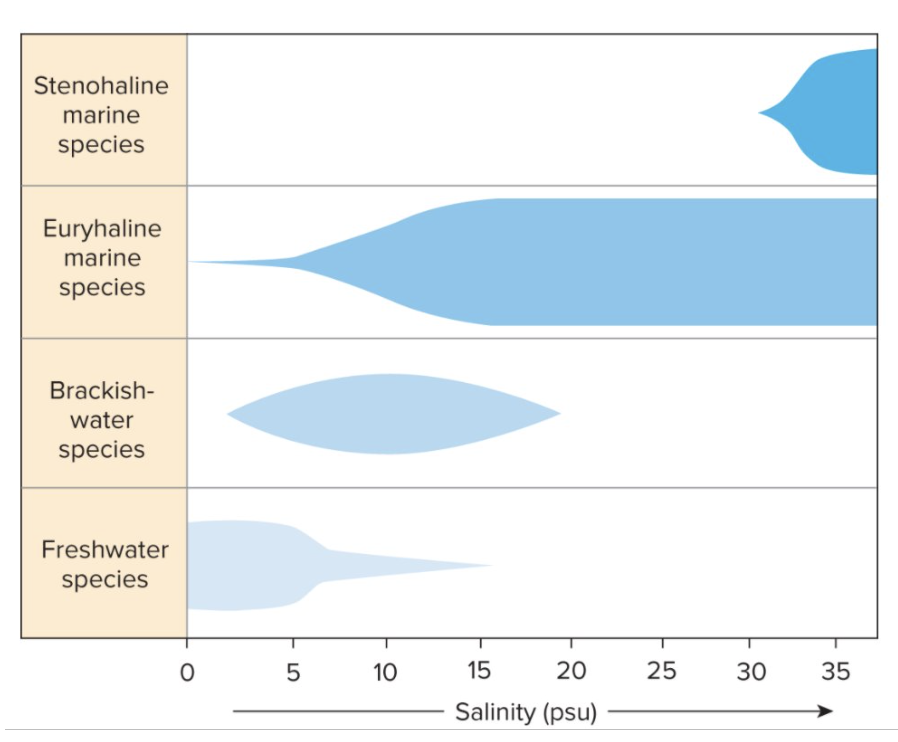
Freshwater lowest tolerance, then brackish species, Euryhaline marine species (highest range), then Stenohaline (only high tolerance); soft bodied organisms more likely to conform; many fish, crab, molluscs, and polychaetes regulate; many inverts regulate at low salinity and conform athigh
Stenohaline
Little tolerance, stay in smaller range
Eurohaline
More tolerance, larger range
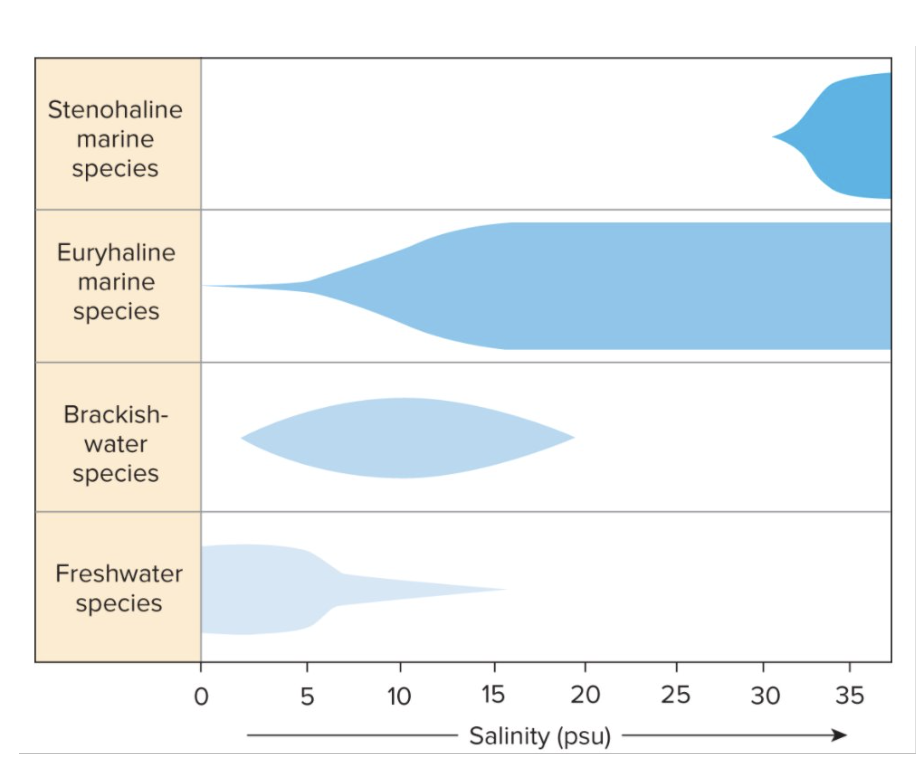
Salt tolerance in estuarine plants
Some actively absorb salts and concentrate harmless solutes like sugar to match the outside concentrations and prevent water from leaving their tissues, excrete salt using salt glands, DO NOT want fresh water leaving, succulents accumulate large amounts of fresh water to dilute salt, some excrete salt along leaves and host large communities
Living in Mud in estuary
Burrow, can be in permeant tubes beneath sediment surface, can also be stationary (rare) or slow moving; Benefits is salinity fluctuates les than in water column, disadvantage is oxygen loss)
Open water estuarine community
Type and abundance of plankton varies with current, salinity, and temp (most marine), turbidity reduces light availability (easier to kick up the larger the particle), mix of salt and fresh water, can disappear at low tide if shallow enough, roots hold sediment; Rich in fish (juvenile like mullet, migration like salmon, or permanent like killifish), also inverts
Invertebrate mudflat community
Dominant producer are diatom and cyanobacteria, most deposit feeders and suspension feeders, feed on detritus, crustaceans and mollusks
Vertebrate mudflat community
Fish at high tide, bird at low (large diversity, resource partitioning through bill size and shape, reduce competition)
Salt Marshes
Subject to extreme salinity and temp and tides, developed as long disturbance from wave action is minimal (allow muddy sediment accumulation), high tide covers them
Salt marsh plants
As go up intertidal transitions from always needs to be submerged → tolerate both → never submerged; smooth cordgrass needs most water, can exchange the type of gas exchange based on which parts submerged or no
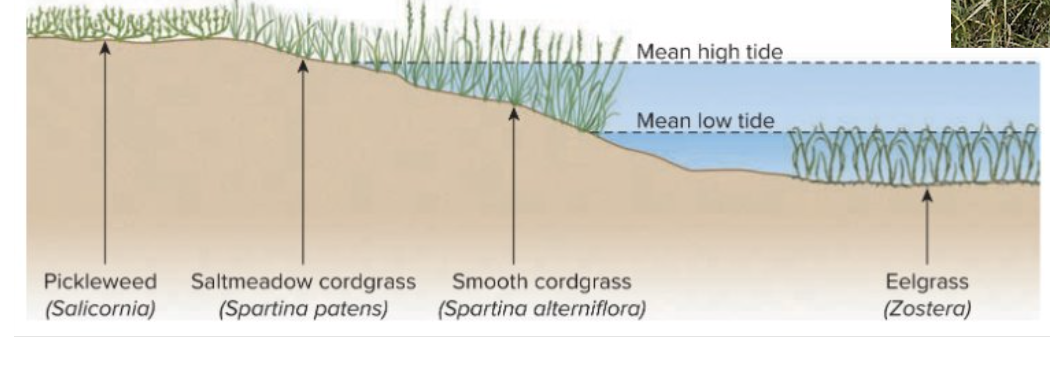
Salt marsh animals
Osprey, terrapin, blue crab, blue mussel (bissell threads), blue crab, silverside, killifish, periwinkle (will go up/down grass before high/low tide since don’t like water), grass can show how high tide goes
Pneumatophores
The roots of mangroves that stick up from the ground to out of the water
Mangroves
Sub/tropical version of salt marsh, high primary productivity, type of tree, how loose water depends on species, rich marine and terrestrial communities, protects coast, roots stick out to receive O2, seed germinate on plant and then drop to water when heaviest
Other types of Estuarine communities
Seagrass beds (eelgrass on temperature, turtle grass in warm water and around mangroves), oyster and shellfish reef
Feeding interactions of mangrove/salt marsh
Low diversity but high productivity (biomass), plant dominated, most food made by plant consumed as detritus (alive more useful as producer)
Why do estuaries have high primary production?
Nutrients brought by rivers, lots of N-fixing organisms, and decompositions putting nutrients back into cycle
Outwelling
Surplus of detritus is exported to the open ocean and neighboring ecosystem, conserving these areas conserves ocean
Continental shelf (subtidal zone)
Always under water, wider in passive margins, biologically richest part of ocean, can support many ecosystems like kelp forest (active), or coral reefs and sea grass meadows (passive)
Physical factors affecting subtidal organisms
Proximity to the shore, being shallow, highly variable temp, bottom more affected by wave/current, stratification preveanted (can’t do less dense warm waves on top and cool waves on bottom since too shallow and waves), sedimentation with turbidity and mostly lithogenous, humans
Types of subtidal communities
Soft bottom subtidal, seagrass meadows, hard bottom subtidal, kelp forest
Soft bottom subtidal
Sand or mud dominate, infauna dominate, always covered by water, most covered by mud or sand, community distribution based on many factor (particle size, stability of sediments, light, temperature)
Soft bottom subtidal community
Sessile species rare due to lack of substrate (if are there, patchy), few primary producers (seaweeds, plants) but some benthic diatoms living on sediment particles, more species present than adjoining intertidal but pachy
Platonic larval settlement in softbottom subtidal
Determines infauna or epifauna, once settlement occurs worry about preds, patchy distribution may be because plankton picking specific places for settlement or interaction with other species after settlement, Larva determined by temp, currents, light, salinity, depth, and type of bottom
Unvegetated soft bottom subtidal
Some large seaweeds like sea lettuce in shallow areas with hard surfaces and light, primary productivity is mainly from phytoplankton and is low, rest of secondary consumers supported by detritus, infauna and epifauna (many tube dwelling and digging species like polychaetas and mollusks and most diverse, epifauna like sea stars and crustaceans, demersal fish)
Soft bottom subtidal adaptations
Deposit feeders, suspension feeders (active or passive); Some urchins stick halfway out of the water and get food particles that way, Bivalves have incurrent and excurrent siphon (active sus feeding), bioturbators, predators
Distribution of deposit vs suspension feeders
1) prefers less turbulence, mud, less oxygen but more detritus. 2) prefers more turbulence, sande, more oxygen less detritus
Soft bottom subtidal predators
Echinoderms, mollusks, arthropods, demersal and pelagic fish
Bioturbators
Anything that mixes up bottom and moves sediment. Can be done by burrowing, kicking it up, etc
Meiofauna subtidal
Between particles of sediment, lots of protists, have very small appendages to stay put or are slender to slide, more space means bigger species, eat detritus and graze diatoms, are what deposition feeder eat
Sea grass meadow
Subtidal ecosystem, develops best in sheltered shallow water, roots stabilize sediments and anchor them, leaves cut down on water action which lets other organisms colonize, nursery, many species (temperate eelgrass, tropical turtlegrass), high biomass and productivity, epiphytes further increase productivity (cyanobacteria are nitrogen fixers), good at dispersing energy on windward side, leaves sticking up mixes up nutrients and lowers turbulance, can trap carbon in sediment while add oxygen to water and removing CO2
Eelgrass (sea grass meadow subtital)
Temperate, blade surface supports many different phylums (like ephiphytes and spirobis, high diversity)
Hard bottom subtidal communities
Small portion of continental shelves, submerged extension of rocky shores, dominated by epifauna, has some subtidal rocky reefs (calcareous algae, oyster shells, tubes of polychaetas)
Rocky bottom of hard bottom subtidal
Good place for seaweed to attach (brow phaeophyta and red rhodophyta most common), can cover rocks with many things (filamentous algal turf, branched, thin, and leafy crusting or enclosing)
Hard bottom subtidal benthos
Rich in epifauna low in infauna; urchins, chitons, sea hares, limpets, abalones, sponges, hydra, anemones, soft corals, bryozoans, tube dwelling polychaetas, barnacles, sea squirt
Hard bottom subditdal food web
No deposit feeders, sea urchin most important (can destroy too many primary producers if not controlled, but if none algae takes over and supresses other plant growth), otters keystone species in kelp forest because they eat urchins
Primary producer defense against predation in harbottom subtidal
Seaweeds produce unpalatable chemicals, upright seaweeds are leathery and tough, calcareous algae deposit calcium in cell walls that makes them resistant to grazing

