W2 - Arbitration (i) | Quizlet
 Call Kai
 Learn
Learn Practice Test
 Spaced Repetition
 Match
Match Flashcards
 Knowt Play
1/32

There's no tags or description
Looks like no tags are added yet.
Name | Mastery | Learn | Test | Matching | Spaced | Call with Kai |
|---|
No analytics yet
Send a link to your students to track their progress
33 Terms
(W2) What is arbitration?
'privately arranged litigation’, voluntary, binding decision as an outcome
- Parties decide to resolve their disputes outside any judicial system
- distinction between institutional and ad hoc arbitration
- opting and agreeing to arbitration means waiving right of access to court (art. 8 UNCITRAL Model Law, art. 16), but this does not include right to a fair trial
(W2) purpose of arbitration
- gives the parties substantial autonomy and control over the process that will be used to resolve their disputes.
- important in international commercial arbitration bc parties do not want to be subject to the jurisdiction of the other party’s court system. Each party fears the other party’s “home court advantage.” Arbitration offers a more neutral forum, where each side believes it will have a fair hearing.
- flexibility of being able to tailor the dispute resolution process to the needs of the parties, and the opportunity to select arbitrators who are knowledgeable in the issue
(W2) characteristics of arbitration
1. consent (voluntary)
2. non-governmental decision makers (arbitrators)
3. final and binding award (arbitral award)
(W2) consent (characteristics of arbitration)
parties’ consent provides the underpinning for the power of the arbitrators to decide the dispute
- Arbitrators are also expected to apply rules, procedures, and laws chosen by the parties
expressed in 2 ways:
- arbitration clause (in the commerical contract before the dispute has arisen)
- submission agreement (after the dispute has arisen)
(W2) arbitrator (characteristics of arbitration)
private citizen, does not belong to any government hierarchy, decide on the arbitral award
- Compared with judges: weigh less heavily any questions of public policy or public interest, bc they see their primary responsibility as deciding the one dispute the parties chose them to decide
- chosen by the parties and would like to be chosen again. It is in their interest to be perceived as even-tempered, thoughtful, fair-minded, and reasonable
- When there are three arbitrators, often each party will choose one arbitrator, and the (chair), will be chosen by the two party-appointed arbitrators
(W2) final and binding award (characteristics of arbitration)
arbitration results in a final and binding award that generally cannot be appealed to a higher level court.
- mostly a party can challenge an award only if there is some defect in the process.
- cannot be challenged on the merits; that is, even if the arbitrators made mistakes of law or mistakes of fact, these are not grounds for nonenforcement, and the award will still be enforced
enforcement:
- Once the arbitrators render an award, the losing party may voluntarily comply with the terms of the award. If it does not, the prevailing party will try to have the award recognized and enforced by a court in a jurisdiction where the losing party has assets.
- Once a party’s award is recognized in the enforcing jurisdiction, it is generally considered to have the same legal effect as a court judgment, and can be enforced in the same way as a judgment in that jurisdiction.
(W2) advantages of arbitration
1. Likelihood of obtaining enforcement (NY Convention with 156 state parties)
- easier to enforce than a national court judgement
- under the convention courts are required to enforce awards unless there are serious procedural irregularities or problems with integrity of the process
- most courts interpret the grounds for non-enforcement narrowly
2. Neutrality of the forum
- being able to stay out of the other party’s court (avoiding home court advantage)
3. Confidentiality
- through confidentiality agreement
- may even cover witness and experts
- companies want confidential procedures to prevent disclosure of into (esp. if a potential negative outcome)
4. Choosing arbitrators with expertise
5. ‘less discovery’
- shorter than full-scale litigation
- lack of opportunity for multiple appeals
- allows for finishing a dispute and continuing business
Less expensive than litigation? – not really today
(W2) disadvantages of arbitration
1. Less discovery
- con for disputes involving extensive discovery (e.g. antitrust).
- often require aggrieved party to prove violation only if it can prove it has sufficient access to documents under control of the offending party --> less of a chance for claimant to meet the burden of proof
2. Lack of right of appeal
- con esp. if the decision is clearly wrong on law or facts
- ability to vacate an award is difficult
3. Arbitrators have no cocerive powers
- no power to penalise
4. Power derived from consent of parties
- if a party has not agreed to arbitrate, usually it cannot be expected joined in the arbitration. A tribunal generally does not have the right to consolidate similar claims of different parties, even if it would be more efficient for all concerned to do so
5. Lack of diversity in experienced international arbitrators
- gender and ethnic
(W2) institutional arbitration
arbitration is administered by an arbitral institution
- Institutional rules ensure that the arbitrators are appointed in a timely way, that the arbitration moves along in a reasonable manner, and that the parties pay fees and expenses in advance.
- an award rendered under the auspices of a well-known institution may have more credibility in the international community and the courts – may encourage losing party not to challenge an award
+ there are also specialised arbitral institutions (industry-based rules)
(W2) institutional arbitration examples
· International Chamber of Commerice (ICC) Int. court or arbitration
· American Arbitration Association's (AAA) International Center for Dispute Resolution (ICDR)
· The London Court of International Arbitration (LCIA)
· Hong Kong International Arbitration Center (HKIAC)
· Singapore International Arbitration Center (SIAC)
(W2) ad hoc arbitration
arbitration with no administering institution
- the parties are not paying the fees and expenses of an administering institution.
- The parties also have more opportunity to tailor a procedure very carefully to the particular kind of dispute. They may draft their own rules, or choose the model law
- sometimes particularly useful when one of the parties is a state (need more flexibility in the proceedings). It can be decided e.g. that neither party is the respondent, because both sides have claims against each other. Then each party will simply have the burden of proof of the claims it raises against the other party.
disadvantage - if either of the parties engages in deliberate obstruction of the process. In that situation, without an administering institution, the parties may have to seek the assistance of the court to move the arbitration forward
(W2) UNCITRAL Model Law
(W2) art. 7 model law
Option II
Definition of arbitration agreement
“Arbitration agreement” is an agreement by the parties
to submit to arbitration all or certain disputes which have arisen or which may arise between them in respect of a defined legal relationship, whether contractual or not.
(W2) art. 8 model law
Arbitration agreement and substantive claim before court
(1) A court before which an action is brought in a matter which is the subject of an arbitration agreement shall, if a party so requests not later than when submitting his first statement on the substance of the dispute, refer the parties to arbitration unless it finds that the agreement is null and void, inoperative or incapable of being performed.
(2) Where an action referred to in paragraph (1) of this article has been brought, arbitral proceedings may nevertheless be commenced or continued, and an award may be made, while the issue is pending before the court.
--> consequence of an arbitration agreement: represents the waiver of right to go to court (court that receives the action and sees the arbitration agreement must refuse to hear the case)
--> but subject to two exceptions
(W2) art. 8 model law exceptions
exception 1: ‘if a party so requests’ – party must mention the agreement, otherwise court will litigate
exception 2: agreement is null and void (invalid), inoperative or incapable of being performed
then, litigation will proceed
(W2) art. 9 Model law
Arbitration agreement and interim measures by court
It is not incompatible with an arbitration agreement for a party to request, before or during arbitral proceedings, from a court an interim measure of protection and for a court to grant such measure.
(W2) art. II NY convention
[…]
3. The court of a Contracting State, when seized of an action in a matter in respect of which the parties have made an agreement within the meaning of this article, shall, at the request of one of the parties, refer the parties to arbitration, unless it finds that the said agreement is null and void,
inoperative or incapable of being performed.
(W2) art. 16 model law
Competence of arbitral tribunal to rule on its jurisdiction
(jurisdiction and separability)
(1) The arbitral tribunal may rule on its own jurisdiction,
including any objections with respect to the existence or validity of the arbitration agreement. For that purpose, an arbitration clause which forms part of a contract shall be treated as an agreement independent of the other terms of the contract. A decision by the arbitral tribunal that the contract is null and void shall not entail ipso jure the invalidity of the arbitration clause.
--> arbitration clause seen as a separate aspect of the contract
(W2) arbitration agreement
constitutes the relinquishment of the right to have the dispute resolved judicially by a national court
- and creates other rights: the rights to establish the process for resolving the dispute.
- the parties can select the rules that will govern the procedure, the location of the arbitration, the language of the arbitration etc.
- ·gives the arbitrators the power to decide the dispute and defines the scope of that power. In essence, the parties create their own private system of justice
expressed via:
a) arbitration clause
b) submission agreement
(W2) arbitration clause
the arbitration agreement is contained in a clause or clauses that are embedded in the parties’ commercial contract.
- agreement to arbitrate is entered into before any dispute has arisen, and is intended to provide a method of resolution in the event that a dispute does arise
- doctrine of separability applies: the arbitration clause is considered a separate and distinct agreement (art. 16 model law)
(W2) doctrine of separability
the arbitration clause is considered a separate and distinct agreement
- may continue to be valid, even if the main agreement – the contract in which the arbitration agreement is found – may be potentially invalid.
- rationale: permits the arbitrators to hear and decide the dispute even if one party claims, for example, that the contract is terminated, or is invalid because it was fraudulently induced
- Such claims would not deprive the arbitrators of jurisdiction because they pertain to the main contract and not specifically to the arbitration clause
(art. 16 model law)
(W2) submission agreement
agreements to arbitrate made after the dispute has arisen.
/ if there is no arbitration clause in the parties’ contract, and a dispute arises, the parties can nonetheless enter into an agreement to arbitrate at that time if both sides agree
- less common than arbitration clauses in contracts: once a dispute arises, the parties often cannot agree on anything.
- For that reason, generally better for the parties to agree to arbitrate at the beginning of the relationship, when they are still on good terms
(W2) elements to include in submission agreement
- issue that is being arbitrated
- whether institutional or ad hoc arbitration
- Number of arbitrators (1 is faster and cheaper but 3 may be better)
- How is the arbitrator(s) is chosen, qualifications of the arbitrators
- Applicable rules
- The seat of arbitration (important because decides procedural law)
- Specifics of the proceedings (e.g. a deadline)
- The language of arbitration
- Who pays what
(W2) arbitration agreements essential requirements
1. choice of arbitrators
- opting for more than 1 arbitrator for high-value, complex disputes or if parties are from different cultural or legal backgrounds
2. seat of arbitration
- important because generally the arbitration law of the arbitral situs will be the law that governs the arbitration procedure (the lex arbitri)
- Parties tend to choose a country that is not the place of business of either party, so they will be in a “neutral” forum.
- important to choose a situs within a country that is a party to the NY Convention
- arbitration should be held in a place where the infrastructure is sufficiently developed
3. language of arbitration
- Parties should state the language of the arbitration in the arbitration clause. Although some parties assume the language of the contract will be the language of the arbitration, that may not necessarily be the case.
(W2) validity of arbitration agreement
2 kinds of validity:
1. Formal validity (written) does the arbitration agreement meet the formal requirements of Article II of the Convention:
(1) that it be in writing
(2) that it be signed (or be contained in an exchange of letters or telegrams)?
2. Substantive validity (consent): Does the arbitration agreement meet the legal requirements to be valid as set forth in paragraphs 1 and 3 of Article II of the Convention?
(W2) additional elements of validity
A defined legal relationship
- dispute between the parties must be “in respect of a defined legal relationship, whether contractual or not.”
- Most arbitration agreements are by their nature contractual. But the defined legal relationship could be a noncontractual one. A noncontractual relationship could be e.g. tort
Capable of being settled by arbitration
- the subject matter must be arbitrable – In most jurisdictions, e.g. issues such as criminal matters, child custody, family matters, and bankruptcy are not arbitrable. It would be against the law or the public policy of the local jurisdiction to try to arbitrate disputes in these areas
-Increasingly, disputes involving antitrust laws, which were formerly considered inappropriate for arbitration, are being arbitrated
cannot be null, void, inoperable or incapable of being performed:
- a court, at the request of a party, must refer the matter to arbitration unless the agreement is “null and void, inoperable, or incapable of being performed."
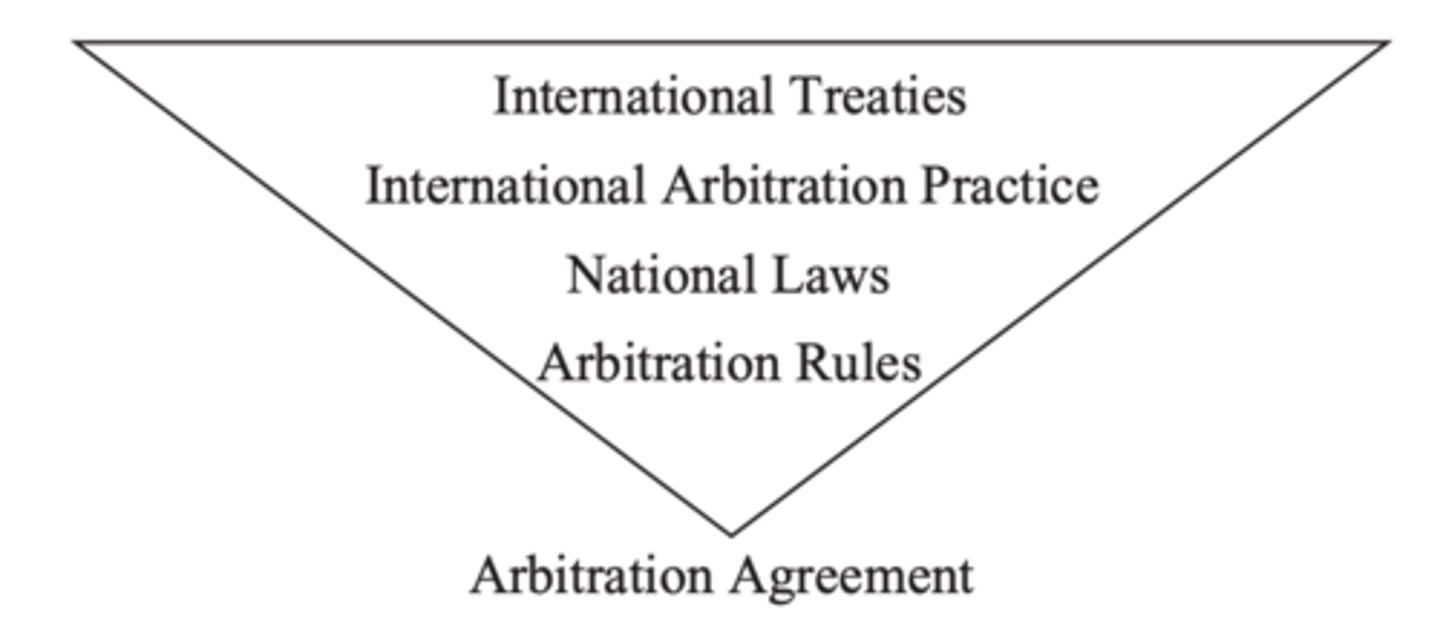
(W2) arbitration regulatory framework
1. International treaties:
- NY Convention – relevant for most int. commercial arbitrations. On enforcement of arbitration agreements.
2. International arbitration practice
- includes various practices that have developed in international arbitration, some of which have been codified as additional rules or guidelines.
3. National laws
- the law of the seat of arbitration (the lex arbitri) and the substantive law chosen by the parties will come into play, and they are likely to be different national laws.
- Many states have adopted the UNCITRAL Model Law
- The Model Law works in conjunction with arbitration rules, does NOT conflict with them
(W2) applicable law and rules
1. substantive law
2. procedural law
(W2) substantive law
applies to:
- the contract (law governing the contract)
- the arbitration agreement (re. material validity, i.e. consent)
- the ________ chosen by the parties is the national law that will be used to interpret the contract, to determine the merits of the dispute, and to decide any other substantive issues. If the parties have not chosen a substantive law, then the tribunal will determine the applicable substantive law.
--> the substantive law for the arbitration agreement has to explicitly stated to avoid confusion
(W2) procedural law
Law of the seat (lex arbitri), e.g. the Model Law
applies to:
- the arbitration proceedings
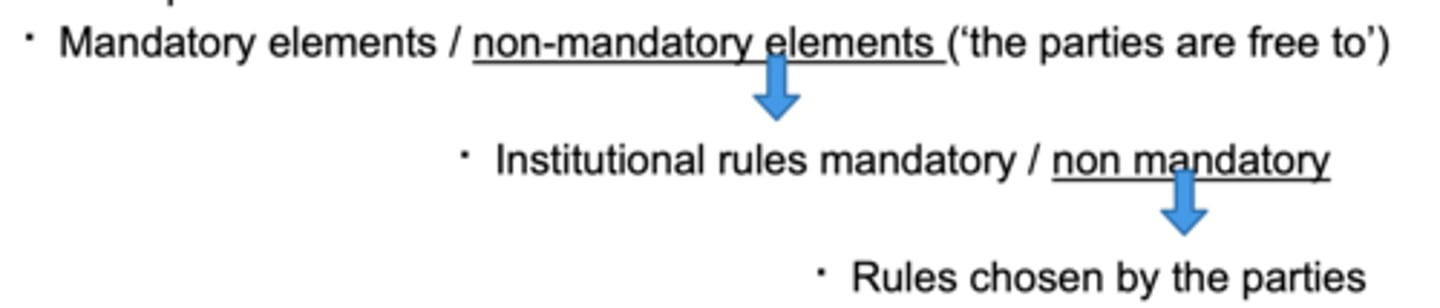
- hierarchy of mandatory and non-mandatory elements:
1. National law Mandatory elements / non-mandatory elements
2. Institutional Mandatory elements / non-mandatory elements
3. rules chosen by the parties
(W2) procedural law hierarchy
(Check first before resorting to own rules):
1. National law (lex arbitri) Mandatory elements / non-mandatory elements
--> mandatory elements: tend to be related to national values/public order arguments
--> non-mandatory elements: indicated by "the parties are free to"
2. Institutional Mandatory elements / non-mandatory elements
--> mandatory elements
--> non-mandatory elements: indicated by "the parties are free to"
3. rules chosen by the parties (only for non-mandatory elements)
--> If the parties have chosen arbitration rules that provide for a process or rule that is different from e.g. the Model Law, normally the arbitration rules will govern, because they represent the parties’ choice of how to carry out the arbitration
--> overlay own rules over the law of the seat (e.g. how many arbitrators you get)
(W2) arbitration rules chosen by the parties
apply to the arbitrations of all parties that choose them, can be modified for cases by the agreement.
· “unless otherwise agreed in writing by the parties” = the rule is not mandatory, default rule which applies if parties have not reached own agreement
· Therefore, if the parties have agreed on a particular matter, their agreement will override the arbitration rules, unless the particular rule is considered mandatory by the arbitral institution
(W2) steps to determine whether arbitration is possible
1. Do the parties have an Arbitration clause beforehand?
- if they do not have an arbitration agreement, one of the parties will have to convince the other to opt for arbitration (voluntary).
2. If not, do the parties have a submission agreement?
– submitting the dispute to arbitration after it has arisen
3. Formal & Substantive validity
- Formal validity (e.g. writing req) depends on different set of laws
- Substantive validity depends on national law (national standards for consent)

