MSM coding capacity + duration
 Call Kai
 Learn
Learn Practice Test
 Spaced Repetition
 Match
Match Flashcards
 Knowt Play
1/12

There's no tags or description
Looks like no tags are added yet.
Name | Mastery | Learn | Test | Matching | Spaced | Call with Kai |
|---|
No analytics yet
Send a link to your students to track their progress
13 Terms
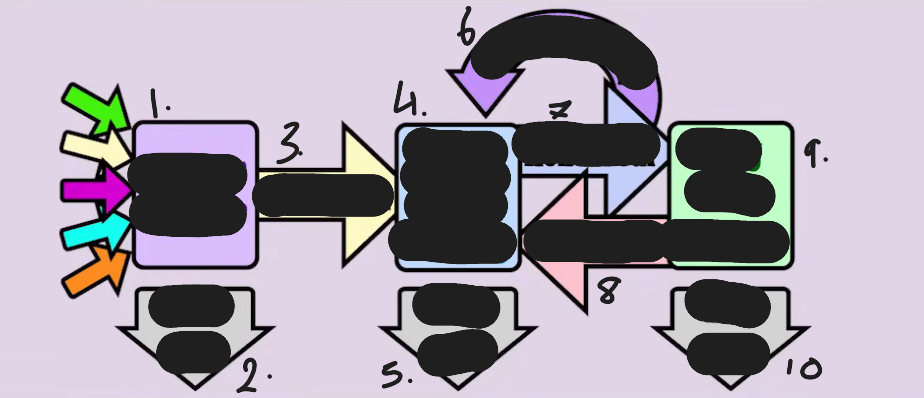
sensory resistor
lost info
attention
short term memory
lost of info
maintance
rehearsal
Retrieval
long term memory
lost info
what is another name for info loss
decay
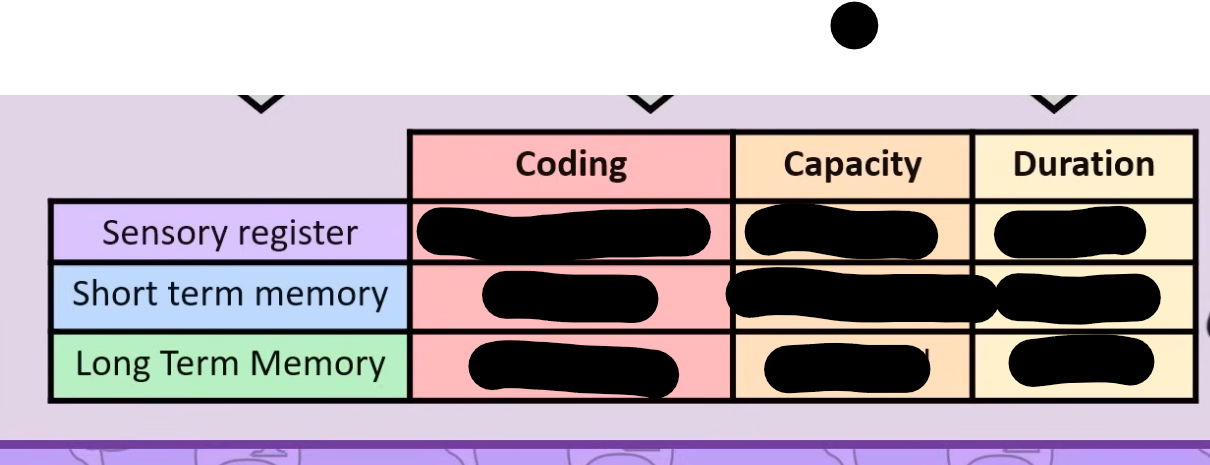
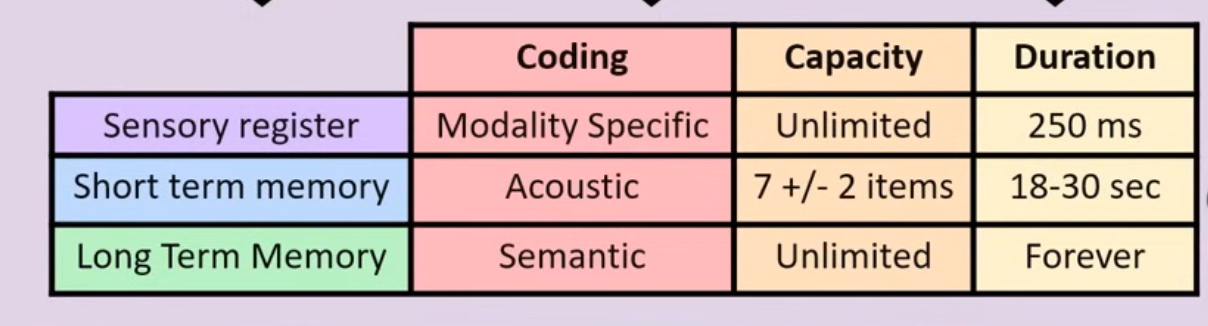
Coding =
The format in which information is stored in the various memory stores.
Capacity =
The amount of information that can be held in a memory store
Duration =
The length of time information can be held in memory
explain research which shows the capacity of STM
Digit span tasks such as Baddeley show that the capacity of STM is limited with a mean of 7.3 words. Miller found that the capacity of STM is 7+/- 2 items. However, chunking can be used to increase this capacity. The capacity of LTM is unlimited.
outline and explain research into the type of coding in the STM
Research by Baddeley using acoustically similar words and semantically similar words found that people tended to perform worse with the acoustically similar words when asked to recall immediately. When there was a delay of 20 minutes, participants performed worse at the semantically similar words. This suggests that STM codes acoustically and LTM codes semantically.
outline Peterson and Petersons trigrams study
Participants were given a consonant trigram (e.g. XQJ) and then asked to count backwards in threes to prevent rehearsal. Recall was tested after different time intervals (up to 18 seconds). The longer the delay, the fewer trigrams were correctly recalled, showing that STM has a very limited duration (around 18 seconds without rehearsal).
outline bahrick study into LTM
Bahrick et al. (1975) – LTM Duration:
Participants were asked to recall the names and faces of people from their high-school yearbooks. Recall was tested after different time intervals, up to 48 years. Bahrick found that many participants could still accurately recall names and faces decades later, showing that long-term memory can last a very long time (potentially a lifetime).
what’s a limitation of this research
A key limitation of memory research, such as Baddeley’s coding study, is that it often lacks mundane realism, which reduces its external validity. The use of artificial and meaningless stimuli, such as word lists and trigrams, does not reflect how memory operates in everyday life. In real-world situations, information is usually meaningful, allowing individuals to use semantic coding even for short-term memory tasks. In contrast, trigrams and random word lists prevent the use of meaning and strategies that people naturally employ when memorising important information, such as material for examinations or key details from work meetings and presentations. As a result, the findings from such laboratory-based memory tasks may not be fully generalisable to real-life memory processes, meaning the research has limited external validity.
One strength
Point:
A limitation of research into the coding capacity and duration of memory is that many studies use artificial tasks and therefore lack mundane realism.
Evidence:
For example, studies such as Peterson and Peterson used meaningless trigrams to investigate the duration of short-term memory.
Explanation:
This may reduce the validity of the findings because remembering random letters is not something people commonly do in everyday life. However, this criticism is not entirely justified because there are real-life situations where people must remember relatively meaningless information for short periods, such as phone numbers, PINs, passwords, or security codes. This means that the trigrams task may still reflect some everyday memory processes. In addition, not all memory research lacks mundane realism. For example, Bahrick et al. investigated the duration of long-term memory by asking participants to recognise faces and recall names from old school yearbooks decades later. Because this used meaningful stimuli from real life, the study had high mundane realism.
Link:
Therefore, although some memory research uses artificial tasks, not all studies lack real-world relevance, meaning research into memory can still provide useful and valid insights into how memory operates in everyday situations.
limitation of real life stimuli in studies
Point:
However, studies involving real-life stimuli often lack control over extraneous variables.
Evidence:
For example, Bahrick et al. conducted a study in which participants had to recall the names of former classmates from school yearbooks many years later.
Explanation:
Although this study had high mundane realism because it used meaningful real-life memories, there was limited control over variables that could have affected participants’ recall. For instance, some participants may have looked through their yearbooks more often than others, which would rehearse the information over time. Others may have stayed in contact with former classmates and therefore seen them more frequently, again strengthening their memories through rehearsal. This means that differences in recall may not have been due solely to the duration of long-term memory, reducing the internal validity of the findings.
Link:
Therefore, while real-life memory studies may have greater mundane realism, the lack of control over extraneous variables can make the findings less reliable and valid.