Chapter 06 Osseous Tissue and Bone Structure
 Call Kai
 Learn
Learn Practice Test
 Spaced Repetition
 Match
Match Flashcards
 Knowt Play
1/251

There's no tags or description
Looks like no tags are added yet.
Name | Mastery | Learn | Test | Matching | Spaced | Call with Kai |
|---|
No analytics yet
Send a link to your students to track their progress
252 Terms
How many bones are in the human body?
Approximately 206 total bones.
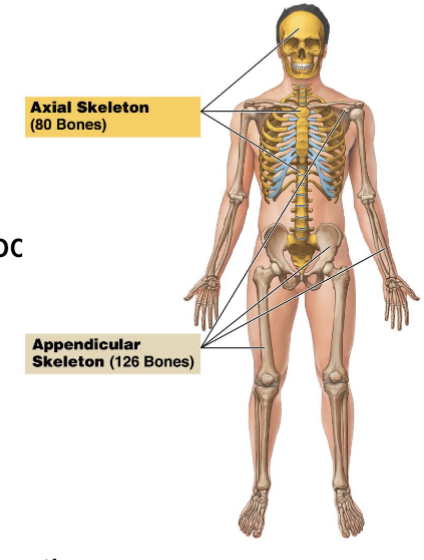
What are the two divisions of the skeletal system?
The axial skeleton and the appendicular skeleton.
How many bones are in the axial skeleton?
80 bones.
What does the axial skeleton include?
Bones of the skull, thorax, and vertebral column.
What does the axial skeleton form?
The longitudinal axis of the body.
How many bones are in the appendicular skeleton?
126 bones.
What does the appendicular skeleton include?
Bones of the limbs and girdles that attach them to the axial skeleton.
What else is part of the skeletal system besides bones?
Associated cartilages, ligaments, and other connective tissues.
What is the first primary function of the skeletal system?
Support.
What is the second primary function of the skeletal system?
Storage of minerals and lipids.
What is the third primary function of the skeletal system?
Blood cell production.
What is the fourth primary function of the skeletal system?
Protection.
What is the fifth primary function of the skeletal system?
Leverage.
How are bones classified?
Bones are classified by their shape and their structure.
What are the six bone shapes?
Flat bones 2. Sutural bones 3. Long bones 4. Irregular bones 5. Sesamoid bones 6. Short bones.
What are flat bones?
Thin roughly parallel surfaces.
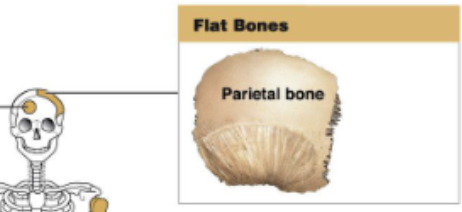
What are examples of flat bones?
Cranial bones, sternum, ribs, and scapulae.
What are the functions of flat bones?
Protect underlying soft tissues and provide surface area for skeletal muscle attachment.
What are sutural bones also called?
Wormian bones.
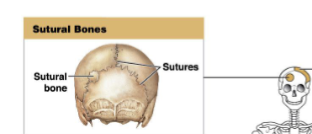
What are sutural bones?
Irregular bones formed between cranial bones.
What varies about sutural bones?
Their number, size, and shape vary.
What are long bones?
Relatively long and slender bones.
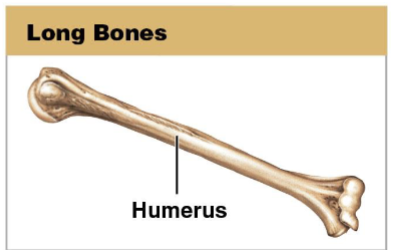
What are examples of long bones?
Various bones of the limbs.
What are irregular bones?
Bones with complex shapes have short, flat, notched, or ridged surfaces.
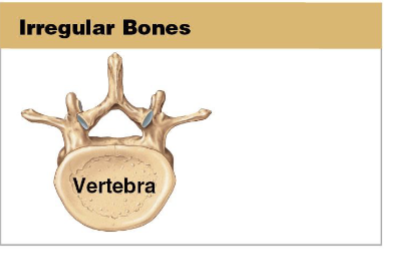
What are examples of irregular bones?
Vertebrae, bones of the pelvis, and facial bones.
What are sesamoid bones?
Small flat bones somewhat shaped like a sesame seed.
Where do sesamoid bones develop?
Inside tendons of the knee, hands, and feet.
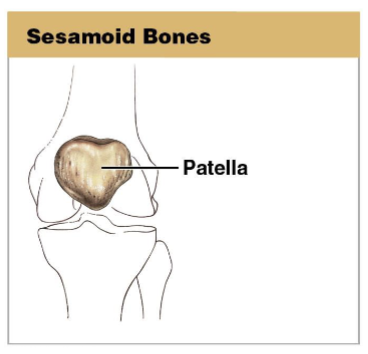
What varies about sesamoid bones?
Individual variation in location and number per person.
What are short bones?
Small and boxy bones.
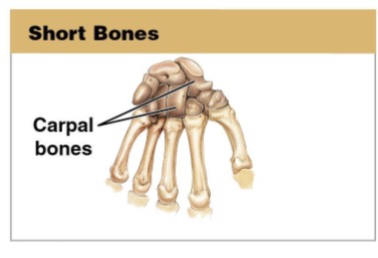
What are examples of short bones?
The bones of the wrist, called carpals, and the bones of the ankles, called tarsals.
Which of these bones is classified as a flat bone?
sternum
What is the structure of a long bone?
It has a diaphysis, a shaft, an epiphysis wide part at each end, and a metaphysis where they meet.
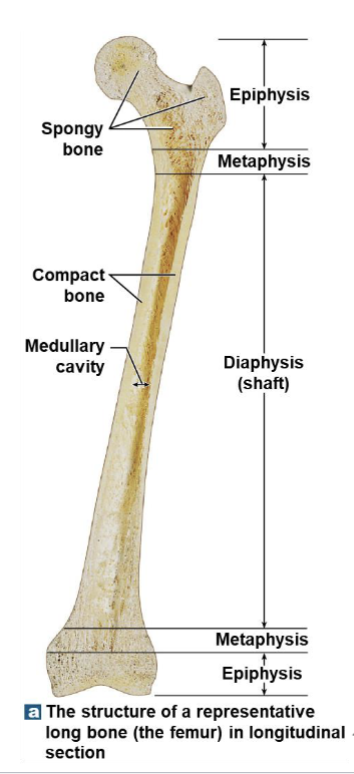
What is the diaphysis?
The shaft of a long bone consisting of a wall of compact bone with a central space called the medullary cavity or marrow cavity.
What is the epiphysis?
The wide part at each end of a long bone mostly made of spongy bone also called trabecular bone.
What is the metaphysis?
The area where the diaphysis and epiphysis meet.
What is the structure of flat bones like the parietal bone?
They consist of spongy bone between two layers of compact bone called cortex.
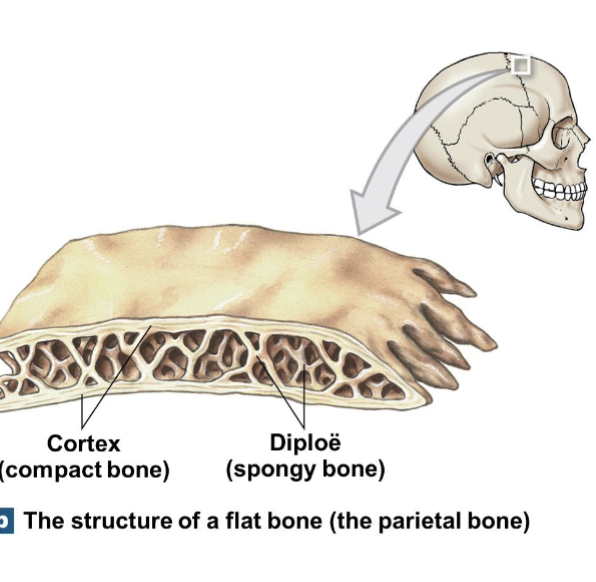
What is the layer of spongy bone within the cranium called?
The diploë.
If in a sample of bone the lamellae are not arranged in osteons, then this sample is from the _____.
The epiphysis.
In osseous tissue which characteristics apply to spongy bone?
Red bone marrow, canaliculi, no osteons.
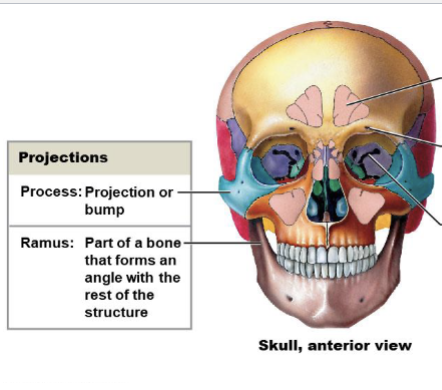
What are bone markings?
Surface features of bones.
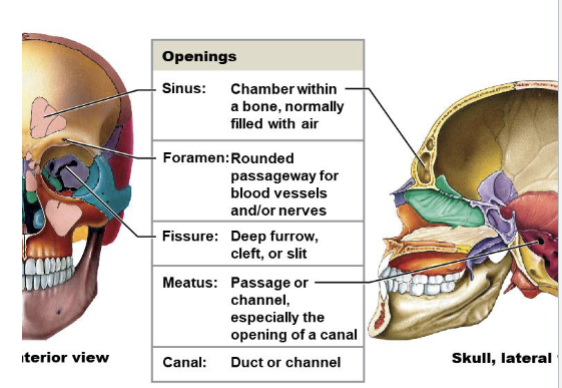
What are the two main categories of bone markings?
Elevations or projections and openings and depressions.
What is the function of elevations and projections?
Where muscles tendons and ligaments attach and at articulations with other bones.
What is the function of openings and depressions?
For passage of blood vessels and nerves.
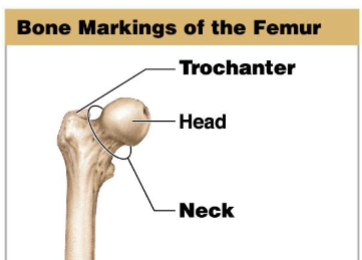
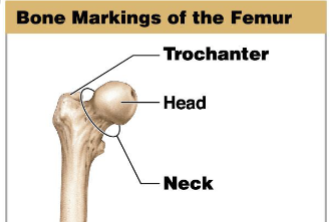
What is a head in bone markings (general)?
The expanded proximal end of a bone that forms part of a joint.
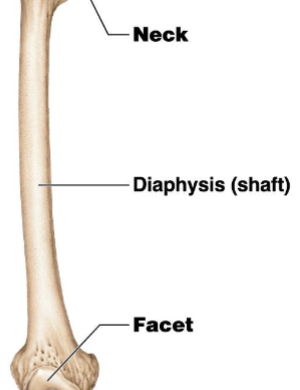
What is the diaphysis in bone markings?
The elongated body of a long bone.
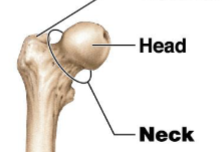
What is a neck in bone markings?
The narrow connection between the head and diaphysis of a bone.
What is a process in bone markings (elevations or projections)?
Any projection or bump.
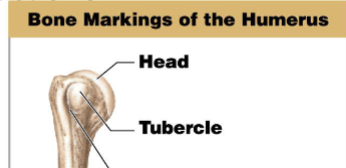
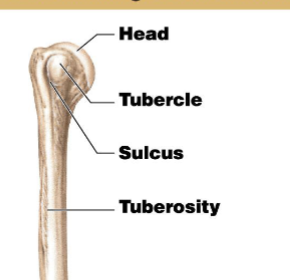
What is a tubercle in bone markings(elevations or projections)?
A small rounded projection.
What is a tuberosity in bone markings(elevations or projections)?
A small rough projection that takes up a broad area.
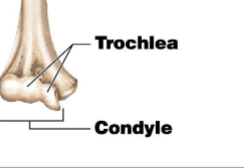
What is a trochlea in bone markings(elevations or projections)?
A smooth grooved articular process shaped like a pulley.
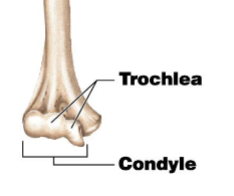
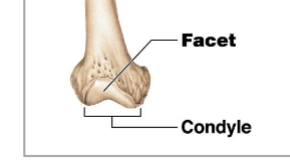
What is a condyle in bone markings(elevations or projections)?
A smooth rounded articular process.
What is a trochanter in bone markings(elevations or projections)?
A large rough projection.
What is a facet in bone markings(elevations or projections)?
A small flat articular surface.
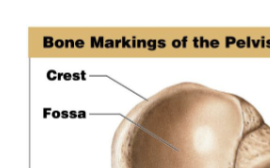
What is a crest in bone markings (elevations or projections)?
A prominent ridge.
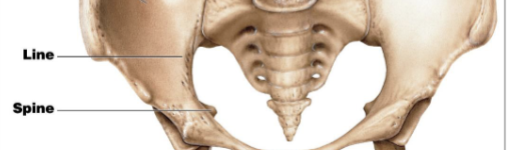
What is a line in bone markings(elevations or projections)?
A low ridge more delicate than a crest.
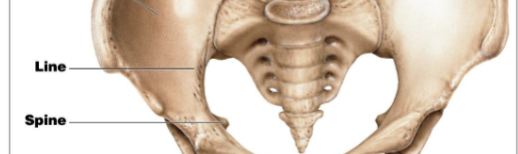
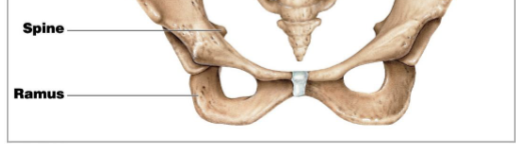
What is a spine in bone markings (elevations or projections)?
A pointed or narrow process.
What is a ramus in bone markings (elevations or projections)?
An extension of a bone that makes an angle with the rest of a structure.
What is a canal or meatus in bone markings (depressions, grooves, and tunnels)?
A large passageway through a bone.
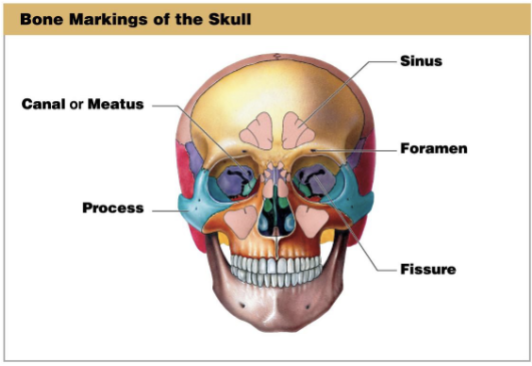
What is a sinus in bone markings (depressions, grooves, and tunnels)?
A chamber within a bone normally filled with air.
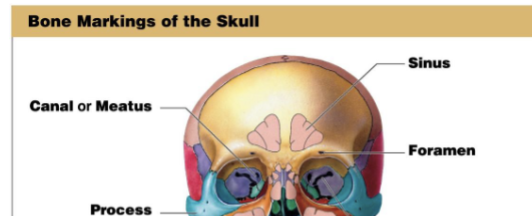
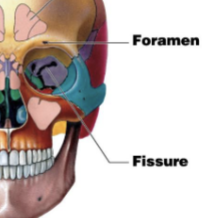
What is a foramen in bone markings (depressions, grooves, and tunnels)?
A small rounded passageway for blood vessels or nerves to pass through bone.
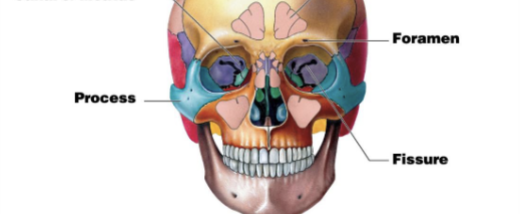
What is a fissure in bone markings (depressions, grooves, and tunnels)?
An elongated cleft or gap.
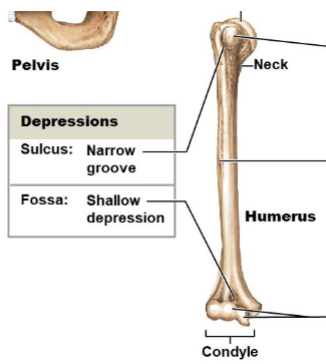
What is a sulcus in bone markings (depressions, grooves, and tunnels)?
A deep narrow groove.
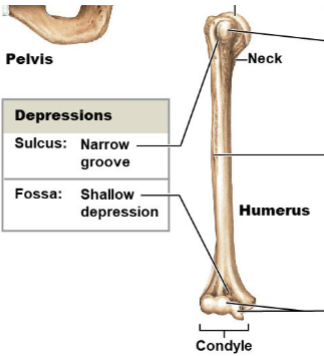
What is a fossa in bone markings (depressions, grooves, and tunnels)?
A shallow depression or recess in a bone surface.
What is bone tissue?
Dense supportive connective tissue containing specialized cells with a solid extracellular matrix containing collagen fibers.
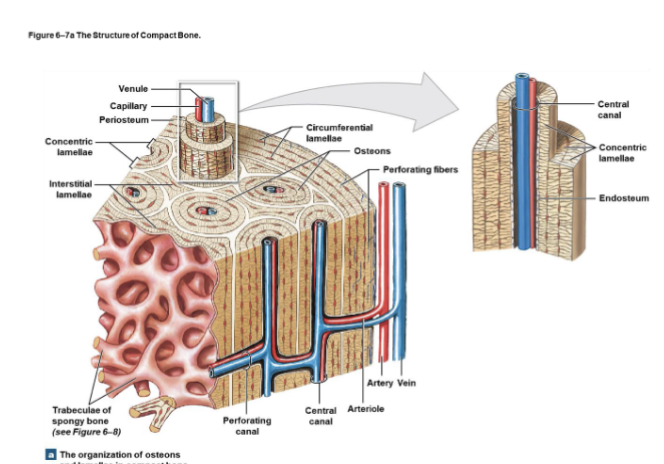
What are characteristics of bone?
Dense matrix due to calcium salt deposits, osteocytes within lacunae organized around blood vessels, canaliculi, and periosteum covering outer surfaces.
What are osteocytes?
Bone cells within lacunae.
What are canaliculi?
Narrow passageways that allow for exchange of nutrients wastes and gases.
What is the periosteum?
A membrane that covers the outer surfaces of bones except at joints; consisting of outer fibrous and inner cellular layers.
What makes up almost two-thirds of bone mass?
Calcium phosphate Ca3(PO4)2.
What does calcium phosphate interact with to form hydroxyapatite?
Calcium hydroxide Ca(OH)2.
What is the formula for hydroxyapatite?
Ca10(PO4)6(OH)2.
What other salts and ions does bone matrix incorporate?
Calcium carbonate CaCO3 and ions such as magnesium.
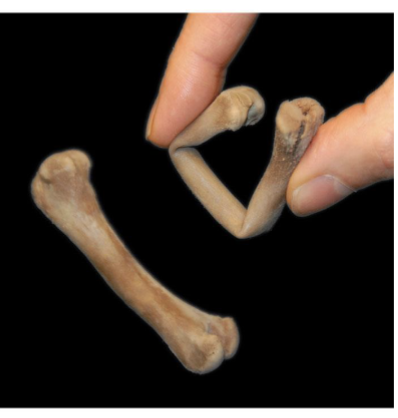
What would a bone lacking a calcified matrix look like?
It would look normal but be very flexible.
What percentage of bone mass is collagen fibers?
About one-third.
What percentage of bone mass do bone cells make up?
Only 2 percent.
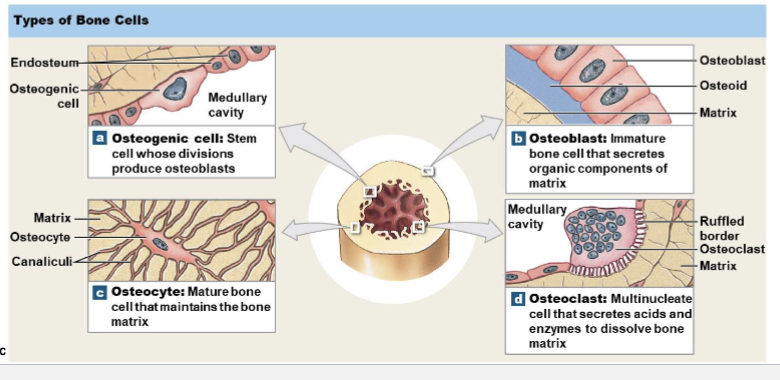
What are the four types of bone cells?
Osteogenic cells, osteoblasts, osteocytes, and osteoclasts.
What are osteogenic cells also called?
Osteoprogenitor cells.
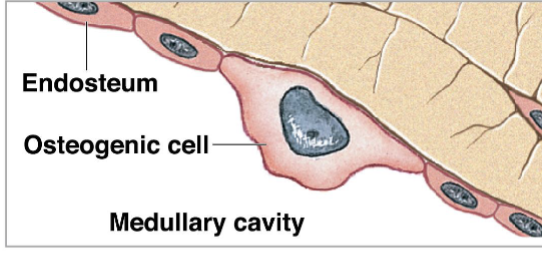
What are osteogenic cells?
Mesenchymal stem cells that produce cells that differentiate into osteoblasts.
What are osteogenic cells important for?
Fracture repair.
Where are osteogenic cells located?
Inner lining of periosteum, lining endosteum in the medullary cavity, and lining passageways containing blood vessels.
What do osteoblasts do?
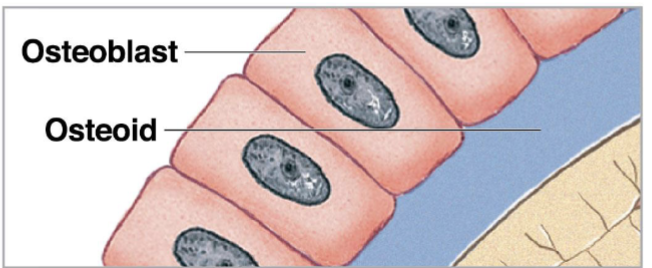
Produce new bony matrix through osteogenesis or ossification.
What is osteoid?
Unmineralized matrix produced by osteoblasts.
How do osteoblasts convert osteoid to bone?
They assist in depositing calcium salts.
What do osteoblasts become once surrounded by bony matrix?
Osteocytes.
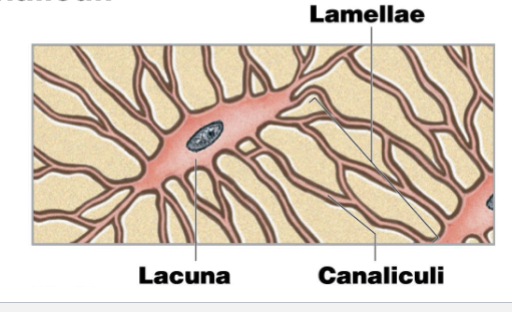
What are osteocytes?
Mature bone cells that cannot divide.
What do osteocytes do?
Maintain the protein and mineral content of the surrounding matrix.
Where do osteocytes occupy?
Lacunae pockets.
How are osteocytes separated?
By layers of matrix called lamellae.
How are osteocytes interconnected?
By canaliculi.
What do osteoclasts do?
Remove and remodel bone matrix.
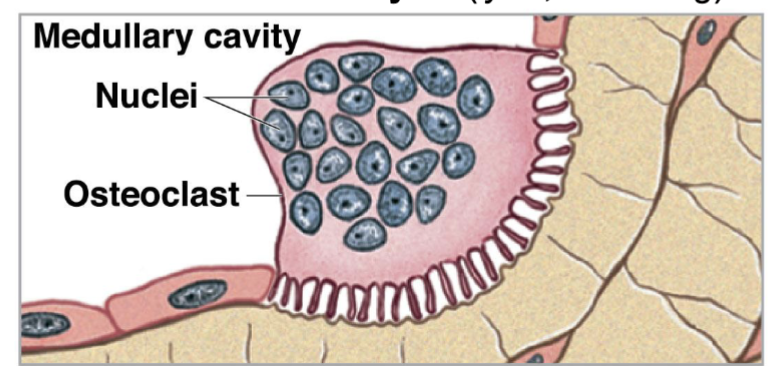
How do osteoclasts remove bone matrix?
They release acids and proteolytic enzymes to dissolve matrix and release stored minerals.
What is this process called?
Osteolysis meaning broken.
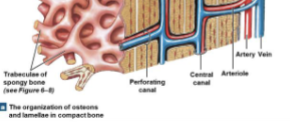
What is the functional unit of compact bone?
The osteon.
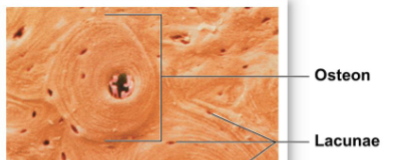
What does the central canal of an osteon contain?
Blood vessels.
What are perforating canals?
Canals perpendicular to the bone surface that carry blood vessels into deep bone and marrow.
What are lamellae?
Layers of bone matrix.
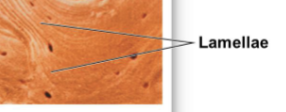
What are concentric lamellae?
Lamellae that surround the central canal.
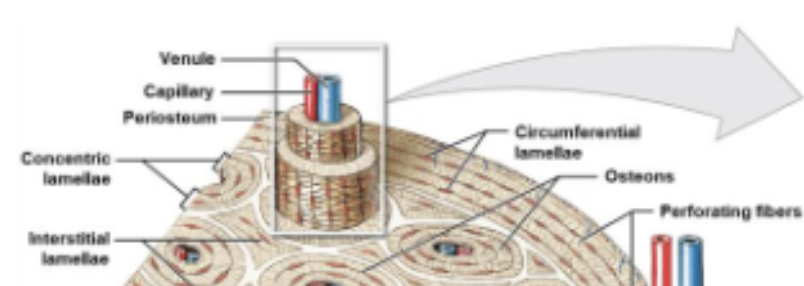
What are interstitial lamellae?
Lamellae that fill spaces between osteons.
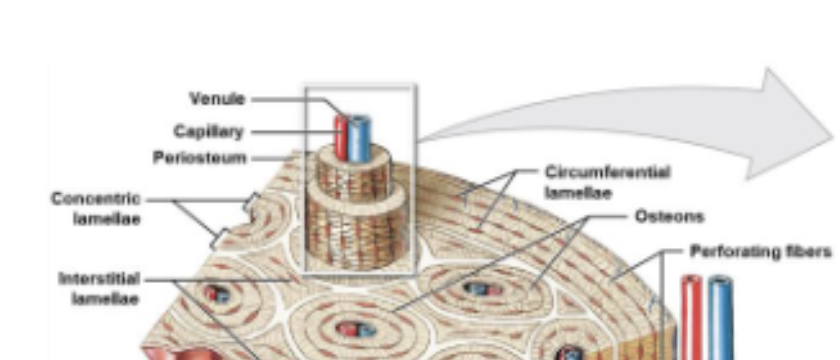
What are circumferential lamellae?
Lamellae at the outer and inner bone surfaces.
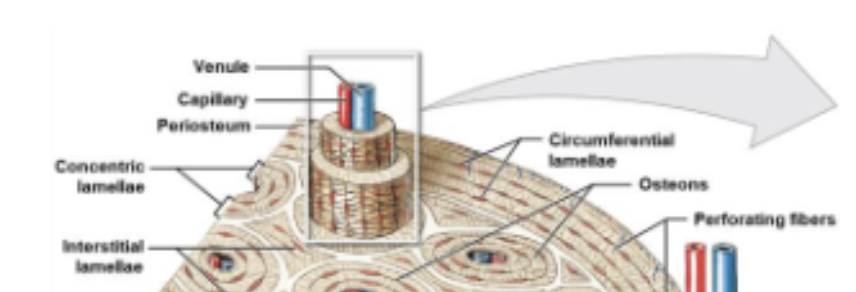
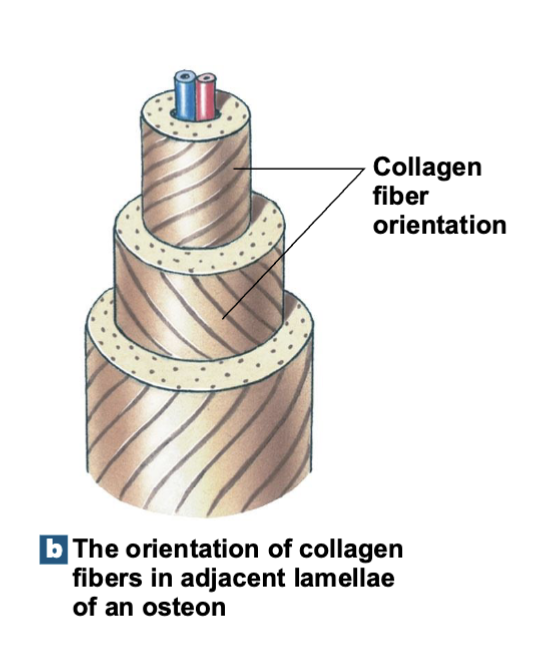
How is the orientation of collagen fibers in adjacent lamellae?
They are oriented in different directions.