PS3130: Forensic Psychology
 Call Kai
 Learn
Learn Practice Test
 Spaced Repetition
 Match
Match Flashcards
 Knowt Play
1/163

There's no tags or description
Looks like no tags are added yet.
Name | Mastery | Learn | Test | Matching | Spaced | Call with Kai |
|---|
No analytics yet
Send a link to your students to track their progress
164 Terms
There are massive rates of __________ in prisoners, including bain damage, ASPD and schizophrenia
undiagnosed mental health problems
Fazel and Danesh (2003) did a meta analysis of surveys across the world and found prisoners were made up of…
4% psychosis, 10% depression, 65% personality disorders (47% ASPD)
Fazel et al. (2006) found XX-XX% of prisoners experience alcohol abuse, XX-XX% substance abuse
18-30%, 10-48%
What is forensic psychology?
AKA legal/criminological psychology - deals with all aspects of human behaviour related to the law or legal system.
Torres et al. (2006) found XX% of mental health professionals endorse that ‘criminal profiling is a useful tool for law enforcement’
86%
What question should be asked when assessing whether criminal profilers are effective?
Can they do better than an untrained individual?
What did Kocisis et al. (2002) find regarding effectiveness of criminal profilers, when participants were given extensive background information about a case and asked to evaluate aspects of the perpetrator?
Participants were better at profiling with extensive background information than if no information was given at all. Chemistry students consistently outperformed profilers, homicide detectives, senior police officers and trainees.
No relationship between experience and accuracy - some hint of an inverse relationship.
What did Snook et al. (2008) find in their meta-analysis regarding the effectiveness of criminal profilers?
Profiling is an extraneous and redundant technique for use in criminal investigations. Persists as a pseudoscientific technique until empirical and reproducible studies are conducted on abilities of a large group of profilers to predict more precisely and of greater magnitude - the characteristics of offenders.
Why does everybody believe in criminal profiling?
Physician’s phallacy, Barnum Effect, Expertise heuristic
How does the Physician’s fallacy explain why everyone believes in criminal profiling?
Only ever report when it works. Thousands of predictions are wrong and unreported. In the Washington sniper case, many predicted it was 1 killer - but a small handful predicted 2 - when it was revealed it was actually 2 it was widely reported that criminal profiling works, whilst disregarding the profilers who claimed it was 1.
How does the Barnum Effect explain why everyone believes in criminal profiling?
People pick out of a profile the bits that seem to fit even if they fit everyone (for example, self-esteem issues) and ignore (or twist) the rest.
How does the expertise heuristic explain why everyone believes in criminal profiling?
Belief that ‘clever’ people with smart titles and university degrees must be correct.
Why is criminal profiling pseudoscience?
Not shown to be more than a sensible review of the facts of a case and intelligent guesswork. No coherence to approach, maybe some things work.
What is the major role of forensic psychologists?
Understanding why the person has committed a crime and implications of this for management of the person.
What techniques do forensic psychologists use to assess clients?
Interviews, psychometric tests, projective tests, objective tests, physiological and neurophysiological tests.
What does forensic psychology assessment typically also involve due to clients malingering and deception?
A full case review of collateral information including criminal records, medical records, school, employment records, other reports from professionals.
When does full case review of collateral information need to be gathered by forensic psychologists?
Before an interview to assess whether they lie during the interview, as many malinger and deceive.
What is a clinical interview?
Covers childhood, attachments, attitudes, sexual fantasies etc. Normally semi-structured, particular standardises interviews for some diagnoses (PCL-R, IPDE), requires clinical skills. (May also be used for diagnoses is have clinical qualifications)
What are the differences between therapeutic assessment (clinical) and forensic assessment?
Therapeutic looks to treat presenting problems, forensic reports of problems and possible consequences of them.
Client has much to gain from therapeutic, forensic possibly has much to lose.
Therapeutic is mainly confidential with exceptions, forensic assessment mostly not confidential.
What are the similarities between forensic and therapeutic assessments?
Both seek to understand current problems and behaviours of client, may try to diagnose mental health problems.
To perform a good clinical/forensic interview, good clinical skills are needed. What are these?
Effective opening statement. Discuss Tarrasof liability and of recording/note-taking. Develop rapport, put them at ease. Non-verbal communication - need to be able to elicit or stop clients talking. Active listening skills and summarising.
What is Tarrasof liability?
If someone informs you of a named victim, must report to the appropriate authorities.
What are psychometric tests?
Standard and scientific method used to measure individual’s mental capabilities and behavioural style. Many psychological concepts now have instruments to help quantify issues.
What are some examples of psychometric tests used in forensic psychology?
Beck Depression Inventory (BDI-II), Impacts of Events Scale, Paulhaus Deception Scale, Reactive and Proactive Aggression, Questionnaire (RPQ)
What are projective tests?
Assessment tools that present individuals with ambiguous stimuli, prompting them to interpret or create stories about them. Used to infer underlying traits.
What are some examples of projective tests?
Rorschach test, Thematic apperception test, House-Tree-Person test
Are projective tests helpful?
Many scientists failed to demonstrate them to be quantifiable, reliable or valid. Little evidence they do what they claim to do.
What did Lilienfeld et al. (2000/01) conclude in their meta-analysis on projective tests regarding norms, reliability, validity?
There is little support for their use and no more insight or accuracy than simply asking the person.
What are neuropsychological assessments?
Distinguishes from others as they are performance based. Assessments of cognitive, behavioural, emotional functioning linked to specific brain structures and performance.
What are some examples of neuropsychological assessments used in forensic psychology?
IQ = Wechsler Adult Intelligence Test (WAIS-IV)
Memory = WMS-IV
Frontal lobe function = Stroop, DKEFS
What are physiological assessments?
Using physiological reactions to infer psychological processes
What are examples of physiological assessment used in forensic psychology?
Skin conductance response and pupillometry used for arousal.
Heart rate, corrugator response, genital response, brain response
What did Burley, Gray and Snowden (2019) find using physiological tests on arousal?
Examined pupil dilation in sample of male offenders for arousing and non-arousing pictures. For most, pupil dilates to both positive and negative. but those with high psychopathy scores, pupil did not dilate to negative images.
What problems are there with assessment in forensic psychology?
Clients may not be honest with questions and performance on tasks.
Motivated to malinger to gain more lenient sentence - pretend to have mental illness
Or fake good, hide thoughts/intentions that may hinder progress.
What is the reference-group effect? (Heine et al., 2002)
Tendency for individuals to evaluate selves by comparing themselves to a subjective group rather than an objective standard, when answering questionnaires.
What is an example of a questionnaire that has the issue of the reference group effect?
IPDE (International Personality Disorder Examination - Screening Questionnaire)
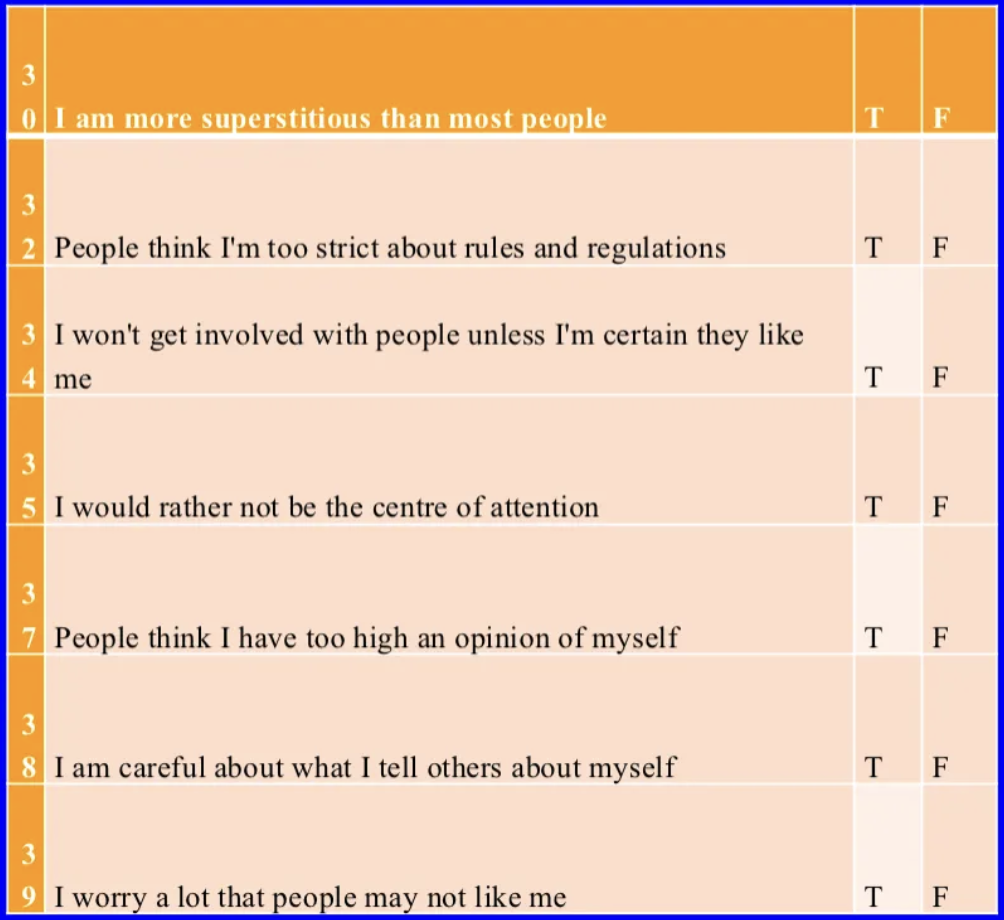
How may client’s context affect their responses to assessments in forensic psychology?
Some may not be able to read or understand questions (many prisoners are illiterate). Furthermore, when asked what others think of them - it is difficult to know how to answer this, cannot be sure how other people view yourself.
What did Heine et al. (2002) find regarding the reference-group effect?
Looked at norms in collectivistic vs individualistic cultures. Gave questionnaire to people in America and Japan, they scored the exact same as they normed themselves to others in their population - therefore they all scored average.
What did Chesterman et al. (2008) suggest to infer malingering from symptom profiles?
Standard tests such as the Structured Interview of Reported Symptoms (SIRS)
Suggestibility - suggest something about forensic psychology that is not true, if they start to perform that behaviour to seem believable can infer malingering.
What do many questionnaires have to assess malingering?
Lie scales - differentiating faking bad and faking good. Also specialised ones for detecting faking (Paulhaus Deception Scale)
What neuropsychological tests are there for faking?
Test of Memory Malingering (TOMM) - Presents a task that appears difficult (remembering 50 pictures) but is really easy. Some participants score less than chance, must know which is the correct answer then pick the other.
Most participants score 49 or 50 out of 50. Demonstrates faking.
What faking are forensic psychologists most commonly concerned with?
Good. Many questionnaires have scale to look for impression management - but most of these scales easy to spot and therefore fake. In clinical interviews it will take place, all clients tend to minimise and lie.
How can lie detection be summarised?
People are not good at spotting lies. This includes psychologists, policemen, trained interviews etc. Though there may be modest effects of training.
What is the polygraph?
Takes physiological responses (typically GSR) as person answers questions. Idea is someone will show abnormal reaction when lying.
What are the claims of accuracy for polygraphs?
From 50-100%. Reality is somewhere in between dependent on several factors.
What do psychologists often use polygraphs for?
Bogus pipeline experiments - can do same for offenders. Can change amount of disclosure.
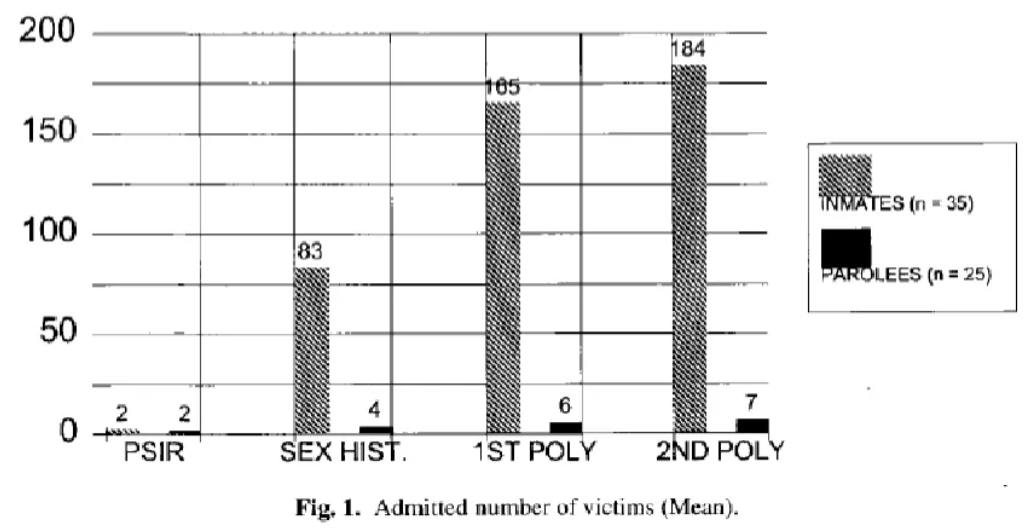
What did Ahlmeyer et al. (2000) find regarding disclosure by male sex offenders when 4 stages used: presentence report, sexual history disclosure, then 2 polygraph tests?
No information, low numbers. But on the first polygraph tests - gave much more information as they believed machine worked and they had to tell the truth.
Aggression is a fundamental part of human (and most other animals’ nature) (Wrangham, 2023), why?
To defend self and others from attack, to hunt for food/valued items
What is focused on regarding aggression/violence in forensic psychology?
Forms of it, factors driving it, factors used to risk assess people and be targets of interventions aiming to reduce levels of it in the individual.
Define aggression (Allen and Anderson, 2017)
A behaviour intended to harm another person who is motivated to avoid that harm (Allen and Anderson, 2017)
Define violence
A subset of aggression which is a severe form of aggression designed to cause severe physical harm
What are the 5 components of aggression?
It is a behaviour, must be deliberate/intentional, must harm recipient in some form, must be towards another person, the person being targeted must be motivated to avoid the harm.
What is not aggression?
Thoughts, having a quick temper/hostile attitudes/getting angry, getting angry and smashing a door in private (unless done to intimidate someone else), self-harm/suicide.
If someone throws something at someone, but misses, is this aggression?
Yes, as the aim was to hurt them.
What are the different taxonomies for aggression and violence?
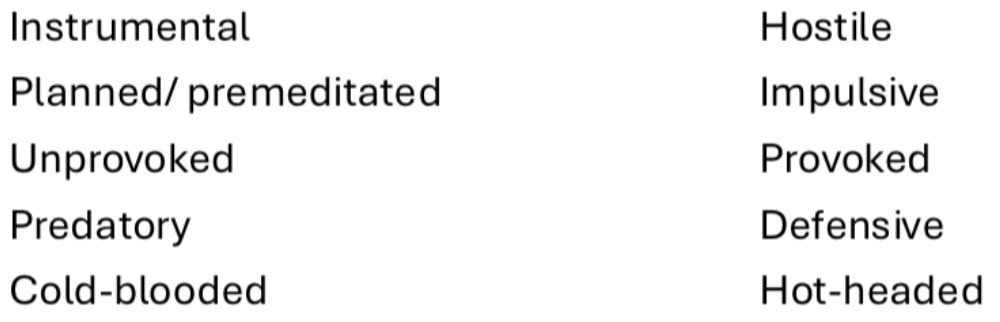
Reactive vs proactive
Direct vs indirect
Physical vs verbal
Domestic violence (interpartner)
What is the major distinction between proactive and reactive aggression?
The motivation
Define proactive aggression
Deliberate and goal-oriented aggression used as a means to achieve a desired outcome
What are the key traits of proactive aggression?
Planned and calculated, not triggered by provocation, often used to gain power/control/rewards
Define reactive aggression
Aggression in response to a perceived threat, frustration or provocation
What are the key traits of reactive aggression?
Emotionally driven (anger, fear), unplanned and defensive, triggered by real or imaged insults/threats
Why is it questionable whether the distinctions between proactive and reactive aggression are helpful?
Because there are correlations between them.
What did Babcock et al. (2014) claim regarding the distinctions between proactive and reactive aggression?
There are close relationships between distinctions, but differ slightly in defining characteristics. However the distinction is not binary, many acts contain a mixture of attributions. Some acts are hard to classify.
What is the distinction between direct and indirect aggression?
How it is delivered
Define direct aggression
Aggression that is openly expressed and targeted directly at the victim
What are the key traits of direct aggression?
Visible and confrontational, physical/verbal, aggressor and victim are clearly identifiable
Define indirect aggression
Aggression that is hidden, subtle or delivered through third parties, often without direct confrontation
What are the key traits of indirect aggression?
Covert and manipulative, often involves social exclusion, gossip or sabotage, victim may not immediately know who aggressor is
Whilst classifying aggression is important, the real aim of assessment is to understand…
the why of aggression
Why is it important to understand the differences between proactive and reactive aggression in forensic psychology?
They differ in motivations (though many exhibit both forms), the form of intervention would be different for someone with primarily proactive aggression than someone with primarily reactive aggression
How do we study violence?
Crime statistics/other official records, informants, laboratory behaviour
What is the issue with using crime statistics to study violence?
Tip of the iceburg, not everything is recorded. Homicide too rare to be useful in many cases.
What is the issue with using informants to study violence?
Ethical concerns
What is the problem with using lab research to study violence?
Difficult to get people to be aggressive in a lab, ethical issues with provoking aggression outside lab
How is aggression and violence currently studied in labs?
Noise blasts or hot sauce.
What is the issue with the current way lab research tests aggression? (using hot sauce and noise blasts)
Doubt usefulness as it is seen as trivial and not what happens in the real world
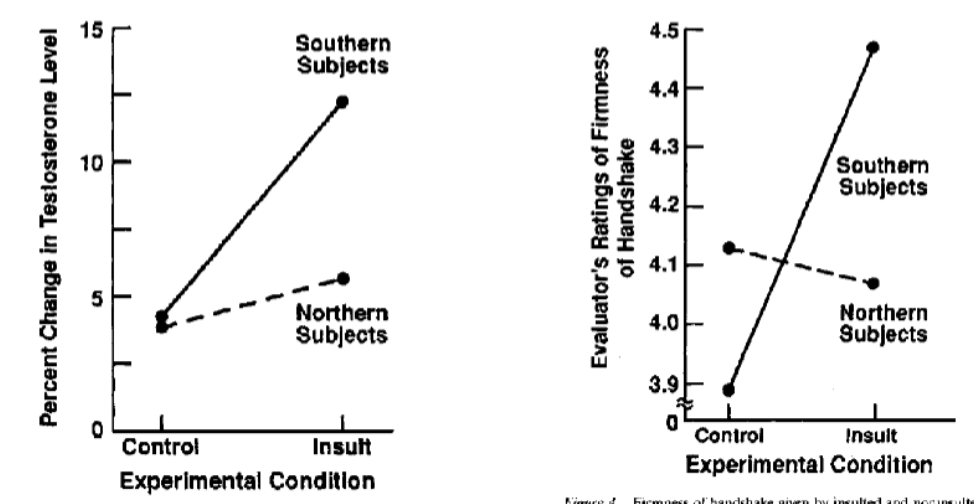
What did Cohen et al. (1996) find when examining Southern vs Northern American participants reaction to insults by a collaborator bumping them in the corridor and calling them an a**hole?
Found increased testosterone and firmness of handshake for southern participants compared to northern, supports idea they have honour culture.
What did Anderson and Bushman (1997) find in support of lab experiments in forensic psychology?
Found good external validity for both real world and lab forensic psychology experiments, across several variables including gender, trait aggressiveness, alcohol, media and temperature.
What did Bartholow and Anderson (2002) find when looking at the effect of playing violent games on subsequent aggression?
Men administered significantly higher punishment intensity and frequency (noise blasts) than women in the violent game condition. Men and women had similar numbers for nonviolent games.
Suggests violent video games do cause greater aggression, which is stronger for men - without the cue to violence men were no more aggressive than women.
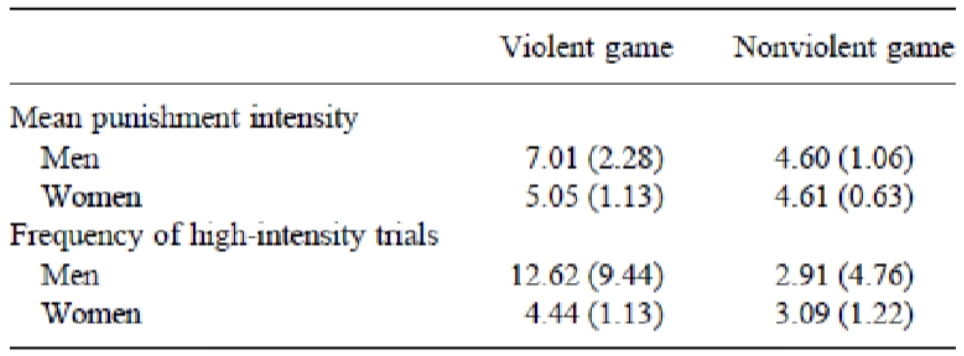
What did Boccadoro et al. (2021) try to produce?
TAP tasks highlighting reactive vs proactive aggression
What does Boccadoro et al.’s (2021) reactive TAP variant task involve?
Participants believe they are competing with opponent who occasionally provokes them. Task makes provocation the most salient cue and measures retaliatory intensity and latency.
Aggression is operationalised as increased aggressive output immediately following provocation.
What does Boccadoro et al.’s (2021) proactive TAP variant task involve?
Same basic interface is re-framed so that aggression can be used instrumentally e.g. to reduce opponents future score, gain points, secure rewards. Provocation is minimised/absent. Decision to aggress is driven by expected outcomes rather than immediate arousal.
Aggression operationalised as unprovoked, strategic aggressive choices.
What self-report techniques are used in forensic psychology for violence and aggression?
Buss-Perry Aggression Questionnaire (1992)
RPQ (Raine et al., 2006) - originally designed for children to measure proactive and reactive aggression
Impulsive Premeditated Aggression Scale (IPAS) (Stanford et al., 2003)
What issues are there with self report of violence and aggression in forensic psychology?
Do people know themselves? How do they compare to others? Honesty? As well as ethics and pragmatical issues.
What are Snowden et al.’s critiques of the RPQ?
Claims many items do not measure aggression according to standard definitions. Claims the two scales are more closely aligned to aggression and anger, rather than proactive and reactive.
Notes lack of items that examine indirect aggression.
What did Snowden et al. develop instead of the RPQ due to its criticisms?
The Motivation for Aggression Questionnaire (MAQ), examining its relationships to the RPQ scales and to established measure of direct vs indirect aggression.
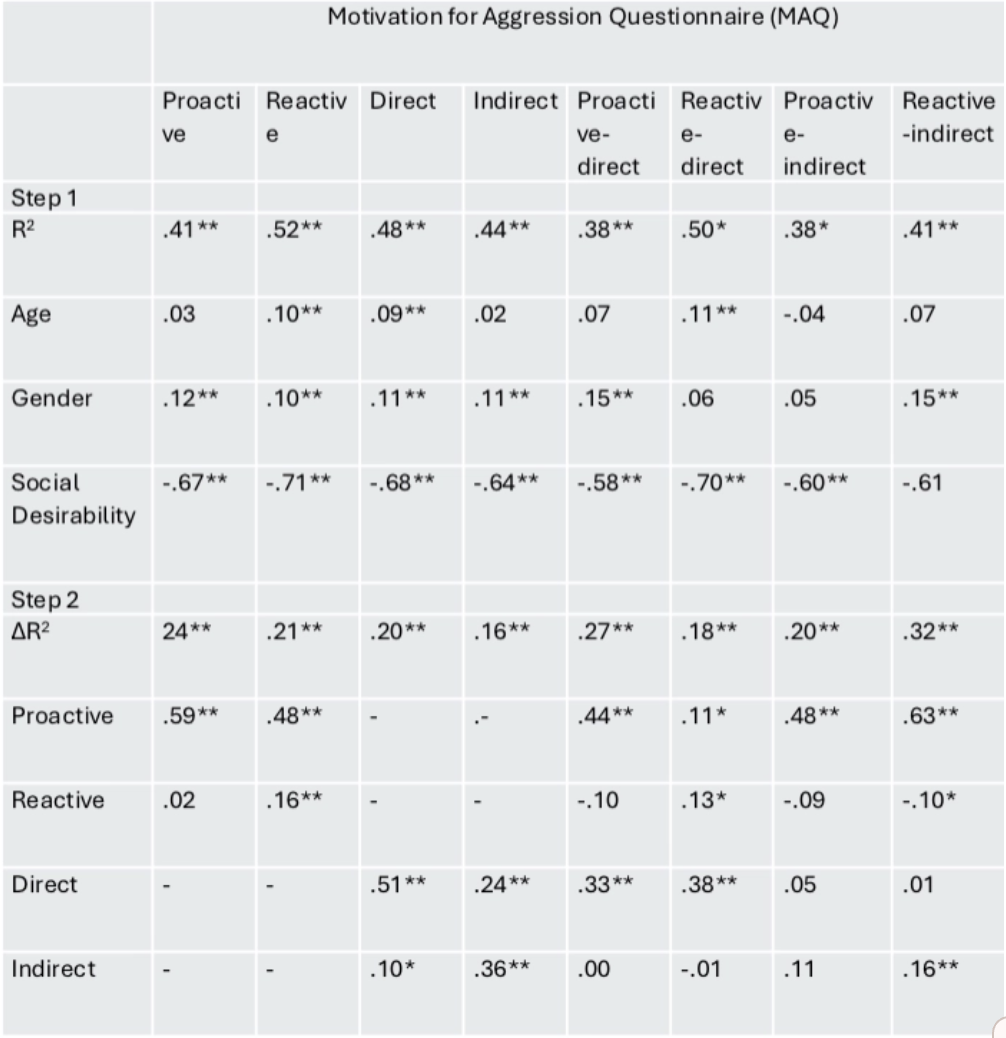
What did Smeijers et al. (2018) regarding the interchanging of self report taxonomies in clinical forensic assessment?
Found poor correspondence between the RPQ and IPAS in forensic psychiatric outpatients, found they are not interchangeable for assessment.
What did Babcock et al. (2023) suggest regarding taxonomies and domestic violence?
Concepts of proactive and reactive aggression may be useful in understanding it.
How may the concept of reactive aggression be used to understand domestic violence?
Many incidents of situational couple violence fits this pattern. Conflicts escalate during arguments, jealousy episodes, or moments of emotional dysregulation.
Research shows it is strongly linked to anger, poor emotional regulation and threat sensitivity.
How may the concept of proactive aggression be used to understand domestic violence?
Aligns closely with coercive control, a pattern of domination involving intimidation, surveillance, isolation and financial/social restriction. Coercive control now recognised as defining feature of the most dangerous forms of abuse (Myhill 2015).
Coercive control is not driven by acute emotional arousal but by a sustained strategy to maintain power over a partner.
What does Johnson’s (2008) typology distinguish between for domestic violence, DV perpetrators tend to show both proactive and reactive tendencies?
Situational couple violence (largely reactive) and intimate terrorism (largely coercive and controlling), demonstrating it is not a single motivational category.
What is the popular belief about gender and aggression?
Men are aggressive/violent gender due to mate selection and defending territory
What is the ratio of homicide committed by men to women?
10:1
What does Archer (2000)’s field and lab studies show about gender and aggression?
Males show greater physical aggression (especially unprovoked), no differences in verbal aggression. Females may show more indirect aggression, at least young females.
What did Kirsch et al. (2024) find after measuring aggression with self report questionnaire on 1640 individuals?
Males engaged in more direct aggression to friends and acquaintances. Direct aggression to siblings was more common and showed no gender differences. Indirect aggression to siblings was less common, with no gender differences.
Found context matters, not just about personality or gender but who you are interacting with.
What percentage of official recorded violence involves an intoxicated perpetrator?
50%
Does alcohol cause violence itself?
No, tends to magnify pre existing problems or inhibit behaviours.
What did Giancola (2002) find after investigating how trait irritability moderates the effect of acute alcohol intoxication on aggressive behaviour in a lab setting?
Found alcohol increased aggressive responding for men, and this effect was stronger for participants who scored high or irritability and under high provocation.
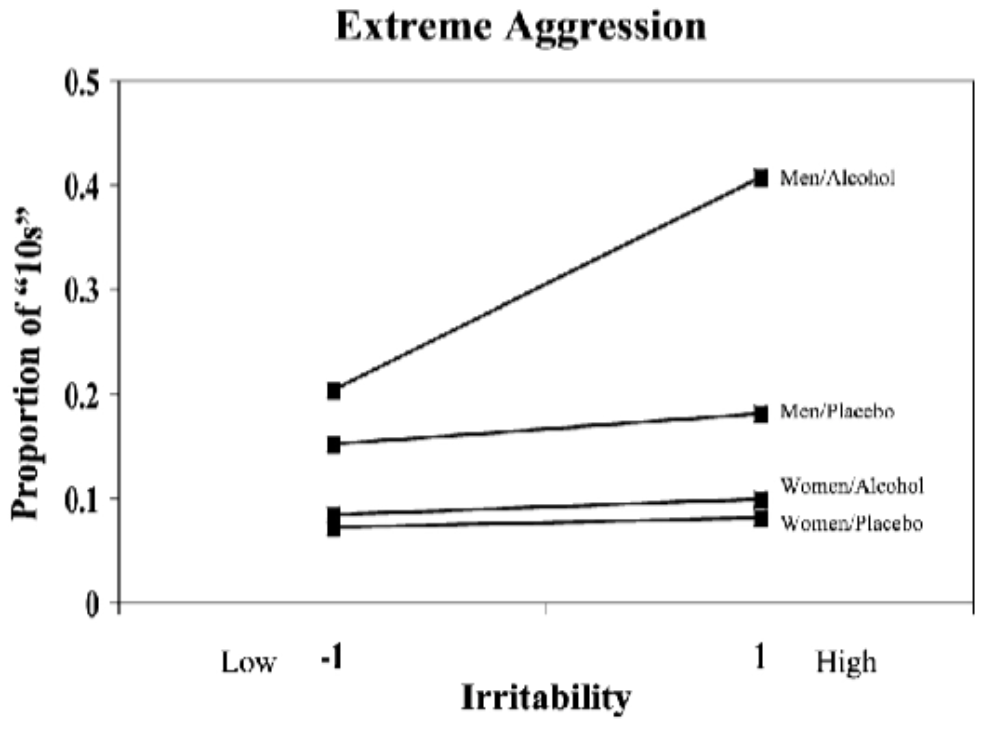
What did Caspi et al. (2002) find regarding the effect of genes and environment on violence and aggression?
500 male children assessed from 3-26 yrs old. Found interactions of genes and environment. Effect of childhood maltreatment, but far greater for those with the gene for low MAOA activity.
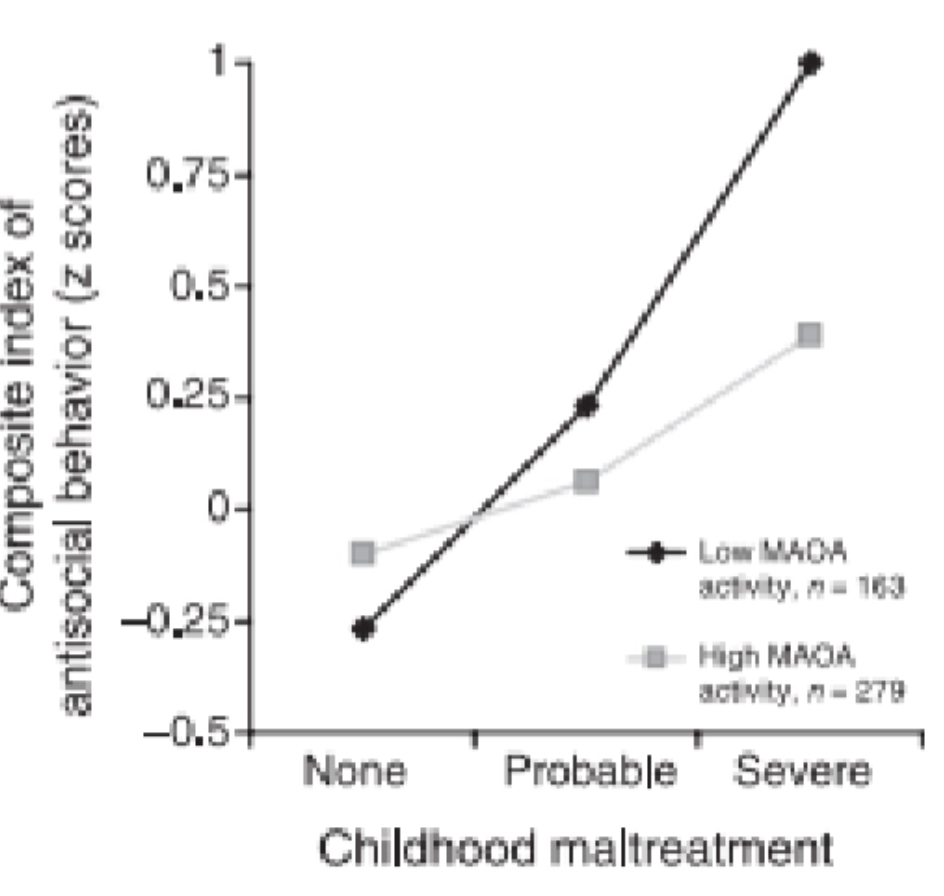
What are aggression related cognitions?
Beliefs and attitudes to aggression and violence. Implicit theories.
What 4 violence-related Implicit Theories were identified by Polascheck et al. (2008) from offence transcripts?
Beat or be beaten (important in society and hierarchy, self image),
I am the law (see selves as leaders, judge and executioner),
violence is normal (means of solving problems, no negative connotations),
I get out of control (viewed as inevitable as they cannot stop it)

