KNES 323 EVERYTHING
 Studied by 3 people
 Call Kai
 Learn
Learn Practice Test
 Spaced Repetition
 Match
Match Flashcards
 Knowt Play
1/1657

There's no tags or description
Looks like no tags are added yet.
Name | Mastery | Learn | Test | Matching | Spaced | Call with Kai |
|---|
No analytics yet
Send a link to your students to track their progress
1658 Terms
what is physiology?
the study of functions and mechanisms responsible for the control and regulation of living things
What is the difference between afference andefference!
Afference is to the brain, efferent is from
Where does the somatic NS go to?
Skeletal muscle
Where does the sympathetic NS go to?
Smooth muscle, cardiac muscle, glands
Where does the parasympathetic NS go to?
Smooth muscle, cardiac muscle glands
Where does the enteric NS go to?
Smooth muscle and glands of GI tract
What serves the integrative function of the NS?
Association or interneurons
Why is white matter in the middle of the brain?
We send impusles straight up through the center of the brain.
Why is gray matter in the center of the spinal cord?
Reflex arcs go inside so we want to protect it so we have white matter outside
What is the function of the thalamus?
Redirects messages
Where do we see summation of action potentials?
Axon hillock
What are our excitatory and inhibitory neurotransmitters?
Excitatory is glutamate, inhibitory is gaba or dopamine
What type of synapse occurs in the heart?
Electrical through gap junctions because desmosomes are packed together not allowing it
What are the characteristics of our voltage gated channels during the absolute refractory period.?
Voltage gated Na channel activations gates are open, Na channels are inactivating as K channels open
What are the characteristics of our voltage gated channels during the relative refractory period.?
K channels are open, na channels in resting stage
What is korotkoff sounds?
Describes sound associated with turbulent flow not laminar or non existent flow
What side of the heart pumps harder? Do the different sides pump different volumes of blood?
Left side because it pumps to body but both sides pump the same volume
What does the dicrotic wave represent?
Represents the closing of the aortic semilunar valves which fills blood into the coronary arteries
What is the TP. Interval?
Time between start of ventricular repolarization and next atrial depolarization
What is the function of the pericardial cavity?
Allows smoother movement, prevents friction, keeps things open
What is key about the location of the coronary arteries/
Prevents collapse, when valves open they block the arteries
Why do conducting and contractile cells have different action potentials?
Conducting cells don’t really have refractory period but contractile do to allow filling and rest of ventricle
What are the different types of white blood cells?
Neutrophils, lymphocytes, monocytes, eosinophils, basophils
What does blood transfusion involve?
Certain parts of blood, RBC, Platelets, plasma, rarely whole blood (rbc, wbc, plasma, platelets)
What is the most and least common WBC?
Most common is neutrophils, least is basophils
What is the general concentration of formed elements?
RBC> platelets > WBC
What happens with very low hematocrit?
low hematocrit means low viscosity and easy flow but no metabolism
What happens with very high hematocrit?
High viscosity, hard to pump blood and die young
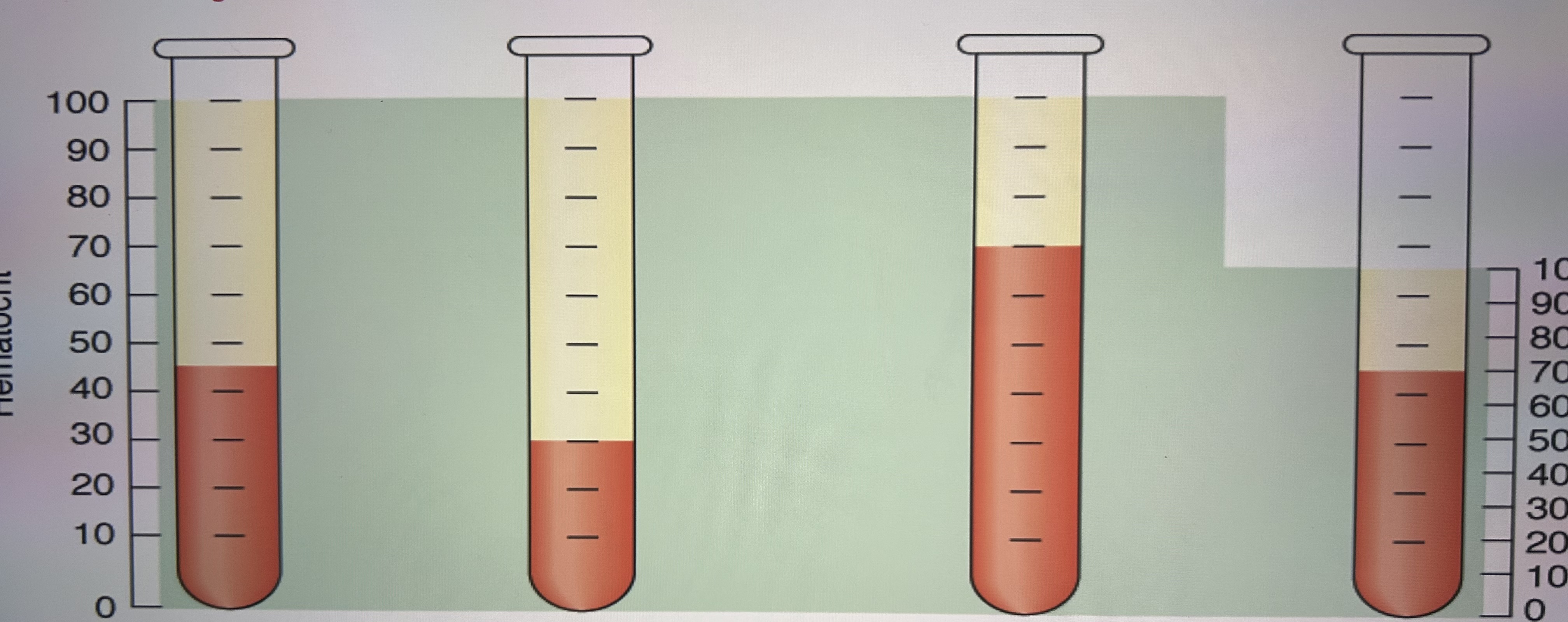
What is seen in each diagram?
Normal (hematocrit 45%), anemia (hematocrit 30%), polycythemia (hematocrit 70%), dehydration (hematocrit 70%)
what is metabolism?
set of life-sustaining chemical processes that enable organisms to transform chemical energy stored in molecules into energy that can be used for cellular processes
what is responsiveness?
react and change to environment
what is growth?
increase in the number and size of cells in an organism
what is differentiation?
less specialized cell matures to a more distinct form and function
what is the chemical level of the body?
atoms (smallest units of matter that participate in chemical reactions, molecules (two or more atoms joined together)
what are cells?
basic structural and functional units of an organism
what are tissues?
groups of similarly specialized cells and the substances surrounding them that usually arise from a common ancestors and perform certain special functions
what are organs?
structures of definite form that are composed of two or more different tissues and have specific functions
what is the human organism?
collection of structurally and functionally integrated systems
what is homeostasis?
condition of equilibrium, or balance, in the body’s internal environment maintained by the body’s regulatory processes
what must a control system be able to do in order to maintain homeostasis?
detect deviations from normal in the internal environment that need to be held within narrow limits even through changes, integrate this info with other relevant info, make appropriate adjustments to restore a factor to its desired value
what is a set point of an individual’s body systems?
the normal range for a given system that is monitored by the control centre for that system
what is the control systems for body temp?
hypothalamus
what are circadian rhythms?
endogenous autonomous oscillators of physiological activities that result in cycles allowing organisms to adapt to a fluctuating environment
what is the circadian clock system?
major regulatory factor for almost all physiological activities and its disorder can have severe consequences on human health
what are intrinsic controls?
local controls that are inherent in an organ
what are extrinsic controls?
regulatory mechanisms initiated outside an organ, accomplished by nervous and endocrine systems
what are feedback loops?
responses made after a change
what are feedforward loops?
responses made in anticipation of a change, aim to anticipate changes before they occur
what are negative feedback loops?
primary type of homeostatic control, opposes initial change
what are the components of a negative feedback loop?
sensor (monitors magnitude of a controlled variable), control centre (compares sensors input with a set point), effector (makes a response to produce a desired effect)
what is the main goal of the negative feedback loop?
keeping internal environment stable, only controlling within the body
what does the negative feedback loop control?
body temp, nutrients/wastes, O2/Co2 levels, pH, water/electrolytes, blood volume/pressure
what is an example of a negative feedback loop?
blood pressure control
what is a positive feedback loop?
amplifies an initial change, doesn’t truly contribute to homeostasis, response reinforces stimulus causing effect
what is an example of a positive feedback loop?
contractions during labour
what is disorder in homeostatic imbalances?
general term for any derangement of abnormality of function
what is meant by disease in homeostatic imbalances?
more specific term of an illness characterized by a recognizable set of signs and symptoms
what is aging in homeostasis?
characterized by a progressive decline in the body’s ability to restore homeostasis
what is an example of feedforward mechanisms in the mouth?
saliva production before eating, prepare for the breakdown of carbohydrates
what is an example of feedforward mechanisms in digestion (past the mouth)?
mechanism increases secretion of insulin to promote cellular uptake and storage of nutrients
what is an example of feedforward mechanisms in exercise?
central command primes body for changes about to take place during the exertion (oxygen extraction rates, cardiac output rates, and oxygen demand increases)
what is an example that demonstrates this circadian rhythm discussed?
cortisol increasing during the day and alternating with melatonin increasing at night demonstrates everything is intertwined to create these cycles
what are the basic components of a feedback loop?
stimulus, controlled condition, receptors, control center, effectors, response
what is the purpose of receptors in a basic feedback loop?
send nerve impulses or chemical signals to a control center
what is the purpose of a control center?
receives input and provides nerve impulses or chemical signals to an effector
where are the most baroreceptors found?
arch of the aorta, also found in the internal carotid
what as an example outside of childbirth for positive feedback loops?
hemostasis, blood clotting
what equation can be used to represent energy balance?
energy intake = internal heat production + internal work + external work + energy storage
what is the law of thermodynamics? What does it tell us?
energy cannot be created or destroyed, thus there is a balance between energy input and output
what is meant by energy input?
energy in ingested food, cells capture portion in high energy bonds of ATP, allows us to do energy output
what does energy output consist of?
external work and energy from nutrients not used to perform work
what is meant by external work in energy output?
energy expenditure when skeletal. muscles are contracted to move external objects or move the body in relation to the environment
about how much of energy is used for biological work and of this energy what occurs to the excess?
25% of chemical energy is used for biological work, the rest is converted to heat/thermal energy (mostly used for body temp regulation)
what is meant by energy storage?
internal work, all other forms of biological energy expenditure that do not accomplish mechanical work outside the body
is all skeletal muscle used for external work outside the body?
no some can be used for things like postural maintenance contractions and shivering
what does internal work include?
all energy expending activities that occur throughout life, skeletal muscle activity outside of that used for external work
what are the three possible states of energy balance?
neutral, positive, or negative balance
what is meant by a neutral energy balance?
energy input = energy output, body weight is constant
what is meant by a positive energy balance?
energy input is greater than energy output, energy not used is stored mostly as adipose, body weight increases
what is meant by a negative energy balance?
energy input is less than energy output, stored energy is used to supply energy needs, body weight decreases
what is meant by metabolic rate?
total amount of energy we need to expend (internal and external work) to perform a given task, energy expenditure/unit of time
what is meant by basal metabolic rate?
the minimal amount of internal energy expenditure that must be maintained for basic physiological functions
what is required to determine our BMR and under what conditions?
calorimetry, person is physical and mentally at rest, done in a comfortable room temperature , no food consumption within 12 hours
what factors influence our metabolic rate?
thyroid hormone level (primary determinant of BMR), sympathetic stimulation (epinephrine/norepinephrine), exercise, daily activities, age, sex/gender
what is the primary determinant of BMR?
thyroid hormone levels
explain how metabolism works with the energy we consume through food?
humans eat food to replenish energy, metabolism breaks down carbohydrates, lipids, proteins and nucleic acids to provide chemical energy for cellular processes
what occurs for every action that requires energy?
many chemical reactions take place to provide energy to our body systems including the muscles, heart, brain, nerves and lungs
what is meant by an anabolic reaction?
cellular processes that builds complex molecules
what is meant by catabolic reaction?
cellular process that breaks down complex molecules
what is meant by exothermic reaction?
reactions that releases energy
what is meant by endothermic reaction?
reaction that requires energy to proceed
what is a big part of our cellular metabolism?
all chemical reactions that take place inside our cells
overall what can potential energy be used for in metabolism and where is it found?
potential energy in chemical bonds can be used to perform work or for biological processes
explain the release of energy through metabolism and its purpose
many metabolic processes breakdown organic molecules to release energy for growth and survival
what is required to start a chemical reaction?
each chemical reaction has a certain amount of activation energy required to start it
what is the role of enzymes in activation energy?
can act as catalyst to reduce the amount of activation energy required and to increase reaction rate
what happens if an enzyme is not active in metabolism?
each enzyme can only control one type of chemical reaction so if it is not active the whole pathway stops working
what is meant by metabolic regulation?
cells use specific molecules to regulate enzymes to promote or inhibit certain chemical reactions
why is it necessary to inhibit reactions sometimes?
to reduce reaction rate
what is competitive inhibition?
inhibitor molecule is similar to substrate so it binds to the enzymes active site preventing the substrate from binding, the substrate and inhibitor compete to bind to the enzyme
 Note
Note  Flashcards (178)