Forces (Elasticity and Pressure)
 Call Kai
 Learn
Learn Practice Test
 Spaced Repetition
 Match
Match Flashcards
 Knowt Play
1/47

There's no tags or description
Looks like no tags are added yet.
Name | Mastery | Learn | Test | Matching | Spaced | Call with Kai |
|---|
No analytics yet
Send a link to your students to track their progress
48 Terms
Deformation
Change in the shape of an object as a result of forces being applied to it
Elastic deformation
change is shape in an object that can be reversed
one forces have been removed
causing it to return to its original shape
(elastic objects)
Inelastic Deformation
Change in shape of an object that cannot be reversed
Once forces causing it has been removed
So it will NOT return to its original shape
(Plastic deformation)
What type of changes can happen to an object?
Stretching
Compressing
Bending
Compression
Weight of the mass
Reaction force from surface of the spring
Act towards each other
WORK IS DONE
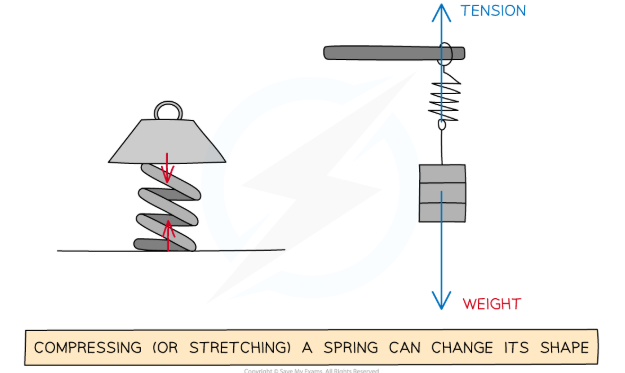
Stretching
Weight of the mass
Tension in the spring
Act away from each other
WORK IS DONE
Bending
Weight of swimmer
Reaction force from the block to diving board
Act towards each but at DIFF points on the object
Could be caused by two forces at angles to each other
Spring Constant
An object's spring constant is a measure of how many Newtons of force it would require to stretch (or compress) the object by 1 metre.
It has the units N/m. It's basically a measure of how firm (or stiff) the spring is.
A higher spring constant means the spring is more firm (harder to stretch).
A lower spring constant means the spring is less firm (easier to stretch).
Why must two forces be applied for a change in shape of an object?
A stationary object is in equilibrium (forces are balanced)
A single force would be unbalanced and cause motion, not deformation
Changing shape requires internal stress within the object
This happens when forces act in different directions or at different points
At least two forces are needed to stretch, compress, or bend the object
The forces can balance overall, so the object stays still while its shape changes
Limited to stationary objects only
Force and Extension Equation (also works for compresion)
F = ke
F = Force in newtons
K = Spring Constant in (N/m)
E = Extension in (meters)
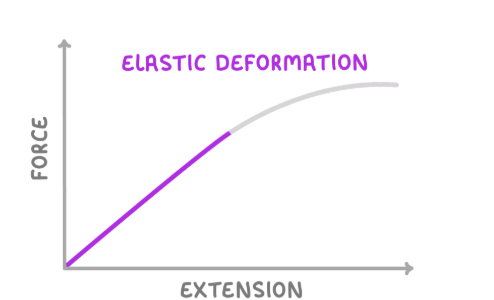
What sort of deformation occurs in highlighted part of the line?
Elastic Deformation
Force and Extensions are directly proportional to each other
As the line is straight (linear)
As the line passes through the ORIGIN
Relationship is called Hookes Law
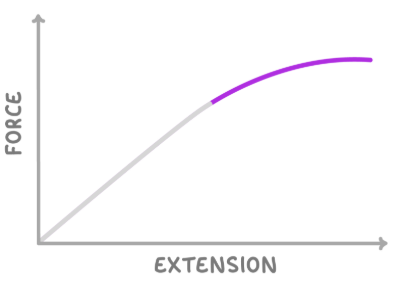
What sort of deformation occurs in highlighted part of the line?
Inelastic deformation (after limit of proportionality)
Object cannot go back to original shape
What is limit of proportionality?
Also known as elastic limit
The point at which an object being stretched stops deforming elastically, and starts deforming inelastically.
Objects stops obeying Hookes law
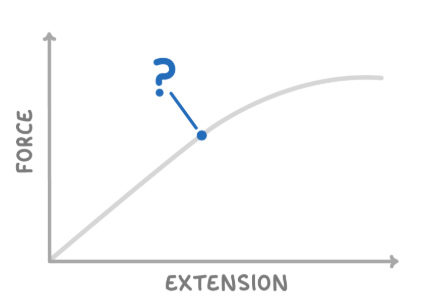
Name the point and effect
Limit of proportionality/Elastic Limit
Elastic deformation → Inelastic Deformation
You might get a swapped aroud axis graph so be careful of that
Elastic potential energy
Energy stored in an object when it is stretched or squashed
Work is done when a forces stretches or compresses an object and causes energy to be transferred
If it is elastically deformed - ALL this energy is transferred to objects elastic potential energy store
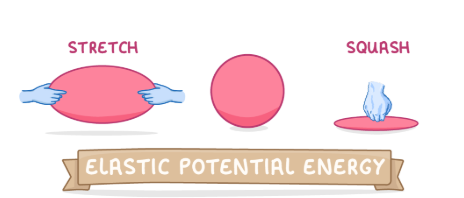
Elastic potential energy equation
Only applied when string is NOT stretched past limit of proportionality
Work done on spring can be calculated by
E = 1/2ke²
E = energy transferred (Joules)
K = spring constant (N/m)
Extension = (meters) how much longer or shorter and object is due to it being stretched/compressed
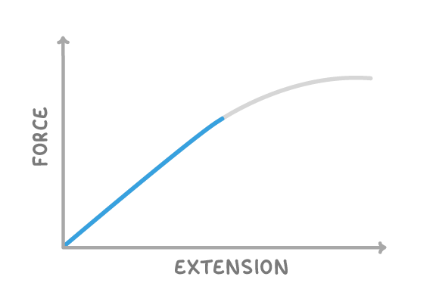
What does gradient of straight part of line tell you?
It tells you the spring constant
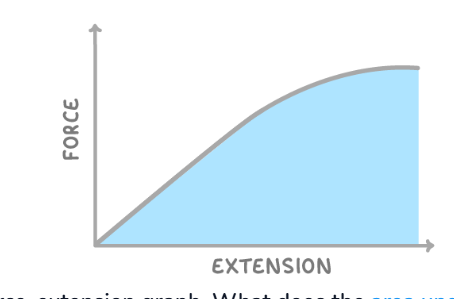
What does area under the curve tell us?
Up to limit of proportionality only (area under linear force extension graph)
Lets us calculate the energy stored in elastic potential energy store
What does elastic potential energy tell us?
Elastic deformation → formula can be used to calculate energy stored in KPE
Energy transferred to the spring as it is deformed (or by the spring as it returns to original shape)
If a stretches spring is released the energy stored in its KPE will be transferred to its kinetic energy store as it springs back to its original size and shape
What happens to an object that is deformed inelastically?
Work done will transfer energy into other stores
eg. Thermal energy stores of the object (not just KPE)
How does an object rotate?
A system of forces/force causes an object to rotate
if object is fixed with a pivot - then rotation can be clockwise and anticlockwise
eg. child on a see saw
turning handle of a spanner
door opening and closing
Moment
The rotational/turning effect of a force
How do you measure distance when calculating the moment?
Measure the perpendicular distance from the line of action of force to the pivot
Line of action - Straight line passing through the point at which F acts and is the same direction as F
Much be perpendicular so if force is at an angle then it should still be 90 degrees to pivot
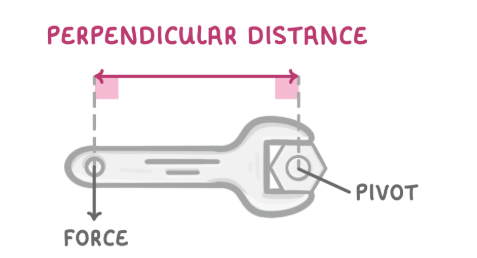
Equation for moments
M=Fd
M = Moment of the force (Nm) - newton meters
F = Force (N)
D = Perpendicular distance from line of action of force to the pivot
In which direction must you push for maximum moment?
Push at right angles to the pivot (line of action at right angle
As at any other angle it means a smaller moment
As perpendicular distance between line of action and the pivot is smaller
Balanced forces
total clockwise moment = total anticlockwise moment
about the pivot
then object is balanced and it wont turn
Levers
Simple device that increase the size of a force action on an object in order to make the object turn more easily
Leavers can be used to help us move or life things easily
How do levers work?
Principle of moments (force* perpendicular distance)
They work by transmitting the turning effect of a force effectively multiplying the force that gets applied to the object
(less force required to get the same moment) - knows as force multipliers
How to find missing distances/force of an object in equilibrium?
Calculate the weight of the object (MASS IN KILOS TIMES GRAVITATIONAL FIELD STRENGTH)
Multiply this by the distance to calcualte force
Then use the given distace/force and rearrage equation to find the missing value
Total sum of movement stay the same
Gears
Circular discs with teeth around their edges
Teeth of different gears interlock so that turning one causes another turn in the opposite direction
Used to transmit rotation effect of a force from one place to another
In which direction to both gears turn
Opposite directions
Different sized gears can be used to change the moment of a force
Force transmitted to larger gear caused a bigger moment as the distance from the edge of the pivot is greater
Larger gear turns slower than a smaller gear
How are rotational forces transmitted?
A simple lever and a simple gear system can both be used to transmit the rotational effects of forces
Turning effect
Ratio of turning effect is proportional to the ratio of the radius of the two gears
(if radius of B is 10 and A is 5 then turning effect of B is also twice the size of A)
Each gears rotation alternates between clockwise and anticlockwise
Fluid
A substances in which all the particles are free to move (“flow”)
A liquid or a gas
Particles are free to move around and collide with surfaces and other particles
Pressure Formula
P = F/A
Pressure → Pascals
Force → Newtons (at a normal to the surface)
Area -→ Area of surface (m²)
Pressure
pressure in fluids when colliding with a surface causes a force normal (at right angles) to any surface
Pressure is force per unit area
Meaning pressure is exerted on the surface by the liquid
3 Factors that determine pressure exerted on by a liquid
1 The depth. At a greater depth, more pressure is exerted.
2 The density of the liquid. More dense liquids exert greater pressure.
3 The gravitational field strength, which is 9.8 N/m on earth.
Density
Measure of how close together the particles in a substance are → density is uniform for a given liquid and doesnt vary with shape/size
A denser liquid will have more particles in a given volume - meaning more particles are able to collide - means more collisions and higher total force exerteted - higher pressure
As depth increases - no of particles above that point increases - weight also increase so these particles add to the pressure experienced at that point (liquid pressure increases with depth)
Liquid pressure formula
pressure = height density gravitational field strength
p = hpg
height of colum above that point (in meters)
pressure due to colum of liquid (pascals)
density of liquid (kg/m³)
gravitation field strength (N/kg)
How to calculate change in pressure
different depths
calcualte pressure at one depth and at the other
and take away smaller from larger
or take away smallest distances from largest and then calculate
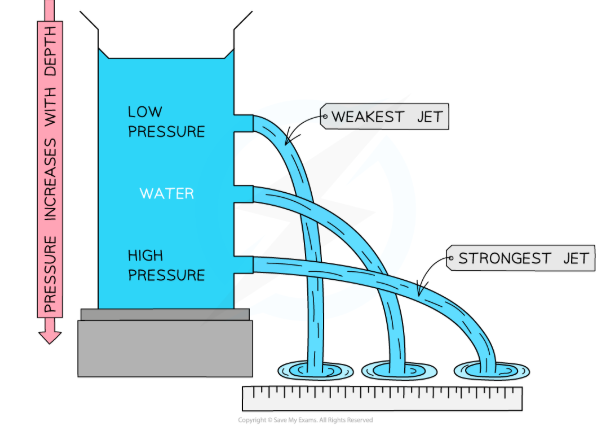
How can we show pressure of liquid increasing with depth
In a column of water, the highest pressure would be at the bottom
(equally sized holes)
If a hole is made at the bottom of the column, the water will pour out with a large force
If a hole was made at the top of the column, the water will pour out with a small force
This is because of the difference in pressure in the column caused by the weight of the wate
Upthrust
when an object is submerged in a fluid (partially/completley) the pressure of fluid exerts a force on it from every direction
A partially (or totally) submerged object experiences a greater pressure on the bottom surface than on the top surface.
This creates a resultant force upwards. - equal to the weight of fluid that has been displaced by object
This force is called the upthrust.
Factors that influence floating and sinking
Upthrust of object is equal to its weight then the forces are balanced and it floats
If objects weight is more than the upthrust then the object sinks
If object is less dense than the fluid it is placed in it weights less then equivalent fluid → displaces a volume of fluid eqaul to its weight before it can be completely submereged to a point → uphtrust is equal to objects weight so it floats
If object is denser than fluid it weight more than equivalent volume of fluid → unable to displace enough fluid equal to its weight → so weight is larger than upthrust and it sinks
Atmosphere
Atmosphere is a thin layer (relative to the size of the Earth) of air round the Earth
The atmosphere gets lets dense with altitude
Atmospheric Pressure
Total force of all the particles constantly colliding with everything in all directions of a surface
Exerting pressure on the object
Why does atmospheric pressure decrease with altitude?
Pulling force from gravitational field of earth becomes weaker and altitude increases
So gas particles spread further apart - atmosphere becomes less dense
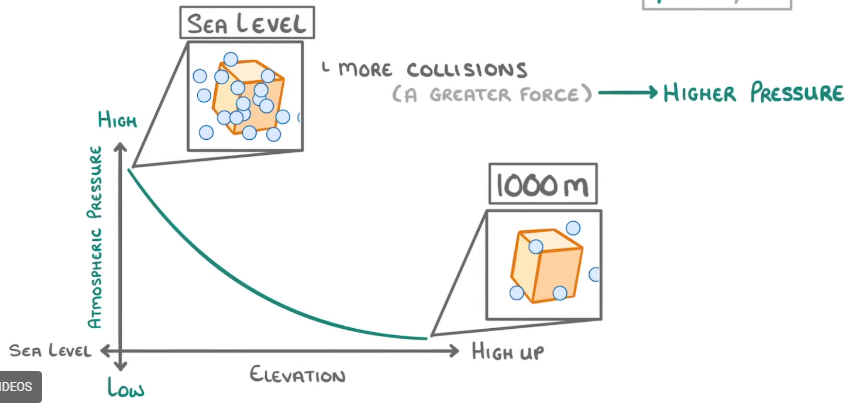
Explain the graph
Density
as altitude increases atmosphere becomes less dense
meaning there are fewer air molecules that are able to collide with the surface
meaning lower atmospheric pressure
Air
increasing altitude means fewer air molecules above a surface
meaning that weight of the air above which contributes to atmospheric pressure decreases
(oxygen tanks while climbing due to lack of o2) density of air is low with height
More collisions → means greater force → higher pressure

