Building Blocks; Macromolecules
 Call Kai
 Learn
Learn Practice Test
 Spaced Repetition
 Match
Match Flashcards
 Knowt Play
1/10

There's no tags or description
Looks like no tags are added yet.
Name | Mastery | Learn | Test | Matching | Spaced | Call with Kai |
|---|
No analytics yet
Send a link to your students to track their progress
11 Terms
Macromolecule
A large, complex molecule created from the linkage of smaller subunits.
Carbohydrates, lipids, proteins, and nucleic acids
Carbon backbones “decorated” with different chemical groups
Polymer
A large molecule consisting of repeating structural units of monomers linked together by covalent bonds.
Monomer / Subunit
The smallest structural unit that acts as a building block for larger molecules.
Polysaccharide
A large, complex carbohydrate molecule created through the linkage of monosaccharides by GLYCOSIDIC bonds.
Membrane Lipids
Protective layer surrounding cells created by phospholipids (and sometimes cholesterol) that bond together.
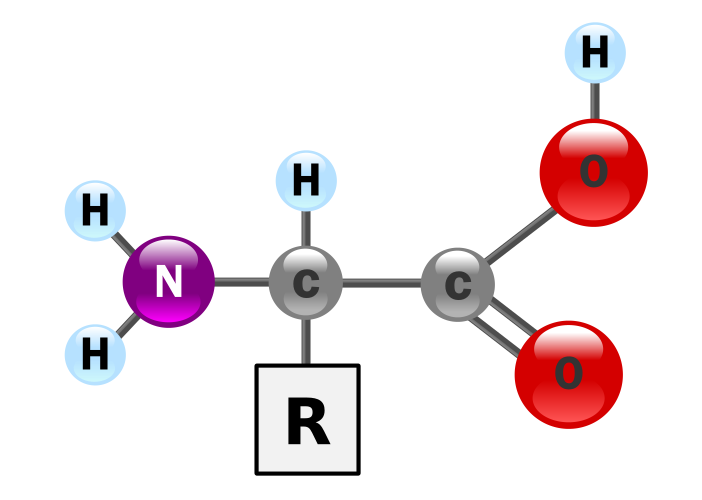
Proteins (C.H.O.N.)
One of the 4 macromolecules
Monomer: amino acid
Polymer: Polypeptide (chains of amino acids)
Linked together through PEPTIDE BONDS
Consist of (1) R group, (2) amino group, (3) carbon, (4) hydrogen, (5) carboxyl group
R group: Gives each amino acid its identity
Flexible, allowing the polypeptide chains to twist
Distinct ends that allow for structural and directional polarity (folding, functions, interactions)
“N”-terminus: Start of protein
“C”-terminus: End of protein (synthesis)
Function: enzyme (catalyst) reactions, building/repairing tissues, regulating hormones, supporting immune function (antibodies)
Carbohydrates (C.H.O)
One of the 4 macromolecules
Monomer: Monosaccharide (simple sugar)
Smallest monomer has 3 carbons
Intermediate Chain: Oligosaccharide (usually refers to ~10 monomers linked)
Polymer: Polysaccharide
linkage of monosaccharides through GLYCOSIDIC BONDING
Condensation (linking molecules through the removal of H2O)
Smallest polymer has 6 carbons (linkage of 2 monomers w/ 3 carbons each)
Chemical Equation Template: (C1H2O1)n, where n can be 3, 4, 5, 6
In aqueous solutions, takes on ring-like structure
Carbon skeletons for many other molecules
A source of stored energy
Can transport chemical energy (meaning molecules can store energy in covalent bonds, that upon breakage, can be transported by cells)
Glucose
In animals, as glycogen
In plants, as starch
Lipids (C.H.O)
One of 4 macromolecules
Make up membranes of the cells (phospholipid bilayers)
Can be stored in the cytosol in droplets (triaclyglycerols) as an energy reserve
Fatty Acid Structure
Hydrophilic (“water-loving”) head
carboxylic
Hydrophobic (“water-fearing”) tail
hydrocarbon
covalently attached to the head
Amphipathic nature of lipids promotes formation of membranes in aqueous solutions
No “traditional polymers” through covalent bonds
Rather, holding them together is accomplished through van der Waal forces
Nucleic Acids (C.H.O.N.P.)
One of 4 macromolecules
Help carry genetic information in the sequence of nucleotides
Monomer: Nucleotide (subunits of DNA & RNA)
Intermediate molecule: Oligonucleotide
Polymer: Nucleic acids
Structure of nucleotides
phosphate group, pentose (5-carbon) sugar, nitrogenous base
location of carbon 1: attached to nitrogenous base
Pyrimidines
Cytosine (C), Thymine (T), and Uracil (U) (found only in RNA)
represented by only one nitrogen-containing ring
Purines
Adenosine (A), Guanine (G)
represented by two connected nitrogen-containing rings
Ribonucleotides
Nucleotides that contain the ribose sugar (meaning carbon 2 has hydroxide group)
Deoxyribonucleotides
Nucleotides that contain the deoxyribose sugar (meaning carbon 2 has a lone H attached to it)
Polymerization of Nucleotides
Phosphodiester bonds
Hydroxide group of one nucleotide joins with phosphate group of another nucleotide
Strands of DNA and RNA have polarity
5’ and 3’ ends
Condensation Reaction
Building up of polymers by expelling a H2O molecules for each bond that is created
Energetically unfavorable (meaning nonspontaneous)
Requires an input of energy
3 macromolecules affected
Proteins, nucleic acids, carbohydrates
Hydrolysis Reaction
Breaking down of polymers by inputs of H2O
Energetically favorable (meaning spontaneous)
Releases energy
3 macromolecules affected
Proteins, nucleic acids, carbohydrates

