#2 Intro to immune function (acquired)
 Call Kai
 Learn
Learn Practice Test
 Spaced Repetition
 Match
Match Flashcards
 Knowt Play
1/57

There's no tags or description
Looks like no tags are added yet.
Name | Mastery | Learn | Test | Matching | Spaced | Call with Kai |
|---|
No analytics yet
Send a link to your students to track their progress
58 Terms
What are the 3 principle mechanisms of the immune system?
Physical barriers are always present
Innate immune responses act very fast
Adaptive (acquired) immune responses take time to develop
Complement (C’)
A group of proteins in blood serum and on cell membranes that act in enzyme cascades to help kill pathogens
involved in both innate and acquired immunity
How does the complement system kill pathogens?
Enhances phagocytosis
Causes lysis of bacterial cell walls
Encourages inflammation
What is the key difference between antigen and antibody?
Antigens stimulate the immune response
Antibodies are produced in response to antigens
Innate immune system
A fast, non-specific defense system that is present at birth
Acquired immune system
A slower, highly specific immune system that develops after exposure to antigens
What role do physical barriers play in immunity?
Passive, non-specific, first line of defense that is always ready
How fast does the acquired immune system respond?
First exposure: ~10–14 days
Subsequent exposures: much faster
Why does the first infection act like a vaccine?
Because it creates immune memory for faster future responses
What does “specificity” mean in acquired immunity?
Immune cells recognize specific antigen structures
Heterogeneity
The presence of >10⁶ different B- and T-cell clones with unique receptors
What is clonal selection theory?
Only lymphocytes whose receptors bind to an antigen are activated and proliferate.
specifically recognize and fight pathogens by selecting and expanding lymphocytes (B/T cells) already possessing receptors for a specific pathogen
Why it matters: Ensures specificity and efficiency
Immune memory
long-lived memory cells that elicit a faster and stronger immune response upon second exposure
What are the two components of acquired immunity?
Cell-mediated immunity (T-cells)
Humoral immunity (B-cells and antibodies)
Cellular immunity
Immune responses carried out by cells that directly attack infected or abnormal cells
Humoral immunity
Immune responses involving antibodies circulating in serum
Antigen Presentation
The process where antigens are broken down and displayed on MHC molecules on cell surfaces to activate T-cells
Which cells are key antigen-presenting cells (APCs)?
Monocytes/macrophages
Dendritic cells
B-cells
MHC
A group of membrane proteins that bind antigens and present them to T-cells
What do monocytes do?
Phagocytize pathogens and present antigens
What turns monocytes into macrophages?
Migration from bloodstream into tissues
What stimulates monocytes/macrophages to phagocytize?
Opsonins (antibodies, complement) and cytokines
What do helper T-cells do?
Recognize presented antigens
Release cytokines
Activate effector immune cells
Where are lymphocytes educated?
T-cells: thymus
B-cells: bone marrow (mammals) or bursa (birds)
Hematopoietic maturation
The process of immune cell education and specialization
What do T-lymphocytes (T-cells) do?
Kill infected cells directly
Release cytokines to influence immune responses
Clonal expansion
Rapid multiplication of antigen-specific T-cells after activation
What do B-lymphocytes do?
Produce antibodies in response to antigens
Plasma cell
An activated B-cell that secretes large quantities of antibodies
Immunoglobulins (Ig)
Serum proteins produced in response to antigens
antibodies
What is the general structure of antibodies?
Y-shaped
Two variable (binding) regions
Hinge region for flexibility
What are the Five Classes of Antibodies?
IgM
IgG
IgA
IgE
IgD
What is IgM?
First antibody produced during infection
Coated with antibodies-> Opsonins
Activates complement
What is the shape of IgM?
Pentamer
What is IgG?
Most abundant antibody
Crosses placenta (Get from mom until build up own supply)
Effective against bacteria in bloodstream
What is the shape of IgG?
Monomer
What is IgA?
a barrier antibody found in mucous membranes
Found in the linings of the intestines, respiratory tracts, & urogenital tracts
Ex:
saliva
tears
milk
colostrum
Transfers IgA to offspring→ helps them survive in the beginning
What is the shape of IgA?
Dimer
What is IgE?
Helps to initiate inflammatory responses
Binds to surface of mast cells and basophils and cause release of histamine
What is the shape of IgE?
monomer
What is IgE responsible for?
Allergic reactions and antiparasitic defense
Triggers histamine release
What is IgD?
Poorly understood
involved in B-cell activation and mucosal immunity
What is the shape of IgD?
monomer
What are the main cell types that participate in the immune response?
B-cell
Dendritic cell
Macrophage
What is the function of dendritic cells?
Activate T- and B-cells in lymph nodes
Capture
(phagocytosis)
Process
(break-down and attach antigen to MHCII molecules on the internal phagosome membranes)
Present antigen on their cell membranes to other leukocytes
(this is an important antigen presenting cell)
Where are dendritic cells found?
Found throughout all tissues typically in low numbers;
highest numbers in skin, mucous membranes (respiratory, urogenital, and gut).
PMN
Polymorphonuclear cells→
Neutrophils
Eosinophils
Basosinophils
What is the main function of neutrophils?
Phagocytosis
Intracellular degranulation
Regulate inflammation
NET formation
neutrophil extracellular traps
What are eosinophils involved in?
Parasite defense and allergic responses
Less efficient at phagocytosis
What is the main function of basophils?
Release histamines and heparin to control allergens
Histamine causes allergic reactions
What are some major differences between innate and acquired immunity?
Innate: fast, non-specific, no memory
Acquired: slow, specific, has memory
What are the 3 different models of disease in populations?
SI
SIR
SIRS
What is the SI model?
Susceptible and infected
Hard to recover from
EX: Rabies – almost all infected mammals die
What is the SIR model?
Animals will recover but will stay infected
ex: many viral diseases in which immunity lasts for ~ the life of the host
What is the SIRS model?
Susceptible → Infected → Resistant → Susceptible again
ex: → many bacterial diseases in which hosts may become immune for a period of time, and before immunity wanes, they become susceptible again
What disease model fits lifelong immunity?
SIR model
What disease model fits temporary immunity?
SIRS model
Which Ig is which?
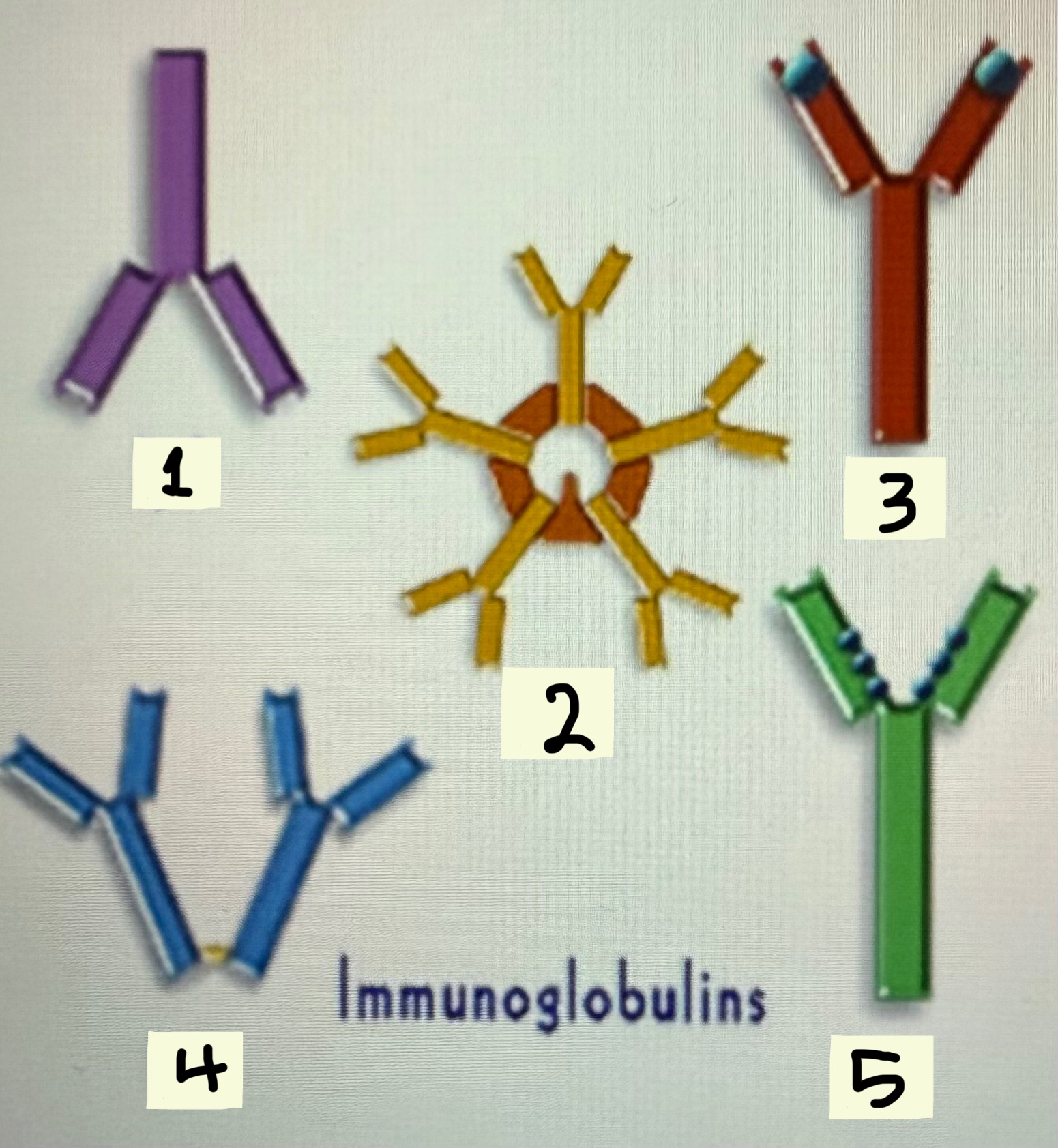
1→ IgG
2→ IgM
3→ IgD
4→ IgA
5→ IgE

