CH 9: Cognitive and Language Development in Early Childhood: Piaget, Vygotsky, and Education Strategies
 Call Kai
 Learn
Learn Practice Test
 Spaced Repetition
 Match
Match Flashcards
 Knowt Play
1/25

There's no tags or description
Looks like no tags are added yet.
Name | Mastery | Learn | Test | Matching | Spaced | Call with Kai |
|---|
No analytics yet
Send a link to your students to track their progress
26 Terms
Preoperational Stage
Piaget's second stage, lasting from 2-7 years of age, when children begin to represent the world with words, images, and drawings.
Operations
In Piaget's theory, reversible mental actions that allow children to do mentally what they formerly did physically (ex: adding/subtracting).
Symbolic Function Substage
Piaget's first substage of preoperational thought, in which the child gains the ability to mentally represent an object that is not present.
Egocentrism
Piaget's concept that describes the inability to distinguish between one's own perspective and someone else's perspective.
Animism
The belief that inanimate objects have lifelike qualities and are capable of action.
Intuitive Thought Substage
Piaget's second substage of preoperational thought, in which children begin to use primitive reasoning and want to know the answers to all sorts of questions.
Centration
Focusing of attention on one characteristic to the exclusion of all others.
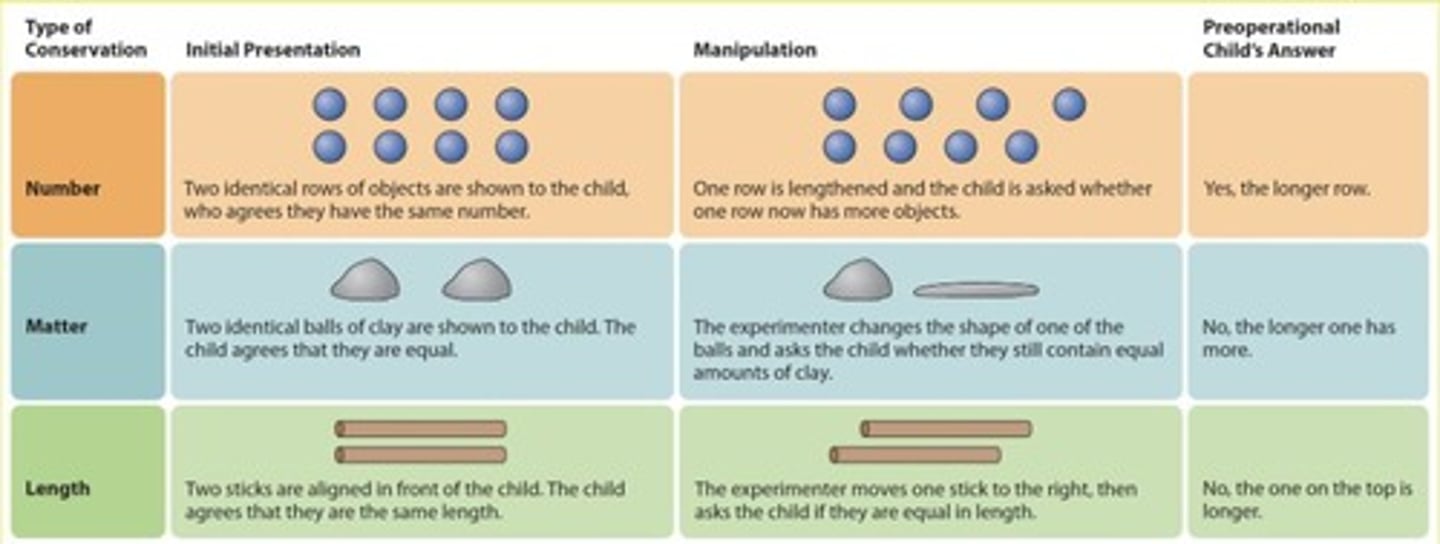
Conservation
The concept that an object's or substance's basic properties stay the same even if its appearance has been altered.
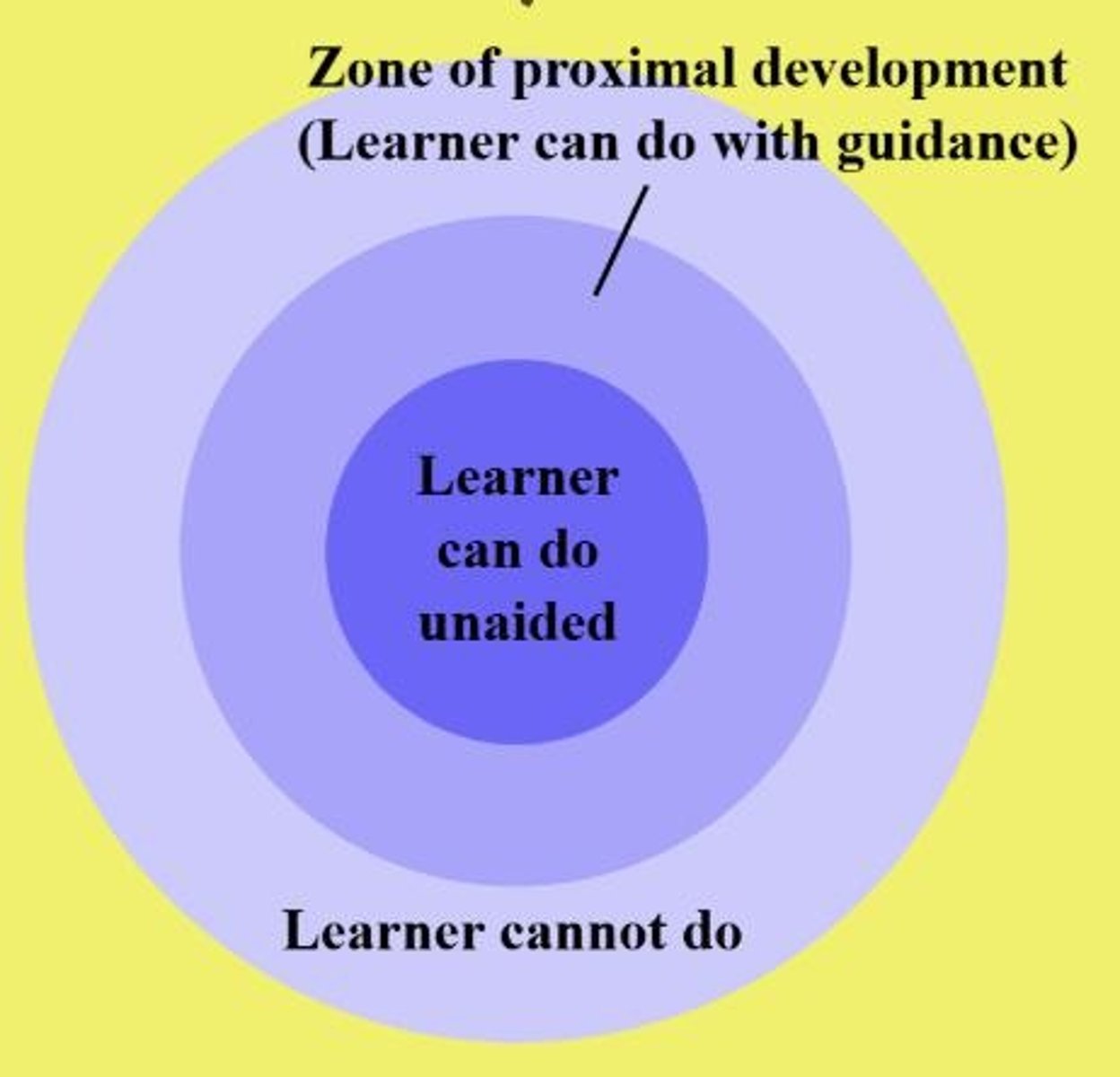
Zone of Proximal Development (ZPD)
Vygotsky's term for the range of tasks that are too difficult for children to achieve alone but can be achieved with the guidance and assistance of adults or more-skilled children.
Scaffolding
Changing level of support provided over the course of a teaching session, with the more-skilled person adjusting guidance to fit the child's current performance level.
Private Speech
Young children sometimes use language to themselves to plan, guide, and monitor their behavior.
Social Constructive Approach
Emphasizes the social contexts of learning and the fact that knowledge is mutually built and constructed.
Executive Attention
Involves planning actions, allocating attention to goals, detecting and compensating for errors, monitoring progress on tasks, and dealing with novel or difficult circumstances.
Sustained Attention
Focused and extended engagement with an object, task, event, or other aspect of the environment.
Short-Term Memory
The memory component in which individuals retain information for up to 30 seconds, assuming there is no rehearsal.
Long-Term Memory
Relatively permanent type of memory that stores huge amounts of information for a long time.
False Memories
Factors that can affect accuracy of a young child's memory, including age, individual differences, and interviewing techniques.
Executive Function
An umbrella-like concept that consists of a number of higher-level cognitive processes linked to the development of the brain's prefrontal cortex.
Theory of Mind
A concept that refers to awareness of one's own mental processes and the mental processes of others.
Phonology
The sound system of a language, including the rules for combining sounds.
Morphology
The study of the structure and form of words in a language.
Fast Mapping
A process that helps to explain how young children learn the connection between a word and its referent so quickly.
Developmentally Appropriate Practice (DAP)
Education that focuses on the typical developmental patterns of children as well as the uniqueness of each child.
Developmentally Inappropriate Practice
Ignores the concrete, hands-on approach to learning, relying instead on abstract paper-and-pencil activities.
Project Head Start
Established in 1965, compensatory education designed to provide children from low-income families the opportunity to acquire skills and experiences important for school success.
Early Head Start
Established in 1995 to serve children from birth to 3 years old.

