Biopsychology
0.0(0)
 Studied by 1 person
 Call Kai
 Learn
Learn Practice Test
 Spaced Repetition
 Match
Match Flashcards
 Knowt Play
Card Sorting
1/116

Earn XP
Description and Tags
Last updated 10:45 PM on 3/21/23
Name | Mastery | Learn | Test | Matching | Spaced | Call with Kai |
|---|
No analytics yet
Send a link to your students to track their progress
117 Terms
1
New cards
What is the human nervous system?
Body wide system of nerve cells that collects information from the world, processing this information and then takes action by direting body organs and muscles via the transmission of electro chemical messages.
2
New cards
What is the nervous system broken down into?
* central nervous system
* Peripheral nervous system
* Peripheral nervous system
3
New cards
What is the role of the central nervous system?
* where complex processing takes place
* the brain- all conscoius and most unconscious processing.
* The spinal cord- recieves and transmits information to and from the brain and body- some reflex processing too.
* the brain- all conscoius and most unconscious processing.
* The spinal cord- recieves and transmits information to and from the brain and body- some reflex processing too.
4
New cards
What is the role of the peripheral nervous system?
* The body wide network of messenger neurons.
* Sensory (afferent) neurons deliver info to CNS
* Motor (efferent) neurons transmit info away from CNS
* Sensory (afferent) neurons deliver info to CNS
* Motor (efferent) neurons transmit info away from CNS
5
New cards
What is the peripheral nervous system broken down into?
* somatic nervous system
* Autonomic nervous system
* Autonomic nervous system
6
New cards
What is the role of the somatic nervous system?
* controls skeletal muscle for movement.
* A Voluntary system - under conscious control
* A Voluntary system - under conscious control
7
New cards
What is the role of the autonomic nervous system?
* controls actions of internal organs and glands
* A involuntary system - not under conscious control.
* A involuntary system - not under conscious control.
8
New cards
What is the auntonomic system broken down into?
* Sympathetic branch
* parasympathetic branch
* parasympathetic branch
9
New cards
What is the role of the sympathetic branch?
* increases bodily activities.
* Releases noradrenaline.
* Activates in stress response (fight or flight)
\
* increase in heart rate, sweat, breathing rate
* Dilates pupils
* Inhibits digestion
* Releases noradrenaline.
* Activates in stress response (fight or flight)
\
* increase in heart rate, sweat, breathing rate
* Dilates pupils
* Inhibits digestion
10
New cards
What is the role of the parasympathetic branch?
* decreases bodiliy activities.
* Release of acetylcholine.
* Activates in rest (rest and diggest)
\
* decrease in heart rate, sweat and breathing rate.
* Constricts pupils
* Stimulates digestion
* Release of acetylcholine.
* Activates in rest (rest and diggest)
\
* decrease in heart rate, sweat and breathing rate.
* Constricts pupils
* Stimulates digestion
11
New cards
What is homeostasis?
Regulation of the internal environement. Balance between sympathetic and parasympathetic systems- maintaining homeostasis.
12
New cards
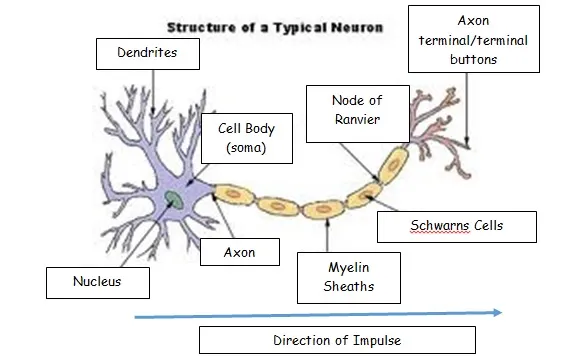
What is the structure of a neuron?
* cell body containg nucleus
* Axon and dentrites- how info is carried throughout body.
* Axon terminals
* Myelin sheath made of schwann cells- helps protect cell and increases speed of transmissionof electrical info along the axon.
* Effector- activated by motor neuron.
* Axon and dentrites- how info is carried throughout body.
* Axon terminals
* Myelin sheath made of schwann cells- helps protect cell and increases speed of transmissionof electrical info along the axon.
* Effector- activated by motor neuron.
13
New cards
Describe the reflex arc process:
* a sensation is detected that the sensory neuron is sending to the receptors. E.g. pain reception.
* Electrical signal rushes along the detrites to the axon and axon terminal.
* Electrical signals convert to chemical signal and crosses synaptic cleft, detected by the relay neuron (spine).
* Reflex immediately passed onto the motor neuron (also to CNS for processing but the brain finds out after the body has moved - avoids tissue damage).
* Signal reaches effector (muscle fibre) causing the limb to move out of danger.
* Electrical signal rushes along the detrites to the axon and axon terminal.
* Electrical signals convert to chemical signal and crosses synaptic cleft, detected by the relay neuron (spine).
* Reflex immediately passed onto the motor neuron (also to CNS for processing but the brain finds out after the body has moved - avoids tissue damage).
* Signal reaches effector (muscle fibre) causing the limb to move out of danger.
14
New cards
What is a synapse?
The point where one neuron (presynaptic) can send a chemical message to the adjacent neuon (post synaptic).
15
New cards
\
What is a neurotransmitter?
What is a neurotransmitter?
Chemical messenger that is released by neurons. Stimulating (or inhibiting) the development of an action potential in other post synaptic neuron.
16
New cards
Describe the synaptic transmission process:
* action potential arrives at axon terminal this causes the vesicles containing neurotransmitters To merge with the membrane of the presynaptic cell, releasing neurtransmitters into the synaptic cleft.
* Neurotransmitters diffuse across synaptic cleft Reaching the post synaptic cell.
* Summation occurs.
* Neurotransmitters attach to recetors- some are broken down others are recylced and move back into the presynaptic cell (reuptake)- resets cell.
\
* Neurotransmitters diffuse across synaptic cleft Reaching the post synaptic cell.
* Summation occurs.
* Neurotransmitters attach to recetors- some are broken down others are recylced and move back into the presynaptic cell (reuptake)- resets cell.
\
17
New cards
\
What do excitatory neurotransmitters do?
What do excitatory neurotransmitters do?
when detected by receptors they make the electrical charge more positive in the cell (depolarisation)→ makes formation of a new action potential more likely - more likely to fire. Na+ enters postsynaptic cell.
18
New cards
What do inhibitory neurotransmitters do?
* when detected by receptors they hyperpolarise thepostsynaptic neuron making it more negative → pushes further from threshold making the formation of a new action potential less likely. K+ leaves post synaptic cell.
19
New cards
Summation
effects of both together (summed) if threshold reached then new action potenital forms and travels to the next axon to detect the presence of neurotransmitters.
20
New cards
What are SSRI’s?
* selective serotonin reutake inhibitors
* Block the reabsorption of serotonin into the presynaptic cell, increasing its level in the synape.
* Block the reabsorption of serotonin into the presynaptic cell, increasing its level in the synape.
21
New cards
What is the endochrine system and what is its functions?
* collections of glands around the body that regulates bodily functions, growth and psychological factors.
* Acts by releasing chemical messengers called hormones into the bloodstream.
* Acts by releasing chemical messengers called hormones into the bloodstream.
22
New cards
What is the role of the pituitary gland?
* controls release of hormones from other glands, known as master gland.
* Hormones released: ACTH (released during figh or flight response.
* Hormones released: ACTH (released during figh or flight response.
23
New cards
What is the role of the hypothalamus?
* part of the brain, links nervous system to endocrine system.
* Maintains homeostasis of bodily systems (heart rate).
* Hormones released: CRH (detected by pituitary gland in fight or flight response.
* Maintains homeostasis of bodily systems (heart rate).
* Hormones released: CRH (detected by pituitary gland in fight or flight response.
24
New cards
What is the role of the pineal gland?
* modulates sleep pattern, keeping the body to a day/night circadian rhythm.
* Horomone released: Melatonin.
* Horomone released: Melatonin.
25
New cards
What is the role of the Thyroid gland?
* modulates metabolism ( rate of energy use in the body).
* Hormone released: thyroxine
* Hormone released: thyroxine
26
New cards
What is the role of the thymus gland?
* stimulates the development of T cells that work in the immune system helping with disease resistance, active until puberty.
* Horone released: Thymosin
* Horone released: Thymosin
27
New cards
What is the role of the pancreas (gland)
* regulates blood sugar levels
* Hormone: Insulin and Glucagon.
* Hormone: Insulin and Glucagon.
28
New cards
What is the role of the adrenal gland?
* regulates biological effects of the fight or flight response. Increases heart rate, blood supply to muscles and sweating.
* Hormone relased: Adrenaline and Cortisol.
* Hormone relased: Adrenaline and Cortisol.
29
New cards
What is the role of ovaries and testicles?
* reproductive glands. Develops secondary sexual characteristics in both males and females, appearing at puberty.
* Hormone released: oestrogen and testosterone.
* Hormone released: oestrogen and testosterone.
30
New cards
Why do we have a fight or flight response?
* evolutionary survival mechanism in response to threat.
* Primes the body and mind for extreme action, fighting or escaping threat.
* Primes the body and mind for extreme action, fighting or escaping threat.
31
New cards
What is acute stress?
* common form of stress in response to immediate pressure, can be exciting in small amounts and give you focus and energy.
* Exhausing if maintained.
* Exhausing if maintained.
32
New cards
What is chronic stress?
* long term stress in response to prolonged emotional pressure- often occurs in situations that the individual feels unable to control. E.g. exam stress.
33
New cards
Describe the fight or flight response:
* recognise threat.
* You enter stress response and your hypothalmus activates the sympathetic brain of the autonomic nervous system and triggers the endocrine system via the pituitary gland.
* The adrenal gland is important in both.
* In the endocrine system, the hypothalamus pituitary adrenal axis (HPA) activates.
* The hypothalamus stimulates the pituitary gland to release ACTH → secretion of stress hormone: cortisol from adrenal cortex.
* In the autonomic nervous system a specialised connection from the brain to the adrenal gland (SAM) is triggered causing adrenaline and noradrenaline to be released from the adrenal medulla.
* You enter stress response and your hypothalmus activates the sympathetic brain of the autonomic nervous system and triggers the endocrine system via the pituitary gland.
* The adrenal gland is important in both.
* In the endocrine system, the hypothalamus pituitary adrenal axis (HPA) activates.
* The hypothalamus stimulates the pituitary gland to release ACTH → secretion of stress hormone: cortisol from adrenal cortex.
* In the autonomic nervous system a specialised connection from the brain to the adrenal gland (SAM) is triggered causing adrenaline and noradrenaline to be released from the adrenal medulla.
34
New cards
What is the role of adrenaline and noradrenaline?
* increases blood flow to the brain an skeletal muscles for quick thinking reactions.
* Decreases blood flow to systems that are not time critical- skin, digestive and immune systems.
* Dialated pupils for imropoved vision and faster breathing rate for increased oxygen in the blood (used in muscles to run). Increased sweat to remove heat.
* Increased anxiety, attention and increased alertness.
* Decreases blood flow to systems that are not time critical- skin, digestive and immune systems.
* Dialated pupils for imropoved vision and faster breathing rate for increased oxygen in the blood (used in muscles to run). Increased sweat to remove heat.
* Increased anxiety, attention and increased alertness.
35
New cards
What is stress related illness?
* Contant triggering of fight or flight response has long term effects on physical and mental health.
* Increased risk of heart disease, obesity and IBS.
* anxiety and depression.
* Increased risk of heart disease, obesity and IBS.
* anxiety and depression.
36
New cards
What is meant by localisation of function?
functions such as movemoent, speech and memory are performed in distinct regions of the brain localised.
37
New cards
What brain regions are in both hemispheres?
Motor, somatosensory, visual and auditory corticles.
38
New cards
What brain regions are hemispherically latralised to the left hemisphere?
Brocas and Wernicke’s area
39
New cards
What is meant by hemispheric laternalisation?
* Each hemisphere of the brain is specialised to perform different functions.
* Language centers are in the left hemisphere, visuospatial tasks are best performed by the right.
* Language centers are in the left hemisphere, visuospatial tasks are best performed by the right.
40
New cards
What is meant by the term: contralateral?
Each hemisphere of the brain controls the opposite side of the body.
41
New cards
What is the cortex?
* Surface layer of the brain - grey matter
* 2-4mm thick and folded for extra surface area for processing.
* 2-4mm thick and folded for extra surface area for processing.
42
New cards
What is white matter?
Mostly myelinated axons.
43
New cards
Wha is the role of the visual cortex (occipital lobe)?
* Brains visual processing centre, each hemispheres occipital lobe recieves information from the contralateral visual field.
44
New cards
What happens if the visual cortex (occipital lobe) is damaged?
* leads to partial or complete loss of vision called cortica blindness. Damage to one cortex can lead to vission loss in the opposite visual field.
45
New cards
Where is the motor cortex located?
Back of the frontal lobe
46
New cards
Where is the somatosensory cortex found?
Front of the parietal
47
New cards
Since the motor cortex and somatosensory cortex are next to one another, how are they divided?
Fold called the central sulcus separates them.
48
New cards
What is the role of the motor cortex?
Area of the brain responsible for volunary motor movements (deciding to move your arm) contralateral.
49
New cards
What happens if the motor cortex is damaged?
Loss of muscle movement function/ even paralysis - contralateral.
50
New cards
What is the role of the somatosensory cortex?
Responsible for recieving sense impressions from around the body - contrallateral.
51
New cards
What happens if you damage the somatosensory cortex?
Loss of sensation, neglect syndrome, loss of ability to recogise objects by their feel (agnosia)- contralateral.
52
New cards
Where is the auditory cortex located?
Located in both heispheres at the top of the termporal lobe.
53
New cards
What is the role of the auditory cortex?
Recieves and processes sound information from ears.
54
New cards
What happens if your auditory cortex is damaged?
Can lead to cortical deafness.- unable to ear despite no damage to the actual ear itself.
55
New cards
Where is Broca’s area located and what is its role?
* left frontal lobe
* Responsible for speech production
* Responsible for speech production
56
New cards
How was Brocas area disovered?
Case study and post mortem exam of Tan, who could only produce the word Tan despite clearly understanding the questions he was asked. - showed extensive damage to bottom of left frontal lobe- broca’s area.
57
New cards
What happens if you damage your Broca’s area?
Broca’s aphesia (motor aphesia) , difficulty producing fluent speech, speech=slow/ missing words→ poor grammar.
58
New cards
Where is Wernicke’s area located and what is its role?
* top temporal lobe
* Speach comprehension
* Speach comprehension
59
New cards
How was Wernicke’s area discovered?
Carl Wernicke discovered this area from case studies of individuals who could produce fluent sounding speech that made little sense.
60
New cards
WHat happens if you damage your Wernicke’s area?
Wernicke’s aphasia (sensory aphasia). Difficulty understanding speech/ written language- speech sounds fluent but lacks meaning.
61
New cards
What is global aspasia?
Damage to both Broca’s and Wernicke’s area - inability to produce or understand language.
62
New cards
What is the strength of having case studies to support localisation of function?
Clincal case studies such as Clive wearing demostrate loss of certain functions if damage is caused to particular areas of the brain. This suggests functions are localised to certain areas.
63
New cards
What is a weakness of using case studies to explain localisation of function?
Case studies = ideographic unique experiences with brain damage that cannot always be generalised to us.
64
New cards
What is a strength of using brain scanning techniques to explain localisation of function?
FMRI support older research on languge centres, showing activation in the regions associated when healthy pts perform language tasks.
65
New cards
Why is localising function not always good?
* Cerain functions e.g. language are distributed around more that just one area of the brain - not a specific same point in every person, some functions e.g. consciousness appear not to be localised at all.
* Suggests corrct approach in arguining for localised or holisitc nature of the brain is dependent on the function.
* Also due to high connectivity of the brain no one area is independant.
* Suggests corrct approach in arguining for localised or holisitc nature of the brain is dependent on the function.
* Also due to high connectivity of the brain no one area is independant.
66
New cards
Describe the Lashley (1925) study which goes against. localisation of function in the brain:
* 50 rats ran a maze before and after areas of their brain cortex were destroyed.
* Lashley found ability to successfully re-run the maze was affected by how much brain cortex was destroyed, not which areas.
* Lashley found ability to successfully re-run the maze was affected by how much brain cortex was destroyed, not which areas.
67
New cards
What do the results of Lashley’s 1925 study suggest?
* suggests higher cognitive rocesses such as learning and memory are not localised but distributed across the brian.
* More brain destroyed → worse functioning becomes.
* Evidience of euipotentiality of the cortex- any healthy area of the cortex can perform the memory function of the damaged area.
* More brain destroyed → worse functioning becomes.
* Evidience of euipotentiality of the cortex- any healthy area of the cortex can perform the memory function of the damaged area.
68
New cards
What is meant by plasticity?
THe brain adapts in both its function and structure as a result of a change in the environment- due to damage/ to meet the cognitive demands of learining new skills.
69
New cards
\
Reasons for plasticity?
Reasons for plasticity?
* leearning new skills
* Result of deveopment changes
* Response to direct trauma to area of the brain
* Response to indirect effects of damage such as brain swelling/ bleeding (from stroke)
* Result of deveopment changes
* Response to direct trauma to area of the brain
* Response to indirect effects of damage such as brain swelling/ bleeding (from stroke)
70
New cards
What is functional recover?
The functions that were perfomred by areas of the brain that are lost (nuronal cell death) or damaged are performed by undamaged aread of the brain - functional reorganisation.
71
New cards
What is synaptic pruning?
Synapses that are used frequently become stronger overtime however unused synaptic connections are lost. This makes the brain a more efficient communication system over time.
72
New cards
What is meant by axonal sprouting?
Existing neurons growing new axons to connect to adjacent neurons. Neural regeneration is the growth of new neural cells.
73
New cards
What is denervation supersensitivity?
To compensate for the loss of axons in a pathway the remaining axons become more sensitve (more likely to fire) this can result in side effects such as pain.
74
New cards
Factors affecting functional recovery?
* age - children are able to recover best.
* Gender - women are more able to recover from brain damage.
* Rehabilitative therapy - focused efforts result in improvement. - expensive.
* Gender - women are more able to recover from brain damage.
* Rehabilitative therapy - focused efforts result in improvement. - expensive.
75
New cards
Describe the Maguire et al 2000 study:
* london taxi drivers complete knowledge test, remembring all key landmarks and street names.
* Matched pair design conducted.
* Structual MRI brain scans (objective scientific measurements providing emprical evidence) of 16 male taxi drivers were compared to the brain scans of 16 matched (age and geder) non- taxi driver controls.
* Matched pair design conducted.
* Structual MRI brain scans (objective scientific measurements providing emprical evidence) of 16 male taxi drivers were compared to the brain scans of 16 matched (age and geder) non- taxi driver controls.
76
New cards
What were the findings of Maguire et al 2000 study?
* Posterior hippocampus in london taxi driverswere found to be significantly largere than the controls.
* Positive correlation (no evidence of causation) between amount of years working as a taxi driver and size of posterior hippocampus.
* Suggests that the physical structure of the brain is plastic,able to reconfigure itself to better adapt to psychological demands - here to improve memory fomation.
* Positive correlation (no evidence of causation) between amount of years working as a taxi driver and size of posterior hippocampus.
* Suggests that the physical structure of the brain is plastic,able to reconfigure itself to better adapt to psychological demands - here to improve memory fomation.
77
New cards
Describe the Danelli et al 2013 study:
* shows how resiliant a brain can be to extreme brain damage.
* Infant EB, had a massive tumour on his left hemiphere.
* At 2.5 yeards old he had a hemispherectomy to remove the tumour. This removed the language centres of Broca’s and Wernicke’s area.
* Immediately after surgery EB lost all language abilities (aphesia).
* After two years of recovery EB had recovered his language ability. He developed normally.
* FMRI of EB’s brain showed “left-like blueprint” for language. - functional reorganisation.
* Infant EB, had a massive tumour on his left hemiphere.
* At 2.5 yeards old he had a hemispherectomy to remove the tumour. This removed the language centres of Broca’s and Wernicke’s area.
* Immediately after surgery EB lost all language abilities (aphesia).
* After two years of recovery EB had recovered his language ability. He developed normally.
* FMRI of EB’s brain showed “left-like blueprint” for language. - functional reorganisation.
78
New cards
Evaluations of brain plasticity and functional recovery:
S:
* practical applications- rehabilitative therapy has helped people to retrn to theor live and productive work → also benefits wider economy.
* Has helped us to uderstand the brain better- now we know about the functions of regions of the brain that were initially damaged.
W:
* individual differences- Mathias (2015) metanalysis demosrated IQ and educational background are positively correlated with better outcomes after traumatic brain injury, suggesting some people have a greater cognitive reserve, helping in recovery.
* practical applications- rehabilitative therapy has helped people to retrn to theor live and productive work → also benefits wider economy.
* Has helped us to uderstand the brain better- now we know about the functions of regions of the brain that were initially damaged.
W:
* individual differences- Mathias (2015) metanalysis demosrated IQ and educational background are positively correlated with better outcomes after traumatic brain injury, suggesting some people have a greater cognitive reserve, helping in recovery.
79
New cards
What is the corpus callosum?
Thick bundle of 200-300 million nerve fibres (white matter) connecting the left and right hemispheres.
80
New cards
Describe Sperry’s 1968 split brain studies:
* Research study on 11 patients who had thr corpus callosum cut (corpus callosotomy) to treat epilepsy.
* Means that communication between hemispheres doesn’t occur.
* Pts cover one eye and were asked to look at a dot, sperry would then flash words/ images independantly to right and left visual fields.
* If the word “key” was shown to right visual field and “saw” to the left, patient could say “key as info was in left hemisphere - language centre (organised contralaterally). Can’t say “saw” however can draw a saw with left hand (controlled by right hemisphere).
* Means that communication between hemispheres doesn’t occur.
* Pts cover one eye and were asked to look at a dot, sperry would then flash words/ images independantly to right and left visual fields.
* If the word “key” was shown to right visual field and “saw” to the left, patient could say “key as info was in left hemisphere - language centre (organised contralaterally). Can’t say “saw” however can draw a saw with left hand (controlled by right hemisphere).
81
New cards
Discuss the findings of the split Brain research variation conducted by Gazzaniga (1983) - facial recognition.
* showed different faces to different visual fields, when shown faces again, the face shown to right hemisphere were recognised ( right hemispere is better at recognising faces).
82
New cards
What is meant by “split brains”?
* cutting corpus callosum for epilespy, isolating each hemisphere from the other.
* The corpus callosum reduces epilepsy symptoms with only few side effects.
* Unusual behaviour and a sense of a loss of agency (feeling of ccontrol) led to research.
* The corpus callosum reduces epilepsy symptoms with only few side effects.
* Unusual behaviour and a sense of a loss of agency (feeling of ccontrol) led to research.
83
New cards
Evaluations of split brain research:
W:
* sample is small- results ungeneralisable to wider population.
* Tasks lack mundane realism -not normal every day tasks → low external validity. IRL both hemipheres would have accessto info by moving head ( so both visual fields see info).
S:
* research has had fundamental impact on psychological and philosophical understanding of both the unity of consciousness and identity → brain = combo of separate intelligent processes working together.
* sample is small- results ungeneralisable to wider population.
* Tasks lack mundane realism -not normal every day tasks → low external validity. IRL both hemipheres would have accessto info by moving head ( so both visual fields see info).
S:
* research has had fundamental impact on psychological and philosophical understanding of both the unity of consciousness and identity → brain = combo of separate intelligent processes working together.
84
New cards
What is spatial resolution?
The smallest feature that a scanner can detect. Greater spatial resolution allows psychologists to discriminate between different brain regions wth greater accuracy.
85
New cards
What is temporal resolution?
The accuracy of the scanner in relation to time- how quickly scanners can detect changes in brain activity.
86
New cards
Describe what is meant by post mortem examination?
Brains precisely cut after reatment to give a firmer texture. Unusul brains are dissectes such as brain that suffered trauma/ mental illnesses. These brains are compares with neurotypical healthy brains.
87
New cards
What are advantages of post mortem examinations?
High spatial reolution - allows the study of microscopic brain structures down to neuronal level.
88
New cards
What is a weakness of using post mortem examinations?
Not conducted on living brain- unusual behaviour in life and damage found is correlational however may not be the causation.
89
New cards
What are FMRI’s?
Detects blood flow in the brain.more active areas of brain need more blood containing oxygenated hemoglobin with distinct magnetic properties. These active areas can be compared to low activation areas with a lower blood supply and displayed on a FMRI image.
90
New cards
WHat are the advantages of FMRI scans?
* good spatial resolution
* Can precisely identify active brain regions and patterns of activaion over time while pts complete exprimental conditions.
* Non-invasive and safe techique for experiments compared to options that use radiation e.g. PET scanners.
* Can precisely identify active brain regions and patterns of activaion over time while pts complete exprimental conditions.
* Non-invasive and safe techique for experiments compared to options that use radiation e.g. PET scanners.
91
New cards
What are weaknesses of using FMRI’s?
* Poor temporal resolution as one image is taken every few seconds and delay in blood flow after activity. - many brain processes are too fast to study.
* Expensive.must be perfectly still - limits experiments done as pts can’t move body.
* Expensive.must be perfectly still - limits experiments done as pts can’t move body.
92
New cards
What are EEG’s?
* 22-34 electrodes that are attached to a cap and fitted carefully to the scalp with conductive gel.
* The read out for each electrode is the sum total of activation of the brain cortex under the electrode. This is displayed as a series of lines showing distinct patters called brain waves.
* Amplitude (size of wave) shows wave intensity and frequence (distance between each wave) shows speed of the activation.
* The read out for each electrode is the sum total of activation of the brain cortex under the electrode. This is displayed as a series of lines showing distinct patters called brain waves.
* Amplitude (size of wave) shows wave intensity and frequence (distance between each wave) shows speed of the activation.
93
New cards
WHat are the four waves detected by EEG’s?
Beta, alpha, theta, delta
94
New cards
What are advantages of using EEG’s
* Used in research for epilpsy and sleep.
* Cheap, pts can move
* Very good temporal accuracy- measuring brain activatio with reolution measured in miliseconds.
* Cheap, pts can move
* Very good temporal accuracy- measuring brain activatio with reolution measured in miliseconds.
95
New cards
What are weaknesses of using EEG’s?
Low spatial activity as pattern is sm of a large number of neurons in the cortex under the electrode - cannot detect activity deep within the brain.
96
New cards
What are ERP’s?
* Same equipment as EEG’s, but present a stimuli to pts many times, creating a smooth curve of activation by combining the data in a process called statisitcal averaging- removes backgrund electrical noise unrelated to stimulus.
* The waveform’s peaks and dips show exactly when cognitive porcesses in the brain happen after the stimulus is presented.
* The waveform’s peaks and dips show exactly when cognitive porcesses in the brain happen after the stimulus is presented.
97
New cards
What are advantages of using ERP’s?
* Allows researchers to isolate and study how individual cogntive porcesses take place in the brain, while EEG’s record general brain activity.
* Good temporal resolution with millisecond sampling rate.
* Good temporal resolution with millisecond sampling rate.
98
New cards
What is a weakness of using ERP’s?
Low spatial reolution
99
New cards
What are endogenous pacemakers?
Internal body clocks that keep biological processes to time.
100
New cards
What is an exogenous zeitgeber?
External cues that entrain internal body clocks, meaning altering body clocks to match the environment.
 Note
Note  Flashcards (36)