synapses
 Call Kai
 Learn
Learn Practice Test
 Spaced Repetition
 Match
Match Flashcards
 Knowt Play
1/33

There's no tags or description
Looks like no tags are added yet.
Name | Mastery | Learn | Test | Matching | Spaced | Call with Kai |
|---|
No analytics yet
Send a link to your students to track their progress
34 Terms
how could you isolate NMDARs
use CNQX (blocks AMPARs)
how could you isolate AMPARs
APV (blocks NMDARs)
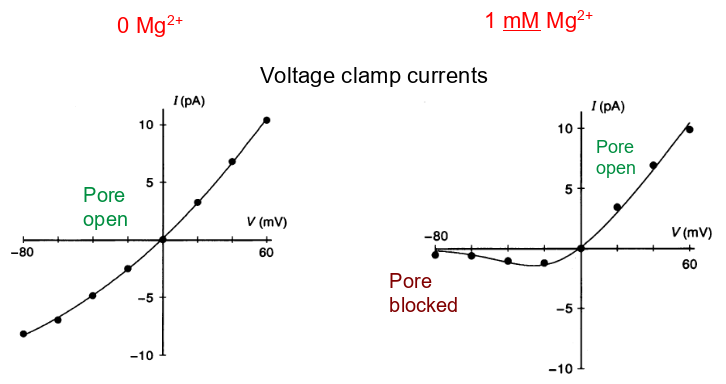
![<p>why is this shifted to the right by higher extracellular [Mg2+] (NMDARs pore blocked by [Mg2+])</p>](https://assets.knowt.com/user-attachments/c225437d-0fa4-4466-9a0e-29c738e61437.png)
why is this shifted to the right by higher extracellular [Mg2+] (NMDARs pore blocked by [Mg2+])
the blocking is faster (#50-100 microseconds) than unblocking
what are the differences between deactivation, inactivation, and de-inactivation?
deactivation- closes if activation condition reversed, fast conformational changes/ un/blocking of hannel pore by an ion
inactivation- closes spontaneously from activated state, longer delay, while activation condition still present (slower than deactivation)(different gates, & several types)
de-inactivation- recovery from inactivation, once activation condition over, slow & ion channel returns to original closed conformational state & capable of being activated again
how do NMDAR I-V graphs differ depending on 0 vs normal extracellular [Mg2+]
in normal Mg lvls, more are driven into channels and block them at -ve voltages, increasingly popped out at +ve voltages (compared to V rest)
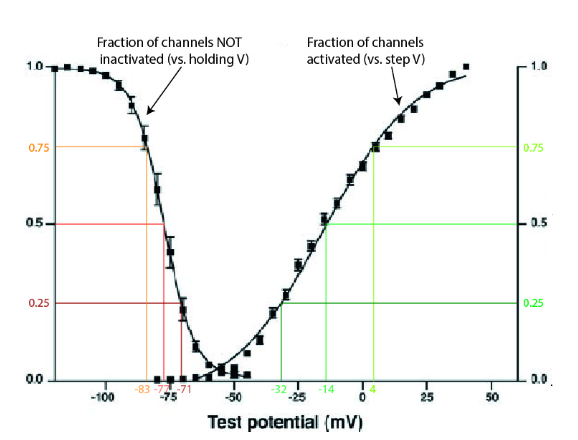
how could you calculate conductance from activation and inactivation curves
conductance= Max. conductance x non-inactivated fraction x activated fraction
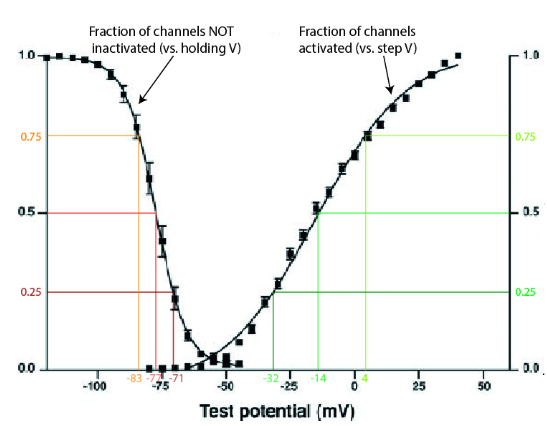
how could you interpret this graph
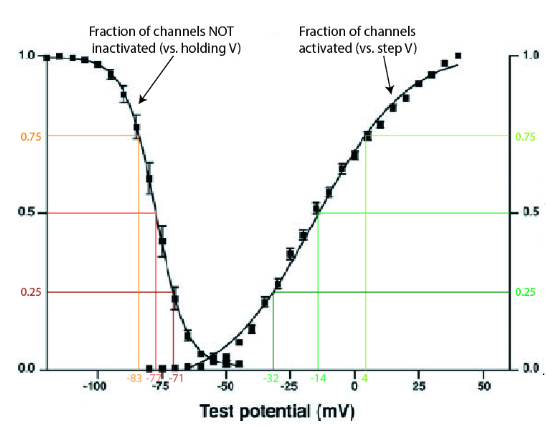
steady-state activation curve on right (open w depolarisation)
steady-state inactivation curve on left (close again more slowly with depolarisation)
what are some effects neuromodulators can have (for hundreds of milliseconds to several minutes)
-alter intrinsic firing activity
-inc/ dec voltage-dependent currents altering synaptic efficacy
-inc bursting activity
-reconfiguring synaptic connectivity
what are some examples of neuromodulators
-dopamine
-serotonin
-nitric oxide
what are some roles dopamine plays in the brain
-largely neuromodulatory
-executive function, motor control, motivation, arousal, reward
-important in ventral tegmental area & substantia nigra (innervate the striatum & frontal cortex respectively)
(there are only a few dopamine producing cells in the brain & they r confined to small areas)
describe dopamine receptors
5 types
all metabotropic, G-protein coupled (exert effects via adenylate cyclase)
2 main types: D1 (excitation) & D2 (inhibition)
what lead to the dopamine hypothesis of schizophrenia (dysfunction of the prefrontal cortex- seen in neuropsychological & neuroimaging studies)
a class of antipsychotics were shown to be antagonists of the D2 receptor
(however its been shown dopamine lvls are not different in schizophrenic pt)
what are the inputs to the prefrontal cortex
-amygdala
-thalamus
-cortical
-hippocampus
-limbic system including VTA
whats the structure of GABAA receptors
pentameric, 2 alpha, 2 beta, 1 gamma
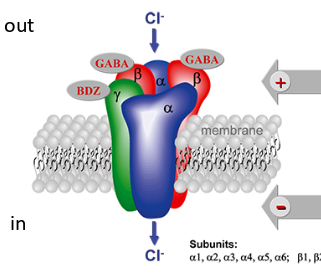
whats the difference between hyperpolarising inhibition, IPSPs, and shunting? (most kinds inhibition are both)
hyperpolarising inhibition - -ve charge injected by Inhibitory post synaptic conductance
shunting- silent/ divisive inhibition- increase in conductance, where + charge from EPSCs can leak through the mb - reduces size of EPSP & Inc speed of decay (reduces mb time constant) (NO effect otherwise)
occurs when Vm close to Ecl (E GABA-A)
what are the differences btwn GABA A and GABA B receptors (IPSPs)
GABA A - ionotropic and faster, Cl- channels ( E rev = Ecl is ~ -75mV)
GABA B- G protein coupled & slower, G protein open K IR channels (inwardlw-rectifying K+) (E rev = E K ~ -90MV)
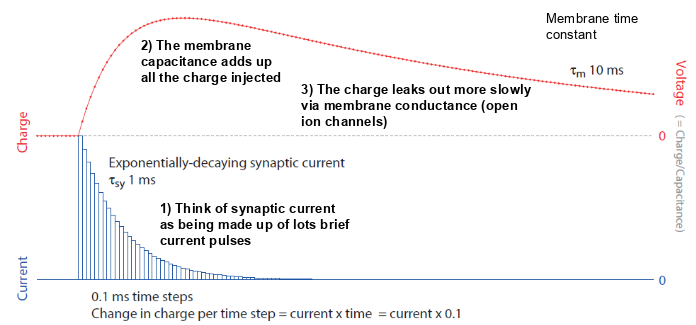
how does synaptic current get turned into a PSP?
-synaptic current made up of lots of brief current pulses
-mb capacitance adds up all the charge injected
-the charge leaks out more slowly via mb conductance (open ion channels)
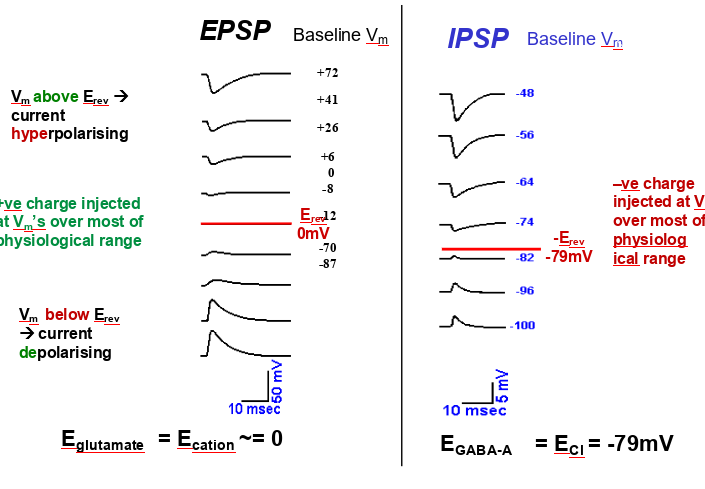
differences btwn charges injected during EPSPs and IPSPs
over most physiological range- +ve charge injected at Vm’s in EPSP, -ve charge inserted at Vm’s in IPSPs
what are some passive (electrically speaking) components of cells?
electrical properties that are constant, don’t change w voltage or intracellular [Ca2+]
-mb capacitance (integrates currents flowing) Cm
-cytoplasmic (axial) conductance (1/resistance) (couples diff parts of cell together, allows different compartments to send electrical signals)
-mb leak conductance (K+, cation, Cl- channels)
what are some active (electrically speaking) components of cells?
mb conductances (ion channels that change w voltage, intacellular [Ca2+] or [Na+])
-Na+, K+, Ca2+ or Cl- channels that open w depolarisation
-K+, cation or Cl- channels which open w hyperpolarisation
-K+, cation or Cl- channels which open when Ca2+ or Na+ rise
what are some passive (electrically speaking) properties of dendrites?
-Cm : specific membrane capacitance (capacitance per unit area): pretty constant
-Rm : specific membrane resistance (resistance of a unit area
-Ri : cytoplasmic (axial) resistivity
-Resting membrane potential or RMP (may vary around cell!)
-Space or length constant ‘lambda’
what are some passive (electrically speaking) properties of cells?
-Input resistance RIN
-Total membrane capacitance
-Time constant ‘tau m’
how do you calculate:
-Input resistance RIN
-Total membrane capacitance
-Time constant ‘tau m’
-Input resistance RIN = ‘total’ resistance of cell ‘seen’ from recording point
-Total membrane capacitance = Cm x surface area
- tm = RmCm
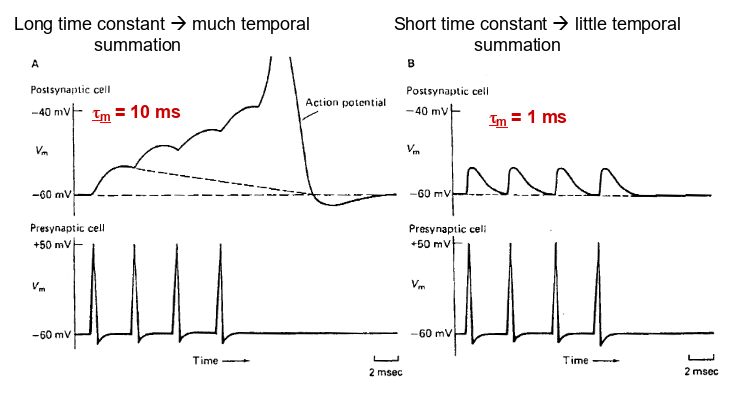
how does the time constant differ between temporal summation and little temporal summation
temporal summation- longer time constant (remember time constant is equal to resistance x capacitance of mb)
what equation can you use to measure exponential decay
V = V0e-t/m

mb potential is ALWAYS given by charged stored/ capacitance, but
How does the charge get onto the membrane?
via ion channel batteries, cytoplasm, extracellular fluid
mb potential is ALWAYS given by charged stored/ capacitance, but
What leads to a steady-state, resting membrane potential?
no change in charge stored
mb potential is ALWAYS given by charged stored/ capacitance, but
Why does it stay constant? (Over short term at least)
zero net current (until a current comes through ofc)
what happens after a brief pulse of current (charge on mb capacitance Inc by total new Q flowing in, so mb potential Inc proportionately (Q/C))
ion channels that are open at V that is around resting mb potential- extra charge leaks out (driven out) until Vm back at V rest
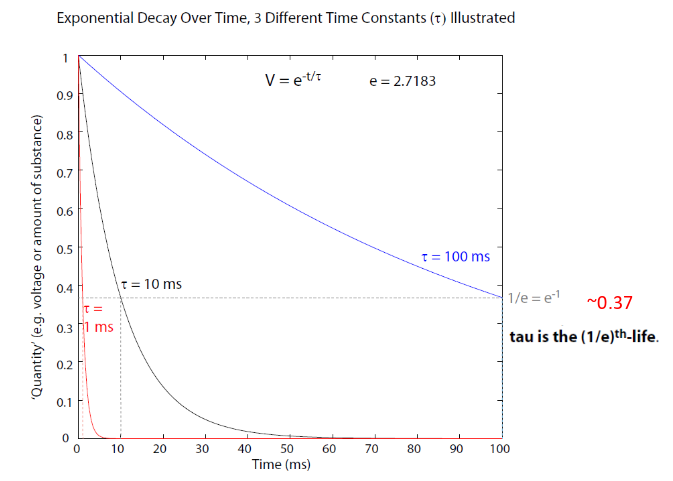
increased time constant means a bigger half life, how are the two related?
tau is the (1/e)th life, using this graph, can calculate using equation V= e ^ -t/ time constant (the pic)

explain the space (length) constant lambda l
a measure of spread of steady state (DC) voltage along an axon/ dendrite
whats the equation to figure out the space (length) constant lambda l
l = √(Rmd/4Ri)
(d diameter
Ri cytoplasmic resistivity
Rm specific membrane resistance)
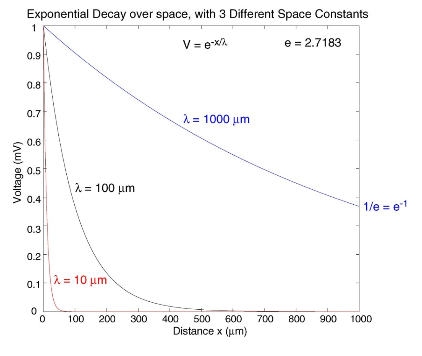
(smaller lambda means steeper curve & decay)
explain this equation: Exponential decay: V=V0e-x/l
-where V0 is voltage at the start position (x=0).
-Over every distance equal to one space constant l, voltage falls to 1/e (~0.37) of value at start position x of that distance, whatever starting position you choose.
-Over distance of 2 l, voltage falls to 1/e2 (~0.14) of value at chosen start position, and so on.
EPSP at soma up to 40 fold smaller than original EPSP in dendrite close to synapse. why?
capacitance of the rest of the dendritic tree- charge spreads out over entire tree
leak ion channels
(C is proportional to area, V= Q/C)

