AP World Midterm
 Call Kai
 Learn
Learn Practice Test
 Spaced Repetition
 Match
Match Flashcards
 Knowt Play
1/66

There's no tags or description
Looks like no tags are added yet.
Name | Mastery | Learn | Test | Matching | Spaced | Call with Kai |
|---|
No analytics yet
Send a link to your students to track their progress
67 Terms
Tang Dynasty
Encouraged agricultural development and foreign trade, improved roads & canals, spread technology. Buddhism became popular, but the bureaucracy tried to fight back. Tang Dynasty began to fall in the 8th century (Vietnamese fought back)
Song Dynasty
Innovation, diversity, wealth, political stability, art. Replaced the Tang in 960, lasted for more than 3 centuries. Meritocracy, civil service exam, prosperity and population growth. First to make g*ns, Champa rice + irrigation, manufacturing, proto-industrialization, paid people to work on public projects, tributary system, urbanization, public hospitals, aid to poor, filial piety
Tang and Song
Affluence in China, educated and intellectual population, exposure to foreign nations (trade), Confucianism, imperial bureaucracy (since Qin Dynasty - continuity) China used compass and paper navigation charts, woodblock printing
Japan
A tributary state of the Song Dynasty. Neo-Confucianism spread to Japan (as well as Korea and Vietnam). Adapted woodblock painting and Chinese traditions in art, politics, and literature (Heian period). Feudal society with no centralized form of government. Daimyo were the aristocrats that fought for land. They were extremely powerful since they were not unified, even though there were shoguns installed to be the emperor.
Timeline of dynasties in China
Shang- 1766-1122 B.C.E.
Zhou- 1027-258 B.C.E.
3. Qin- 221-202 B.C.E.
4. Han- 200 B.C.E.-220 C.E.
5. Sui- 589-618 – C.E.
6. The Tang Dynasty- 618-907
7. The Song Dynasty- 960-1279
What is the Grand Canal?
Public work project started by the Sui Dynasty (581-619)
Continued during the Tang-Song era Key infrastructural development
Vital connection between North and South – Yellow and Yangtze Rivers
Water transportation system that was cheap and effective. It helped China become a thriving trading empire. It extended over 30,000 miles. Hangzhou, a center of commerce, was located at the southern end of the Grand Canal.
What is the Silk Road?
An ancient network of trade routes over land that connected the East and West, Europe to Asia.
Important for Cultural Diffusion
A network of trade routes that spread ideas, technology, and goods throughout Eurasia. Buddhism came to China through the Silk Road, and gunpowder and guns spread from China throughout Eurasia through the Silk Roads.
What effect did foot binding have on women in China during this time?
Enforced the patriarchal society and Confucian traditions.
Women had limited mobility
Footbinding was used by aristocratic families (starting in the Song Dynasty) to show social status and secure potential suitors (who desired foot binding because of its proof of social status). Foot binding wrapped feet very tightly so that bones will not grow naturally. This prevented women from moving and participating in the public sphere
Discuss the tribute system of the Tang and Ming
Imposed tributary systems upon neighboring peoples (Vietnam, Korea).
The tribute included tax payments and valuable resources.
The Tang and Ming collected goods and money from tributary states for the Chinese emperor. The tributary system asserted China’s power over many surrounding countries, but also led to stability and trade for every party involved. Representatives from tributary states were required to show their respect by bowing their heads down to the floor. China sent large fleets to show their power and collect tribute. Tributary states: Japan, Korea, kingdoms throughout southeast Asia.
What group conquered the Song?
The Mongols conquered the Southern Song. Song Dynasty fell in 1279
What is the Tale of Genji?
Novel depicting life in the imperial court at Heian. Made by Lady Murasaki
he world’s first novel, written by a female Japanese writer (Lady Murasaki) in the 11th century (Heian period). It is about the life of a Japanese prince at court, specifically his various romances.
Discuss Japanese Feudalism
Rigid social hierarchy
Remained in place until 1868
Shogun held the true power
Japan did not have a centralized government for hundreds of years. There was little social mobility, and Japanese Feudalism consisted of hereditary hierarchies. The serfs were dependent on the daimyo (especially economically), and samurai were born to be the protectors of the land. Furthermore, daimyo had so much land and power that they were more powerful than an emperor or a shogun.
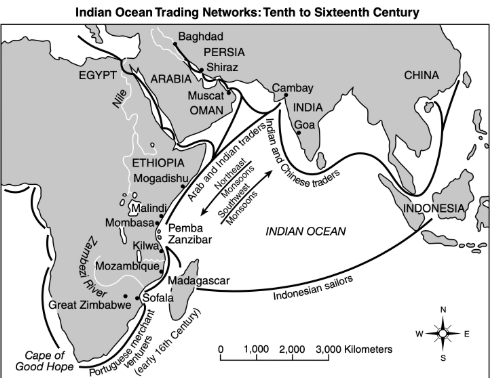
Why did the Chinese abandon the commercial voyages of the Zheng He expeditions? What was the impact of the voyages of Zheng He? What was the Indian Ocean trade network?
After his death the Chinese ended the expeditions.
The result of the voyages led to cultural diffusion and the dominance of China in the Indian Ocean trade network
Trade continued in this area among empires in the network.
The Chinese abandoned the commercial voyages of the Zeng He expeditions because they were controversial. Confucian scholars believed that too much interaction and trade with foreigners would threaten the social order of China. Some even believed that other cultures were barbaric, and many believed that the expeditions were just too expensive. However, the voyages still left a great impact - Zheng He traveled far, exploring areas such as Indonesia, the east coast of Africa, the Cape of Good Hope, the Indian Ocean, Arabia, and Ceylon. He left a lasting impression on these areas, displaying the power of the Ming Dynasty. He also brought back exotic goods. The Indian Ocean trade network was a system of trade that exchanged goods throughout the Indian Ocean. Other empires that were not close to the ocean participated as well (Eurasia, Africa). Fabric, carpets, steel, leather, stonework, pepper, spices, enslaved people, ivory, gold, silks, porcelain, horses, figs, and dates were traded.
What are some major differences between the Aztecs and Inca civilizations?
Aztec – Mesoamerica – warm climate
Aztec – Developed a system of writing
Andean – Large States – Andes mountains, can be cold climate.
Andean (Inca)- Did not develop a system of writing - Quipu
Some major differences between the Aztecs and Inca civilizations is that much of the Aztec’s income came from tributes, while those who were conquered by the Inca were only required to the mit’a system (required public service, including farming and building). The Aztecs were also more focused on human sacrifice than the Incas. Although the Incas did occasionally practice human sacrifice, the Aztecs practiced human sacrifice at a much larger scale. Furthermore, the Incas believed that dead rulers in the afterlife continued to rule the land and property that they ruled when they were living. Because of this, Incan rulers had to gain more property and territory for themselves. The Aztecs did not practice this belief, but they were still dedicated to gaining as much land and power as possible.
Discuss the Aztec economy and the Tribute system
Tribute and taxation were the main sources of income for the empire.
Conquered regions paid tribute to the empire.
The Aztecs created a tribute system in order to secure their dominance and grow more powerful. Those who were conquered were required to pay tribute to the government, give up their lands and property, and participate in the military. In return, the conquered people were protected by the Aztecs. Additionally, the Aztecs sorted the city-states into provinces. The Aztecs ensured that they controlled each province by moving warriors and officials that collected tribute to each province.
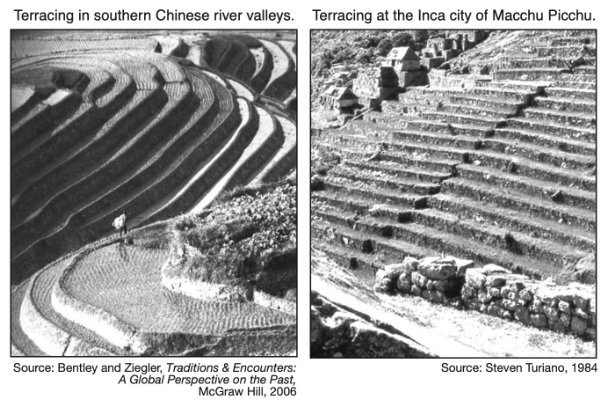
What did the Incas use to increase farmland?
Terrace Farming
Most significant impact on Africa between 800 and 1500?
Contact with the outside world increased and Islam began to spread from North to South.
(North Africa- Sahara and Sub-Saharan Africa)
The most significant impact of Africa between 800 and 1500 was the spread of Islam. Islam was a crucial aspect of the growth and development of many powerful West African empires, such as Mali, Ghana, and Songhai. It also led to important trade connections throughout the Sahara Desert, spreading many goods and ideas.
Why was Islam so readily adopted by rulers within Sudan?
United civil and religious authority-reinforced traditional ideas of kinship.
In East Africa Islam helped with international trade
Islam was so readily adopted by rulers within Sudan because Islam led to unity throughout the Muslim nations, and also formed trade connections. In addition, they believed that having a Muslim ruler would bring stability and authority.
Who was Mansa Musa? Discuss the importance of Timbuktu.
Emperor of Mali – 1312-1337
Centralized a strong central government
Converts to Islam
Forges ties with other Muslim States
Timbuktu the capital of Mali became well known for its Islamic scholarship.
Mansa Musa was the ruler of the West African empire Mali during the 14th century. Mansa Musa was known for being a devout Muslim and going on a grand pilgrimage to Mecca. Mansa Musa was extremely wealthy and traveled with an extravagant caravan, showing off his gold, thousands of slaves and soldiers, and power. Timbuktu was a wealthy and intellectual city in Mali that fostered Islamic learning and academics. Books created in Timbuktu were sold for higher prices than most of the other goods. In addition, Mansa Musa built religious schools in Timbuktu
Discuss the Gold-Salt trade.
Gold traded from the Sudan across the Sahara for salt from North Africa.
Over time, Muslim merchants dominated the trans-Saharan trade.
The Gold-Salt trade was the exchange of gold and salt throughout the Trans-Saharan trade network. Africans traded gold and ivory in exchange for Arab salt, cloth, paper, and horses. Salt from North Africa was traded with gold from African kingdoms south of the Sahara desert. (North to South: salt, South to North: gold)
Discuss the Sufi Islam movement
Muslim mystics who traveled the Indian Ocean area and spread Islam.
The movement incorporated mysticism with a trend toward evangelism.
The Sufi Islam movement is a mystical movement that encourages practicing Islam by finding truths that can’t be found by just studying the Quran. Sufism contributed greatly to the spread of Islam because many Sufi missionaries adapted to local cultures and traditions and connected it to Islamic elements. Furthermore, Sufis participated in missionary work in Southeast Asia and were able to win many converts because of their religious tolerance. ‘A’ishah al-Ba’uniyyah was a famous Sufi poet. Her most popular work was “Clear Inspiration, on Praise of the Trusted One”.
What was important for travel in the Indian Ocean Trade Network?
Monsoon winds
In what ways did the trans-Saharan slave trade differ from that of the Atlantic slave trade?
Trans-Saharan trade was dominated by Muslim traders.
Trans-Saharan focused more on women while the Atlantic slave trade concentrated on men
The Trans-Saharan slave trade differed from the Atlantic slave trade because most of the slaves that were traded in the Trans-Saharan trade network were taken from eastern Africa. Meanwhile, slaves that were taken from west and central Africa were transported to the Americas through the Atlantic slave trade. Furthermore, the Trans-Saharan slave trade focused on female slaves (concubines), while the Atlantic slave trade focused on male slaves.
What was the demographic impact of the slave trade on Africa?
Will lead to a decline in population as well as a decline in the number of men.
The slave trade affected Africa by imbalancing the proportion of women to men. Since mostly men were taken from west and central Africa, many women were left behind, making the majority of the population female.
Who was Ibn Battuta?
Moroccan scholar who explored Afro-Eurasia, largely the land of Dar al-Islam, traveling more than Zheng-He or Marco Polo.
Born – 1304- Died 1368
Ibn Battuta was a Muslim scholar and explorer during the 14th century. He described in his commentaries about the traders and merchants that traveled the Trans-Saharan trade routes with caravans. Ibn Battuta himself traveled a lot, throughout Central Asia, Southeast Asia, South Asia, China, Spain, North Africa, and Mali. He was told to record the various events he experienced on his journeys. He mostly traveled to areas where Islam was the predominant religion. One of the main reasons why he traveled was to learn more about Islam and other Muslims.
What were the middle ages?
Post Classical time period between the fall of the Roman Empire and the Renaissance
he Middle Ages (also known as the medieval period) was the period where the quality of life in Western Europe declined (after the fall of the Roman Empire). There was less trade, intellectualism, and unity. The Roman Empire was replaced with smaller kings. The Catholic Church was the only thing from before the Middle Ages that remained powerful in Europe (but it split into two branches - Orthodox and Catholic) Religion was the most prominent aspect of the Middle Ages (Crusades) The Black Death brought disease and death throughout Europe.
Who were the Vikings?
Scandinavian invaders who disrupted the development of political institutions in the Medieval west until the 10th century.
Raiding and trading
The Vikings were invaders from northern Europe that raided and attacked mostly coastal areas in Europe and even Asia. Their descendents were the Normans. Many people in Europe needed protection from the Vikings, bandits, and rival lords, so many decentralized states were created, exchanging land for loyalty (feudalism).
What was the impact of the Crusades on the Christian West?
Cultural diffusion to the West
Military technology, some language, and scientific learning.
The crusades began due to restrictions from traveling to holy sites imposed on Christians. Trying to claim the Holy Land for themselves, Christian Europeans organized to fight against those who occupied the area. The Crusades lasted from 1095 to the 1200s. Conflict between authority figures in Catholicism fueled the Church to take control of the Holy Land. The Church also used Catholicism to recruit believers by declaring that those who participated in a Crusade will reach Heaven sooner.
Define: Renaissance. Discuss briefly.
Emphasis on Classical Tradition rather than independent innovation
More concerned with things of the Earthly world.
1300’s-1500’s
Humanism – Renaissance- characterized by independent thought and a renewed interest in classical Greek and Roman culture
The Renaissance was a period in Europe that revived intellectual curiosity through Greek and Roman culture, art, literature, and culture. Humanism: focus on individuals rather than God.
What were the causes and effects of the Bubonic Plague?
Fleas from rates infecting Humans
Led to the death of 25 million people
The Bubonic Plague (black death) was so deadly and infectious that it killed about a third of Europe’s population. Because so many people died, agricultural production declined. Serfs gained more power and bargained with lords for higher wages (there were less workers, so labor was valuable). The Bubonic Plague killed half of Constantinople’s population. It killed about 75 to 200 million people in Eurasia.
Who was Niccolo Machiavelli?
Author of The Prince- Handbook for Renaissance rulers.
Italian diplomat and statesman
“The end justifies the means”
“It is better for a ruler to be feared than loved”
Niccolo Machiavelli was an Italian author during the Renaissance. He is known for writing The Prince, a treatise that claims the only way for a ruler to maintain political power is to be feared rather than loved. He also believes that the ideal ruler is one who is willing to act ruthlessly and immorally when necessary.
What were the Khanates?
After the death of (Genghis) Chinggis Khan, the Mongol Empire was divided into 4 Khanates.
The Khanates were territories throughout Eurasia ruled by a Khan (Genghis Khan’s grandsons) after his death. Four Khanates were created: the Golden Horde, Ilkhanate, Chagatai Khanate, and the Yuan Dynasty. Genghis Khan’s grandsons strived to expand their empires, just like Genghis Khan.
What was the religious policy of the Mongols under (Genghis) Chinggis Khan?
Genghis Khan’s religious policies were progressive for the time period. He brought forth policies of religious tolerance throughout the empire, and even brought peace throughout the empire (Pax Mongolica).
What was the status of Mongolian women during the Yuan dynasty of China?
Women remained relatively independent, refused to adopt footbinding and retained rights to own property.
Mongolian women enjoyed more rights and freedoms than other women of that time. Mongolian women raised their children, cooked meals, and tended to flocks of sheep and goats. They also rode horses, so they were able to wear pants. Mongolian women could also divorce and remarry after being widowed.
What was one of the most important effects of the Mongol drive to the west?
Black Death – Demographic impact on European populations
One of the most important effects of the Mongol drive to the west was the spread of the Bubonic Plague to the west. While the Mongolians expanded throughout Europe and Asia, it is speculated that they accidentally brought over the bubonic plague through fleas or rats. The Bubonic Plague is responsible for killing a third of Europe’s population.
What Chinese dynasty succeeded the Mongol Yuan dynasty?
Mongols had conquered the Song in 1279
Ming Dynasty succeeded the Mongol Yuan Dynasty
Mongols: continuity
Not much change in the political and social structures in the places they conquered. They often relied on existing bureaucracies. Daily life was not really altered.
Mongols: change
Expanded and stabilized long distance trade by domination of Asia for nearly two centuries. (Pax Mongolica) The expansion of greater interregional connectivity led to great expansion of social networks. Led to the increase of goods, ideas and disease
What were the Gunpowder Empires?
The Gunpowder Empires were empires that depended on gunpowder and firearms to conquer, expand their territories, and maintain control. The Gunpowder Empires were the Ottoman Empire, the Safavid Empire, and the Mughal Empire (sometimes Russia is considered one too).These empires were typically militaristic.
What is the Taj Mahal? Why was it built?
Built during the reign of Emperor Shah Jahan
Built as a Mausoleum (tomb) for his wife
Showed off the Mughal empire’s wealth and power
Which was the most powerful and long-lasting of the Gunpowder Empires?
The most powerful and long-lasting of the Gunpowder Empires was the Ottoman Empire. It lasted from the 1300s until 1918, and was a very powerful empire that conquered lands through military technology (firearms, gunpowder) and their navy.
What are characteristics of absolute monarchy?
Centralized power and authority
Constant warfare among monarchs.
Examples : Louis XIV, Peter the Great
Monarchs have total, complete power and authority over their empire. They do not share power with anyone else, and only they are in charge of lawmaking and justice systems.
Louis XIV – Palace of Versailles
Louis XIV, the Sun King, was the absolute monarch of France from 1643-1715. He had complete control over France and forced nobles to live in his palace at Versailles. He did this to prevent the nobles from scheming and acting independently.
Martin Luther - The Protestant Reformation
Initiated the Protestant Reformation
Cited the corruption of the Catholic Church from the sale of indulgences.
Martin Luther was a monk from Wittenberg who opposed various Catholic practices and teachings, which he said went against the bible. He was against the sale of indulgences and simony. He nailed his charges, the 95 Theses, to a door of a church. Although the Catholic Church fought back, his ideas still spread throughout Europe.
Elizabeth I - English Reformation
Elizabethan Settlement – ends the religious conflicts between Catholics and Protestants.
Golden Age of England
England defeated the Spanish Armada
William Shakespeare wrote plays
Sir Francis Drake circumnavigated the globe.
Elizabeth I brought peace to England after religious conflicts from Henry VIII, Edward VI, and Mary I’s reign, which were caused by the English Reformation. The English Reformation began when King Henry VIII broke away from the Catholic Church and began the Church of England. She also freed the remaining serfs in England.
Discuss how Russia was influenced by the Byzantines
Influenced Russian religion – Eastern Orthodox
Influenced language (Cyrillic Alphabet), culture.
Russia was influenced by the Byzantines because they were inspired by Christianity and its influence in the Byzantine Empire. Russia adopted Orthodox Christianity, church architecture, the Cyrillic alphabet, and iconography. Russia was also inspired by the connection between the Church and state in the Byzantine Empire.
Peter the Great
Westernization limited to upper class at the expense of the peasants and serfs.
Modernized the Russian Navy
Journeyed into Western Europe to learn more about Western culture and technology
Peter the Great gained control over Russia in 1613, but faced many difficulties. He had to compete against his half-sister Sophia and the Streltsy, but he managed to succeed and consolidated power. The Streltsy continued to fight back, but he disbanded the group. He defended Orthodox Christianity, yet he desired to westernize Russia after being inspired by western powers. He made many Russians dress and look more western as much as possible - he imposed a beard tax on those who kept their beards. He also opened schools, started the first newspaper in Russia, and reformed the calendar.
St. Petersburg
St. Petersburg, founded by Peter the Great, was the capital of Russia for 200 years. Peter the Great made St. Petersburg so that Russia could have a warm-water port on the Baltic Sea. He also made it the capital so that he could keep an eye on the boyars. The architecture there was built in a European style (The Winter Palace).
Expansion of Russia during the Catherine the Great
After defeat of the Ottoman Turks, acquired a warm water port on the Black Sea.
Catherine the Great was an enlightened despot who sought to expand the Russian Empire. She gained control of Alaska and also seized Poland to gain access to a warm water port on the Black Sea.
Discuss the early dominance of Spain, Portugal, Age of Exploration use of Caravel Ships, compass:
Spanish had mostly American colonies. Portuguese was more widespread with colonies in Asia, Africa, and Brazil
Caravel Ships- Small very maneuverable ships developed by the Portuguese.
Use of Astrolabe, Compass for navigation (diffusion from Islamic and Asian empires)
Maritime Trade
Spain and Portugal began to explore due to a lack of access to Asian imports. They aimed to find new trade routes to reach Asia better, but Spain and Portugal also explored other areas and expanded their empire. Spain explored and colonized the Americas, gaining new resources through the Columbian exchange (such as silver and new foods and crops). Meanwhile, Portugal colonized Brazil and also controlled areas in Oman, areas in Africa (Angola, Mozambique, Cape Verde, etc.) and areas in Asia (Goa, Macau, East Timor). The caravels were small ships with three masts that were created by the Portuguese. Sailors were able to survive storms at sea better with the caravels. The magnetic compass was also used for navigation. It helped steer ships in the right direction.
Spanish Reconquista
711-1492
Expansion of Christian Kingdoms and the defeat of Granada
1492 – Defeat of Muslims by Ferdinand and Isabella.
The Spanish Reconquista was a series of campaigns by Christians to take back territory from the Moors (who were Muslim). They specifically fought for the Iberian Peninsula, which was ruled by Christians before it was conquered. The Spanish Reconquista ended in 1492 when the Catholic Monarchs of Spain captured Granada. The new Catholic Monarchs removed any presence of Islam that remained in the Iberian Peninsula.
Define: Mercantilism
An economic system that colonies exist for the benefit of a Mother Country (Empire).
Colonies serve as a source of raw materials and markets.
Example: 13 American colonies of Britain
Spanish colonies in the New World.
Portuguese colonies
Mercantilism is a theory that the wealth of a country is determined by how much gold and silver it has. Countries that followed mercantilism aimed to sell as many goods as possible to maximize the amount of gold and silver brought into the country, and buy as few as possible from other countries.
What was the Treaty of Tordesillas?
Divided the world into spheres of influence between Portugal and Spain.
The Treaty of Tordesillas was an agreement between Spain and Portugal that separated their territories with an imaginary north to south line. Spain was given the territories in the west, while Portugal was given the territories in the east. Spain kept control over the majority of the Americas, while Portugal settled with Brazil and its territories in Africa and Asia.
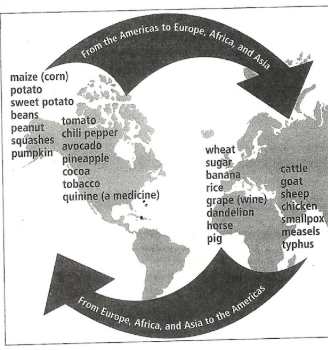
Impact of introduction of American crops in Europe? Discuss the Columbian Exchange; effects
American crops were introduced to Europe through the Columbian Exchange and left a lasting impact on European cuisine. Europeans explorers brought maize, potatoes, tomatoes, beans, peppers, and corn back to Europe, which quickly gained popularity. Potatoes were extremely popular in Europe, and many think that potatoes are native to Ireland. The arrival of these crops stimulated tremendous population growth in Europe during the 16th and 17th centuries. New foods such as meats were introduced to the Americas, along with horses. However, thousands of Americans died due to disease brought by the Europeans.
Continuities of slave trade
Slavery has existed for centuries - small-scale or household based forms of slavery.
Enslaved labor is used for economic gain.
Changes in slave trade
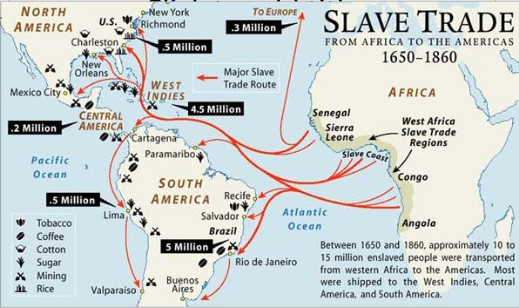
Slavery is much more extensive. It becomes a global system after the conquering of the Americas. European demand for plantation crops lead to the forced migration of millions of Africans through the the transatlantic slave trade. Chattel Slavery - Slaves are Property
Who were the conquistadors? Discuss briefly the overthrow of the Aztec Civilization.
Hernando Cortes - Spain
Led the conquering of the Aztec Civilization. 1519-1521
Tribute Empires = Collaborators with the Spanish led the conquering of the Aztec Civilization. 1519-1521
The conquistadors were Spanish soldiers that colonized the Americas and brought smallpox along with them. While in México, Hernán Cortés worked with conquered groups of the Aztecs to overthrow the Aztec Empire. They successfully overthrew the Aztecs in 1521 and created the colony of New Spain. Following their win, the Spanish sent back gold to Europe by melting Aztec treasures.
Who was Bartolomé de la Casas?
Conquistador turned priest who became a strong supporter of Indian rights
Advocate of conversion to Christianity
Bartolomé de la Casas was a Spanish historian, reformer, and Dominican Friar. He wrote accounts of how the Spaniards treated the indigenous population of America, trying to raise awareness of the mistreatment the indigenous suffered. He also contributed to the passing of the New Laws in 1542, which banned enslaving the indigenous people and attempted to ban the encomienda system.
What factors led to the rise of capitalism?
Increased trade, the start of joint-stock companies (John Locke)
Adam Smith: Wealth of Nations- Laissez-Faire
Factors such as mercantilism led to the rise of capitalism. Mercantilism enabled European powers to gain massive amounts of wealth through expansion of trade, so many European monarchs made sure to develop mercantilist economic policies that would supply them with a steady source of income. Mercantilism eventually led to capitalism, and investors created joint-stock companies so that they could share the outcomes of global trading opportunities.
What were three causes of the French Revolution? What were two effects of the French Revolution? When did the French Revolution begin (with what event)? What role did King Louis XVI and Robespierre have in the Revolution?
Social and economic inequality
July 14, 1789- Storming of the Bastille
Inspired by the American Revolution – French Revolution has a stronger social component as characterized by the storming of the Bastille.
Three causes of the French Revolution were economic hardships, inequality between the three estates, and taxes imposed on the third estate. Two effects of the French Revolution was the end of the monarchy and the rise of Napoleon and increased rights for commoners. Louis XVI was against the revolution and worked towards diminishing the power of the third estate, why Robespierre worked towards leading the revolution. He was responsible for the Reign of Terror, which killed thousands of suspects.
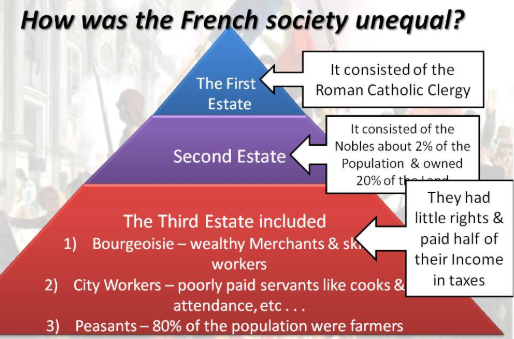
American Revolution vs. French Revolution
American Revolution – Rebel against colonial rule.
French Revolution – Rebel against a tyrannical monarchy and social inequality
Enlightenment ideas- John Locke (Intellectual)
Nationalism -Latin America (Ideological) also social inequality (Latin America & Haiti)
Help to create Democracy in both France and the United States.
What are the different phases or stages of the French Revolution? Briefly explain each stage.
Middle Class revolt that becomes more radical.
Moderate Phase- 1789-1792- Gradual change, King is in power, but true power is with the National Assembly.
Radical Phase – 1792-1794- Reign of Terror- Robespierre- Radical Direction
The Directory -1795-1799 – Corrupt
Coup d’etat - Napoléon
Members of the third estate began to acknowledge the abuses of the monarchy and the inequality between the estates. Many Enlightenment writers advocated for democracy and change, believing that all men are equal and are entitled to human rights. There were also other revolutions that inspired the French including the Glorious Revolution and the American Revolution. The Bourgeoisie became the leaders of the Revolution and planned revolts against the French Monarchy. Members of the third estate left the Estates-General (congress) and declared themselves as the National Assembly. They moved to a tennis court, where they swore to work together and develop a new constitution. Robespierre led the Reign of Terror, killing thousands who were suspected of opposing the revolution. Thousands of people stormed the Bastille as well. The King and Queen of France were beheaded, and Robespierre was beheaded as well. The revolution began to calm down after his death, and the Directory eventually formed.
What are some of the positive accomplishments of the French Revolution?
Declaration of the Rights of Man
France was unsuccessfully invaded by several other European powers.
Political power shifts to the Bourgeoisie, while French nobles decline in power.
Some accomplishments of the French Revolution were the Declaration of the Rights of Man, which declared that all men are equal and are entitled to human rights; taxes were lowered for those in the third estate; the monarchy was abolished and a new successful monarchy was established.
Who was Napoleon Bonaparte? How did he gain power? What are some of the positive accomplishments of his rule in France? What year was his final defeat?
Gained power in coup d’etat – the final phase of the revolution - 1799
Napoleonic Code- Equality of all citizens before the law.
Napoleon’s conquests inspire nationalism in the places he conquered- Example the German States.
1815- Waterloo
Napoleon Bonaparte was a general who took power over France from the Directory through a coup d’etat in 1799. He became the emperor of France and was very successful. He won numerous battles, reformed the French government, and promoted equality amongst men. He conquered a lot of territory and brought stability back to France. However, he was defeated twice in battle. His last battle, the Battle of Waterloo, marked his defeat and exile to St. Helena in 1815.
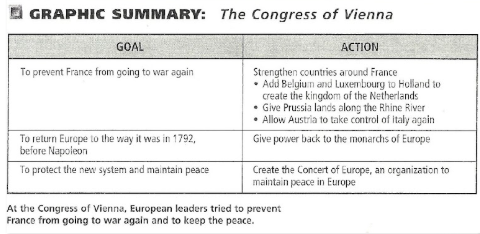
What was the Congress of Vienna? What effects will it have on Europe?
Kept Europe fairly stable for almost a century
Preserve the balance of power.
Tried to “turn back the clock”
The Congress of Vienna was a conference between other European nations such as Britain, Russia, Prussia, Austria, and France. They discussed what the future of Europe would be like after France’s defeat in Waterloo. The conference removed Napoleon from power, exiled him, and reconquered territory they lost from the French. They also ensured that no country would dominate Europe themselves.
Discuss the impact of the French Revolution on Europe – Name two nations that successfully fought for independence from 1820-1830.
Led to increased nationalism in other European countries.
Greece: free from the Ottoman Empire
Belgium: free from the Netherlands
The French Revolution had a major impact on Europe because it was proof that commoners were capable of overthrowing their government and starting a revolution. Other European countries were inspired by the French Revolution and began to explore Enlightenment ideas. Greece and Belgium were two European nations that successfully fought for independence from 1830-1830.
Name two Enlightenment thinkers who inspired revolutions during this time period.
John Locke
Voltaire
Baron de Montesquieu

