Expert Testimony Final Exam (Modules 7-11)
 Studied by 0 people
 Call Kai
 Learn
Learn Practice Test
 Spaced Repetition
 Match
Match Flashcards
 Knowt Play
1/124

There's no tags or description
Looks like no tags are added yet.
Name | Mastery | Learn | Test | Matching | Spaced | Call with Kai |
|---|
No analytics yet
Send a link to your students to track their progress
125 Terms
what is the anita hill/clarance thomas case?
A landmark Supreme Court confirmation hearing in 1991 where Anita Hill accused Clarence Thomas of sexual harassment during his time as her supervisor. The case raised national awareness about workplace sexual harassment and the complexities of such accusations in judicial proceedings.
how do sexual harassment and sexaul assault differ?
Sexual harassment involves unwanted sexual advances or conduct in the workplace, while sexual assault refers to physical sexual acts without consent. Both are offenses that violate personal boundaries and can have serious legal consequences.
sexual assault = criminal issue
sexual harassment = employment law and employer liability
between sexual assalt and sexual harassment, which is anemployment law/employer liability issue?
Sexual harassment is an employment law and employer liability issue, as it occurs in workplace settings and involves violations of workplace rights.
how common is sexual harassment in women?
approx ¼ will experience sexual harassment in their lifetimes
what are the financial and business ramifications of sexual harassment in the workplace?
Increased absences, reduced motivation and productivity, lower job
satisfaction, increased turnover, adverse impacts on career advancement
Most sexual harassment is _______, meaning __________
repeated; delayed reporting and certain memory issues occur
*possible SA question
what are the two types of sexual harassment and how do they differ
1) Quid pro quo type: “something for something” “this for that”
this entails an employee submitting to unwanted sexual harassment (perhaps sexual remarks or sexual contact) in order to receive job benefits, or avoid negative employment consequences
this means their employment may be threatened if this harassment did not occur
this is related to a clear abuse of power/ power struggle dynamic
this is the most CLEAR CUT FORM OF SEXUAL HARASSMENT due to its direct nature
2) Hostile work evironment type
the general atmosphere of the workplace environment is one where the employee is regularly subjected to pervasive unwanted sexual comments or sexual contact (either from peers or coworkers)
compared to the quid pro quo, this form may entail more harassers on average (instead of just your boss) and may be harder to notice due to it being more instilled within the atmosphere, rather than a single individuals actions
employers may be liable in this case for creating, maintaining, or ignoring the overall hostile environment present.
what is the most clear cut form of sexual harassment?
Quid pro quo sexual harassment, where an employee must submit to unwanted advances to secure employment benefits.
*very possible SA question
what is the criteria needed for establishing the occurance of sexual harassment?
1) Subject to “unwelcoming” Conduct
the harassment must be deemed unwelcoming, typically distinguished by the presence or absence of consent
may look at shared photographs, shared messages, jokes, conversations, physical contact, etc.. in order to establish if the conduct was consensual or nonconsensual
this can be difficult cuz this places a lot of scruitiny on the victim
may be subject to the reasonable women/reasonable third-party criteria (although this is a subjective measure)
the plantiff’s overt rejection and filing of a compaling also establishes unwelcoming conduct
2) The Discrimination is Based on Sex.
this one is pretty simple. the root of the discimination must be based on sex, rather than other factors (like age or race. these can still be discriminated upon, but do not qualify for sexual harassment)
3) The Conduct Caused Harm
must look at if harm has been caused and, if so, does it meet the legal threshold to stasify harm has been caused.
eg. subjectively being offended is not enough to satisfy the legal threshold of harm, but emotional damages sustained for eg would meet this threshold
some form of tanagable psychological, pysical, or material injury MUST be met in order to sustain the legal threshold of harm
what is often put into question when establishing “unwelcoming” in sexual harassment. what does this end up causing
the plantiff’s credibility. often times the plantiff is put through emense scrutiny (past sexual history, past
abuse, mental health history) so the defense can try to fracture their credibility
this can end up causing a battle of credibility where its “his word against hers” and both parties are simply trying to establish credibility while fracturing each other’s.
how does expert testimony relating to sexual harassment differ for testimony provided for the defense vs the plantiff?
expert testimony for the plantiff:
may talk about the social psychology of victim blaming that may have made formal reporting difficult or caused a delay in reporting
may talk about the powerdifferential (especially in quid pro quo cases) and explain how people do not want to lose their jobs and do not want to come forth as a result.
may talk about sterotyping
may talk about the limitations of arguemnts stating that the sexual harassment was welcoming
may talk about emperical studies where men were found to falsely interpret sexual interest
there could also be a bunch more research presnted depending on its applicability to the case
expert testimony for the defense
may argue that the plantiff’s behaviour or actions were welcoming of sexual advances
may talk about mental health
may talk about the manner of speach and the way the plantiff dressess (depending on probative value)
what is one of the least common responses to sexual harassment?
filing a formal complaint. (rather just put up with it, transfer to a different department, try to ignore it, because there are real consequences to coming forward and speaking up.)
what 3 important elements consittute the definition of sexual harassment?
do these elements all need to be present?
(1) submission to that sexual conduct is explicitly or
implicitly a term or condition of employment
(2) submission or rejection of that sexual conduct is the basis of employment decisions affecting such individuals
(3) such conduct has the purpose or effect of unreasonably interfering with an individual's work performance creating an intimidating, hostile, or offensive work environment
first 2 are more quid pro quo, and the last element is more of a hostile work environment)
these elements do not need to all exist together. the 3rd can exist on its own and be its own hostile work environment claim. the first 2 can be their own individual claims for quid pro quo claims.
what is the reasonable woman/ reasonable third-party criteria?
The reasonable woman/reasonable third-party criteria is a standard used in sexual harassment cases to assess whether the behavior in question would be perceived as offensive or unacceptable by a reasonable woman or third party in a similar situation.
what is the consensus on probing into one’s past emotional state and mental health in order to preceive their perception of welcomeness/unwelcomness
little emerpical support for this. however, it is still done.
workplace sexual harassment laws fall under________
anti-discrimination laws
*possible SA question
how can organizational climate, organizational leadership, gender composition of the work group, and sexual harassment policies, practices, and procedures individually affect sexual harassment?
organizational climate
work envionrments are very influential, as they can either discourage or foster sexual harassment.
if an organization tolerates sexual harassment, sexual harassment is likely to to increase in ferquency and severity, and retaliation against those who fail to submit to sexual harassment will become the norm.
organizational leadership
if people in leadership roles do not view sexual harassment as a serious work-related problem, a toxic work environment/climate will be created and individuals who experience sexual harassment will not feel inclined to report sexual harassment (cuz who wants to report to leadership that doesn’t care about the issue)
this will also create the aformentioned work climate that tolerates sexual harassment which will perpetuate sexual harassment and increase the frequency at which sexual harassment occurs.
gender composition of the work group
sex-skewed environments, especially women in male dominated areas (like the trades) are more likely to experience sexual harassment.
there is also more negative consequences associated with reporting sexual harassment in such environments for those in non-traditional occupations for their gender.
sexual harassment policies, practices, and procedures
when policies, practices, and procedures lack (meaning they are not distributed to all, not backed by all levels of management, and are weak in their approach) than an increased climate of tolerance for sexual harassment is bred
this can lead to unclear reporting procedures, unclear investigation protocals, and vague and uncertain sanctions for those who perpetrate sexual harassment
what struggles do the courts have to grapple with when determining if harm was caused in order to determine if sexual harassment occured?
1) how do you assess harm, and from whose perspective do you view harm
2) what level of harm must be met for the legal threshold to be stisfied
if a sexual harassment case drifted into the claims of severe psychological trauma, what would you require in order to make such claims?
you would need a clinical psychologist (expert) to substantiate these claims by interviewing the plantiff and diagnosing them. (diagnoses based on the DSM-5’s definition)
if liability is established (meaning sexual harassment was proven to exist), what must happen to seek damages?
in order to get repaid or seek damages, you must than establish what otherwise would not have been lost if the harassment did not occur (which can be difficult to do in a concrete way).
what are some controversial issues/ findings related to sexual harassment
measuring and defining sexual harassment
external validity of expert testimony to the specific case (other side will argue that the other side’s expert’s testimony does not apply to case, especially common in SH cases)
problems with assessing mental health
lack of emperical research on policies, training, and procedures related to sexual harassment (their usefullness, how well they are understood, etc…)
lack of research attention paid to those who have experienced sexual harassment.
how does intimate partner violence and domestic violence differ?
Intimate partner violence refers specifically to violence occurring between partners in a romantic relationship, while domestic violence encompasses abuse occurring in any domestic setting, including family members and housemates.
what is battered woman syndrome?
A psychological condition that can develop in women who are subjected to long-term domestic violence, characterized by feelings of helplessness, depression, and a distorted perception of reality regarding their relationship.
what is the Lavallee v. Regina 1990 case?
A landmark Canadian Supreme Court case that recognized Battered Woman Syndrome as a valid psychological condition in legal contexts, ultimately allowing expert testimony regarding domestic violence to be considered in court.
battered woman sysndrome is put forth as what type of defense? what type of denfense is it often mistaken for?
a self-defense claim; often mistaken for a psychological defense
what factors does a self defense claim usually require?
an active/immininat threat
no easy means of escape
the force used was proportionate to the threat
what societal and cultural factors are a predictor of intimate partner violence?
societies with stronger patriarchial values (i.e. they support the male dominance of women) and cultures with stricter gender roles have higher rates of IPV
how does social lerarning theory explain intimiate partner violence?
Social learning theory suggests that intimate partner violence is learned behavior, where individuals model violent actions observed in others, particularly in familial or societal contexts.
*possible SA question
What are the ecological systems that can impact intimate partner violence?
(from broadest to most specific)
Macrosystems
broad set of social or cultural beliefs (standards, norms, etc..)
Exosystems
the social structures are in place (things like employment, friends, family, social supports, peer groups, or the lack thereof that can feed into the occurance or continuation of one’s violence)
Microsystems
the immediate environment (usually the home)
looks at communication patters, how they deal with conflict, what is the relationship like
Ontogenic fators
psychological and biological features of the individuals themselves (their unique history of abuse, their personality characteristics, their exposure to violence in their own lives, their degree of impulsivity, etc…)
*possible SA question
What is Walker’s constuct of Battered Woman Syndrome
what 2 factors does he highlight?
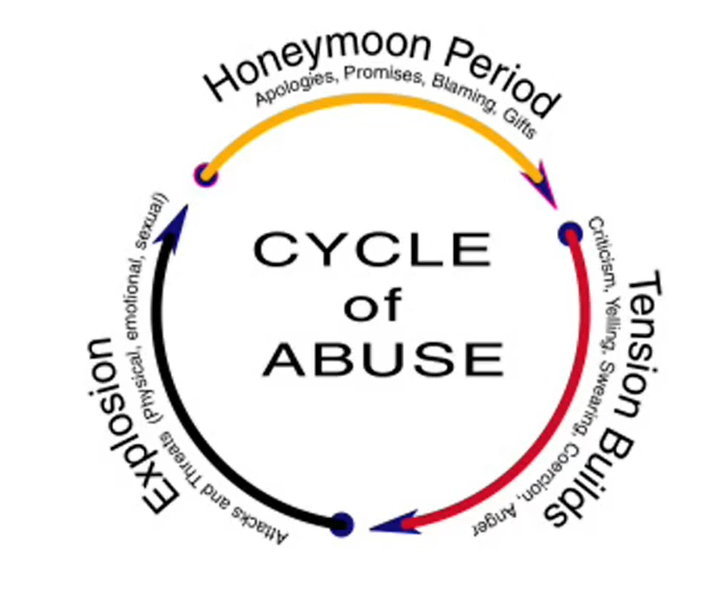
he highlights a circle theory of violence, that has 3 stages within the cycle of abuse:
1) tension building period
swearing, yelling, criticism, coercion, anger, (minor abuseive incidents that build to the second pahse)
2) explosion period
attacks and threats (physical, emotional, sexual)
this is the shortest phase, and most harm is likely to occur here
3) the honeymoon period
marked by apologies, promises, gift giving, etc. (kinda love-bombed by abuser)
also highlights learned helplessness
Learned helplessness is a psychological state in which a person, typically a victim of abuse, believes they have no control over their situation and cannot escape from it, leading to passive acceptance of abuse and a lack of action to change their circumstances.
this learned helplessness can cause further repetition of the cycle as the battered women becomes psychologically trapped in abusive relationship.
what is learned helplessness in Battered Woman’s Syndrome?
Learned helplessness is a psychological state in which a person, typically a victim of abuse, believes they have no control over their situation and cannot escape from it, leading to passive acceptance of abuse and a lack of action to change their circumstances.
what is Battered Woman Syndrome listed under within the DMS-5
Battered Woman Syndrome is classified under the "Post-Traumatic Stress Disorder" section in the DSM-5, as it reflects the symptoms arising from prolonged exposure to intimate partner violence.
____________% of homicides in America are committed by women, and a majority if their victims are their intimate partners
10-15%
what is the most common reason battered women return to relationships with IPV?
71% of the time, partners promised to change.
*maybe a posssible SA question?
what are some reasons battered women feel they can’t leave relationships with intimate partner violence?
Battered women may feel they can't leave due to financial dependency, fear of retaliation, lack of support systems, emotional manipulation, or believing their partner will change.
How does a forensic expert or expert witness assess claims of self defense on account of Battered Woman’s Syndrome?
they have 4 things they must do
1) Determine the Presence of IPV
must proved that the person killed their partner as a result of intimate partner violence, and not any other reasons
2) Assess the Symptoms of BWS
once detmerining violence involved, you must look at the BWS symptoms present (usually thoguh a semi-structured clinical interview that looks at the structure of the relationship and past history of abuse)
3) Determine State of Mind at the Time of the Crime (Mens Rea)
this feeds into the questions of self defense
did they believe there was a legitimate threat present?
do they beleive the degree of force they took was reasonable?
4) Report Findings
reporting all findings (either in a written report or through a testimony in court)
expert may be best person to testify to this, rather than defendant, as they might have a more neutral and objective stance + the experience in talking about such topics.
is expert testimony on battered womens syndrome/ipv admissable?
Yes, if it meets relevance and reliability standards set by the court, following guidelines like Daubert or Frye.
most state-level and federal level courts have it admissable if it is relevant and meets the aformentioned standards.
although some prosecutors will argue that BWS itself doesn’t have a firm emperical basis with reliability and validity (meaning it may violate one of the standards) BUT… its generally allowed
*possible SA question
what can an expert cover in their testimony about Battered Woman Syndrome or intimate partner violence?
what must they prove/cover
An expert can cover the nature of intimate partner violence, symptoms of Battered Woman Syndrome, psychological effects on the victim, dynamics of abusive relationships, and the impact of these factors on the victim's actions and state of mind.
they would also have to explain:
why the defendant was in imminant danger
why the defendant was unable to escape the situation (practial reasons, psycholoigcal reasons, children involved, finances, etc…)
how the force used by the defenant was proportional (talk about strength differential, the inability to match strength in hand-to-hand combat so a weapon was used, a fear of being killed if you didn’t kill or severely injur the partner, etc…)
why is an expert connecting BWS to PTSD a double-edged sword?
its good because it can help bolster the effects of expert testimony and give further insight into the diagnoses provided in the DMS to jurors (perhaps solidifying its validity)
PTSD is also more recognizable and may help jurors understand better
HOWEVER, it can be bad cuz this may make htem thing the defendant was psychologically unstable/not in control at the time of the crime. remember, BWS is a self defense claim, not a psychological claim. it is not arguing that the defense was mentally unstable and not responsible for the crime, it is saying they were just in their conscious action.
what are some general patterns of legal outcomes related to Battered Woman Syndrome
research shows
more “not guilty” verdicts and less severe verdicts (e.g. decreaes the chance of a first-degree murder charge)
effectiveness may vary depending on how consistent the defendant’s behaviour is with BWS
it may generate sympathy for the defense amongst jurors (which can cause jury nullification even tho this is not legally permitted)
BUT, it may backfire as well
what is social framework testimony?
Social framework testimony refers to expert evidence that provides context about social, cultural, or psychological factors affecting the case, helping jurors understand behaviors and dynamics relevant to the testimony. It often includes insights on societal issues such as domestic violence, Battered Woman Syndrome, child abuse, or biases in victim responses.
what type of expert testimony is common in cases of child abuse
social framework testimony
daubert criteria: expert testimony must be ___________ but also ____________-
reliable; assist the trier-of-fact
what is the R v. Mohan case (1994). what did it create?
The R v. Mohan case established the necessity for expert testimony to meet specific criteria regarding relevance and necessity in assisting the trier-of-fact, influencing subsequent legal standards for expert evidence.
established that expert testimony in canada must be:
relevant
necessaryto assist the trior of fact
t/f:
If a child has been repeatedly and painfully sexually abused as an infant, he/she can remember it.
false. infantile amnesia says this would be incredibly unlikely/impossible
However, over 64% of jurors beleived this to be true
T/F
Children cannot remember events well enough to be reliable witnesses in court.
False. children, especially with short delay periods, can be good and reliable witnesses in court
However, over 1/3 of jurors said that they beleived children could not remembere eveents well enough tobe a reliable witness in court.
there is a lot of variation in juror knowledge, so _____________
expert testimony is critical, especially in cases of child abuse, so that all jurors and even the judge are on the same page regarding children’s memory and the factors that may influence the accurate or inaccurate recollection of their testimony.
they need to explain the factors that influence reliability in children
does expert testimony regarding child witnessess sensitize jurors to forensic interview quality?
w/o expert testimony, jurors didn’t consider quality of the forensic interview quality (poorly conducted vs well conducted interview with children)
with the expert testimony, jurors did consider the quality of the forensic interviews more critically, which influenced their judgments about the reliability of child testimonies.
this caused mock jurors to render more guilty verdicts in in well-conducted interviews once expert testimony on the topic was provided (this is good)
what concepts may an expert witness testify to regarding the factors that may influence the credibility of a child’s testimony?
An expert witness may testify to concepts such as delay, recantations, memory development, children acquescing, interview techniques, and the impact of stress or trauma on a child's recall ability.
What is sexual abuse accomodation syndrome? what 5 factors are expected to be seen in children dislosing their sexual abuse? what was the goal of this in the court
Sexual Abuse Accommodation Syndrome refers to a set of behavioral patterns commonly seen in child victims of sexual abuse and the patterns in which they exhibit while recalling abuse
secrecy
helplessness,
entrapment and accomodation,
delayed, conflicted, and unconvincing disclosures,
retraction.
the original goal of this was to bing up in court that children had been sexual abused, even if said child did not disclose that they had been abused or had recanted their disclosure. however, there is no emeprical evidence supporting this model. some research suggests the opposite in fact.
what is capital mitigation?
Capital mitigation refers to evidence and arguments presented in a capital trial aimed at reducing a defendant's sentence to life imprisonment instead of death, often focusing on the defendant's background, mental health, or circumstances surrounding the offense.
how many states allow the death penalty?
28 states currently have it
what is the average age of someone on death row in the states?
The average age of a person on death row in the United States is approximately 52 years old.
what is the only crime punishable by death in the united states?
Murder, particularly aggravated murder
is capital punishment common in murderers?
no. less than 1% of murderers are sentenced to death.
what is a death qualified juror? when are jurors to be determined to be death qualified?
A death qualified juror is a juror who is eligible to serve on a capital case jury, meaning they can impose the death penalty if warranted. Jurors are determined to be death qualified during the voir dire process, where they are questioned about their views on capital punishment.
during the voir dire process, how many jurors are excluded from being death qualified?
the voir dire process excludes 30-40% of jurors from being on a death qualified jury
are capital juries/death qualified juries more or less representative of the larger community?
Less representative; they skew towards pro-death penalty views, and often are made up of fewer women, fewer african americans, fewer liberals, and fewer catholics)
how do death qualified jurors preceieve aggrivating and mitigating factors?
death qualified jurors are more receptive to aggrivating factors, and less receptive to mitigating factors. this causes death qualified juries/capital juries to be more prone to conviction
how many people have been released from death row since 1973 with evidence of their innocence?
191
who is Garry Graham (2000)
A man exonerated from death row after DNA evidence proved his innocence, highlighting flaws in the capital punishment system.
who is Ruben Cantu (1993)
A man wrongfully convicted and executed in Texas, later found to be innocent, raising significant concerns about the reliability of eyewitness testimonies and the criminal justice system.
can “mentally retarted” prisoners be executed/sentenced to death?
no
can judges rule a death sentence?
no. only a jury can.
can juveniles be sentenced to death?
no.
can rapists of adults/children be sentenced to death?
no
Black men convicted of raping white women were_________ than any other racial combination
18 times more likely to receive a death sentence
Black defendants are more likely than white defendants:
• To be charged with capital murder
• To be convicted of capital murder
• To be sentenced to death once convicted
• To actually be executed
how does the race of the victim affect capital punishment?
if the victim was white, they are twice as likely to seek the death penalty than black victims.
baldus studies also show that, after for controlling for 20 variables, prosecutors seek death penalty 5 times more often against those who kill white people than those who kill Black people
what was the McCleskey v. Kemp 1987 trial and what did it deem?
The McCleskey v. Kemp trial in 1987 challenged the constitutionality of the death penalty in Georgia, citing racial bias. The Supreme Court upheld the death sentence, ruling that “some unfairness is inevitable and tolerable”
rather, you’d have to show that the jurors acted with a discriminatory purpose (saing that, in this case, it was not intentional/intentionally discriminatory)
what was the Furman v. Georgia, 1972 case.
A landmark Supreme Court case that ruled the death penalty as applied in Georgia was unconstitutional, finding it violated the Eighth Amendment's prohibition on cruel and unusual punishment due to arbitrary and discriminatory enforcement.
what are aggrivating and mitigating factors for the death penalty?
Aggravating factors are circumstances that increase the severity of a crime, potentially leading to a harsher sentence (how henious the crime is, if there are multiple victims, if the victim is a child, priors, etc..), while mitigating factors are conditions or aspects of a defendant's situation that may lessen their culpability or severity of punishment (for example, mental illness, lack of prior criminal record, or being a minor at the time of the offense).
why are developmental psychologists experts common in capital mitigation cases?
because the expert should put forth an explaination of the defendant’s life story and how factors throughout their life (mitigating factors) led them to the point of their crime. A developmental psychologist can do this well as they can talk about their development through their life.
what are protective factors an expert witness can talk about in capital mitigation cases?
Protective factors are elements of a defendant's background or circumstances that may reduce the likelihood of criminal behavior or suggest potential for rehabilitation. These can include positive family relationships, stable employment history, supportive peers, and participation in community programs.
(note, these are different from mitigating factors but the absence of protective factors can explain why an individual committed the crimes that they did)
in a capital trial, every defendant is entitled to be considered as _____________
an individual when facing capital punishment
*Possible SA question
what is Brofenbrenner’s Bioecological Model? how does this apply to capital mitigation?
A theoretical framework that explains how an individual's development is influenced by various environmental systems, including the microsystem, mesosystem, exosystem, macrosystem, and chronosystem.
Examples include
historical changes over time that influence other systems (chronosystem),
the cultural context in which the other systems are embedded in (macrosystem),
environmental settings that don’t affect the person directly, but rather indirectly (exosystem),
the interactions between various mircrosystems (mesosystem),
the immediate environment an individual experiences (microsystem).
This model applies to capital mitigation by highlighting how a defendant's experiences within these systems can inform their behavior and circumstances leading to the crime, ultimately providing a more nuanced understanding of their life and choices.
how does resiliance and vulnerability come into play in expert testimony in capital mintigation cases?
what is a struggle experts face with this?
Resilience refers to an individual's capacity to cope with adversity and bounce back from hardships, while vulnerability highlights the factors that may predispose someone to negative outcomes. In expert testimony for capital mitigation, understanding these concepts helps to contextualize a defendant's behavior within the broader spectrum of their life experiences, showing how both resilience and vulnerabilities can influence their actions and choices.
experts struggle to make it sound like an explination of human behaviour and not an excuse for their behaviour.
*possible SA question
what steps would an expert go thorugh in order to prepare for a capital mitigation case?
1) Review records
school records, medical records, employee evaluations, prison records, etcc..
looking for behavioural issues, mallajudgements, cognitive impairments, etc.. things that could be mitigating factors.
2) Interview the Defendant
establish your role (make it clear you are not a therapist) and that you can’t uphold confidentiality
get their perspective on things you found and their life/upbringing.
look for pathologies or other cognitive impariments here
3) Interview Others
family members, friends, former employers, teachers, etc (anyone who can offer insight into their risk factors or lack thereof)
family is really important. can talk about generational trauma or family dyanmics (like abuse) that can serve as mitigating factors
4) Compile Reports
not just a list of facts, but a coherent report that tells the defendant’s life story which could explain their behavour and give reasons as to why the defendant should not be executed.
how does the extent to which an expert connects science to the case at hand affect how jurors view capital mitigation testimony?
Expert testimony that effectively connects scientific principles to the specifics of a case can enhance jurors' understanding of a defendant's circumstances, making them more likely to consider mitigating factors. A clear linkage demonstrates the relevance of scientific evidence in explaining behavior and life history, thereby influencing jurors' perceptions and decisions.
how do jurors tend to fail to understand the penalty phase instructions?
Failure to understand the concepts of aggravation and mitigation, even when explicit legal definitions were included in instructions
Failure to understand the full range of mitigating factors (Stevenson et al., 2010)
Think any aggravating factor means automatic vote for death
Mistakenly believe if they don’t vote for death, the person can be paroled
Racial bias can creep in without clear instructions
what did Ralph Erdmann do in 1992?
Ralph Erdmann was convicted of falsifying autopsy reports in 1992 as to match the claims of the prosecution
what is the Motherrisk scandle
The Motherrisk scandal involved allegations of improper testing and use of hair analysis by a laboratory in Canada, leading to wrongful convictions and significant legal controversies regarding child protection cases.
what is the ethical role conflict expert witnessess face?
they are made to “please too many masters”
the side who reatined them expects that said expert will help them win the case through their expert testimony
the exerpt also has to adhere to ethical guidlines and adhere to the field’s state of knowledge
and the other side implictely wants to show that you, the expert, are a liar
i.e. a lot of competing expectations for the expert
*possible SA question
what are the ethical principles an expert should uphold?
1) Truth
tell the truth, the whole truth, and nothing but the truth
experts must educate without having a staked interest/ desired outcome
2) Justification
the conclusions made by the expert should be done in accordance with the highest degree of rigor and scientific method. not just “vibes” based judgements
3) Transparency
should be transparent in how they came to their decision and it should be able to be followed by the triers of fact.
in essence, be able to show your work.
*possible short answer question
what are the differences between psychology and law
1) Goals
psychology has the goal of the truth
law has the goal of justice
2) Methods
psychology uses data for its methodology to support claims
Law uses rulings and precident to support claims
3) Styles of Inquiry
as an expert, you are only support to educate, while a lawyer tends to advocate for their client
psychology is __________, law is ___________
discriptive; prescriptive
what is the quasi-collaborative relationship between expert witnessess and an attorney?
The quasi-collaborative relationship between expert witnesses and attorneys involves the expert providing specialized knowledge and insights to assist the attorney in building a case, while also maintaining their impartiality and adherence to ethical standards. This relationship is characterized by collaboration in the gathering of evidence and formulating strategies, yet experts must remain unbiased and focused on their role as educators.
what are some ethical challenges experts face
Experts may face challenges such as conflicts of interest, pressure to align with attorneys' positions, maintaining objectivity while offering testimony, and ensuring confidentiality of sensitive information.
what is adversarial allegiance?
Adversarial allegiance refers to the potential bias that experts may experience when they are retained by one party in a legal dispute, leading them to unconsciously favor that party's interests over objective analysis and testimony.
what is the PCL-R checklist?
The PCL-R checklist is a diagnostic tool used to assess the presence of psychopathy in individuals, consisting of 20 items that evaluate interpersonal, affective, lifestyle, and antisocial traits.
what did the Murrie et al. (2013) study conclude about expert biases?
the study found that those retained by the prosecution gave higher risk scores on a risk-assessment test, while those retained by the defense gave lower scores.
this study had a large effect size, which further proved that the side that retains the expert does prove to cause bias in the expert.
what happens if experts testify outside of their area of expertise?
Testifying outside their area of expertise may lead to opinions being deemed unreliable or inadmissible in court, potentially undermining the integrity of the testimony and affecting case outcomes.
what is the overarching thought an expert should have as they take on a case and approach serving as an expert?
The overarching thought that expert
witnesses should bear in mind as they
approach the task of serving as an expert
witness is that they will be scrutinized like
they have never been scrutinized before
what should you do to avoid ethical pitfalls as an expert
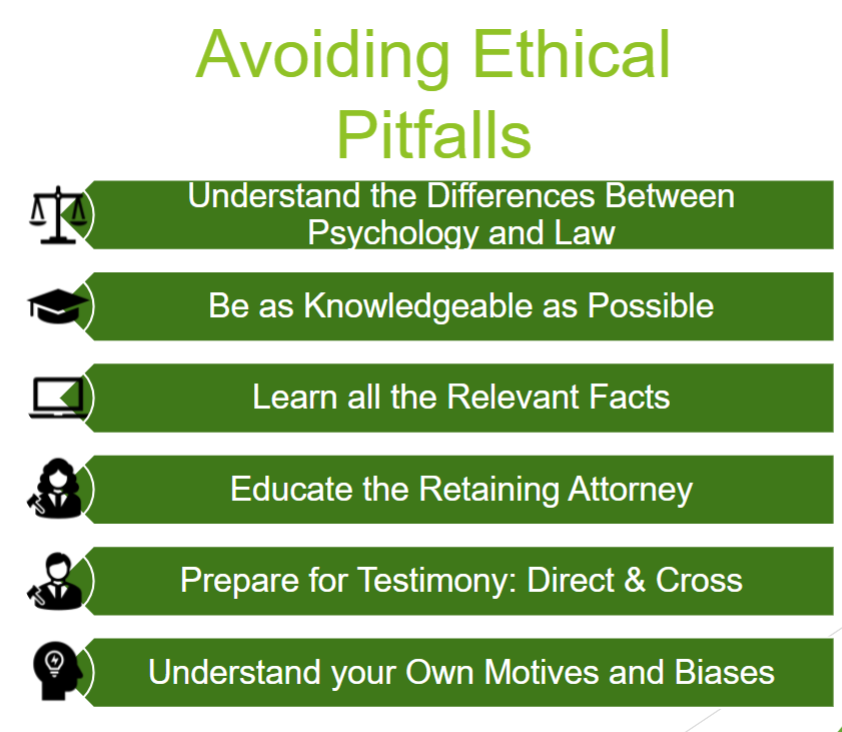
*possible SA question
what were some possible solutions as to help avoid biases in experts as a result of being retained to one side (and being biased for that side)
the court/judge generally appoints the expert, and the expert reports to the judge
randomly selecting experts from a pool
a double blind selection
do death sentences have to be 100% unnanamus?
The requirement for death sentences to be unanimous depends on state law; some jurisdictions require a unanimous jury for capital punishment while others may allow non-unanimous verdicts (usually with a majority of 10/12).
*possible SA question
what are some different types of risk factors? how do they differ.
(name 6)
static risk factors
risk factors that cannot be changed. often something like previous offences or an individual’s family background
historical risk factors
these are a form of static risk factor that have been experienced in the past
clinical risk factors
these are risk factors that relate to mental disorders, symptoms of mental disorders, etc.. (basically things that can be clinically observed or diagnosed it seems)
dynamic risk factors
risk factors that can fluctuate over time and are subject to change
dispositional risk factors
risk factors that reflect one’s individual traits or tendencies
situational/contextual risk factors
risk factors that relate to some aspect of one’s current environment
*possible SA question
how do first generation, second generation, third generation, and fourth generation risk assessments differ?
First Generation
unguided relying on clinical judgement
Second Generation
uses static actuarial measures (like the VRAG, or Static-99r) that worked in a mathematic and mechanical way
only looks sat static risk factors (meaning that there is no hope for the person to change cuz it only looks at static risk factors which cannot change)
Third Generation
looks at both static and dynamic risk factors
Fourth Generation
includes a full casemanagement approach that not only tells you about an individual’s risk based on static and dynamic factors, but also makes recommendations on areas to target for rehabilitation.
risk assessments usually include 2 sections/ parts that the assessor must do. what are these?
a case file review, and an interview with the individual
what are clinical judgements with regards to risk assessments
Clinical judgments in risk assessments refer to the evaluative decisions made by professionals based on their expertise and experience rather than solely relying on structured tools or measures. They involve synthesizing information from various sources, including interviews and historical data, to assess the risk of future behavior.
they are completely subjective. unless it is a standardized clinical judgement, it uses a subjective professional evaluation.
 Note
Note  Flashcards (36)