8. recap - representation deficits & solutions
 Studied by 0 people
 Call with Kai
 Learn
Learn Practice Test
 Spaced Repetition
 Match
Match Flashcards
 Knowt Play
1/15

There's no tags or description
Looks like no tags are added yet.
Name | Mastery | Learn | Test | Matching | Spaced | Call with Kai |
|---|
No study sessions yet.
16 Terms
Devroe: legislative recruitment model
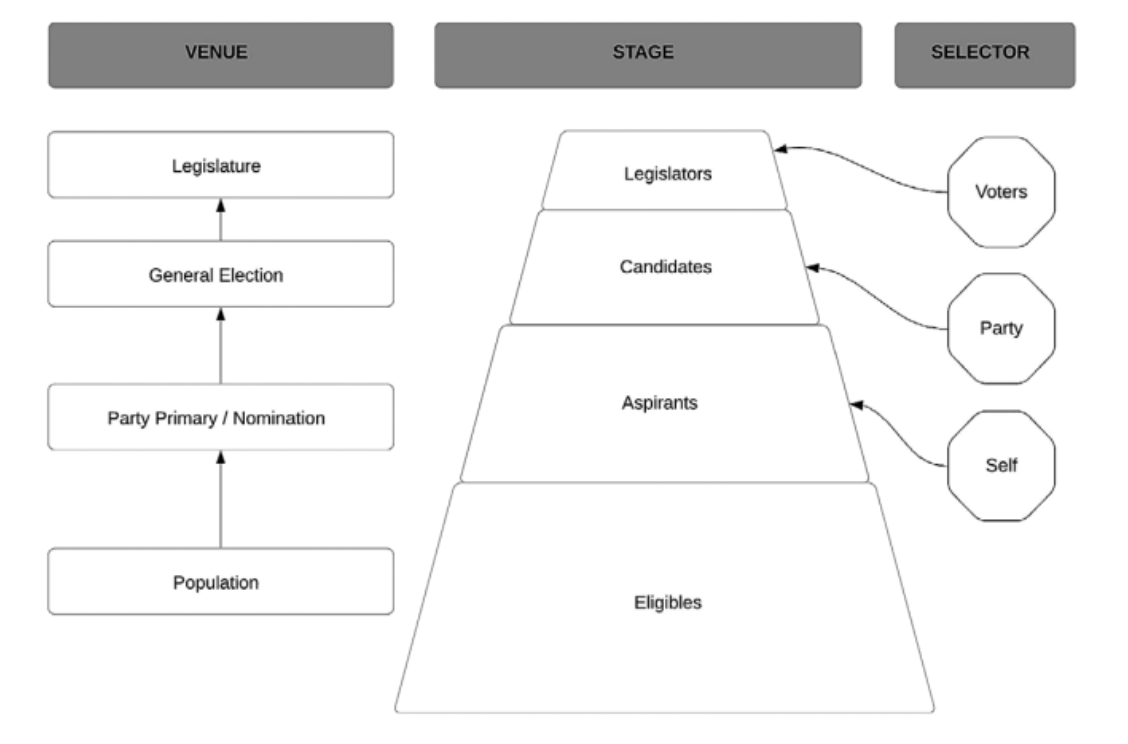
Deficits
political ambition
political parties’ selection
voter bias
gendered workplaces
vertical & horizontal segregation
gendered media representations
gendered drop-out mechanisms
violence against women in politics
Deficit #1: political ambition amongst women (Devroe)
Three common explanations
1) No ambition: women are less ambitious then men
2) No capacities (merit): women are more conflict avoidant and risk averse than men
3) Women have lower levels of political interest
We should also look at preferences and perceptions
What are the goals we associate with politics? (preferences)
Power – status, self-promotion, recognition, …
Independence – achievement, individualism, …
Communal – helping and caring for others, serving humanity, working with people, …
How do people perceive if these goals can be reached through politics? (perceptions)
Goal congruity framework → do these things match?
= a very big democratic deficit – politics is understood as something hat does not align with
1) what women want
2) what women think can be realized through politics
If we want to fully understand the gender gap in political ambition, we need to understand the interaction between perferences and perceptions and how they differ between women and men
Explains the deficit of political ambition amongst women
two responses for establishing gender equality
Role of parties to spark interest for women
Different socialization processes so women do not feel like politics is not for them (representation of politics, politician’s behaviour, wanting to reach communal goals …)
Deficit #2: political parties’ selection (Devroe)
party trade-off → seek to be more occlusive and attractive to minority / cosmopolitan voters VS not pushing away populations that are not in favour of diversity
e.g., visible minority women are selected in less diverse districts and rightist parties; more men in diverse districts and left parties.
→ male spots remain ethnic majority and thus less diverse
nuances the double jeopardy hypothesis
Deficit #3: voter bias (Devroe)
Not an explanation for gender inequality: research on stereotypes shows a positive bias towards female ministers in terms of perceived (issue) competence (and no effect of soft/communal vs hard/agentic issues)
Still, …
political stereotypes related to other identity markers (e.g., religion) prevail.
positive bias is only there own the hypothetical
if real women make mistakes, this bias backfires
However, this does show that inequalities in politics are not about what voters want, but about what parties think voters want.
→ political parties are at the center of the web in structural inequalities
Deficit #4: gendered workplaces (Runderkamp)
Politicians work in a workplace: a physical place where they practice their political job. These workplaces are gendered.
Politics assumes an “ideal worker” – full-time, no care duties
• Late meetings, unpredictable hours, informal hierarchies
• Institutions assume total availability Yet:
• Work-life imbalance = structural, not personal
• Care remains feminized → double burden
• “Outside world” (family) shapes “inside” (politics)
→ Male lifestyle steering how these institutions work
→ The ‘ideal’ worker (or politician) is expected to be flexible, availbale long hours, …
→ We all know (has been studies since the 70s) that this work-life imbalance is not
a personal, but a structural issue – care is still structurally assigned to wome
Deficit #5: vertical and horizontal segregation
Political parties are drivers of gendered ‘division of labour’ in institutions like parliaments
Vertical segregation
gendered division of leadership positions: chair of parliaments, committees, party groups
Gatekeeping role
Committee chairs → decide what’ll be discussed, who can speak, whether a committee is public, …
Party group leaders → determine who can speak on issues? (visibility)
Gendered # seniority; positional power, gate keeping & visibility (cfr Devroe on written vs oral questions; cfr. Berthet: women struggle to be seen as expert in economic policy)
GL Devroe: research on party questions → oral questions are more visible and extremely divided gender-wise
Horizontal segregation
‘Soft/low’ & ‘hard/high’ : family, education, culture, equality (e.g. FEMM), … vs budget/finance, military, foreign aOairs; Defined by how much money is involved
GL Berthet: male domination in certain committees (e.g., budget- and female in others (culture, education, …) – certain policy issues seen as male or female – e.g., women struggle to be seen as experts in economic policy. Masculine committees seen as ‘high politics’
Gendered division of committees; gendered visibility
Deficit #6: gendered media representation (Runderkamp)
media highlight difference
white men: no mention of background or gender
women are referred to a being female, married, mother, … or other identity markers.
same goes for ethnic minorities
women & ethnic minority MPs are covered via identity
amount of space to spend on what they actually say or care for (policy) shrinks
minorities are space invaders → highlighted as bodies out of place by stressing elements and identity features that makes them ‘others’
white men are described along their ideology, policy proposals, …
this produced unequal legitimacy
People with clear ideas, good proposals, … merit political power - this information is communicated via the media, and this gendered representation disadvantages women because male political appear as being more competent
double edge of visibility → not all visibility is good!
Deficit #7: gendered drop-out mechanisms (Runderkamp)
Drop-out mechanisms are gendered (more women drop out)
mid-term exits can be the result of
conflict with party
personal reason
new non-political job
new political mandate
= mix of personal and institutional
Runderkamp research → more women and ethnic minorities leave politics
some turnover is healthy, but selective dropout = inequality
aside from people entering politics, we should look at retention
importance of seniority as power prediction in politics
Deficit #8: violence against women in politics (Van Bavel)
Gendered motives
perpetrators commit violence to preserve the gendered order of political power
emerges from persistence of roles and stereotypes, and backlash of the increasing number of women in politics
Gendered forms
typically sexualised language, imagery or content
online violence (e.g., appearance, sexual)
physical violence (e.g., acid attacks)
economic violence (e.g., vandalising with sexual messages)
psychological violence (e.g., rape threats)
Sexual violence (e.g., jokes, remarks, unwanted physical touching, …)
Semiotic violence (e.g., mansplaining, manterrupting, …)
Gendered impact
inducing fear in female MPs
women experience these impacts more profoundly
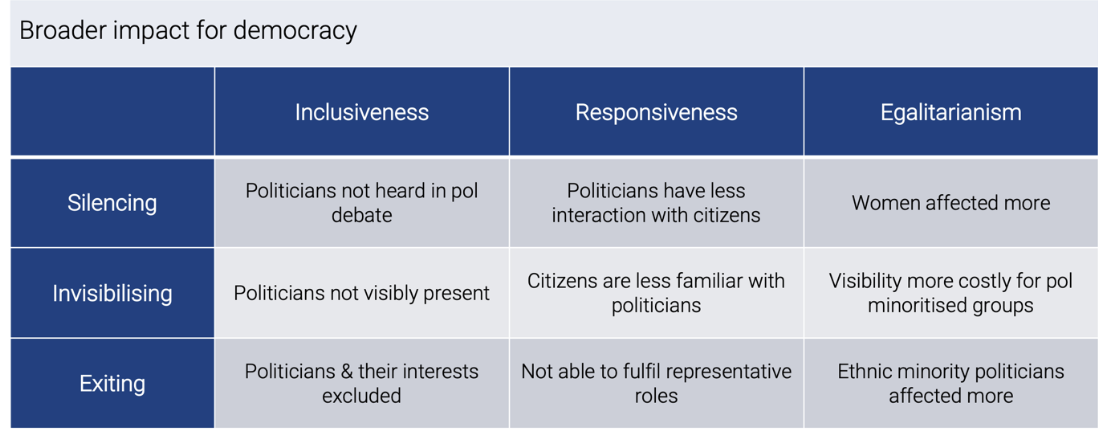
silencing → voice disappearing from debate
invisibilising → physically removed from the political arena (careful to be present)
exiting → leaving the political arena
VAWIP → consequences
Solutions
Quota (first generation design)
Gender-sensitive parliaments (workplace approach)
Feminist democratic representation (second generation design)
Quota (first generation design)
applied to electoral lists (30-50%)
path dependency → once one group gets quota, others might follow
gender x ethnic?
double counting allowed → advantage for ethnic minority women
double counting not allowed → prototipicality: most dominant subgroup favoured
nested / tandem quota → within ethnic quota, half must be women & vice versa
reserved seats
certain number of seats in parliaments are allocated to a certain group
usually ethnic or religious minorities
in Belgium → language groups
variations
legislative quota → legally binding
voluntary party quota → can be combined with legislative (e.g., alternating men and women on electoral lists)
implementation
soft vs hard sanctions
financial, not providing candidates beyond quota, …
why do we have quota?
women lobby (women’s movements)
party competition & contagion
values of equality (left wing ideology)
international pressure
effects?
qualitatively → ranges from major increase to setbacks
on women?
stigmatising (labelling)
essentialization of identity
on citizens? (democratic effect)
closing the gap with representatives
erode perceptions about women’s abilities to rule
encourages (young) women
but also research that says no impact
no impact on parties & cultures
quota and electoral systems → only work if they’re well designed and embedded in electoral systems
proportional vs majoritarian
PR: higher turnover and contagion
district & party magnitude
the bigger the better
open & closed lists
closed lists fit better (but depends on culture and voters)
Quota: Vierge & De La Fuente
RQ: did quota reduce parties’ institutional sexism?
definition of valuable merits and skills not changed
informal practices sustaining women’s subordination
challenging subordination through individual agency and collective action
conclusion → quota are not designed to change political parties, but to increase women’s presence
Gender-sensitive parliaments
→ approach parliaments as a workplace
infrastructure
institutional culture
gendered parliaments culture
masculine culture seems to be less dominant in parliaments with more women
gender and age intersect → harder for young women
gender-sensitive parliaments
increasing demand to change infrastructure and culture due to…
increase in female MPs
growing need for both men and women to combine work and family life
measures
promote less aggressive language and behaviour
family-friendly sitting hours
childcare facilities and parental leave
gender-sensitive training
gender neutral language
rotating positions of authority between men and women
→ both men and women benefit
Feminist democratic representation (second generation design)
different minorities and marginalised groups
intersectional update to group representation
not only focus on voicing, but also ensuring listening
 Note
Note  Flashcards (41)