(3) De Novo FA synthesis
 Call Kai
 Learn
Learn Practice Test
 Spaced Repetition
 Match
Match Flashcards
 Knowt Play
1/60

There's no tags or description
Looks like no tags are added yet.
Name | Mastery | Learn | Test | Matching | Spaced | Call with Kai |
|---|
No analytics yet
Send a link to your students to track their progress
61 Terms
De novo fatty acid synthesis occurs under conditions of
excess energy intake
Fatty acids synthesis is most active in the —-, in the —-- state, and in —------
liver; postprandial(fed) ; lactating mammary glands
Four steps of de novo fatty acid synthesis
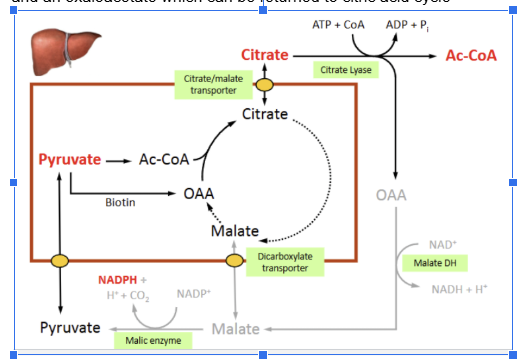
citrate exits mitochondria and enter cytoplasm of hepatocytes, production of cytoplasmic acetyl-CoA from the citrate, production of malonyl-CoA from Acetyl-CoA, and then de novo fatty acid synthesis via FA synthase
What three tissues synthesize only a minor amount of FAs?
adipose tissue, brain, and kidney
t/f de novo FA synthesis is costly and highly regulated
true
Citrate movement to cytoplasm occurs under what conditions
high insulin, high glycolysis rate (PFK1 active due to high [F2,6BP]), glucose is being converted to pyruvate and pyruvate is being fed into the CAC
How is cytoplasmic acetyl-CoA produced?
citrate lyase catalyzes the reaction, which uses cytoplasmic citrate, CoA, and an ATP to produce cytoplasmic acetyl CoA, ADP, Pi, and an oxaloacetate which can be returned to citric acid cycle
How is malonyl-CoA produced?
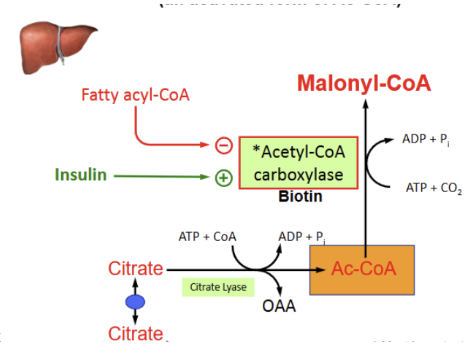
acetyl-CoA carboxylase uses one ATP and CO2 to produce it from Acetyl-CoA
acetyl-CoA carboxylase is regulated by what?
fatty acyl-CoA inhibits it while insulin stimulates it
Most important control point of FA synthesis
conversion of cytoplasmic Ac-CoA to Malonyl-CoA
Describe the process of de novo fatty acid synthesis via fatty acid synthase
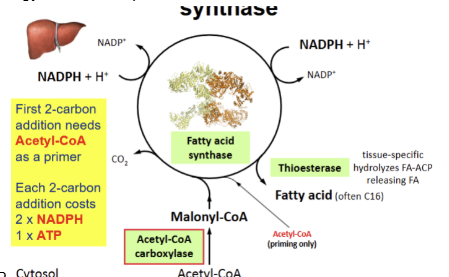
acetyl CoA is used as a primer then 3 carbon malonyl CoAs are added to the chain in a stepwise manner. After each malonyl CoA is added, the intermediate loses a CO2 which releases enough energy to make the process irreversible. Each 2 C extension costs 2 NADPH and 1 ATP.
Each 2 carbon extension in the FA synthesis costs
2 NADPH and 1 ATP
Fatty acid synthase
dimer of a protein that contains all enzyme activities necessary for FA synthesis
FA synthases is on the —- surface of the —--
cytosolic surface of the endoplasmic reticulum
Acyl carrier protein (ACP)
during FA synthesis, growing fatty acid chain is attached to ACP, which passes the chain from catalytic site to catalytic site of fatty acid synthase. Accordingly, the intermediates are often written as intermediate-ACP
ACP contains —- which is also found in CoA
pantothenate (vitamin b5)
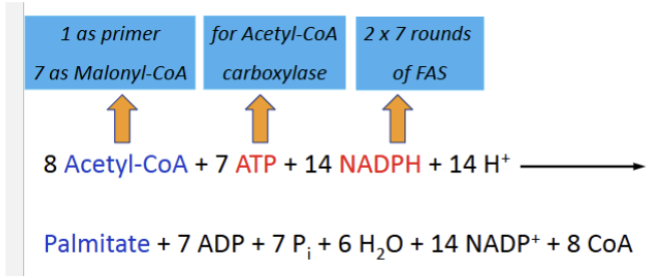
Overall stoichiometry to synthesize a palmitate (C16 fatty acid)
2 sources of NADPH for FA synthesis in liver
pentose phosphate pathway and malic enzyme
How does the pentose phosphate pathway provide NADPH for FA synthesis in the liver?
creates 2 NADPH per glucose in the pathway.
How does malic enzyme provide NADPH for FA synthesis in the liver?
converts malate into pyruvate to produce 1 NADPH per malate
—% of fatty acids in adipocytes come from diet
95
Regular fatty acid synthesis go up to about C–
C16 (palmitate)
Any fatty acids longer than 16 carbons must be synthesized via —-
elongation
Very-long-chain fatty acids
fatty acids that have greater or equal to 20 carbons
The — makes particularly long fatty acids
brain
Elongation of fatty acids is important for longer fatty acids needed to
regulate membrane fluidity (phospholipids in brain) or synthesize eicosanoids
t/f FA elongation resembles synthesis, but is catalyzed by different enzymes
true
Show the 2 steps of fatty acid elongation using palmitate
1st step is activation by esterification with CoA and 2nd step is addition of 2 C atoms from malonyl-CoA
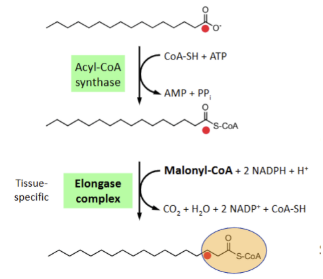
Desaturation of fatty acids
uses desaturase to introduce double bonds into fatty acids which change physiochemical properties
Desaturase
position-specific enzyme involved in desaturation of fatty acids. may only introduce double bonds between Carbon 1 and carbon 9 of a FA and it can only introduce cis double bonds (NO TRANS)
2 limitations of desaturation in humans
desaturase may only introduce double bonds between Carbon 1 and carbon 9 of a FA and it can only introduce cis double bonds (NO TRANS)
Trans vs cis fatty acids
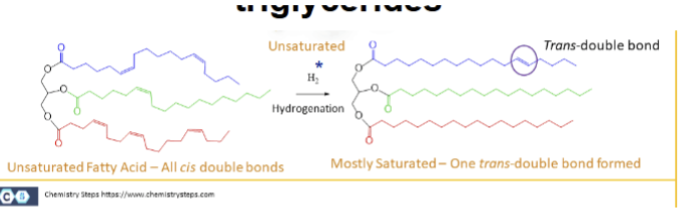
Cis fats have hydrogen on the same side, causing a bent chain and liquid state, while trans fats have hydrogen on opposite sides, creating a straight, solid, and often artificial fat that increases heart disease risk
Symbiotic bacteria in ruminants can give rise to — FAs which are incorporated into the host body, thus the meat of ruminants are high in this kind of FA.
trans
t/f the human body can degrade BOTH cis and trans fatty acids
true
Common sources of trans fatty acids
meat (particularly red meat), oil heated to high temperatures, and partial hydrogenation of fatty acids (seen in margarine)
Hydrogenation of poly-unsaturated triglycerides
done by bubbling H2 through oil in presence of nickel catalyst to produce margarine. Increases stability of the fat (less likely to go rancid). Converts unsaturated fatty acids with cis bonds to mostly saturated FAs with little double bonds are that are more likely to be trans
Trans fatty acids are associated with higher risk of —
Cardiovascular disease
The US department of agriculture recommends intake of trans fatty acids that amount to less than — % of daily calories. Americans typically consume about –% of their calories as trans fatty acids
1; 2-3
A person’s risk for heart disease depends on the balance of intake of
both saturated fatty acids and unsaturated trans fatty acids
t/f FAs that contain >=2 double bonds after C9 must be synthesized
false, they must come from diet
2 essential fatty acids
linoleate (omega-6) and linolenate (omega-3)

What fatty acid is this?
linoleate (omega-6)
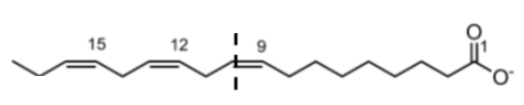
What fatty acid is this?
linolenate (omega-3)
Why can we not make essential fatty acids?
they include double bonds past carbon 9
What foods are a good source of linolenate
fish, seafood, flax seeds, eggs, and avocado
The body converts some linolenate to —- and — in –/– steps
EPA and DHA in 3/4 steps
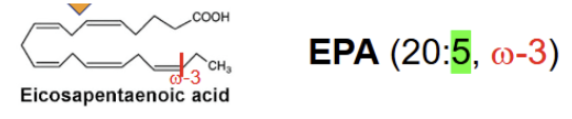
EPA
omega-3 FA synthesized from linolenate. Made from 2 desaturations and 1 elongation of linolenate
DHA
omega-3 FA synthesized from linolenate.Made from 2 desaturations and 2 elongations of linolenate

DHA is the most abundant —- FA in the —- and —-
omega-3 ; brain and retina
What foods are good source of linoleate
nuts, olive oil, and eggs
The body converts some linoleate to — in – steps. What are these steps?
arachidonate; 3 steps; 2 desaturations and 1 elongation
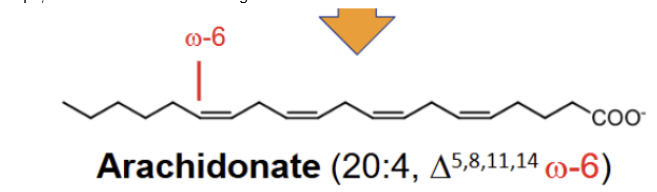
Arachidonate becomes essential if — is deficient
linoleate
How many of each essential fatty acids do we need a day
~250 to 500 mg/day of linolenate and 11-22 g/day of linoleate
Eicosanoid
omega-6 signalling lipids derived from oxidation of arachidonic acid ( C20
Majority of arachidonic acid in the body are in the form of —-
phospholipids
Phospholipase A2
enzyme that catalyzes release of arachidonic acid from phospholipids in the cell membrane
NSAIDs
anti-inflammatory drugs like aspirin or ibuprofen that inhibit COX-½ to prevent prostaglandin synthesis
Cyclooxygenase (COX1/2)
enzyme that converts arachidonic acid into prostaglandin (lipid hormone)
Two functions of aspirin
inhibits prostaglandin synthesis by inhibiting COX-1/2 (ant-inflamatory, analgesic, and antipyretic action) inhibits thromboxane A2 synthesis (antiplatelet agent<-- prevents platelets from sticking together to form clots)
Thromboxane A2
eicosanoid that plays a role in coagulation. Activated platelets synthesize and release thromboxane A2, which then activates other platelets nearby
How does low does aspirin low risk of heat attack and stroke
it is an anti-platelet agent as it inhibits thromboxane A2 production

