PSY263 Unit 3 Exam: Dr. Heidenreich ISU
 Call Kai
 Learn
Learn Practice Test
 Spaced Repetition
 Match
Match Flashcards
 Knowt Play
1/80

Earn XP
Description and Tags
will be added to until 4/13
Name | Mastery | Learn | Test | Matching | Spaced | Call with Kai |
|---|
No analytics yet
Send a link to your students to track their progress
81 Terms
what role does the hypothalamus have in emotion?
releases corticotropin-releasing factor (CRF)
what role does the anterior pituitary gland have in emotion?
releases adrenocorticotropic hormone (ACTH)
what role does the adrenal cortex have in emotion?
releases cortisol
what does cortisol do in the body?
elevates blood sugar and metabolic rate, prepares body to response
what nervous system is responsible for emotion?
autonomic NS —> sympathetic NS
what is the step-by-step process that happens in the body for emotion to occur?
hypothalamus releasing CRF, anterior pituitary gland releasing ACTH, adrenal cortex releases cortisol
what is the james lange theory?
body reacts first, then the emotion (see snake, heart races, then fear)
stimulus —> autonomic arousal, muscle tension —> emotion (perception leads to particular label of emotion)
what is the evidence for james-lange theory?
spinal cord injury —> less emotional experience (emotions come from bodily changes, disruption in body changes leads to feeling less)
locked in syndrome (damage to brainstem, no motor function) —> Absence of body movement → absence of sensation → absence of emotionality
what is the cannon-bard theory?
emotion and body reactions happen simultaneously (see snake, heart races and feeling fear)
stimulus —> autonomic arousal, muscle tension (nonspecific) —> emotion (both caused by non-conscious effect of stimulus on brain)
what part of the brain is responsible for emotions?
amygdala
what happens in the central nucleus of the amygdala for emotions to be experienced?
neurons are activated by threatening stimuli that then receives sensory information from thalamus and cortex
what happens if the central nucleus (amygdala) is stimulated in rats?
fear behavior, agitation, affective attack
what happens if the central nucleus (amygdala) is destroyed in rats?
decreased emotional behaviors, lower level of stress hormones, decrease in conditional emotional response (CER), decrease in emotional-enhanced memory formation
what is an important site for benzodiazepine anti-anxiety drugs?
amygdala’s central nucleus
what is emotional expression?
innate, unlearned set of facial movement
what side of the face is more expressive?
left side of face (right hemisphere)
what part of the brain is responsible for facial emotional recognition?
right frontal cortex and amygdala
what happens if the orbitofrontal cortex is damaged?
indifference, inappropriate social behavior, lack of restraint and inhibitions, decreased emotionality, impulsive
what part of the brain is damages in a lobotomy?
orbitofrontal cortex
what happens when there is low levels of serotonin in the orbitofrontal cortex?
aggressiveness
what happens when there are high levels of testosterone in the orbitofrontal cortex?
aggressiveness
sensation definition
trandformation of energy from stimulus into neuronal energy
transduction definition
process of sensation in sensory neurons
perception definition
interpretation and organization of sensation by mind/brain
what are the steps of sensation/perception?
stimulus, sensation (transduction), perception
when sound waves are more complex, there is more…
timbre (being able to tell the diff. btwn a guitar/piano playing same note)
when sound waves have a higher/lower frequency, there is higher/lower…
pitch
when sound waves have a higher/lower amplitude, there is higher/lower…
loudness
what is the structure of the outer ear called?
pinna
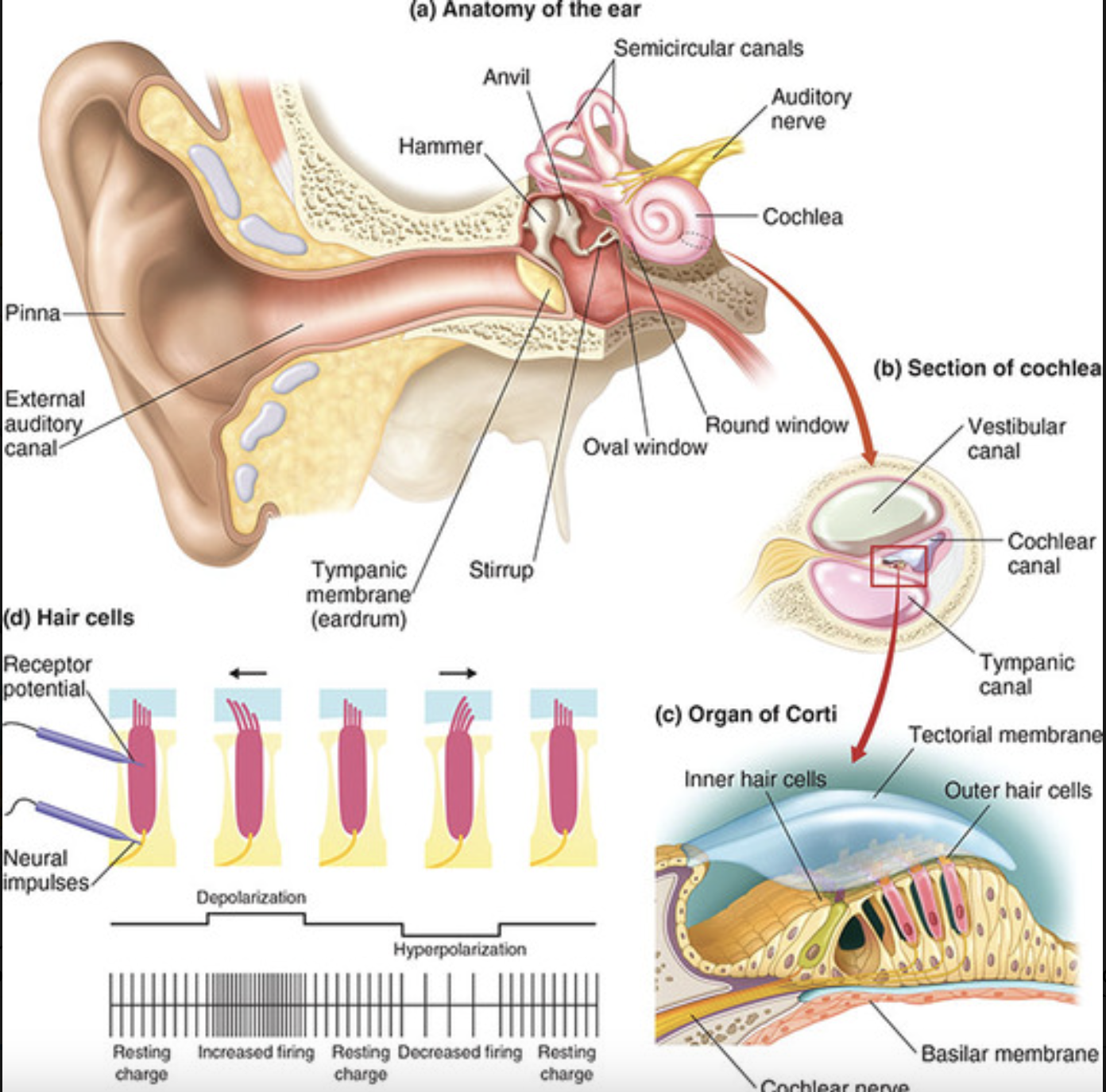
what are the structures of the middle ear?
eardrum, bones that transmit vibrations, hammer (malleus), anvil (incus), stirrup (stapes)
what are the parts of the inner ear?
cochlea, vestibular system
what is the cochlea?
snail shaped thing filled with fluid, contains the basilar membrane
what is the process for hearing?
stapes vibrates against the oval window of cochlea, basilar membrane transmits the sounds, hair cells move in the fluid with vibrations that depolarizes the auditory nerve in brain which then causes action potential.
what does place theory say about high pitched sounds?
travel shorter distances on basilar membrane
what does place theory say about low pitched sounds?
travel longer distances on basilar membrane
what kind of sound produces more hearing loss?
loud, low pitched
what is frequency theory?
the number of action potentials on auditory nerve is proportional to frequency of sound
what is the process that causes us to have pitch perception?
cochlea —> auditory nerve (CN8) —> dorsal cochlear nucleus —> (mostly crosses midline) —> inferior colliculus —> medial geniculate nucleus of thalamus —> primary auditory cortex in temporal lobe
what part of the brain contains most of the functions for speech and language?
left hemisphere
what is the right hemisphere responsible for in speech and language?
expression and recognition of emotional content of speech, ability to speak about visual-spatial relations
what is an aphasia?
a deficit in production and/or comprehension of speech caused by brain damage
what is broca’s aphasia?
damage to brocas area in frontal lobe
poor speech quality, good comprehension
telegraphic speech
anomia (difficulty finding words)
difficulty articulating, slow speech, effort intensive, non-fluent speech
what is wernicke’s aphasia?
damage to wernicke’s area (temporal cortex) and surrounding posterior language area (angular gyrus)
poor word recognition, poor comprehension
anomia (difficulty finding words)
word deafness (can hear noises/sounds, but can’t comprehend words)
fluent, meaningless speech
inability to verbalize thoughts
what is broca’s area responsible for?
speech production
what is wernicke’s area responsible for?
speech comprehension
what is anomia?
difficulty finding words
what is pure alexia?
inability to read, but all other language is intact, including writing
what is the problem in perception of pure alexia?
damage to the visual cortex and/or no input from visual cortex to left hemisphere language areas
what is a deficit in whole-word reading?
surface dyslexia: can sound out words, but can’t recognize whole words well
what is a deficit in phonetic reading?
phonological dyslexia: canr ead whole words that are recognized, but can’t sound out new words
what is agraphia?
no writing ability
what is dysgraphia?
impaired writing ability
what is developmental dyslexia?
impairment in reading, often transposing letters and characters
poor handwriting
difficulty in using/telling left from right
difficulty in perception of moving objects
what kind of developmental delays come with developmental dyslexia?
motor abilities and coordination, spatial reasoning, attention
what part of the brain is defective in developmental dyslexia?
magnocellular system of vision with input to cerebral cortex
affects perception of visual info (including words)
when light waves have a longer/shorter wavelength, what changes?
hue (color)
when light waves have a higher/lower amplitude, what changes?
brightness
when a light wave’s purity changes, what changes?
saturation
light waves are…
perceptions
what is the corea?
the clear, outside covering of the eye
what is the iris?
colored part of the eye, muscle that opens and closes the pupil
what is the pupil?
hole in the eye that allows light in
what is the lens?
responsible for focusing light
what does the lens do to the image you’re seeing?
it is inverted (upside down) and reversed (mirror image)
what is the retina?
contains sensory cells that transduce light into nervous system activity
what structures are in the retina?
photoreceptors, fovea, optic disk
what are photoreceptors?
rods and cones
what are rods sued for?
light/dark vision
what are cones used for?
colored vision (blue, green, red)
what is the fovea?
highest acuity vision (sharpest/clearest), directly behind pupil where cones are located
what is the optic disk?
(blind spot): few rods and cones because this is where the optic nerve exits the eye. too many axons of retinal ganglion cells so no rods/cones can fit.
photoreceptors contain what?
rhodopsin
what is rhodopsin?
a chemical that breaks light into retinal and opsin
how is adaptation explained in regards to rhodopsin?
rhodopsin can be resynthesized, but it takes time in bright light or darkness
what happens to rhodopsin going from dark to light?
it adjusts fast bc rhodopsin breaks down fast
what happens to rhodopsin going from light to dark?
it adjusts slow because putting rhodopsin back together takes time
what is the process for visual perception?
photoreceptors —> bipolar cells (no visual pigment) —> ganglion cells (no visual pigment)
what are the parts of ganglion cells?
output neurons, amacrine cells, horizontal cells
what are output neurons?
the axons that form the optic nerve - in blind spot
what are amacrine cells?
“side to side” connections between bipolar cells and ganglion cells
what are horizontal cells?
“side to side” connections from the rods/cones to bipolar cells

