Transport across Cell membrane
 Call Kai
 Learn
Learn Practice Test
 Spaced Repetition
 Match
Match Flashcards
 Knowt Play
1/21

There's no tags or description
Looks like no tags are added yet.
Name | Mastery | Learn | Test | Matching | Spaced | Call with Kai |
|---|
No analytics yet
Send a link to your students to track their progress
22 Terms
name the similarities between the diagram of a cell membrane and the fluid mosaic model (4)
both have a phospholipid bilayer
both have hydrophobic tails pointing inwards
both have hydrophilic heads pointing outwards
both have protein
name the differences between the diagram of a cell membrane and the fluid mosaic model (4)
fluid mosaic has carrier and channel proteins
fluid mosaic has cholesterol
fluid mosaic has glycoproteins
fluid mosaic has glycolipid
draw the fluid mosaic model
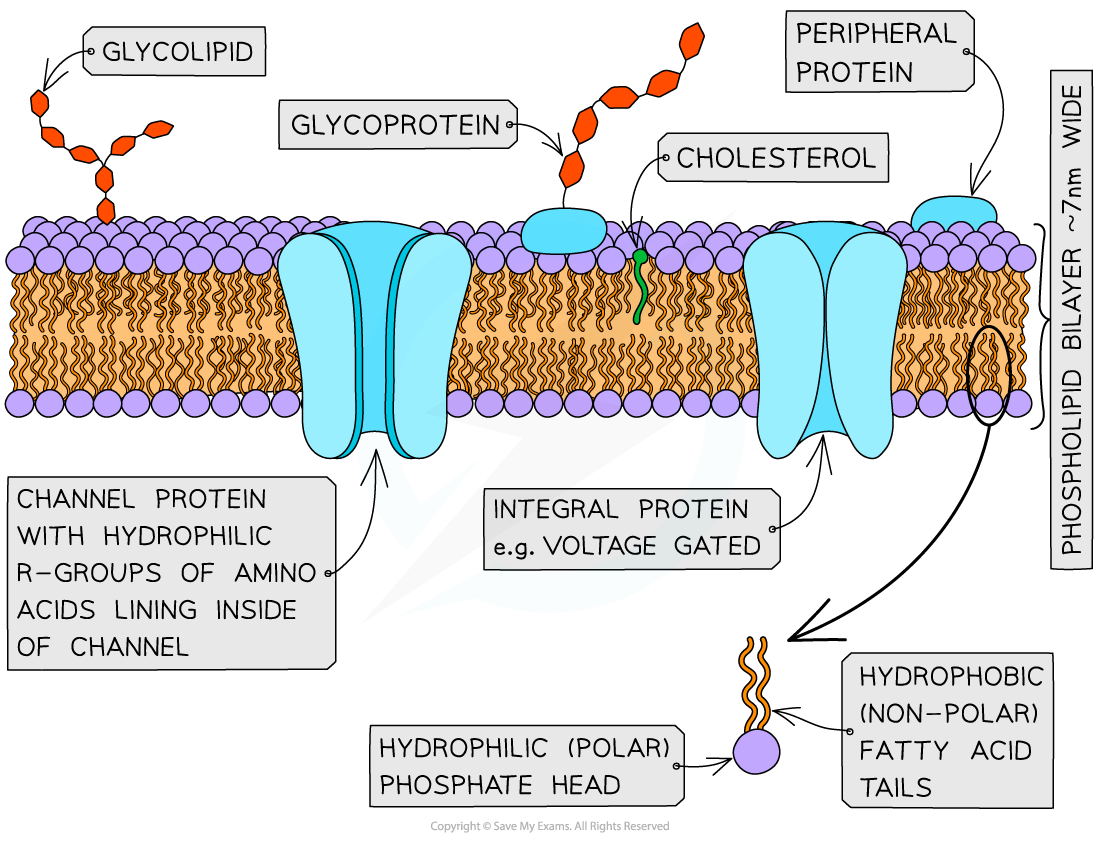
name how substances can move across the cell membrane
simple diffusion
facilitated diffusion
osmosis
active transport
co-transport
what is the role of ATP hydrolase in a K+ NA+ pump (2)
releases energy
to allow ions to be moved against a concentration gradient via active transport
how does the movement of Na+ out of the cell allow the absorption of glucose into the cell (2)
maintains a conc gradient for Na+ in the cell
so Na+ moves in via facilitated diffusion and brings glucose with it
explain the features of a cell specialised for absorption (4)
folded membranes to increase the surface area
large number of carrier and channel proteins to increase the rate of absorption via active transport and facilitated diffusion
large number of mitochondria to release ATP for active transport
membrane-bound digestive enzymes to maintain the concentration gradient
describe how the movement of substances across cell membrane is affected by the membrane structure (7)
phospholipid bilayer allows the movement of nonpolar substances
phospholipid bilayer prevents movement of polar substances
carrier proteins allow active transport
channel and carrier proteins allow facilitated diffusion
number of channel and carrier proteins determine how much movement
membrane surface area determines how much movement
cholesterol affects permeability of the membrane
how is ATP used in co-transport (3)
hydrolysis of ATP
changes the shape of the protein
and causes the release of molecule
compare the processes by which water and inorganic ions enter the cell (3)
both move down the concentration gradient
both move through channels in the membrane
ions can move against a concentration gradient via active transport
contrast the process of facilitated diffusion and active transport (3)
facilitated diffusion involves channel or carrier proteins whereas active transport only involves carrier proteins
facilitated diffusion does not use ATP whereas active transport does
facilitated diffusion is down a conc gradient whereas active transport is against a conc gradient
explain how glucose is absorbed by the ileum cells (4)
Na+ leaves the cell to enter blood via active transport through the sodium-potassium pump
therefore the conc of Na+ in cell is lower than outside of cell
this maintains a conc gradient for Na+ to diffuse into the cell through a simporter via facilitated diffusion
glucose absorbed with Na+ via the Na+ and glucose co-transport protein via facilitated diffusion
why is a fluid mosaic model called that (2)
fluid because the phospholipids and proteins can move around via diffusion
mosaic because there is a scattered pattern of proteins within the bilayer
What is the function peripheral proteins
Provide mechanical support
Can connect to proteins or lipids to make glycoproteins and glycolipids
Cell recognition as receptors
What is the function of integral proteins
Protein carriers or channel proteins involved in transport
What are protein channels
Tubes that fill with water to enable water soluble ions to diffuse
What are carrier proteins
Bind with larger molecules and change shape to transport them to other side
Why do we say that the membrane is partially permeable
As lipid soluble substances and very small molecules can diffuse across the membrane but larger molecules and water soluble molecules cannot
Define isotonic
Water potential in solution is same as cell
Define hypertonic
Water potential of solution is lower than cells
How does active transport work in the phospholipid bilayer
Transport through carrier proteins
Molecules bind to receptor complementary in shape on the protein
ATP binds to carrier protein from inside cell and is hydrolysed into ADP + Pi
This causes carrier protein to change shape and release molecule out of the other side of the
Phosphate ions is then released and protein returns to original shape
Define hypotonic
Water potential of solution if greater than cells

