BIO FINAL... ☠️
 Call Kai
 Learn
Learn Practice Test
 Spaced Repetition
 Match
Match Flashcards
 Knowt Play
1/35

There's no tags or description
Looks like no tags are added yet.
Name | Mastery | Learn | Test | Matching | Spaced | Call with Kai |
|---|
No analytics yet
Send a link to your students to track their progress
36 Terms
Monomer and functions of Lipids
Glycerol + fatty acids ; Long-term energy storage, insulation, protection, make up cell membranes
Monomer and functions of Carbohydrates
Monosaccharide (simple sugar like Glucose) ; the body's primary energy source, supplying immediate fuel (glucose) for cells, tissues, and the brain, and storing energy in the liver and muscles as glycogen
Monomer and functions of Proteins
Amino Acid ; build, strengthen, and repair bodily tissues (muscles, skin, bone), act as enzymes to catalyze metabolic reactions, and regulate immune function
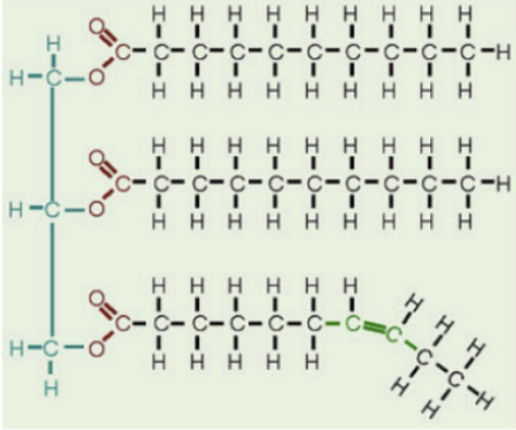
Identify which organic compound it is found in
Lipid
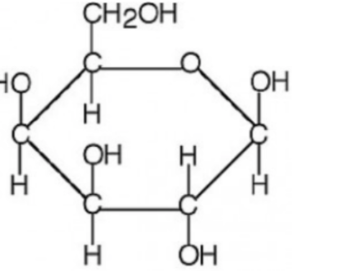
Identify which organic compound it is found in
Carbohydrates
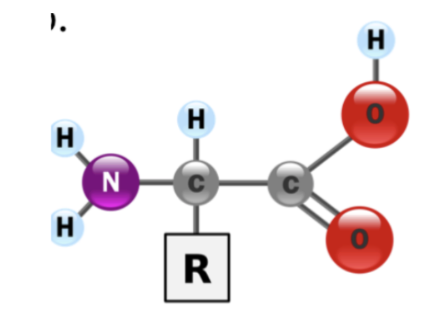
Identify which organic compound it is found in
Protein
Identify which organic compound for each:
Oil
amino acids
sugar
saturated fat
enzymes
Glucose
Lipid — oil
Protein — amino acids
Carbohydrate — sugar
Lipid — saturated fat
Protein — enzymes
Carbohydrate — Glucose
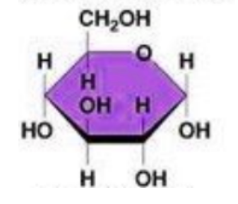
type of carb and how its identified
monosaccharide: Identified by: one single sugar unit ; ex: Glucose
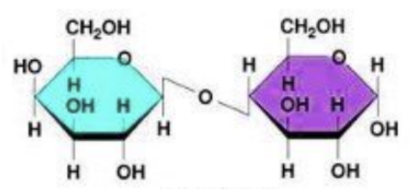
type of carb and how its identified
Disaccharide: Identified by 2 sugar units joined together ; ex: sucrose
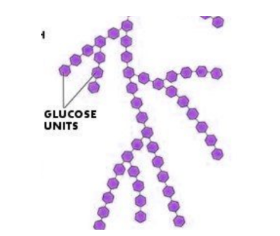
type of carb and how its identified
polysaccharide: Identified by many sugar units linked in long chains ; ex: Starch

which one is saturated/unsaturated?
Saturated Fats Unsaturated Fats
SF: Identified by: straight chains : (no double bonds, fully saturated with hydrogen)
UF: Identified by: bent/curved chains (has double bonds causing kinks)
SF: Example: butter UF: Example: olive oil
What is the main function of the cell membrane?
The main function of the cell membrane is to control what enters and leaves the cell (it acts as a selective barrier).
The cell membrane is selectively permeable. Explain what this means
The cell membrane is selectively permeable, which means it controls what enters and leaves the cell. It allows certain substances, like nutrients, water, and oxygen, to pass through easily, while keeping out harmful materials or regulating larger molecules. This selective control helps the cell maintain a stable internal environment, called homeostasis, which is essential for the cell to function properly and survive.
The cell membrane is a lipid bilayer made of phospholipids. say the parts of the phospholipid
Hydrophilic head, hydrophobic tails
Hydrophobic
refers to parts of molecules (like the tails of phospholipids in the cell membrane) that repel water and do not mix with it.
Hydrophilic
refers to parts of molecules (like the heads of phospholipids) that attract water and can interact or dissolve in it.
why are phospholipids important/why do they work with having hydrophobic and hydrophilic
Important for forming structures like the cell membrane, where hydrophilic heads face water and hydrophobic tails face inward, away from water.
Functions of:
Channel
Carrier
Receptor
Cell recognition
Forms a tunnel that lets specific substances (like ions or water) pass through the membrane.
Binds and transports specific molecules across the membrane, often changing shape to move them. CLAM
Detects signals (like hormones or chemicals) from outside the cell and triggers a response inside the cell CHIPPED
Helps the cell identify itself to other cells, often using glycoproteins, which is important for immune response and tissue formation. IN BETWEEN 2 CIRCLES THAT FORM ITS SHAPE
Equilibrium
is a state where substances are evenly distributed and there is no net change over time. In biology, it often refers to molecules moving across a membrane until their concentration is the same on both sides.
Simple Diffusion
the movement of high solute into low solute in a solvent (water) - NO PROTEIN NO ENERGY
Osmosis
The movement of water from its area of high water concentration to its area of low water concentration (water that has a solute like sugar) through a semi-permeable membrane - NO ENERGY NO PROTEIN
Hypertonic (Osmosis)
higher solute outside the cell : When there is more solute (salt) than solvent (water) around the cell so water will rush out of cell, shrinking the cell.
Hypotonic (Osmosis)
lower solute outside: When theres lower solute (sugar) outside the cell than inside so the water comes rushing in (potentially causing the cell to burst, called cytolysis )
Isotonic (Osmosis)
solute and solvent reach equilibrium, the cell neither grows, nor shrinks, and is much more likely to survive
Active Transport
the process of moving ions or molecules across a cell membrane from a region of lower concentration to a region of higher concentration, against the concentration gradient, while using energy in the form of ATP (primary) or stored energy as it piggy backs off another solute moving through the membrane (secondary) - NEEDS ENERGY AND CARRIER PROTEIN ; AGAINST GRADIENT
Protein pump (same as Carrier protein)
act as active transporters, which require energy, usually from ATP hydrolysis to move ions or molecules across cell membranes against their concentration gradient
Hydrolysis
The breaking down of complex molecules with the chemical addition of water molecules, breaking down covalent bonds
Dehydration synthesis
a chemical process that bonds smaller molecules, called monomers, together to build larger polymers by removing a water moleculw
Facilitated Diffusion
a type of passive transport that allows large, polar, or charged molecules to cross cell membranes down their concentration gradient using specific transmembrane carrier or channel proteins. (BASICALLY DIFFUSION, INSTEAD MOLECULES MUST PASS THROUGH PROTEINS) - NEEDS MEMBRANE TO WORK
Glycogen
Glycogen is a highly branched polysaccharide ( that acts as the primary, short-term energy storage molecule in animals, fungi, and bacteria. Known as "animal starch," it is stored in the liver and muscle tissues to maintain blood sugar levels and fuel physical activity.
13. When you drop food coloring into a glass of water, the color will eventually spread throughout the glass.
which type of transport is this an example of:
simple diffusion, facilitated diffusion, or osmosis?
Explain how you knew it was that type of transport.
It is simple diffusion because in this experiment we are simply just dropping food coloring into water and watching as it goes from high to low concentration as the food coloring molecules bounce off the molecules in the water. One of the Several ways I can differentiate that this is simple diffusion and not a facilitated or Osmosis one is that there is no membrane in this experiment, so therefore there is no area for a protein to be needed for it to be Facilitated diffusion and we are not measuring the movement of solely water so it cannot be Osmosis.
why do some molecules need help passing through the membrane? (through a protein)
Too large → Molecules are too big to fit through the membrane.
Charged → Ions (like Na⁺, Cl⁻) are repelled by the membrane.
Polar → Don’t mix with the nonpolar (hydrophobic) membrane.
Hydrophobic barrier → The membrane blocks substances that aren’t lipid-soluble.
Against gradient → Moving from low → high concentration requires protein help (and energy).
. A person with swollen gums rinses their mouth with salt water and the swelling decreases, what type of osmosis is undergoing and explain how adding salt water reduces swelling.
The salt water is a hypertonic solution, meaning it has a higher concentration of solute (salt) than inside the gum cells. Because of this, water moves out of the cells by osmosis (from high water concentration inside → lower outside). As water leaves the cells, they shrink, which reduces the swelling in the gums.
Homeostasis
Homeostasis is the process by which an organism maintains a stable internal environment (like temperature, water balance, and pH) despite changes in the outside environment.
Negative feedback loop
A process where a change in the body triggers a response that reverses the change and brings conditions back to normal. “stop, go back to normal”
Positive feedback loop
A process where a change in the body triggers a response that amplifies the change, making it grow until a specific outcome is reached. “keep going, more, more”

