N354 Exam 1: Physiologic Responses of the Newborn to Birth
 Studied by 1 person
 Call Kai
 Learn
Learn Practice Test
 Spaced Repetition
 Match
Match Flashcards
 Knowt Play
1/38

There's no tags or description
Looks like no tags are added yet.
Name | Mastery | Learn | Test | Matching | Spaced | Call with Kai |
|---|
No analytics yet
Send a link to your students to track their progress
39 Terms
The nurse is caring for a newborn 30 minutes after birth. After assessing respiratory function, the nurse would report which findings as abnormal?
Note: Credit will be given only if all correct choices and no incorrect choices are selected.
Select all that apply.
A) Respiratory rate of 66 breaths per minute
B) Periodic breathing with pauses of 25 seconds
C) Synchronous chest and abdomen movements
D) Grunting on expiration
E) Nasal flaring
Answer: B, D, E
Explanation:
A) Immediately after birth and for the next 2 hours, the normal respiratory rate is 60 to 70 breaths per minute.
B) Periodic breathing with pauses longer than 20 seconds (apnea) is an abnormal finding that should be reported to the physician.
C) Abdominal movements that are synchronous with the chest movements are normal.
D) Grunting on expiration is an abnormal finding that should be reported to the physician.
E) Nasal flaring is an abnormal finding that should be reported to the physician.
Page Ref: 642
A 2-day-old newborn is asleep, and the nurse assesses the apical pulse to be 88 beats/min. What would be the most appropriate nursing action based on this assessment finding?
A) Call the physician.
B) Administer oxygen.
C) Document the finding.
D) Place the newborn under the radiant warmer.
Answer: C
Explanation:
A) The apical pulse rate is within normal range. There is no need to call the physician.
B) There is no need to administer oxygen at this time.
C) An apical pulse rate of 88 beats/min is within the normal range of a sleeping full-term newborn. The average resting heart rate in the first week of life is 110 to 160 beats/min in a healthy full-term newborn but may vary significantly during deep sleep or active awake states. In full-term newborns, the heart rate may drop to a low of 80 to 100 beats/min during deep sleep.
D) There is no need to place the infant in a radiant warmer.
Page Ref: 643
The nurse is assessing a newborn at 1 hour of age. Which finding requires an immediate intervention?
A) Respiratory rate 60 and irregular in depth and rhythm
B) Pulse rate 145, cardiac murmur heard
C) Mean blood pressure 55 mmHg
D) Pauses in respiration lasting 30 seconds
Answer: D
Explanation:
A) The respiratory rate is normal. The normal newborn respiratory rate is 30 to 60 breaths per minute. Initial respirations may be largely diaphragmatic, shallow, and irregular in depth and rhythm.
B) This pulse rate is normal. The average resting heart rate in the first week of life is 110 to 160 beats/min. Cardiac murmurs are often present in the initial newborn period as transition from fetal to neonatal circulation occurs.
C) This is a normal finding in an infant 1 hour old. The average mean blood pressure is 31 to 61 mmHg in full-term resting newborns.
D) Pauses in respirations greater than 20 seconds are considered episodes of apnea, and require further intervention.
Page Ref: 642
The nurse has assessed four newborns' respiratory rates immediately following birth. Which respiratory rate would require further assessment by the nurse?
A) 60 breaths per minute
B) 70 breaths per minute
C) 64 breaths per minute
D) 20 breaths per minute
Answer: D
Explanation:
A) The normal range for respirations of a newborn within 2 hours after birth is 60 to 70 breaths per minute.
B) The normal range for respirations of a newborn within 2 hours after birth is 60 to 70 breaths per minute.
C) The normal range for respirations of a newborn within 2 hours after birth is 60 to 70 breaths per minute.
D) If respirations drop below 20 when the baby is at rest the primary care provider should be notified.
Page Ref: 642
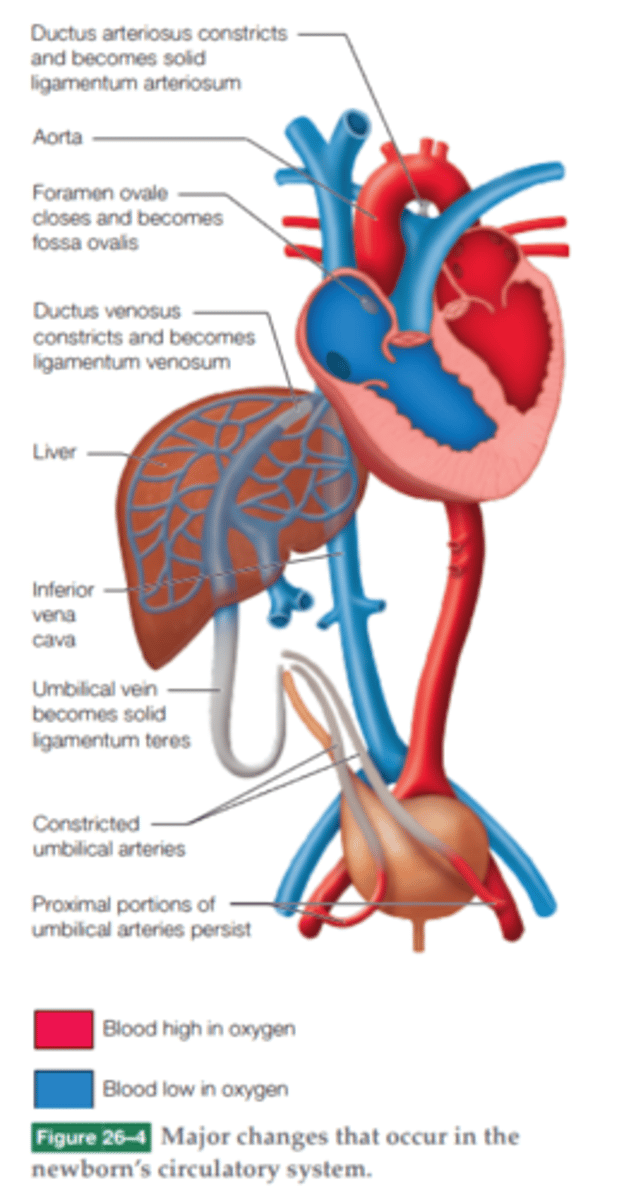
Marked changes that occur in the cardiopulmonary system at birth include which of the following?
Note: Credit will be given only if all correct choices and no incorrect choices are selected.
Select all that apply.
A) Closure of the foramen ovale
B) Closure of the ductus venosus
C) Mean blood pressure of 31 to 61 mmHg in full-term resting newborns
D) Increased systemic vascular resistance and decreased pulmonary vascular resistance
E) Opening of the ductus arteriosus
Answer: A, B, D
Explanation:
A) Closure of the foramen ovale is a function of changing arterial pressures.
B) Closure of the ductus venosus is related to mechanical pressure changes that result from severing the cord, redistribution of blood, and cardiac output.
C) The average mean blood pressure of 31 to 61 mmHg in full-term resting newborns is a normal finding, but not a marked change in the cardiopulmonary system.
D) Increased systemic vascular resistance and decreased pulmonary vascular resistance; with the loss of the low-resistance placenta, systemic vascular resistance increases, resulting in greater systemic pressure. The combination of vasodilation and increased pulmonary blood flow decreases pulmonary vascular resistance.
E) Functional closure, not opening, of the ductus arteriosus in the well newborn starts at 10 to 15 hours after birth.
Page Ref: 641
The pediatric clinic nurse is reviewing lab results with a 2-month-old infant's mother. The infant's hemoglobin has decreased since birth. Which statement by the mother indicates the need for additional teaching?
A) "My baby isn't getting enough iron from my breast milk."
B) "Babies undergo physiologic anemia of infancy."
C) "This results from dilution because of the increased plasma volume."
D) "Delaying the cord clamping did not cause this to happen."
Answer: A
Explanation:
A) At 2 months of age, infants increase their plasma volume, which results in physiologic anemia. This condition is not related to iron in the breast milk.
B) This initial decline in hemoglobin creates a phenomenon known as physiologic anemia of the newborn.
C) Hemoglobin values fall, mainly from a decrease in red cell mass rather than from the dilutional effect of increasing plasma volume.
D) Early or delayed cord clamping does not affect hemoglobin levels at this age.
Page Ref: 644
Which of the following is a benefit of delayed umbilical cord clamping for the preterm infant?
A) Fewer infants require blood transfusion for anemia
B) Fewer infants require blood transfusion for high blood pressure
C) Increase in the incidence of intraventricular hemorrhage
D)Increase in incidence of infant breastfeeding
Answer: A
Explanation:
A) Clinical trials in preterm infants found that delaying umbilical cord clamping was associated with fewer infants who required blood transfusion for anemia.
B) Clinical trials in preterm infants found that delaying umbilical cord clamping was associated with fewer infants who required blood transfusion for low blood pressure.
C) Delayed umbilical cord clamping shows a significant reduction in the incidence of intraventricular hemorrhage.
D) Delayed umbilical cord clamping does not impact the incidence of breastfeeding.
Page Ref: 645
In utero, what is the organ responsible for gas exchange?
A) Umbilical vein
B) Placenta
C) Inferior vena cava
D) Right atrium
Answer: B
Explanation:
A) From the placenta, highly oxygenated blood flows through the umbilical vein.
B) In utero, the placenta is the organ of gas exchange.
C) From the placenta, highly oxygenated blood flows through the umbilical vein. A small amount of blood perfuses the liver, with the majority of blood volume flowing through the inferior vena cava and to the right atrium.
D) From the placenta, highly oxygenated blood flows through the umbilical vein. A small amount of blood perfuses the liver, with the majority of blood volume flowing through the inferior vena cava and to the right atrium.
Page Ref: 639
A postpartum mother questions whether the environmental temperature should be warmer in the baby's room at home. The nurse responds that the environmental temperature should be warmer for the newborn. This response is based on which newborn characteristics that affect the establishment of thermal stability?
Note: Credit will be given only if all correct choices and no incorrect choices are selected.
Select all that apply.
A) Newborns have less subcutaneous fat than do adults.
B) Infants have a thick epidermis layer.
C) Newborns have a large body surface to weight ratio.
D) Infants have increased total body water.
E) Newborns have more subcutaneous fat than do adults.
Answer: A, C, D
Explanation:
A) Heat transfer from neonatal organs to skin surface is increased compared to adults due to the neonate's decreased subcutaneous fat.
B) Preterm infants have increased heat loss via evaporation due to thin skin.
C) Heat transfer from neonatal organs to skin surface is increased compared to adults due to the neonate's large body surface to weight ratio.
D) Preterm infants have increased heat loss via evaporation due to increased total body water.
E) Newborns do not have more subcutaneous fat than adults.
Page Ref: 645
The nurse is teaching new parents how to dress their newborn. Which statements indicate that teaching has been effective?
Note: Credit will be given only if all correct choices and no incorrect choices are selected.
Select all that apply.
A) "We should keep our home air-conditioned so the baby doesn't overheat."
B) "It is important that we dry the baby off as soon as we give him a bath or shampoo his hair."
C) "When we change the baby's diaper, we should change any wet clothing or blankets, too."
D) "If the baby's body temperature gets too low, he will warm himself up without any shivering."
E) "Our baby will have a much faster rate of breathing if he is not dressed warmly enough."
Answer: B, C, D, E
Explanation:
A) Because of the risk of hypothermia and possible cold stress, minimizing heat loss in the newborn after birth is essential.
B) The newborn is particularly prone to heat loss by evaporation immediately after birth and during baths; thus drying the newborn is critical.
C) Changing wet clothing or blankets immediately prevents evaporation, one mechanism of heat loss.
D) Nonshivering thermogenesis (NST), an important mechanism of heat production unique to the newborn, is the major mechanism through which heat is produced.
E) A decrease in the environmental temperature of 2°C is a drop sufficient to double the oxygen consumption of a term newborn and can cause the newborn to show signs of respiratory distress.
Page Ref: 646
The nurse is planning care for a newborn. Which nursing intervention would best protect the newborn from the most common form of heat loss?
A) Placing the newborn away from air currents
B) Pre-warming the examination table
C) Drying the newborn thoroughly
D) Removing wet linens from the isolette
Answer: C
Explanation:
A) Placing the newborn away from air currents reduces heat loss by convection, which is not the most common form of heat loss.
B) Pre-warming the examination table reduces heat loss by conduction, which is not the most common form of heat loss.
C) The most common form of heat loss is evaporation. The newborn is particularly prone to heat loss by evaporation immediately after birth (when the baby is wet with amniotic fluid) and during baths; thus drying the newborn is critical.
D) Removing wet linens from the isolette that are not in direct contact with the newborn reduces heat loss by radiation, which is not the most common form of heat loss.
Page Ref: 646
The nurse is planning an educational presentation on hyperbilirubinemia for nursery nurses. Which statement is most important to include in the presentation?
A) Conjugated bilirubin is eliminated in the conjugated state.
B) Unconjugated bilirubin is neurotoxic, and cannot cross the placenta.
C) Total bilirubin is the sum of the direct and indirect levels.
D) Hyperbilirubinemia is a decreased total serum bilirubin level.
Answer: C
Explanation:
A) The (direct) conjugated bilirubin progresses down the intestines, where bacteria transform it into urobilinogen (urine bilirubin). Even after the bilirubin has been conjugated and bound, it can be changed back to unconjugated bilirubin via the enterohepatic circulation.
B) Fetal unconjugated bilirubin crosses the placenta to be excreted, so the fetus does not need to conjugate bilirubin.
C) Total serum bilirubin is the sum of conjugated (direct) and unconjugated (indirect) bilirubin.
D) Hyperbilirubinemia is an elevated total serum bilirubin level.
Page Ref: 648
A telephone triage nurse gets a call from a postpartum client who is concerned about jaundice. The client's newborn is 37 hours old. What data point should the nurse gather first?
A) Stool characteristics
B) Fluid intake
C) Skin color
D) Bilirubin level
Answer: C
Explanation:
A) The stool characteristic of green coloration indicates excretion of bilirubin.
B) Breastfeeding is implicated in jaundice in some newborns. Breast milk jaundice occurs in approximately 2% to 4% of term infants with an onset of 4 to 7 days of life.
C) Jaundice (icterus) is the yellowish coloration of the skin and sclera caused by the presence of bilirubin in elevated concentrations. Inspection of the skin would be the first step in assessing for jaundice.
D) Bilirubin is primarily the metabolic end product of erythrocyte (RBC) breakdown. Conjugation, or the changing of bilirubin into an excretable form, is the conversion of the yellow lipid-soluble pigment (unconjugated, indirect) into water-soluble pigment (excretable, direct).
Page Ref: 648
The mother of a 3-day-old infant calls the clinic and reports that her baby's skin is turning slightly yellow. What should the nurse explain to the mother?
A) Physiologic jaundice is normal, and peaks at this age.
B) The newborn's liver is not working as well as it should.
C) The baby is yellow because the bowels are not excreting bilirubin.
D) The yellow color indicates that brain damage might be occurring
Answer: A
Explanation:
A) Physiologic jaundice occurs soon after birth. Bilirubin levels peak at 3 to 5 days in term infants.
B) The liver of an infant is not fully mature at this point.
C) The liver of an infant conjugates the bilirubin, which is then excreted through the bowels.
D) Unmonitored and untreated severe hyperbilirubinemia may progress to excessive levels that are associated with bilirubin neurotoxicity. An infant with severe jaundice would have a high level of yellow skin color, but this infant is only slightly yellow.
Page Ref: 650
The visiting nurse evaluates a 2-day-old breastfed newborn at home and notes that the baby appears jaundiced. When explaining jaundice to the parents, what would the nurse tell them?
A) "Jaundice is uncommon in newborns."
B) "Some newborns require phototherapy."
C) "Jaundice is a medical emergency."
D) "Jaundice is always a sign of liver disease."
Answer: B
Explanation:
A) Physiologic jaundice is a normal process that can occur after 24 hours of life and develops in more than 60% of term newborns and 80% of preterm neonates.
B) Physiologic jaundice is a normal process that can occur after 24 hours of life in about half of healthy newborns. It is not a sign of liver disease. Physiologic jaundice might require phototherapy.
C) Physiologic jaundice is a normal process that can occur after 24 hours of life in about half of healthy newborns. It is not a medical emergency.
D) Physiologic jaundice is not a sign of liver disease.
Page Ref: 648
Which of the following would be a newborn care procedure that will decrease the probability of high bilirubin levels?
A) Monitor urine for amount and characteristics.
B) Encourage late feedings to promote intestinal elimination.
C) All infants should be routinely monitored for iron intake.
D) Maintain the newborn's skin temperature at 36.5°C (97.8°F) or above.
Answer: D
Explanation:
A) Monitor stool for amount and characteristics. Bilirubin is eliminated in the feces.
B) Encourage early feedings to promote intestinal elimination and bacterial colonization, and to provide the caloric intake necessary for hepatic binding proteins to form.
C) All infants should be routinely monitored for the development of jaundice.
D) Maintain the newborn's skin temperature at 36.5°C (97.8°F) or above; cold stress results in acidosis.
Page Ref: 649
Clinical risk factors for severe hyperbilirubinemia include which of the following?
Note: Credit will be given only if all correct choices and no incorrect choices are selected.
Select all that apply.
A) African American ethnicity
B) Female gender
C) Cephalohematoma
D) Bruising
E) Assisted delivery with vacuum or forceps
Answer: C, D, E
Explanation:
A) A clinical risk factor for severe hyperbilirubinemia includes Asian ethnicity.
B) A clinical risk factor for severe hyperbilirubinemia includes male gender.
C) A clinical risk factor for severe hyperbilirubinemia includes cephalohematoma.
D) A clinical risk factor for severe hyperbilirubinemia includes bruising.
E) A clinical risk factor for severe hyperbilirubinemia includes assisted delivery with vacuum or forceps.
Page Ref: 649
The home care nurse is examining a 3-day-old infant. The child's skin on the sternum is yellow when blanched with a finger. The parents ask the nurse why jaundice occurs. What is the best response from the nurse?
A) "The liver of an infant is not fully mature, and doesn't conjugate the bilirubin for excretion."
B) "The infant received too many red blood cells after delivery because the cord was not clamped immediately."
C) "The yellow color of your baby's skin indicates that you are breastfeeding too often."
D) "This is an abnormal finding related to your baby's bowels not excreting bilirubin as they should."
Answer: A
Explanation:
A) Physiologic jaundice is a common occurrence, and peaks at 3 to 5 days in term infants. The reduction in hepatic activity, along with a relatively large bilirubin load, decreases the liver's ability to conjugate bilirubin and increases susceptibility to jaundice.
B) The conjugation of bilirubin has nothing to do with cord clamping.
C) Prevention and treatment of early breastfeeding jaundice includes encouraging frequent (every 2 to 3 hours) breastfeeding.
D) Direct bilirubin is excreted into the bile ducts and duodenum. The conjugated bilirubin then progresses down the intestines, where bacteria transform it into urobilinogen and stercobilinogen. Stercobilinogen is not reabsorbed, but is excreted as a yellow-brown pigment in the stools.
Page Ref: 650
Which of the following is the primary carbohydrate in the breastfeeding newborn?
A) Glucose
B) Fructose
C) Lactose
D) Maltose
Answer: C
Explanation:
A) Glucose is not the primary carbohydrate in the breastfeeding newborn.
B) Fructose is not the primary carbohydrate in the breastfeeding newborn.
C) Lactose is the primary carbohydrate in the breastfeeding newborn and is generally easily digested and well absorbed.
D) Newborns have trouble digesting starches (changing more complex carbohydrates into maltose), so they should not eat them until after the first 6 months of life.
Page Ref: 651
At birth, an infant weighed 6 pounds 12 ounces. Three days later, he weighs 5 pounds 2 ounces. What conclusion should the nurse draw regarding this newborn's weight?
A) This weight loss is excessive.
B) This weight loss is within normal limits.
C) This weight gain is excessive.
D) This weight gain is within normal limits.
Answer: A
Explanation:
A) This newborn has lost more than 10% of the birth weight; this weight loss is excessive. Following birth, caloric intake is often insufficient for weight gain until the newborn is 5 to 10 days old. During this time there may be a weight loss of 5% to 10% in term newborns.
B) This weight loss is greater than the expected 5% to 10%.
C) This is not a weight gain.
D) This is not a weight gain.
Page Ref: 651
A new grandfather is marveling over his 12-hour-old newborn grandson. Which statement indicates that the grandfather needs additional education?
A) "I can't believe he can already digest fats, carbohydrates, and proteins."
B) "It is amazing that his whole digestive tract can move things along at birth."
C) "Incredibly, his stomach capacity was already a cupful when he was born."
D) "He will lose some weight but then miraculously regain it by about 10 days."
Answer: C
Explanation:
A) At birth, neonates can digest fats, simple carbohydrates, and proteins.
B) The stomach empties intermittently, starting within a few minutes of the beginning of a feeding and ending between 2 and 4 hours after feeding.
C) The newborn's stomach has a capacity of 50 to 60 mL.
D) Following birth, caloric intake is often insufficient for weight gain until the newborn is 5 to 10 days old. During this time there may be a weight loss of 5% to 10% in term newborns.
Page Ref: 651
A postpartum client calls the nursery to report that her 3-day-old newborn has passed a green stool. What is the nurse's best response?
A) "Take your newborn to the pediatrician."
B) "There might be a possible food allergy."
C) "Your newborn has diarrhea."
D) "This is a normal occurrence."
Answer: D
Explanation:
A) It is not necessary for the client to take her newborn to the pediatrician.
B) The green color of stool is not due to food allergies.
C) The green color of stool is not due to diarrhea.
D) The newborn's stools change from meconium (thick, tarry, black) to transitional stools (thinner, brown to green).
Page Ref: 651
A newborn who has not voided by 48 hours after birth should be assessed for which of the following?
Note: Credit will be given only if all correct choices and no incorrect choices are selected.
Select all that apply.
A) Restlessness
B) Pain
C) Kidney distention
D) Adequacy of fluid intake
E) Lethargy
Answer: A, B, D
Explanation:
A) A newborn who has not voided by 48 hours after birth should be assessed for restlessness.
B) A newborn who has not voided by 48 hours after birth should be assessed for pain.
C) A newborn who has not voided by 48 hours after birth should be assessed for bladder distention, not kidney distention.
D) A newborn who has not voided by 48 hours after birth should be assessed for adequacy of fluid intake.
E) A newborn who has not voided by 48 hours after birth should be assessed for restlessness, not lethargy.
Page Ref: 652
The parents of a newborn are receiving discharge teaching. The nurse explains that the infant should have several wet diapers per day. Which statement by the parents indicates that further education is necessary?
A) "Our baby was born with kidneys that are too small."
B) "A baby's kidneys don't concentrate urine well for several months."
C) "Feeding our baby frequently will help the kidneys function."
D) "Kidney function in an infant is very different from that in an adult."
Answer: A
Explanation:
A) Size of the kidneys is rarely an issue.
B) The ability to concentrate urine fully is attained by 3 months of age.
C) Feeding practices may affect the osmolarity of the urine but have limited effect on concentration of the urine.
D) The neonate's ability to dilute urine is fully developed, but concentrating ability is limited.
Page Ref: 652
The student nurse notices that a newborn weighs less today compared with the newborn's birth weight three days ago. The nursing instructor explains that newborns lose weight following birth due to which of the following?
A) A shift of intracellular water to extracellular spaces.
B) Loss of meconium stool.
C) A shift of extracellular water to intracellular spaces.
D) The sleep-wake cycle.
Answer: A
Explanation:
A) A shift of intracellular water to extracellular space and insensible water loss account for the 5% to 10% weight loss.
B) Loss of meconium stool does not effect this amount of weight loss.
C) A shift of intracellular water to extracellular space and insensible water loss account for the 5% to 10% weight loss.
D) The sleep-wake cycle does not effect this amount of weight loss.
Page Ref: 651
Which of the following would be considered normal newborn urinalysis values?
Note: Credit will be given only if all correct choices and no incorrect choices are selected.
Select all that apply.
A) Color bright yellow
B) Bacteria 0
C) Red blood cells (RBC) 0
D) White blood cells (WBC) more than 4-5/hpf
E) Protein less than 5-10 mg/dL
Answer: B, C, E
Explanation:
A) Urine color should be pale yellow.
B) Bacteria value should be 0.
C) Red blood cells (RBC) should be 0.
D) White blood cells (WBC) should be less than 2-3/hpf.
E) Protein less than 5-10 mg/dL would be considered normal.
Page Ref: 652
The mother of a 2-day-old male has been informed that her child has sepsis. The mother is distraught and says, "I should have known that something was wrong. Why didn't I see that he was so sick?" What is the nurse's best reply?
A) "Newborns have immature immune function at birth, and illness is very hard to detect."
B) "Your mothering skills will improve with time. You should take the newborn class."
C) "Your baby didn't get enough active acquired immunity from you during the pregnancy."
D) "The immunity your baby gets in utero doesn't start to function until he is 4 to 8 weeks old."
Answer: A
Explanation:
A) The immune responses in neonates are usually functionally impaired when compared with adults.
B) This response does not address the physiology of neonatal infection, and is not therapeutic because it is blaming.
C) The pregnant woman forms antibodies in response to illness or immunization called active acquired immunity. Neonatal defense against infections in utero or after delivery is dependent on maternal immunity.
D) When antibodies are transferred to the fetus in utero, passive acquired immunity results because the fetus does not produce the antibodies itself.
Page Ref: 652
Which nonspecific immune mechanism helps the ability of antibodies and phagocytic cells to clear pathogens from an organism?
A) Complement
B) Coagulation
C) Inflammatory response
D) Phagocytosis
Answer: A
Explanation:
A) Complement helps or "complements" the ability of antibodies and phagocytic cells to clear pathogens from an organism.
B) Coagulation is the process by which blood forms a clot.
C) Inflammatory response is the complex biologic response of vascular tissues to harmful stimuli such as pathogens, damaged cells or irritants.
D) Phagocytosis is a major mechanism to remove pathogens and cell debris.
Page Ref: 652
Specific cellular immunity is mediated by T lymphocytes, which enhance the efficiency of the phagocytic response. What do cytotoxic activated T cells do?
A) Enable T or B cells to respond to antigens
B) Repress responses to specific B or T lymphocytes to antigens
C) Kill foreign or virus-infected cells
D) Remove pathogens and cell debris
Answer: C
Explanation:
A) Helper activated T cells enable T or B cells to respond to antigens.
B) Suppressor activated T cells repress responses to specific B or T lymphocytes to antigens.
C) Cytotoxic activated T cells kill foreign or virus-infected cells.
D) Phagocytosis is a major mechanism to remove pathogens and cell debris.
Page Ref: 653
The student nurse notices that the newborn seems to focus on the mother's eyes. The nursing instructor explains that this newborn behavior is which of the following?
A) Habituation
B) Orientation
C) Self-quieting
D) Reactivity
Answer: B
Explanation:
A) Habituation is the newborn's ability to process and respond to complex stimulation.
B) Orientation is the newborn's ability to be alert to, follow, and fixate on complex visual stimuli that have a particular appeal and attraction. The newborn prefers the human face and eyes, and bright shiny objects.
C) Self-quieting is the ability of newborns to use their own resources to quiet and comfort themselves.
D) The newborn usually shows a predictable pattern of behavior during the first several hours after birth, characterized by two periods of reactivity separated by a sleep phase.
Page Ref: 655
A new father asks the nurse to describe what his baby will experience while sleeping and awake. What is the best response?
A) "Babies have several sleep and alert states. Keep watching and you'll notice them."
B) "You might have noticed that your child was in an alert awake state for an hour after birth."
C) "Newborns have two stages of sleep: deep or quiet sleep and rapid eye movement sleep."
D) "Birth is hard work for babies. It takes them a week or two to recover and become more awake."
Answer: C
Explanation:
A) Although it is true that babies have several sleep and alert states, the wording of this response is condescending and not therapeutic.
B) Although this statement is true, it does not respond to the father's question about sleeping now.
C) Teaching the parents how to recognize the two sleep stages helps them tune in to their infant's behavioral states.
D) Recovery from the birth process only takes a day or two. The newborn usually shows a predictable pattern of behavior during the first several hours after birth.
Page Ref: 654
A new mother is holding her 2-hour-old son. The delivery occurred on the due date. His Apgar score was 9 at both 1 and 5 minutes. The mother asks the nurse why her son was so wide awake right after birth, and now is sleeping so soundly. What is the nurse's best response?
A) "Don't worry. Babies go through a lot of these little phases."
B) "Your son is in the sleep phase. He'll wake up soon."
C) "Your son is exhausted from being born, and will sleep 6 more hours."
D) "Your breastfeeding efforts have caused excessive fatigue in your son."
Answer: B
Explanation:
A) Although this infant's behavior is expected, nurses must avoid using clichés in therapeutic communication.
B) The first period of reactivity lasts approximately 30 minutes after birth. During this period the newborn is awake and active and may appear hungry and have a strong sucking reflex. After approximately half an hour, the newborn's activity gradually diminishes, and the heart rate and respirations decrease as the newborn enters the sleep phase. The sleep phase may last from a few minutes to 2 to 4 hours.
C) Six hours of sleep at this point is not an expected finding.
D) Breastfeeding does not cause fatigue in a normal term newborn.
Page Ref: 654
The nurse is teaching a newborn care class to parents who are about to give birth to their first babies. Which statement by a parent indicates that teaching was effective?
A) "My baby will be able to focus on my face when she is about a month old."
B) "My baby might startle a little if a loud noise happens near him."
C) "Newborns prefer sour tastes."
D) "Our baby won't have a sense of smell until she is older."
Answer: B
Explanation:
A) Newborns can focus on faces, eyes, and shiny objects at birth.
B) Swaddling, placing a hand on the abdomen, or holding the arms to prevent a startle reflex are ways to soothe the newborn. The settled newborn is then able to attend to and interact with the environment.
C) Newborns can distinguish between sweet and sour at 3 days of age. Sugar, for example, increases sucking, and newborns tend to have a preference for sweet tastes.
D) Newborns develop the sense of smell rapidly and can differentiate their mother by smell within the first week of life.
Page Ref: 655
The nurse is teaching a group of new parents about newborn behavior. Which statement made by a parent would indicate a need for additional information?
A) "Sleep and alert states cycle throughout the day."
B) "We can best bond with our child during an alert state."
C) "About half of the baby's sleep time is in active sleep."
D) "Babies sleep during the night right from birth."
Answer: D
Explanation:
A) Sleep and alert states are noticeable behaviors in infants, beginning immediately after birth with the first period of alert activity.
B) Bonding between infant and parents takes place with interaction during alert states.
C) About 45% to 50% of the newborn's total sleep is active sleep, 35% to 45% is quiet sleep, and 10% is transitional between these two periods.
D) Over time, the newborn's sleep-wake patterns become diurnal, that is, the newborn sleeps at night and stays awake during the day.
Page Ref: 654
At birth, a newborn weighs 8 pounds 4 ounces. When discussing the infant's weight over the next week, what is the maximum amount of weight the mother should expect that the infant will lose? (Calculate to the first decimal point.)
Answer: 13.2 ounces
Explanation:
The maximum amount of weight loss over the first 5 to 10 days of extrauterine life is 10%. If the infant weighs 8 pounds 4 ounces, this weight in ounces is 132 ounces. Multiply this weight by 10% to find that the mother can expect the infant to lose 13.2 ounces. When converted to pounds and ounces, the infant should not weight less than 7 pounds 5 ounces.
Page Ref: 651
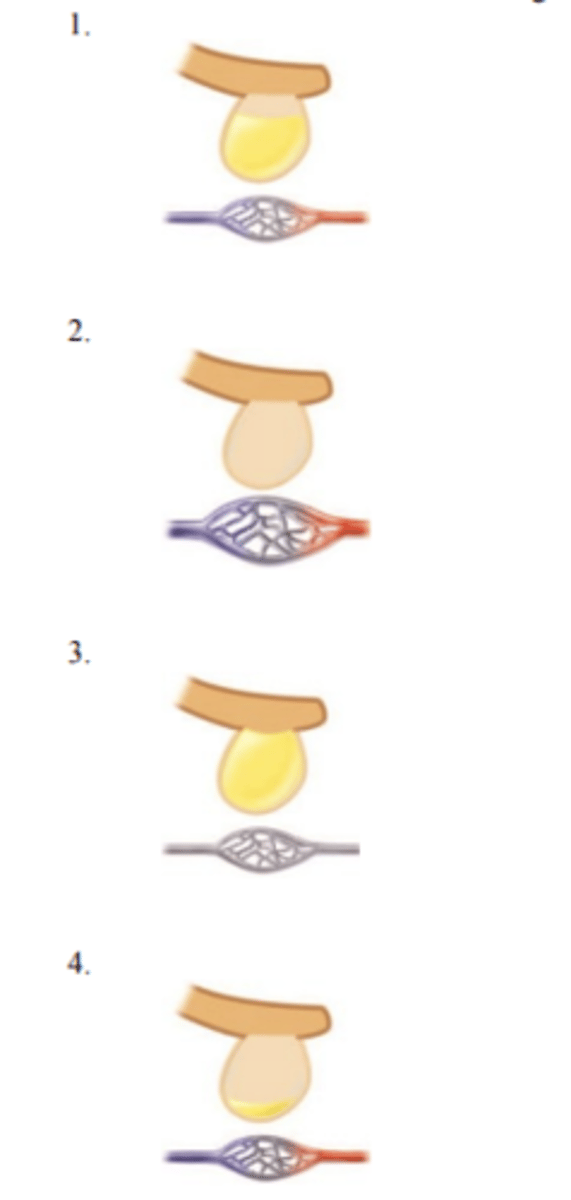
Answer: 3, 1, 4, 2
Explanation: In Diagram 3, fetal alveoli are filled to functional residual capacity with fetal lung fluid. Fetal lung fluid is produced by the alveoli, fills the airways, and eventually enters the amniotic fluid. Diagram 1 shows how after fetal chest compression, one third of the fetal lung fluid is squeezed out, allowing air to enter passively as the chest recoils. Diagram 4 shows how with each subsequent breath, the lungs expand, facilitating the movement of the remaining fetal lung fluid into the capillaries and lymphatic system. Pulmonary blood flow is increasing. Diagram 2 shows normal alveoli after removal of fetal lung fluid and dilatation of pulmonary arteries. Surfactant has lined the inside of the alveoli to prevent collapse. Page Ref: 639
35) The nurse is explaining the process of how a newborn adapts to breathing after delivery. In which order should the nurse review the following diagrams?
The nurse is instructing a new mother on the amount and frequency of bottle-feeding for her newborn. The mother plans to use formula that is available in 6-ounce cans. If the infant ingests 25 mL for each of 8 feedings per day, how many cans of formula should the mother have available for a week? (Round to the nearest whole number.)
Answer: 8 cans
Explanation:
One ounce is equal to 30 mL. For a 6-ounce can, the amount of formula is 30×6 or 180 mL. For one day, the infant will ingest 25 mL×8 feedings or 200 mL. For 7 days the infant will ingest 200 mL × 7 = 1400 mL. To determine the number of cans of formula needed divide the weekly total of 1400 mL by 180 mL or 1400/180 = 7.78 or 8 cans of formula is needed.
Page Ref: 651
During a home visit the mother of a 2 week old newborn is concerned that the baby always seems to be "wet" and wonders if this is normal. The newborn weighs 4 kg. How many mL of fluid should the nurse explain that the infant makes each day? (Round to the nearest whole number.)
Answer: 100 mL
Explanation:
The newborn voids 5 to 25 times every 24 hours, with a volume of 25 mL/kg/day. If the newborn weighs 4 kg then the amount of urine produced every day is 25 mL × 4 = 100 mL.
Page Ref: 652
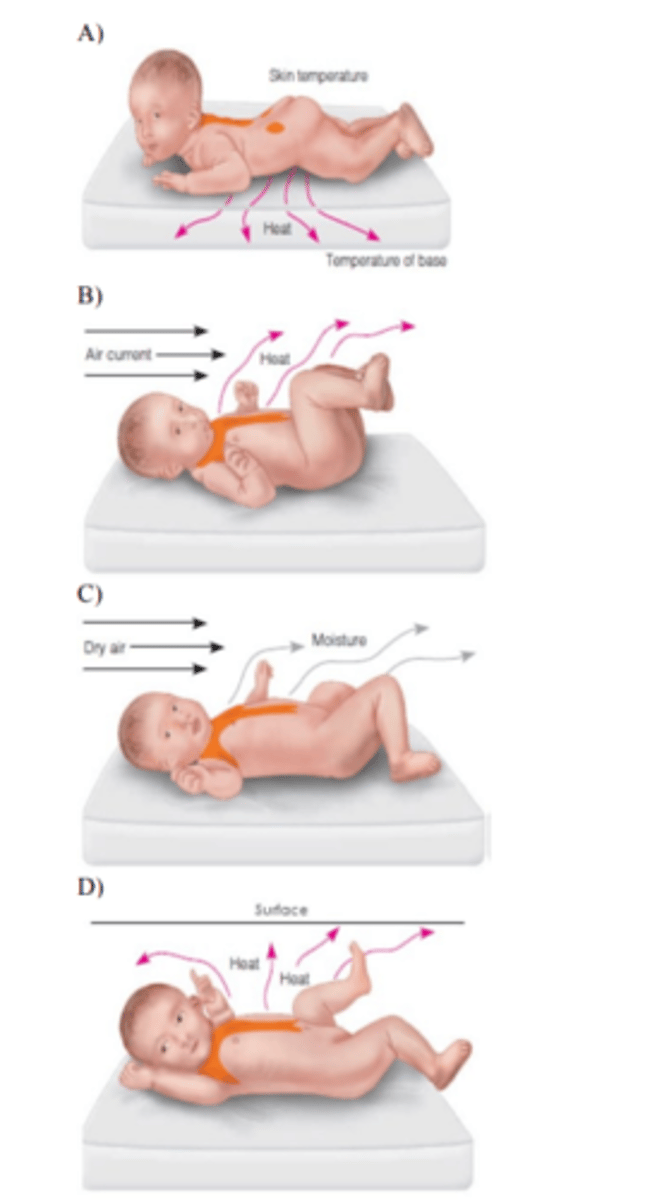
Answer: B
Explanation: B) Convection is the loss of heat from the warm body surface to cooler air currents, as shown in Diagram 2. Air-conditioned rooms, air currents with a temperature below the infant's skin temperature, unwarmed oxygen by mask, and removal of the infant from an incubator for procedures increase convective heat loss of the newborn. Conduction is the loss of heat to a cooler surface by direct skin contact, as shown in Diagram 1. Chilled hands, cool scales, cold examination tables, and cold stethoscopes can cause heat loss by conduction. Evaporation is the loss of heat incurred when water is converted to a vapor, as shown in Diagram 3. The newborn is particularly prone to heat loss by evaporation immediately after birth (when the baby is wet with amniotic fluid) and during baths; therefore, drying the newborn is critical. Radiation losses occur when body heat is transferred to cooler surfaces and objects that are not in direct contact with the body, as shown in Diagram 4. The walls of a room or of an incubator are potential causes of heat loss by radiation, even if the ambient temperature of the incubator is within the neutral thermal range for the infant.
Page Ref: 646
36) The nurse is explaining the processes of infant heat loss to a new mother. Which diagram should the nurse use to describe the process of convection?
 Note
Note  Flashcards (25)