globalisation
 Call Kai
 Learn
Learn Practice Test
 Spaced Repetition
 Match
Match Flashcards
 Knowt Play
1/61

There's no tags or description
Looks like no tags are added yet.
Name | Mastery | Learn | Test | Matching | Spaced | Call with Kai |
|---|
No analytics yet
Send a link to your students to track their progress
62 Terms
what is time space compression
David Harvey 1990 - the world feels smaller than before due to advances in travel and communication, spatial shrinkage and metaphorical contraction of the globe as relation to travel speed
the world feels smaller due to rapid rate of globalisation - we are more connected - accelerated compression
e.g. planes are faster than boats, modern trains are faster than steam trains
what is the global village
Marshall McLuhan - everyone knows everyone, all parts of the world are being brought together by the internet and other electronic communication interconnections
News quickly travels and is reported globally e.g. 9/11
what is the definition of globalisation
‘Globalisation is the increasing connections between places and people across the planet, established through trade, politics and cultural exchanges, and helped by technology and transport.’
It is a PROCESS.
what are key events that enabled globalisation or highlighted the extent of it
World Bank at the end of WW2 - global economy by establishing common economic rules (1944)
Britain joins EU (1975)
First Windows computers sold (1990)
Broadband internet for homes (1996)
Tesco opens a store in Asia (1998)
Millennium development goals are set (2000)
9/11 (2001)
Facebook (2004)
China becomes world’s largest economy (2011)
how is globalisation measured
KOF Globalisation Index
The KOF Globalisation Index measures 27 economic, social and political dimensions of globalisation. Globalisation in the economic, social and political fields has been on the rise since the 1970s, receiving a particular boost after the end of the Cold War. The KOF index is a score each country is given out of 100, the higher the number the more Globalised the country is considered to be
what are the top 5 countries on the KOF index
Switzerland
Belgium
Netherlands
Sweden
Germany
(some of the richest HIC countries)
what are social, economic, political categories of globalisation
Economic globalisation is measured by the actual flows of trade, foreign direct investment and portfolio investment, as well as the restrictions applying to these flows.
Social globalisation is expressed as the spread of ideas, information, images and people. It is estimated by personal contact (international telephone traffic, transfers, tourism, foreign population, and international letters), information flows (Internet users, television ownership, trade in newspapers), and cultural proximity (number of McDonald’s restaurants, number of Ikea shops and trade in books).
Political globalisation is characterized by the degree of political cooperation. It is measured by the number of embassies, membership of international organizations, participation in UN Security Council missions, and number of international treaties signed.
what are weaknesses to the KOF index for measuring globalisation
outdated despite being updated yearly
e.g. people don’t read newspapers as much anymore, everyone uses te internet, people do not really send letters, mobiles over TV
what are some factors that KOF takes into account
International letters
Television ownership
International telephone traffic
Cultural proximity (measured through number of McDonalds and IKEAS)
Membership of international organizations
Flows of trade
Participation in UN Security Council
Number of international treaties signed.
Internet users
Trade in newspapers
Tourism
Number of embassies
Foreign investment
what are global flows
Connections = ‘flows’ (money, ideas, people, commodities)
Global flows are embedded in political and legal rules / conventions
E.g. free trade and property rights = global norms
how have global systems changed
Global systems have become more complex and ↑ interdependent
Few places self sufficient
Growth of global systems → social, cultural and economic transformations in local places → globalisation
What are the five key ‘flows’ that create global systems? i.e. they connect countries / regions.
Capital
Information
Product
Services
Labour
what are remittances and their importance
money that workers send from to their family from abroad
in 2018, $529 billion
have become a critical part of many LDEs and are expected to grow in importance as a source of external financing
net flows are sent from HDEs to LDEs
what are the benefits and drawbacks of remittances
pros
present a more stable and steadily rising source of income, unlike FDI which fluctuates and dips during recessions
an effective way to alleviate poverty because they go directly to families
cons
benefits are reduced by the high charges made by banks, post offices, and other transfer agencies
can be as high as 15-18% for some transfers
UN recognises the importance of remittances for development - made reducing remittance costs to 3% by 2030 a global target under Sustainable Development Goals
how has globalisation expanded in breadth
The focus of globalisation has been primarily on economic relationships such as international trade, foreign direct investment (FDI) and international capital flows.
Globalisation has since been expanded to encompass a wider range of dimensions including media, culture and social, political, environmental and even biological factors, for example the control of pandemics or the impacts of climate change.
The process involves the spread of ideas and information across the world, but in doing so it creates a growing uniformity shared by very different places - clone town and marginalised local communities
what are the strands of globalisation

what are flows of capital
For the purpose of understanding ‘international capital flows’ capital includes all money that moves between countries which is used for investments, trade, or productions.
how has flows of capital been aided
In the late 20th century (1980s), deregulation of the world financial markets meant that the activities of financial institutions such as banks, insurance companies and investment companies were no longer confined within national boundaries.
how can flows of capital be visualised
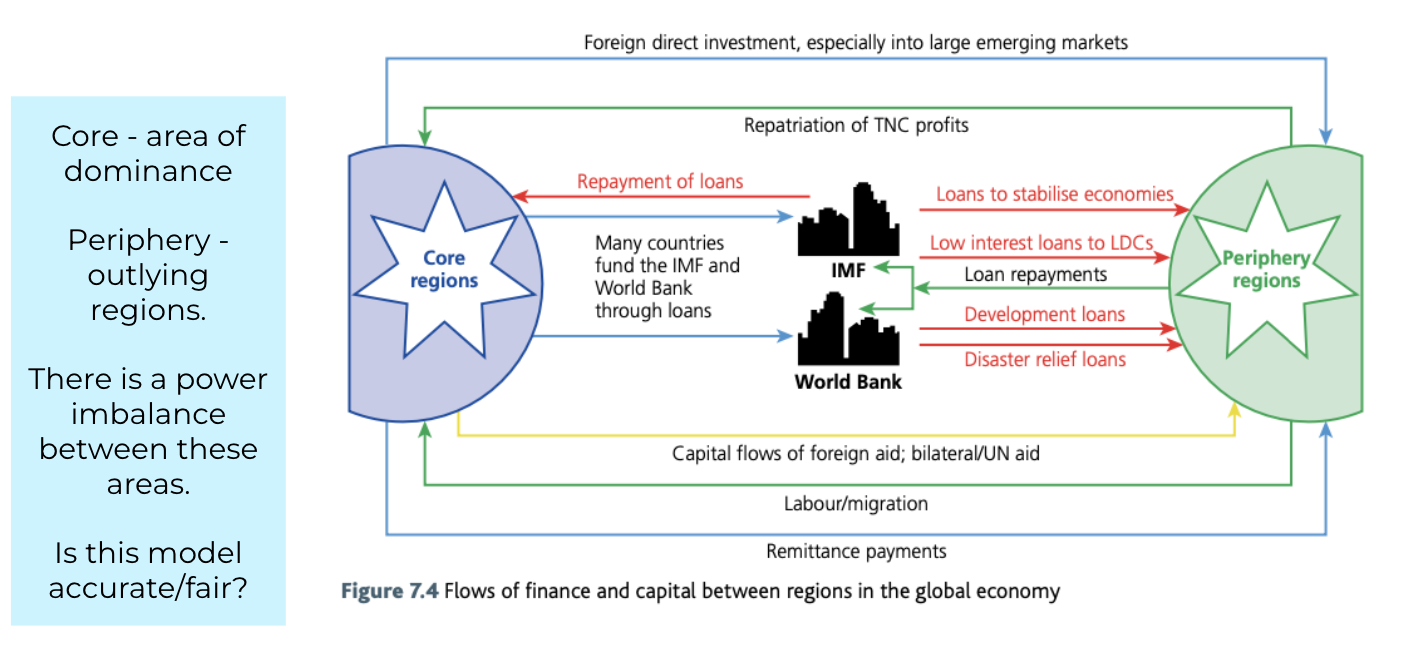
Frank's Dependency Model - core and periphery model
Core (HICs) and Periphery (LICs)
core to periphery - finished goods with high value, FDI, remittance, aid (can be conditional)
periphery to core - raw materials (low value), migration, TNC profits (repatriation)
Periphery countries export low value and import high value, which hinders development due to dependency
what are flows of labour
Labour markets are not as free flowing as financial markets. People move less easily around the world than money because of restrictions on immigration. However, in recent years there has been a phenomenal rise in the numbers of migrants crossing international borders, mainly to seek better employment opportunities.
what are benefits of migration for host and home country
Home country
migrants pay tax and contribute to economy
filling labour force gaps
charges on remittance money
Home country benefits
alleviates poverty
increases GNI
what are flows of services
Services are economic activities (intangible goods) that are traded without the production of material goods, for example, financial or insurance services. They can also be subdivided into:
- High level services - services to businesses such as finance, investment and advertising
- Low level services - services to consumers such as banking, travel and tourism, customer call centres or communication services.
Services such as banking, insurance and advertising depend on communication and the transfer of information. They are footloose and can locate anywhere and advancing technology means that they can still serve the needs of consumers worldwide. High level services have increasingly been concentrated in cities in the more developed world, such as London, New York and Tokyo, which are the major centres of global industrial and financial control. With the empowerment of East Asian economies, Hong Kong, Singapore, Hong Kong Seoul and Shanghai have also become major global financial centres. A growing number of transnational service conglomerates have emerged, seeking to extend that influence on a global scale, such as HSBC holdings in banking and finance services, Omnicom in advertising and TUI group in travel and tourism. One trend has been the decentralisation of low services from the developed to the developing world. Call centre operations, for example, have moved from the UK to India where labour costs are generally 10 to 20% lower than in the UK
what are flows of product and how have they changed
Flows of manufactured goods have increased significantly in recent years. This has been stimulated by demand from affluent populations in developed countries, combined with low production costs because of mass production and low wage economies in exporting regions in China and South East Asia.
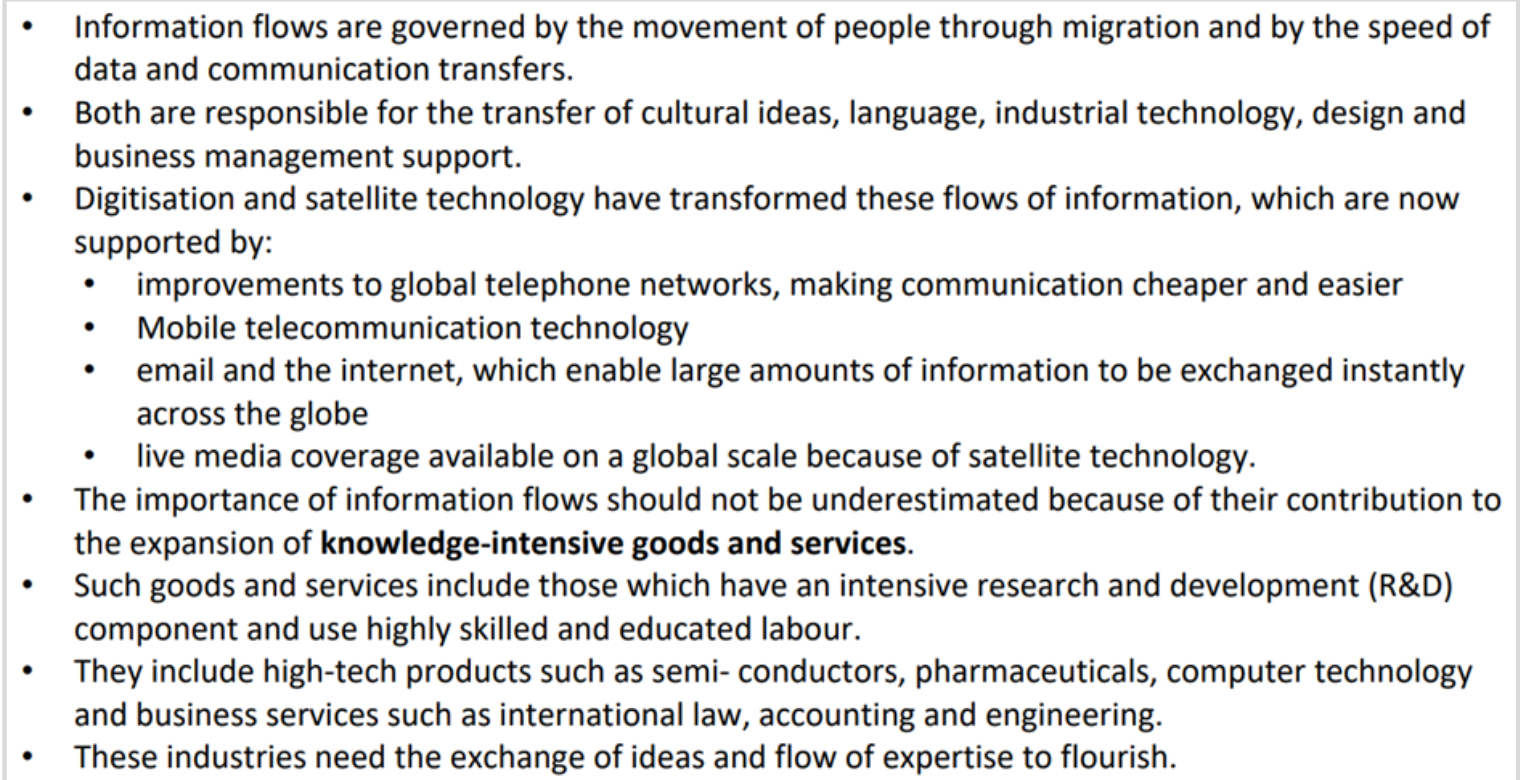
what are flows of information
what are factors in globalisation
Factors in globalisation just mean the factors affecting / impacting / accelerating globalisation.
what are factors that are accelerating globalisation
1. Communication technologies
2. Finance
3. Transport
4. Security
5. Management and information systems
6. Trade agreements
7. Government support

what is containerisation
Containerization is a system using large, standardized steel boxes (shipping containers) to move goods efficiently across ships, trains, and trucks without repacking the contents, revolutionizing global trade by reducing costs, increasing speed, improving security, and simplifying logistics through mechanized handling.
how has communication technologies affect globalisation
this allows the other factors to occur
there are few barriers to prevent the sharing of information and flows of data globally
development of IT, computer tech, internet mobiles - growth of digital age
nearly 7 billion mobile phone subscribers worldwide
4.5 billion internet users worldwide - allows 24/7 connection
computers and robotics integrated manufacturing
computerised logistics systems support supply chain distribution
overseas employment online
fewer cultural barriers due to media
global village
online education and work
how has finance affected globalisation
increased financial integration in the 1980s and 1990s due to financial deregulation
decreased gov rules and restrictions on financial institutions
made it easer to move finance across borders, facilitating trade and investment
however - free movement of capital leaves system exposed to volatile capital flows e.g. global banking crisis 2008
global financial systems - framework to facilitate flows of capital
deregulated by bodies such as IMF
integration of developing economies increases global trade
high speed transaction systems and global exchange connectivity facilitates transactions
how has transport affected globalisation
quicker shipping eases international trade
high speed rail, increased size of aircrafts, standardised containers (containerisation)
increases dry ports located inland - saves time and cost e.g. 6 in Pakistan
containerisation in 1950s (first introduced 1956)
quicker handoffs/loading facilitated trade
led to closure of many ports - needed deep water and wide ports (Felixstowe became very important)
lowered consumer cost and enabled delivery of a wider variety of goods and services
how has security affected globalisation
national boundaries are less of a barrier
threats:
terrorism - screening and monitoring
food imports - ensuring they meet required safety standards
biosecurity - transmission of disease
cybercrime - breaches of secure info due to internet reliance
supply chains - ensuring products are authentic and safe
how has management and information systems affected globalisation
high volume production allows economies of scale and cost advantage
investment in advanced tech
global marketing and distribution networks to keep pace with production
global value chains, where different stages of the production process are located in different countries
remote management e.g. virtually free telecommunications and video conferencing, integrated ICT management systems
JIT (just in time) systems ensures the correct materials are available on time, reduces cost of stocking up
what is marketing and global marketing
Marketing is the process of promoting, advertising and selling products or services. When a company becomes a global marketeer, it views the world as one single market and creates products that fit the various regional marketplaces. It will usually develop a recognisable ‘brand’ and employ one marketing strategy to advertise the product to customers all over the world. The ultimate goal is to sell the same product, the same way, everywhere. Having one marketing campaign on a global scale like this generates economies of scale for the organisation, which reduces their costs. Coca-Cola is an example of a company with a single product; only minor elements are tweaked for different markets. The company uses the same formulas (one with sugar, the other with corn syrup) for all its markets. The bottle design is recognisable in every country but the size of bottles and cans conforms to each country’s standard sizing.
Global Marketing is promoting, advertising or selling products or services. It wants to create products for a global consumer. It essentially treats the world as one target audience, though it may change its advertising strategies depending on the location.
what is evidence that Coca Cola is a global brand
1.9 billion servings sold a day
biggest drink company
50% of soft drink market share - monopoly power
CC owns many other brands e.g. Costa, Monster, Innocent
most known non-tech brand in the world
99% of world population recognise
how has coca cola embedded itself into countries around the world
10% of total revenue goes to advertising ($4bn)
associates the brand with a good feeling
disembedding - removing original context e.g. CC now embedded everywhere, not just USA
targeted marketing
different ads tweaked for different countries
why has coca cola been criticised for its marketing practices
monoculturalisation - western ideals
homogenisation
water shortages at CC indian plants
places where there is no drinking water but CC is sold
what factors have enabled coca cola to become a global brand
Global marketing strategies
catchy slogans and songs
sponsoring major sporting events e.g. Olympics
Technology
product transportation
quick manufacturing and shipping
computerisation and automation
all allow for efficient and quick transport of the product globally
Product differentiation
youth - flavoured coke, powerade
older generations - diet coke, vitamin water
packaging - various designs that are all recognisable and labelled e.g. cans, bottles, glasses, fountains
manufactured opening of cans - best sound for best satisfaction
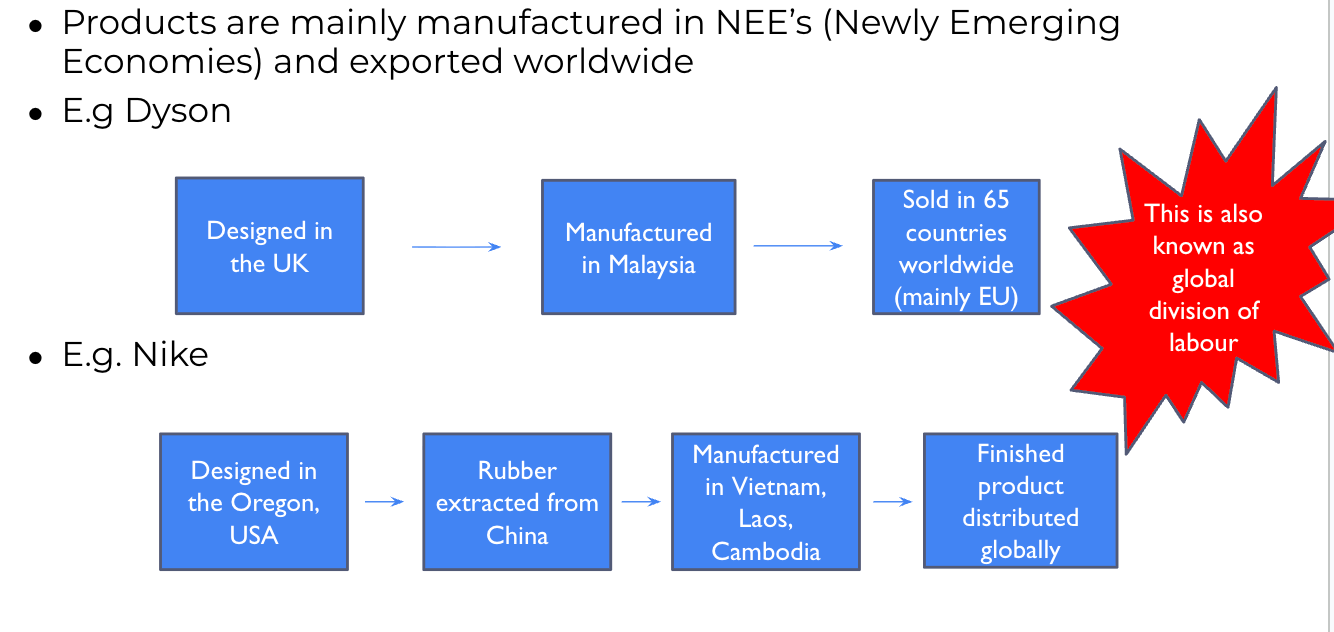
where are products made vs exported (e.g. Dyson/Nike)
what is the international division of labour
The highly skilled highly paid, decision making research and managerial occupations which are concentrated in more developed countries
The unskilled/low skill, poorly paid assembly occupations, which tend to be located in developing countries that have lower labour costs
what is the new international division of labour (since globalisation)
The main thesis of this study is that the world economy is undergoing a profound structural change that is forcing companies to reorganize their production on a global scale. This is being brought about both through the relocation of production to new industrial sites, increasingly in the developing countries, and through the accelerated rationalisation measures at the traditional sites of industrial manufacture. (1945)
how has division of labour changed
Emergence of NICs -> changing patterns of distribution and consumption.
e.g. Dyson - 75% significant growth in 2017 came from its Asian market and only 20% from Europe
Shift from WEST to EAST as the centre of economic activity
car industry example - change in manufacturing
Ebbs and flows in manufacturing are exemplified by the motor vehicle industry, the most global manufacturing industry.
For example, since 1994 the US vehicle giants Ford and General Motors have relocated much of their component assembly to maquiladora plants* in Mexico to take advantage of the cheaper production costs and the non- tariff barriers that are part of NAFTA (North American Free Trade Agreement). (link back to CUE and Detroit!)
At the same time, the US car industry has been revitalised by investment in new plant and technology by foreign vehicle manufacturers such as Toyota.
* a factory that is largely duty free and tariff free
The UK lost most of its domestic car industry as part of deindustrialisation from the 1980s onwards.
However, as a result of investment by the Japanese companies Honda, Nissan and Toyota at factories in Swindon (Honda closed in 2021 - link to CP!), Sunderland and Derby respectively, the UK is now one of the most productive car manufacturers in Europe.
These plants give the Japanese TNCs access to the large and lucrative EU market, underlining the importance of free trade agreements as one of the factors in determining the location of production. …..EXCEPT – BREXIT!!
UK vehicle manufacture has been further boosted by investment by TNCs from BRIC economies, especially by Indian conglomerate Tata who bought Jaguar Land Rover (JLR) from Ford in 2008.
what is populism
Populism is a range of political stances that emphasise the idea of "the people" and often juxtapose (put against) this group with "the elite". It is frequently associated with anti-establishment and anti-political sentiment.
what is nationalism
Nationalism a person who strongly identifies with their own nation and vigorously supports its interests, especially to the exclusion or detriment of the interests of other nations.
what are special economic zones
Special Economic Zones - areas to attract investment. Economic policies of SEZs included tax exemptions, reduced custom duties, reduced priced land, and increased flexibility to negotiate labor contracts and financial contracts.
Describe the change in production over the past 40 years.
manufacturing has become decentralised, moving away from HDEs
as a result of FDI by TNCs, many NEEs have been able to develop competitive manufacturing industries
What has caused changes in production patterns?
Global shift from HDEs to lower wage economies
Factors:
lower land and labour costs
gov incentives like tax breaks, special economic zones - encourages TNC investment and production relocation abroad
transfer of technology enables increased productivity without increased wages in developing economies
availability of skilled and educated workforce
availability of new tech allowing new plants being built
access to large markets without tariffs due to trade agreements
availability of infrastructure (though TNCs can also in this if unavailable)
How has the shift in manufacturing impacted HDEs?
deindustrialisation and subsequent decline and loss of jobs in manufacturing sector
e.g. UK manufacturing employment has fallen nearly 60% since 1970s
also due to outdated production methods and lack of investment
HDE govs have tried to reverse decline
government incentives for foreign TNC investment
investment in skills and technology
protectionist policies
productivity in the UK has been rising as a result
What are the political ramifications (consequences) of changes in production?
global shift in production patterns has caused political reaction against globalisation
rise in populist and nationalist movements in developed economies partly due to lowered standards of living in areas of decline due to deindustrialisation
2016 - a large driver of Brexit voting and election of trump
Explain how patterns of distribution and consumption have changed over time
emerging NICs (newly industrialised countries) - increased affluence and demand for similar consumer products that are exported from their own countries
growth of Asian markets - increased competitiveness means more Asian export to other Asian countries
China’s changes in production over the last 40 years
more than 40 years ago, China opened its economy to overseas investors and embraced globalisation
1978 Deng Xiaoping - era of ‘reform and opening up’ that involved free-market reforms and welcoming of foreign investment
agricultural poverty → urban industrial country fuelled by mass migration of 300 million rural migrants to cities
Development of economy and society:
first phase - urbanisation led to increased low wage factories (‘workshop of the world’)
top destination for outsourcing and inward investment from TNCs, especially coastal regions like Shanghai
low wages led to ethical concerns
second phrase - 2010-2018, wages in China’s manufacturing sector tripled following worker protests and shortage of young labourers (legacy of one child policy)
thus, shift to producing higher value goods and increased value chain (more electronics)
labour intensive, cheaper products now imported from Vietnam
structural changes - emergence of Chinese middle class - increased affluence = private consumption
more balanced economy - less reliant on exports
China’s role in south-south trade and migration
China’s growth = increased development in Africa
2006-2016, Chinese exports to sub-saharan Africa rose 250%
Chinese investment and migrant labour → Africa
over 1 million economic migrants to Africa - contract workers and entrepreneurs
significant investment in brazil ($20 million in 2016-2017), especially in oil - recent offshore oil discoveries
analysts say it is a state-led direction to ensure future food and energy security for China
increased interdependence between China/Brazil
in future, likely to be less migration to Africa, South America - due to increased wages in China
many believe that Chinese companies gain an unfair trade advantage via state subsidies
Gov has not always followed WTO rules
US-China bilateral trade gap hit a record $37 billion in Chinese labour in 2017, triggering 2018 trump US tariffs on Chinese goods
what is coffee’s history
A valuable commodity since the 1800s.
International Coffee Agreements (ICAs) in place until 1989.
Since then prices have fluctuated.
Prices are influenced by factors including:
Growth in suppliers
Dominance of 4 MNCs
what is coffee’s changing production and consumption
High growth rates from Peru, Nicaragua, Honduras, India, and Ethiopia.
Vietnam has also increased its production by 1400%!!
Consumption has increased on average by 1.9%/year
Where you drink coffee varies on the country
world coffee production
South america leading coffee production (46% of world total - equatorial strip of countries - 10/20 top countries)
Asia and Oceania - strongest production growth over last 50 years, now 2nd region whereas 4th previously
Vietnam - production up 1400%, becoming a major producer
decreased African production over last 50 years due to low yields and economic liberalisation in 1990s
was 2nd region, now 4th
world coffee consumption
top 8 consumers (countries) in Europe, especially Scandinavia (top 3) and colder Northern countries
14/20 top countries in Europe
Brazil a top consumer as well as producer
coffee - differences between consumption and production
production mostly in an equatorial belt - warmer regions for growing
consumption occurs a lot in colder, high latitude regions e.g. Scandinavia, Canada
but other high consumers also include Brazil, Greece, Costa Rica, Cyprus, Spain
challenges for coffee producers
climate change, risk management in response to price volatility, growing cost of inputs, sustainability of the sector, development of world consumption
regulated coffee market by International Coffee Agreements collapsed collapsed in 1989, now market is subject to free market forces of supply and demand
in 2001, coffee prices were 1/3 of 1960 levels, impacting more than 25 million households in cofee producing regions
large TNCs can force countries to compete by reducing prices, which small coffee producers are particularly vulnerable to
production is a biennial cycle, trees can take time to recover after a large crop, disease can wipe out entire seasons
coffee market since 1800s
has been a valuable trade commodity since 1800s
up until 1989, International Coffee Agreements (ICAs) - intended to manage supply and maintain price stability - system collapsed
since 1990 - free market forces of supply/demand
1965-1989 - regulated market had relatively high prices
1989-1993 and 199-2004 - start of free market had 2 periods of markedly low prices
2001 - 1/3 of 1960 price
2004-2011 - high price recovery, peak in 2011
factors that can affect coffee prices
increased demand = increased price
decreased supply e.g. crop failure = increased price
and vice versa
changing consumption levels - affect demand eg. coffee trends, substitutes
crops can fail due to disease, changing climate, cold seasons, floods, droughts, extreme weather
more suppliers = more market access
coffee production instability - biennial cycle means alternating up and down year to year in Arabica production - 75% of Brazil production
crops need to recover
large crop one year means small crop next year
2012/13, central American producers were badly affected by leaf rust - over 2.7 million bags were lost
Africa - low yields, aging crops, economic liberalisation = lower production
coffee - changes in exports
total exports increased over the last 50 years 1963-2013
increase in re-exporting, considerable value added
most of the value is in the export of unrefined coffee
world consumption up 2% a year
coffee industry valued at $170bn in 2012
exporting countries tend to be consumed at home (domestically) whereas importing countries tend to drink out e.g. cafes
total consumption in importing is slowing down whereas exporting is growing
coffee - impact of fairtrade
national scale
fairtrade coffee households are 15% more resilient
access to credit, good connections to traders, higher net revenues and income
greater price stability, better standards of living
higher total household income
producer organisations invest in community projects
e.g. climate adaptation, gender equity, farm renovation to increase yields
local expertise, practical training
negotiating power to farmers
protect land, health, equality, environment, human rights - fairtrade standards
global scale
tackling climate change and deforestation
many fairtrade producers adopt climate-resilient practices
more opportunities for women - 33% of fairtrade farmers are female

