Unit 5.3 Discovering the Endocrine System
 Call Kai
 Learn
Learn Practice Test
 Spaced Repetition
 Match
Match Flashcards
 Knowt Play
1/102

There's no tags or description
Looks like no tags are added yet.
Name | Mastery | Learn | Test | Matching | Spaced | Call with Kai |
|---|
No analytics yet
Send a link to your students to track their progress
103 Terms
The endocrine system is crucial for-
homeostasis
Besides homeostasis, what other things is the endocrine system important for?
Mood, growth, development, tissue function, metabolism, s3xual function, reproductive processes
What is the endocrine system?
A system of glandular tissues that produce and secrete hormones into the blood
Hormones: ____ → ____ → ____ → ____
Produced in one part of the body → travel in the blood → to target tissue cell → bind and affect
There are 2 types of hormones, they can either be ____ or ____
Target or non-target
What is a target hormone?
A hormone that targets specific tissues/cells
What is an example of a target hormone?
Gastrin- stimulates just the cells of the stomach to produce digestive enzymes
What is a non-target hormone?
Hormone that impacts many cells of the body instead of just one specific cell type
What is an example of a non-target hormone?
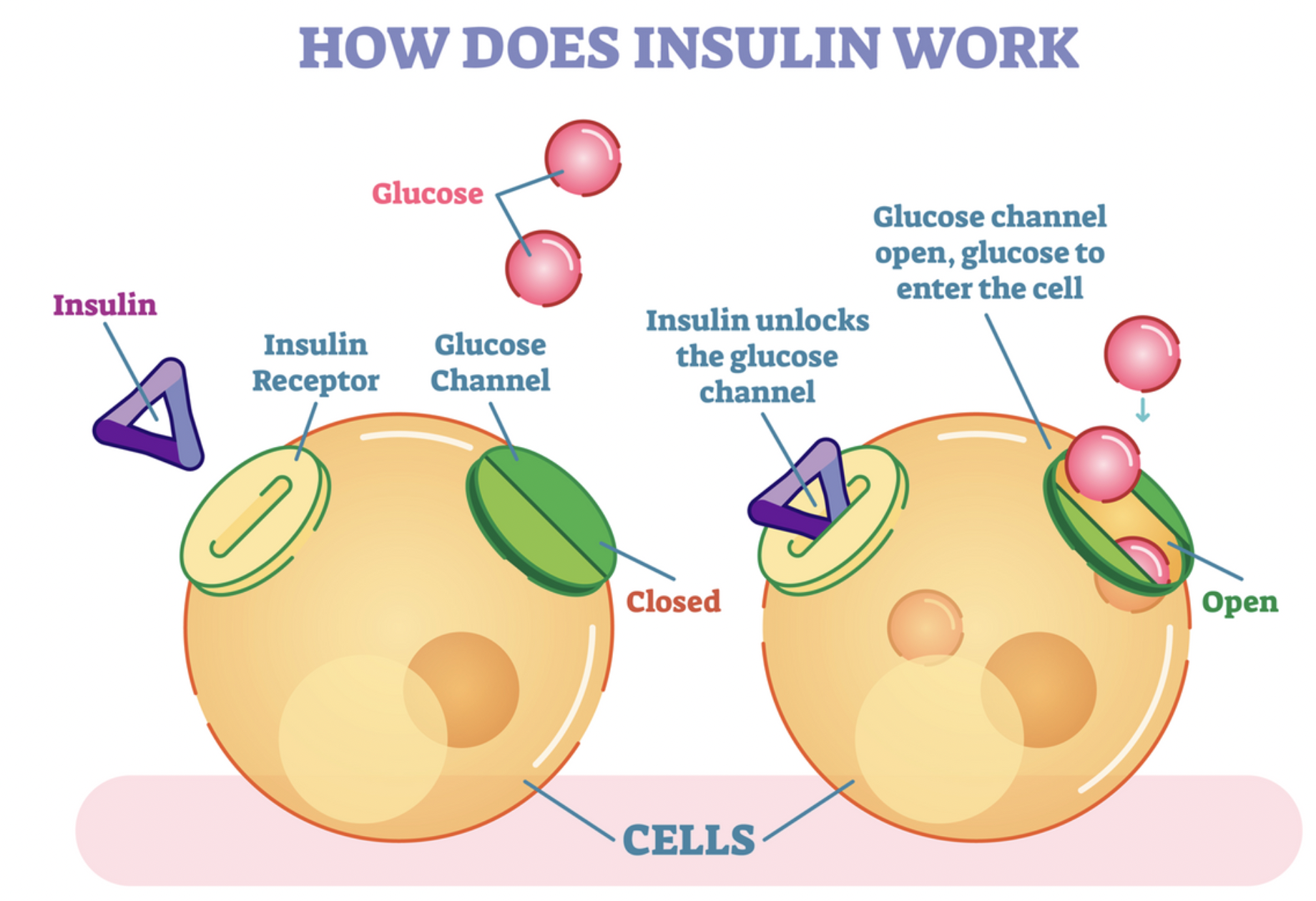
Insulin- can increase the permeability of all cells to glucose
Do hormones affect all cells? Why or why not?
No; cells may have receptors for one hormone but not for another
There are two types of hormones and they differ in what 2 ways?
Structure
Action
Name the 2 types of hormones
Steroid hormones
Protein hormones
Steroid hormones are derivatives of what?
Cholesterol
Steroid hormones are composed of complex, fused rings of what 3 molecules?
Carbon
Hydrogen
Oxygen
Are steroid hormones soluble/insoluble in water? Fat?
Insoluble in water; soluble in fat
What are the 3 types of steroid hormones?
Male sex hormones
Female sex hormones
Cortisol
What is the pathway of steroid hormones? ( ___ → ___ → ___ )
Diffuse from the capillaries → into interstitial fluid → into target cell
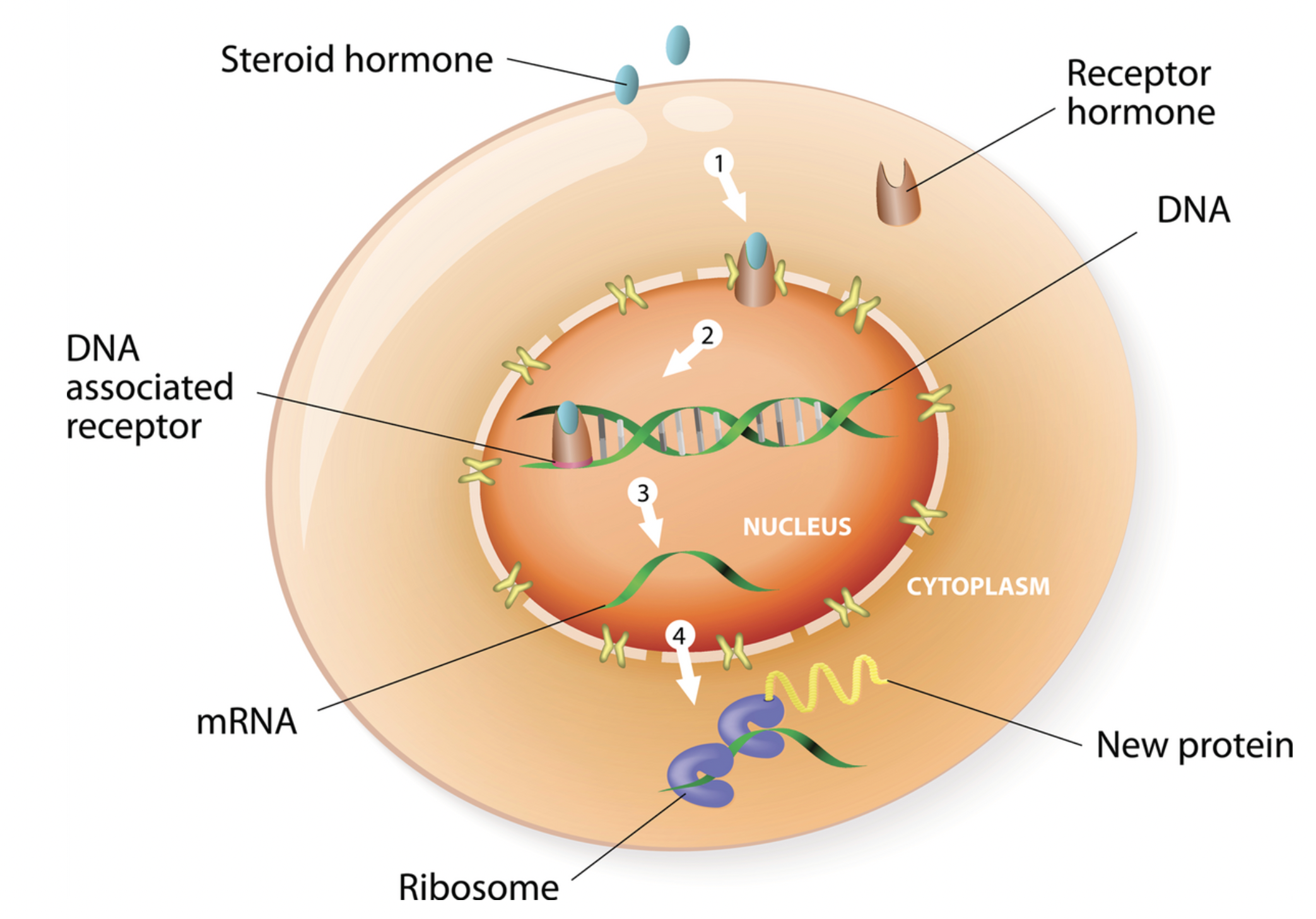
What is the 4 step process of steroid hormone to protein?
Hormones combine with receptor molecules in the cytoplasm
Hormone-receptor complex moves into the nucleus
Hormone-receptor complex attaches to a segment of DNA that has a complimentary shape. Transcription of an mRNA strand
mRNA diffuses out of the nucleus into the cytoplasm where it’s translated into a specific protein
What are the names of the 2 protein hormones?
Insulin
Growth hormone
What is the structure of protein hormones? Their length?
Contain chains of amino acids; they vary in length
Are protein hormones hormones soluble or insoluble in water?
Soluble
Protein hormones bind at ___ receptor sites
Specific
What is a big difference between steroid and protein hormones?
Protein hormones cannot easily cross the phospholipid bilayer.
What it the pituitary gland “called”?
“Master gland”
How is the pituitary related to hormones?
It both produces and stores them
The pituitary gland is connected physically to what?
The hypothalamus
What are the names of the two lobes of the pituitary gland?
Posterior and anterior
The pituitary gland is controlled by who?
The hypothalamus
ADH is produced by the hypothalamus and is stored and released by the pituitary. What is its function? Who does it act on?
Responsible for increasing water absorption into the blood; acts on the kidneys
Thyroid-stimulation hormone → ___ → ___
Thyroid gland → release of thyroxine that regulates cell metabolism
Adrenocorticotropic hormone → ___ → ___
Adrenal cortex → release of stress hormones
Somatotropin/growth hormone → ___ → ___
Most cells → growth and cell division
Follicle-stimulating hormone → ___ → ___
Ovaries/testes → follicle development in ovaries/sperm cells in testes
Luteinizing hormone → ___ → ___
Ovaries/testes → ovulation and corpus luteum/production of testosterone
Prolactin → ___ → ___
Mammary glands → milk production in lactating females
Oxytocin → ___ → ___
Uterus/mammary glands → contractions in childbirth and milk release
Antidiuretic hormone → ___ → ___
Kidneys → increase water reabsorption by the kidneys
Name the 4 main types of human hormones
Hormones that regulate blood sugar levels
Adrenal glands and stress hormones
Reproductive hormones
Hormones affecting metabolism
#1 Hormones that regulate blood sugar levels are produced where?
In the pancreas
#1 Where are they located inside the pancreas?
In the islets of Langerhans
#1 Inside are 2 types of cells of cells that each produce what?
Beta cells produce insulin
Alpha cells produce glucagon
#1 What is the relationship between insulin and glucagon?
They are antagonistic because they have opposite effects in response to high or low blood sugar
#1 What is diabetes mellitus? What happens?
When a person cannot produce enough insulin to regulate blood glucose levels; blood sugar rises causing hyperglycemia
#1 What are the symptoms are hyperglycemia?
Glucose in the urine, dehydration/thirst (caused by glucose in the nephron that draws water out of the blood), low energy (permeability of glucose into cells does not increase so less glucose is burned so less ATP made)
#1 What are the names of the 3 types of diabetes mellitus?
Type 1
Type 2
Gestational
#1 What is type 1 diabetes?
An inability to produce insulin due to early degeneration of beta cells; occurs in early childhood; insulin must be taken daily to survive
#1 What is type 2 diabetes?
A decrease in insulin production/ineffective use of the insulin that is produced; can be controlled with diet, exercise, medication
#1 What is gestational diabetes?
A temporary condition in pregnant women; controlled with diet, exercise
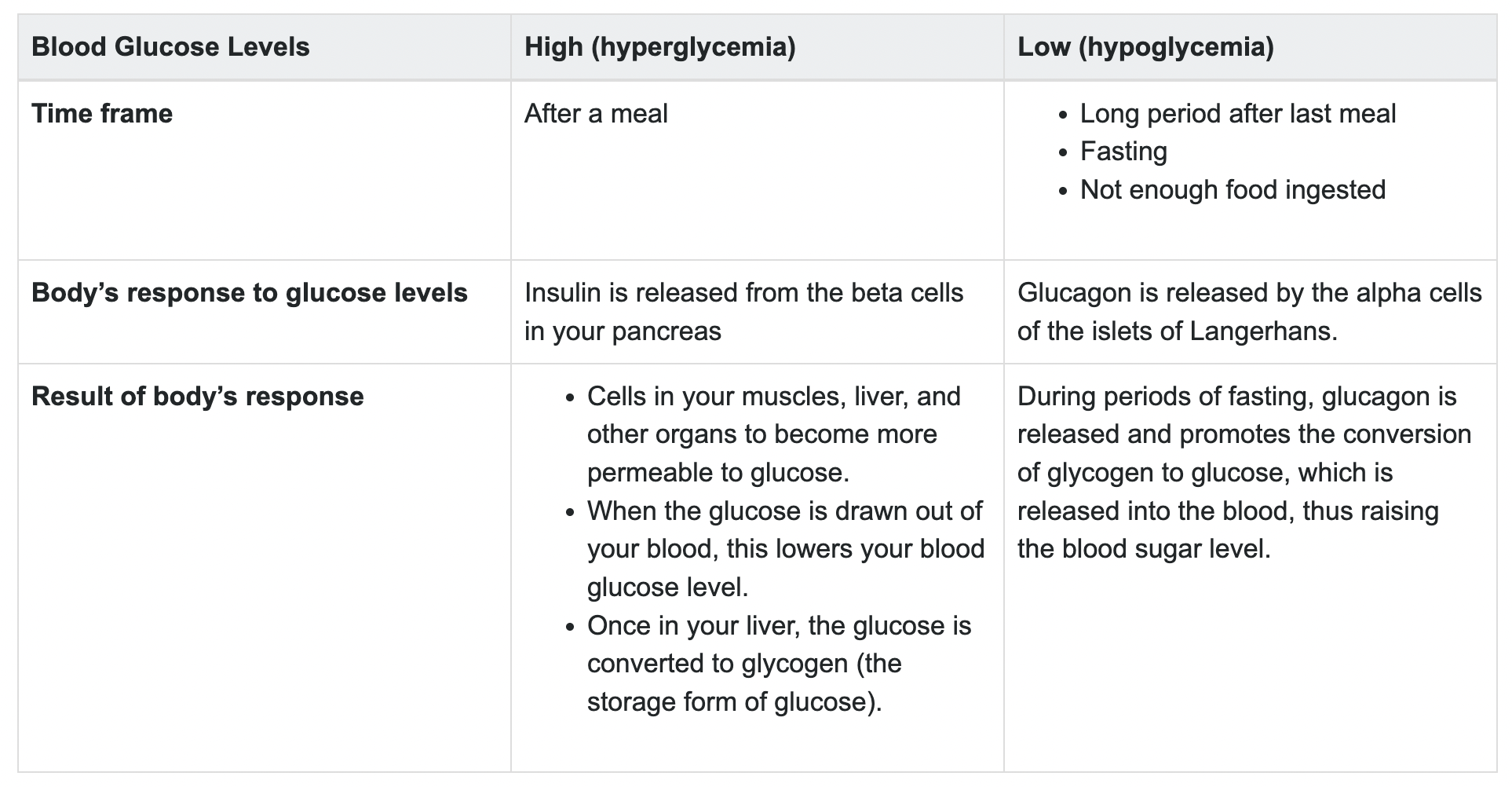
#1 Describe what happens when blood sugar levels are high?
Insulin is released from beta cells in the pancreas causing the cells of the muscles/liver/other organs to draw glucose out of the blood
#1 Describe what happens when blood sugar levels are low?
Glucagon is released by alpha cells of the islets of Langerhans and promotes the conversion of glycogen to glucose which is released into the blood thus raising blood sugar levels
#2 When stressed, the body may need to tap into-
Energy reserves
#2 Adrenal glands release hormones that trigger the release of-
Sugar in the blood
#2 The adrenal glands are physically found where?
Above the kidneys
#2 What are the names of the two parts of the adrenal glands?
Outer cortex and inner medulla
#2 Short term stress response comes where where? What two hormones are released?
Adrenal medulla; Epinephrine and norepinephrine
#2 What is the body’s response to short-term stress?
Blood sugar level rises, glycogen converted to glucose for quick energy, heart rate/breathing/cell metabolism increases, blood vessels dilate, irises dilate
#2 Long-term stress response comes from where? What three hormones are secreted?
Adrenal cortex; cortisol, aldosterone, and ACTH
#2 What is the body’s long-term stress response?
Proteins/fat broken down to glucose, blood sugar levels rise, increase blood volume and blood pressure, partial suppression of the immune system
#3 Reproductive hormones control the development of reproductive systems during what two life stages?
Growth and use when sexually mature
#3 Male reproductive hormones are called-
Androgens
#3 What is the main androgen?
Testosterone
#3 Testosterone is manufactured where?
By cells in the testes
#3 Secretion of testosterone increases at puberty. What happens?
Beard, low voice, production of sperm, sex drive
#3 What two things control sperm production?
Hypothalamus and pituitary
#3 Describe the negative feedback loop of male reproductive hormones
Hypothalamus secretes GnRH
GnRH activates pituitary to secrete FSH and LH
FSH acts on sperm producing cells
LH stimulates the production of Testosterone
Testosterone increases sperm production
When the hypothalamus detects high levels of testosterone it shuts it off
(Believed that FSH acts on Sertoli cells which produce Inhibin that sends message to the pituitary inhibiting the production of FS)
#3 While males constantly produce sperm, how are females different?
Females develop one mature ovum each month
#3 At puberty, females have _____ follicles
400 000
#3 In each cycle, many follicles develop during _____
Oogenesis
#3 How many follicles will become dominant and reach maturity during a cycle?
Usually only one#3
#3 ____ eggs will mature during a female’s reproductive life
400
#3 The age of follicles is linked to what?
Increased rates of genetic defects
#3 Menopause marks the end of a female’s reproductive life and signals a drop in ____
The production of female hormones
#3 Ovulation occurs once a month and it is the process of____
Releasing a mature haploid egg
#3 Describe the steps of ovulation
FSH is released from the pituitary and stimulates the immature follicle to develop into a haploid egg
LH released from pituitary cause the follicle to be released into the fallopian tube or oviduct
Surrounding follicle cells remain within the ovary and are transformed into the corpus luteum which secretes the hormones needed for pregnancy if the egg is fertilized within 10 days
#3 If an egg is fertilized, the embryo attaches to____
The lining of the uterus
#3 Placenta cells that nourish the egg produce ____
Human Chorionic Gonadotropin (HCG)
#3 The menstrual cycle lasts for ____
About 28 days
#3 What are the names of the 4 distinct phases of the menstrual cycle?
Flow phase
Follicular phase
Ovulatory phase
Luteal phase
#3 What happens in the flow phase? Days?
Menstruation- the shedding of the endometrium; days 1-5
#3 What happens during follicular phase? Days?
Development of follicles within the ovary, estrogen is secreted and increases; days 6-13
#3 What happens during ovulatory phase? Days?
Estrogen decreases, egg bursts from the ovary, follicle cells differentiate into the corpus luteum; day 14
#3 What happens during the luteal phase? Days?
Estrogen restored, corpus luteum develops and releases estrogen and progesterone, prepares the uterus for a fertilized egg, inhibit further ovulation; days 15-28
#3 What happens if the egg isn’t fertilized?
Estrogen and progesterone decrease, endometrium sheds, end of this cycle and beginning of the next
#3 What two things control the female reproductive system? What two hormones do they make?
Hypothalamus and the pituitary; regulate the production of estrogen and progesterone
#3 Describe the negative feedback loop of female hormones
At puberty, GnRH is released from the hypothalamus
GnRH activates pituitary which releases FSH and LH
FSH travels through the bloodstream and stimulates follicle development. Follicles secrete estrogen which initiates the development of the endometrium
LH stimulates ovulation and the remaining follicular cells to become the corpus luteum
Corpus luteum secretes estrogen and progesterone which both further develop the endometrium
As estrogen and progesterone increase, negative feedback mechanism causes FSH and LH to become inhibited causing the corpus luteum to degenerate and menstruation to begin
#4 Name the 3 kinds of glands that affect metabolism
Thyroid gland
Parathyroid gland
Anterior pituitary gland
#4 What is the thyroid gland’s function?
Regulates body metabolism and the rate at which blood glucose is metabolized
#4 What three hormones are produced by the thyroid gland?
Triiodothyronine (T3), thyroxine (T4), and calcitonin
#4 Where is the thyroid gland physically located?
At the base of the neck in front of the windpipe and trachea
#4 What is the role of T3 and T4?
Regulate body metabolism and the growth/differentiation of tissues
#4 What is the role of calcitonin?
Acts on bone cells to lower calcium ion levels in the blood
#4 Describe the negative feedback loop of T3 and T4
Hypothalamus receptors activated when metabolic rate decreases
Nerve cells secrete thyroid-releasing hormone (TRH)
TRH stimulates pituitary to release thyroid-stimulating hormone (TSH)
TSH carried in the blood to thyroid gland which releases T3 and T4
T3 and T4 increase in the blood and stimulate sugar oxidation
What T3 and T4 reach a critical point, they cause the pathway to turn off by inhibiting the release of TRH from the hypothalamus thus stopping TSH in the pituitary
#4 What is hyperthyroidism? What would the person feel?
Produce too much T3 and T4; lose weight, feel warm (from high respiratory rates from high glucose oxidation
#4 What is hypothyroidism? What would a person feel?
Low levels of T3 and T4; gain weight, glucose isn’t consumed at normal rates, gets stored in the liver, body converts sugar to fat, muscle weakness, cold intolerance, dry skin/hair
#4 What is the role of the parathyroid glands?
Regulate calcium ion levels in the blood
#4 What hormone do the parathyroid glands release?
Parathyroid hormone (PTH)
#4 What happens with our bones, small intestine, and kidneys if the body was low in blood calcium levels?
PTH would accelerate the breakdown of bones to produce higher calcium levels; PTH causes absorption of calcium ions from undigested food to increase levels; PTH causes reabsorbed calcium ions from the filtrate to increase levels

