LPPS 3390 Test 2
 Call Kai
 Learn
Learn Practice Test
 Spaced Repetition
 Match
Match Flashcards
 Knowt Play
1/35

There's no tags or description
Looks like no tags are added yet.
Name | Mastery | Learn | Test | Matching | Spaced | Call with Kai |
|---|
No analytics yet
Send a link to your students to track their progress
36 Terms
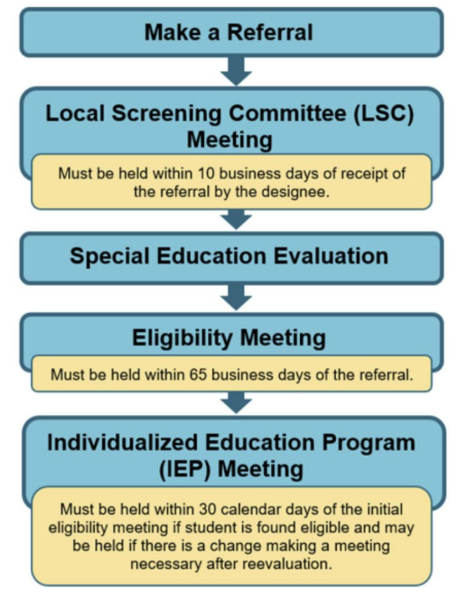
IEP Timeline
A school counselor, sped teacher, parent, or the child themself can make a referral
LSC ran by a school administrator, school counselor, & the person who made the referral & must happen w / in 10 school days after the referral is made
At any age, the child themself can join the process
Not very formal, if the meeting determines there should be a further sped evaluation → sped evaluation/testing
Parents don’t have to be informed 3 times about this
Sped evaluation is based on what was identified in the screening
Eligibility meeting is a meeting when the child is either told they are eligible or ineligible
Must by completed w/ in 65 school days of the original referral (could be 5 months)
Parents are alerted 3 times about the meeting (mandatory for the school), parents don’t have to go tho
Parents can appeal the decision
School/fam has 30 days after the eligibility meeting to have the IEP meeting (where they design the IEP)
Fam must also be informed 3 times about it
A lot of these meetings are required to happen w/ in a school facility or often happen online
Zero Reject
This IDEA principle guarantees that all children are entitled to a public education, and no student can be excluded regardless of the severity of their disability. It also provides protections regarding school discipline, stating a child cannot be expelled or suspended for behaviors that are a direct result of their disability
Nondiscriminatory Evaluation
This IDEA principle states that to determine eligibility for special education, schools must use unbiased and culturally responsive assessments. Evaluations must consider the student’s primary language and ensure that testing materials are valid for the specific information being measured
FAPE
IDEA principle: Schools are required to provide an education that is personalized to meet the child's specific needs at no cost to the parents. This principle emphasizes accountability for results and the use of effective, evidence-based teaching methods
Least Restrictive Environment (LRE)
IDEA principle: Students with disabilities must be educated in regular classrooms with their non-disabled peers to the "maximum extent possible". Specialized placements or removal from the general education setting should only occur when the nature of the disability is such that education in regular classes, even with supplemental aids, cannot be achieved successfully
Due Process
This IDEA principle provides a system of legal checks and balances to prevent the government or school districts from unfairly depriving a student of services. It includes the right to prior written notice of changes to a child's program and the ability to resolve disputes through impartial hearings
Parent Participation
IDEA principle: Parents have the right to be active partners in their child’s education. This includes the right to be involved in decision-making processes, attend IEP meetings, and have a voice in determining the services their child receives
Alfredo & Kozleski- Inclusive Education
-the idea of inclusivity for sped students in schools comes from the Declaration of Salamanca in 1994 & has received both pos & neg responses
-get rid of social inequality → everybody on equal playing field when entering school → inclusive education (including inc access of all students, enhance school’s personnel’s & student’s acceptance of all students, maximize student participation, & inc the achievement of all students)
-US inclusive ed is most closely linked to IDEA LRE clause
-there’s often differences between policies/ideas about inclusivity and how it can actually be implemented in the classroom (policy is more idealistic, what actually happens is more realistic)
-“inclusive exclusions”/”discrimination by inclusion”: inequities arise w/ in inclusive education systems (Ex: policies like bilingual ed require ELL students learn English as “proof” of their success in the program → assimilation to English instead of encouraging them to know both languages)
Carter et al.- Randomized Evaluation of Peer Support Arrangements to Support the Inclusion of High School Students With Severe Disabilities
-peer support arrangements are an inclusive classroom tool
-how it works: Students from w/ in the gened class are paired w/ a student w/ a severe disability
-goals: The non-disabled peers can model age-appropriate social & communication skills & help the student w/ disability w/ the school work they’re all given (aimed to supplement instruction, not replace it)
-benefits: “Striking” social & academic benefits
Inc the interactions students w/ disabilities had w/ their peers, the # of classmates they talked to, & the extent to which they made progress of social-related goals
Inc in academic engagement/participation & students w/ disabilities spent sig less time out of the classroom
Facilitated content-appropriate peer interaction in classrooms (but didn’t really inc them outside of the classroom)
also inc awareness & positive attitudes of non-disabled students to their severely disabled peers
Lo- Demystifying the IEP Process for Diverse Parents of Children With Disabilities
-Teachers + families = success for all students
-Assumption that when parents are involved in this process, the child benefits
BUT this belief is reflective of a culture that values individualism, equality, & the need to exercise one’s own rights → not always shared by fams of other cultures & the IEP process is foreign/complicated to many immigrant fams (Ex: language barriers)
-recommendations for practice:
teachers should provide info (including the basics of the meeting & their rights) to the fams before the IEP meeting & possibly meet w/ them beforehand to answer questions they may have
provide all materials in the fam’s native language (& have a translator present at all meetings)
provide training sessions/workshops for parents to hear from other fam’s similar experiences
provide a summary of the meeting & the drafted IEP (in the fam’s native language) after the meeting
Murphy et al.- The Impact of the Novel Coronavirus Disease 2019 on Therapy Service Delivery for Children with Disabilities
-44% of parents reported low satisfaction w/ their child’s therapy services BUT satisfaction inc if they had access to telehealth
issue w/ telehealth: Only 47% of students receiving school-based therapy had access to telehealth → inc overall dissatisfaction parents expressed w/ school-based services
-School-based therapies are legally mandated for eligible students, free for fams, & integrated in the academic setting → must address the dissatisfaction during COVID to prevent inc dissatisfaction & meet the student’s needs
Burlington School Committee v. DoE of Massachusetts (1985)
1976: 1st grader Michael Panico diagnosed w/ specific learning disability
Qualified for IDEA
1978: determined his school wasn't fit for his needs & a new IEP was created which involved moving him to a new school
Parents did not agree w/ this → enrolled him in a private sped school at their own expense for 1979-1980 school year
1980: after several hearings, the DoE eventually paid for his tuition BUT didn’t reimburse the parents for the 1979-80 school year
Argued they didn't have to reimburse for that year bc the parents chose to move their child (parents disagreed & said the school failed to provide FAPE) → taken to Supreme Court
Final ruling: Supreme Court sided w/ the parents & said that the school had to reimburse the parents for that year bc the parents have discretionary power in determining what “appropriate” relief is & if the public school is deemed inappropriate for the child then a private school may be the only method to “ relief”
Parents were able to be reimbursed bc schools must provide “handicapped children both an appropriate education & a free one”
Big takeaway: the very first case that showed parents can be reimbursed for private school tuition, also set the precedent for what “appropriate relief” is
Shows appropriate education, parent participation, & due process
G.L. v. Ligonier Valley School District Authority (2015)
2008: GL entered high school & teachers reported to his father that he seemed distracted in class → father verbally requested he be evaluated for sped by the district → no evaluation took place
GL later experienced family trauma & little was done to address GL’s struggles (the school district invested GL’s residency instead of providing an evaluation)
2009-2010: evaluated for sped → learning disabilities in reading, writing, & math → IEP → parents found IEP to be inadequate
2010: diagnosed w/ 2 more conditions including PTSD from bullying (bullied for his sexual orientation & sped status) → GL’s parents withdrew him from school in March 2010
Him being bullied caused him to dec academic output (which is why it was put in the IEP)
2012: parents filed due process complaint in 2012 & requested compensatory education for September 2008 through March 2010
Compensatory education: if a child wasn’t provided specific services during a period of time, the school has to compensate the fam in the form of providing those services
Arguments
GL: school district denied FAPE & are entitled to compensatory education for the entire period of the school’s failure to identify, evaluate, & provide FAPE
District: (tldr) the dates didn’t align for what the parents were requesting & what actually happened
Introduced new idea of when the parents “knew or should have known” should have been when they filed a claim (not after)
Rulings
Third circuit ruling: sided w/ the parents (i kinda missed this…)
Big takeaways: strengthened child find by preventing school districts from not identifying/evaluating children (the school originally wasn’t testing the student after the parents requested & instead punted to other factors/questions like where they lived), also set precedent for compensatory education
Opened up the timeline of the lack of education & introduced service related remedies through compensatory education (previously had to sue w/ in 2 years of the offense)
Appropriate education, due process, nondiscriminatory evaluation, parent participation
Kim Dean’s Story
-where FAPE was followed: Early in Johnny’s life, FAPE was largely upheld through early intervention services beginning at 9 months old. He received speech and other therapies, which aligns with IDEA’s requirement to identify and support disabilities early. His transition into preschool and elementary school also included supports like a 1:1 aide (initially) and structured skill-building, helping him access education.
In high school, Johnny’s experience improved significantly. The school created an inclusive environment, provided community-based opportunities like accessible sports, and helped him feel socially integrated. These elements reflect FAPE’s emphasis on both academic and functional progress, as well as inclusion.
-where FAPE wasn’t followed:
Failure to implement the IEP: Johnny lost his 1:1 aide because it was not properly documented, and later the school failed to hire one even when it was in the IEP. This directly violates FAPE, which requires full implementation of IEP services.
Lack of appropriate placement: He was placed in a general education classroom without adequate supports, despite it not being appropriate for his needs.
Lack of progress monitoring/data: In high school, the school could not provide data on his progress toward IEP goals, suggesting they were not properly tracking or implementing those goals—another FAPE violation.
Unqualified staff: An unlicensed teacher became his primary educator, raising concerns about whether instruction was appropriate and legally compliant.
Inadequate IEP development: The school proposed an IEP that did not reflect Johnny’s needs, indicating a failure to provide an individualized and appropriate plan.
Service gaps during COVID: The school’s refusal to fund necessary in-home supports limited Johnny’s access to education.
Insufficient compensatory services: Although the family proved Johnny needed compensatory education, the school only offered limited hours and restricted when they could be used.
-role of advocacy & inequity: A major takeaway is that Johnny’s access to FAPE often depended on his family’s resources and advocacy rather than the school system alone. His parents:
Attended IEP meetings regularly
Hired an advocate and lawyer
Paid for private services when the school failed
Used their knowledge and social capital to identify noncompliance
Even with these advantages, they still struggled to secure consistent FAPE—suggesting that students without these resources are even more at risk of not receiving appropriate services.
Rosenbaum- How Adequate Must a “Free and Appropriate” Public Education Be for Children with Disabilities? Endrew F. v Douglas County School District
-Endrew F. v Douglas County School District opened awareness about what FAPE really means
-An IEP must consider the child’s overall circumstances & needs, must be “fact-intensive”, & must focus on progress (Way different from just providing “de minimus”)
-An IEP should allow the child to move through a gened curriculum & advance from grade to grade
BUT even where a child’s disability prevents grade-level advancements, a de minimus standard is wrong bc in such a case a child “can hardly be said to have been offered an education at all. For children with disabilities, receiving instruction that aims so low would be tantamount to sitting idly,… awaiting the time when they are old enough to drop out.”
Blad- Special Education During the Pandemic, in Charts
-tldr: any issue or decline that a “normal” student faced, students w/ disabilities had it worse
-schools struggled to meet IDEA requirements & deliver support to sped students during COVID —> big concern for parents
Advocacy
-definition in sped: supporting & defending the rights of students w/ disabilities & their fams
-Advocates include: parents, teachers, lawyers, disability orgs, privately-hired advocates, & policymakers
parents represent the child the best, whereas advocates know the law/the players the best
-Goal: ensure students receive FAPE w/ educational supports, accommodations, & services
Especially important through laws like IDEA
-Why is advocacy important?
Student w/ disabilities historically faced exclusion from school
Advocacy ensure students receive individualized supports (rather that the one-size-fits-all gened)
Fams play a central role in advocating for services/accommodations
Schaffer v. Weast (2005)
Importance
This case doesn't talk about whether services are being provided as laid out. This case just talks about IEPs not being sufficient after creation
Background
1997: Brian Schaffer (7th grader w/ speech-language impairments & other disabilities) enrolled in a private school w/ out sped services → wasn’t good → parents requested sped services from Montgomery County Public Schools (MCPS) → Brian moved & provided an IEP → parents rejected proposed IEP claiming it was inadequate & didn’t provide FAPE → parents request admin due process
Who bears the burden of proof was not yet established
Legal arguments
Parents: burden of proof of providing FAPE should fall on the school district (bc they already have the burden of providing IEPs), IEPs are presumed invalid until schools prove otherwise
There is an information asymmetry between schools and parents and thus schools have more responsibility → IEPs are invalid until schools prove otherwise
Weast (Superintendent of MCPS): burden of proof should fall onto the part seeking relief (IDEA doesn’t specify → plaintiffs should hold the burden), presume schools are properly performing their responsibilities
If schools had the burden of proof, hearings would be much more complex
Main legal questions
Should the burden of proof in an IEP challenge fall on the part seeking relief?
Should IEPs be presumed as invalid or valid?
Outcome
The burden of persuasion lies w/ the party seeking relief in an IEP challenge
In Schaffer’s case it was the parents, but it can also apply to school districts
Major takeaways
Burden of proof falls on the party seeking relief
If you are considering advocating through a hearing → you hold the burden of persuasion
IDEA has sufficient procedural safeguards → limits asymmetry (?)
Protects the schools: dec their cost & maintains their expertise
Protects the notion that we should trust the expertise of public schools
2 kinds of burden of proof
-Burden of production: Which party bears the obligation to come forward w/ the evidence at diff points in the proceeding (introducing evidence)?
-Burden of persuasion: Which party loses if the evidence is closely balanced?
Needs to convince the courts that the claim is significant
Winkelman v. Parma City School District (2007)
Importance
This case increased accessibility to ppl with fewer resources to advocate on their own behalf
Background
2001-2003: Jacob (child w/ autism) attends Achievement Center for Children which offers specialized services in autism ed
June 2003: PCSD proposed an IEP that placed Jacob in kindergarten at Pleasant Valley Elem → fam believed this didn’t meet Jacob’s needs → parents filed for an admin hearing BUT it was rejected by impartial due process & state review hearing officers → fam removed parents from Pleasant Valley & placed him in a private school for autistic children
2005: fam filed a complaint to US District Count on behalf of Jacob
Fam hired an attorney for guidance w/ proceedings BUT said the would represent themselves in court (“pro se”)
Legal arguments
Parents: have roles & legal protections that require them to be involved in the placement of their child → IDEA gives parents independent, enforceable rights that allow them to represent themselves in courts
PCSD: IDEA gives ed rights only to the child (not the parents), parents don’t have “pro se” rights → parents can’t appeal IEP adequacy on their own
Main legal questions
Under IDEA, do parents have the right to argue their own behalf or on the behalf of their child in federal court, even if they’re not licensed lawyers?
Does the right to a FAPE belong to the child alone?
Rulings
SC ruled in favor of the parents, saying they have independent, enforceable rights in both admin disputes & federal court
Since rights granted by IDEA are not just for the child alone, parents are entitled to prosecute IDEA claims on their own behalf
Major takeaways
Affirmed parental procedural safeguards: protection of informed involvement in child’s education
Parents can challenge school districts & advocate enforcement of an adequate ed
Inc accessibility for fams w/ less resources to pursue legal action
School systems were worried about more people filing suit without having to get an attorney, which didn’t pan out
Big clarification: the parents must sue on behalf of their child, they can’t say that they were injured
basically to prevent double dipping in the offense (you can’t sue saying that your child received damages & then also sue saying that you received damages)
Minority Students in Sped
-are minority students over or under represented in sped?
it depends!
Depends on the disability & which factors you control for
Remains an enduring issue in sped that we are misidentifying certain populations for diff disabilities based on culturally specific biases
-Morgan & Farkas Study
main takeaways:
we aren’t asking the right questions when it comes to minority populations in sped (morgan & farkas would say “it depends how you ask the question”)
we under identify for black students when it comes to behavioral issues
there’s both an under & over representation of POCs (if we think they’re over represented & we stop identifying them —> do them a disservice)
if they have externalizing behavior, they’re more likely to be identified (correctly? we don’t know) BUT if they don’t they’re more likely to go unidentified (“fall through the cracks”)
take home: in sped its about the individual child & a POC is much less likely to have the individual attention & more likely to be put in a category (a disability), over/under representation is A LOT more nuanced (you can’t just say one or the other)
race & SES are intertwined so the same conclusions go for low-income students (bc they’re more likely to be POC)
• BIG NOTE from the study: variations in grades means ACADEMIC grades not grade level (left category: academic achievement, middle category: externalizing behaviors, right category: none of those factors, only race)
Is it beneficial to be identified for a disability?
In theory, it’s beneficial for students to get identified so they can receive the proper services BUT irl not all students actually receive these services
Are we identifying correctly? Idk!
It can hurt students to be identified if they are misidentified for the wrong disability (or for any disability when they don't actually have one)
Why? Puts students in situations & sets them on a track that may not be correct or beneficial for them
Fenning & Rose- Overrepresentation of African American Students in Exclusionary Discipline
-Children of poverty, african american males, & those w/ academic problems are overrepresented in discipline consequences (ex: suspension & expulsion)
Why? Bc school personnel perceive such indivs as “not fitting into the norm of the school”
This belief & the fear that school personnel may receive consequences if they can’t “control” a child/classroom → students who don’t fit the social & behavioral norms of a school are labeled as “dangerous” or “troublemakers”
Students of color are typically targeted in this → they receive more punitive discipline consequences (including the school-to-prison pipeline)
Something that seems totally normal to a student may be seen as “bad behavior” by a teacher
Ex: having a large fam so the child must speak loudly to be heard → talking loudly is often seen as “disruptive” in school
-possible solutions: training teachers about these differences & inclusion
Grindal et al.- Racial Differences in Special Education Identification and Placement: Evidence Across Three States
Focused on the probability that a student would be identified as having a learning, emotional, intellectual, or sensory disability & later educated in a substantially separate placement
Looked at different across race w/ in income groups → found that income does play a role in sped BUT didn’t explain away racial disparities
Findings were consistent w/ “the bias hypothesis: discrimination and implicit biases against students of color lead to disproportionately high representation of Black and Hispanic students in special education”
Why? Systematic bias in identification
Consistent pattern of overrepresentation of POC in sped among non-low-income students
Patterns of overrepresentation are not present in sensory disability categories that are typically identified by a health care provider (not in school)
For, POC the magnitude of the difference of probability of identification between non-low-income students & low-income ones was smaller than the magnitude of diff for white students
Race has a bigger influence over income level on a child being identified for a disability
Artiles et al.- Over-Identification of Students of Color in Special Education: A Critical Overview
Factors shaping minority representation
Socioeconomic issues
Poverty can contribute both directly & indirectly to the risk of school failure and/or sped placement
Important for POC bc a higher % of them live in poverty
2001 Census: 8% of white ppl live in poverty compared to 23% of latinos & 24% of black ppl
How does it contribute? Poverty can cause a child to have worse medical care (even including pre & postnatal care for mothers) bc they can’t afford private physicians/insurances & inappropriate nutrition bc its all the fam can afford
Living in poverty can also have neg impacts on the child’s development
Structural & instructional factors: funding, resources, & quality of schooling (poorer schools are more likely to have larger class/school sizes, less qualified personnel, dec access to college-level courses, & assessment issues due to a lack of resources)
Larry P v. Riles (1972 & 1979)
Background
Larry P. was a young black student in SanFran, CA
After taking an IQ test, Larry was put into specialized classes
These classes were seen as a “dead-end”, stigmatizing, & limiting opportunities
The case was filed as a class action lawsuit on behalf of multiple black students who had been wrongly placed into sped classrooms based on their IQ scores → led them to be overrepresented in sped
Bc IQ tests viewed a culturally biased
The arguments
Larry’s argument: IQ tests are culturally biased & don’t reflect black student’s experiences → misclassification & systematic discrimination → violates CRA & Rehabilitation Act
The placement process also led to segregation w/ in schools
Riles’s (superintendent) argument: IQ tests are not intentionally discriminatory → basically said its not their problem
The ruling
Court sided w/ Larry, claiming that IQ tests were found to be biased against black students & had been improperly used for classroom placement
Caused a discriminatory impact on black students
The court banned IQ tests for placing black students in sped classes & mandated more holistic/individualized assessments
Important note: didn’t ban IQ tests overall, just made it illegal to use an IQ test as the only measure of testing a child for an intellectual disability
Key takeaways
Raised questions about fairness of standardized testing, bias in sped placement, what counts as an “objective” measure of intelligence
IQ tests still exist, they’re just broader
Have separated intelligence into multiple categories of multi-model tests about development (cognitive, social/emotional, etc)
S.H. v. Lower Merion School District (2001)
Background
Case arose in a time where overrepresentation of minority populations in sped was a hot topic
S.H. was a black student who struggled academically in 1st-5th grades & was placed in sped despite her objections
In 9th grade: a new evaluation labeled her w/ a specific learning disability (but type was unspecified)
In middle & HS: S.H.’s test scores fluctuated & got honor roll twice
In 10th grade: S.H.’s mother asked the school for a new evaluation → school referred → mother filed a due process complaint & an independent evaluation confirmed that S.H. never had a learning disability
The fam sued the district under IDEA (for failing to properly identify & evaluate S.H.) & Rehabilitation Act & ADA (for intentional discrimination)
The arguments
S.H.: bc she was mistakenly identified in sped & discriminated against, she was limited in her class options & academic progress & damaged her self-confidence
Requested monetary damages for tutoring, psychotherapy, & 2 years of college disability
School district: said that the fam couldn’t sue under IDEA since S.H. technically didn’t have a disability & IDEA only applies to students w/ disabilities
Wild loophole
The ruling
District county unanimously dismissed the fam’s IDEA claim & sided w/ the school districts
Why?
Said that a child mistakenly identified for a disability cannot bring claims under IDEA bc technically IDEA doesn’t serve them
Even if you qualify for IDEA for some time, being misdiagnosed & not actually having a disability strips you of these rights
For the claims against the Rehabilitation Act & ADA violation for intentional discrimination: there’s not sufficient evidence that they were intentionally discriminated against
Big takeaways
Some groups are over/under represented in diff areas of sped due to racial/cultural biases
Proving intentional discrimination is crucial to winning a case & very difficult to do
Systematically prevented people to sue based on a false diagnosis
2 Intervention Models
**not mutually exclusive, can overlap
-Response to Intervention (RTI)
-Universal Design for Learning (UDL)
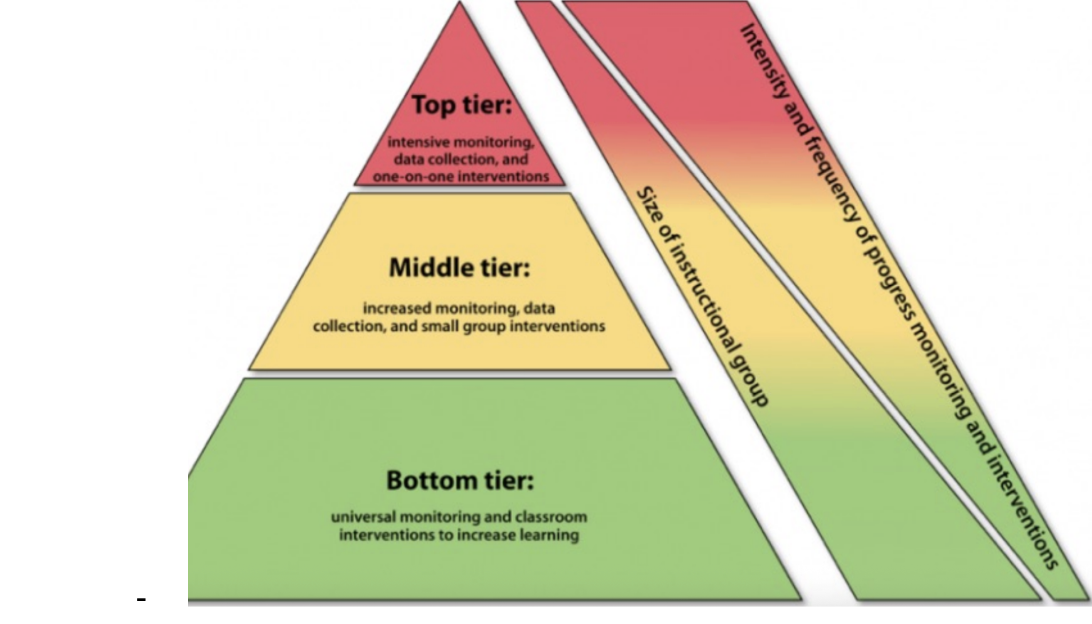
Response to Intervention (RTI)
-tiered
-interventions varies in size & intensity
-much more common in classrooms than UDL
Universal Design for Learning (UDL)
Provided across all settings
Focused on targeted multiple areas of learning & the brain
Ex: helping kids who have a processing delay → UDL makes the processing more accessible & faster
3 main areas of focus (a lot more info on slides)
Engagement: provide options for self-regulations, sustaining effort & persistence, recruiting interest
Representation: provide options for comprehension, language/mathematical expression/symbols, perception
Action & expression: provide options for executive functions, expression/communication, physical action
Diff from RTI
Born from the technology wave (early 2000s)
technology is very encouraged & can apply to all 3 areas of focus (ex: Go Noodle videos, iPads for sounding out words/answers)
Less common than RTI bc it’s the burden of the teacher to provide this (they’re not paid for it)
BUT some parts of RTI (mainly at the bottom tier/universal level) can overlap w/ UDL
Collaborative
3 focuses of UDL
target diff areas of the brain
Engagement: provide options for self-regulations, sustaining effort & persistence, recruiting interest
ex: stop/go signs for all students, “cool down” corners
Representation: provide options for comprehension, language/mathematical expression/symbols, perception
ex: have audio/visual/written ways of explaining info, physical models of concepts (ex: the water cycle)
Action & expression: provide options for executive functions, expression/communication, physical action
ex: Go Noodle videos, “shake it out”
Spectrum of Inclusion
-most —> least inclusive
-co-teaching:
-collaborative/consultation:
-Exam question: How might these delivery methods work under RTI? Under UDL?
RTI: universal/bottom level as co-teaching/collaborative & 3rd tier as small group w/ in or outside the class
UDL: emphasis on co-teaching & collaborative work between the gened & sped teachers

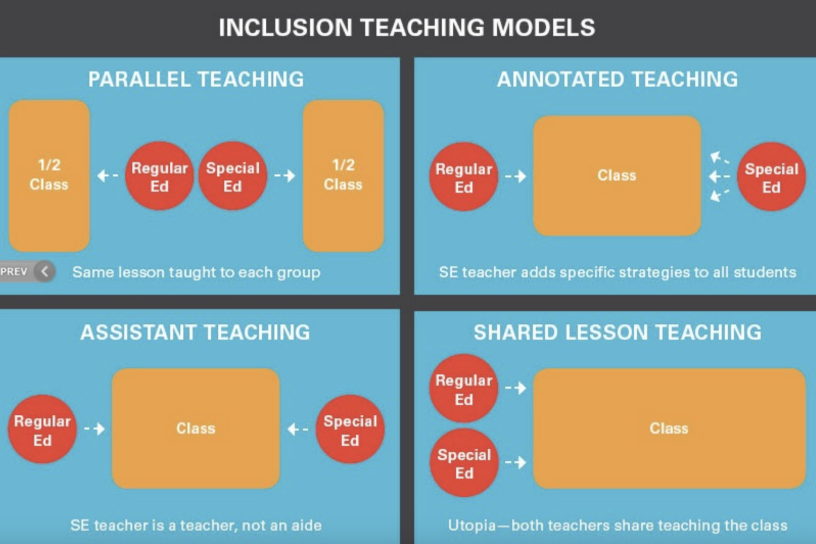
Inclusion Teaching Models
This is how teachers are trained (bc it’s the best practice) → the pulling students out of the classroom method normally just ends up happening bc of FUNDING
best option: shared lesson teaching
The regular ed & special ed teachers develop the curriculum together
Good for if the sped teacher can’t be in the classroom at all times → the gened teacher still knows what to do
worst (& most common): having a sped aide in the classroom only focused on the sped students (no co-teaching)
Positive Behavior Support (PBS): A Proposal for Updating and Refining the Definition
-PBS is a broad, integrated approach (not a single intervention)
constantly adapting & changing to fit a classroom’s/student’s needs
can also be on a school-wide level
evidenced-based
-focuses on prevention: designing environments that reduce triggers, teaching skills proactively, avoiding harsh discipline
ex: if a student frequently disrupts class, adjust their seating or give schedule breaks instead of giving them a detention
-emphasizes improving a child’s overall well-being & life outcomes, not just making them “behave”
focuses on independence, relationships, & participation
values based
A Review of Research on Universal Design Educational Models
-students don’t need accommodations if you design curriculum to be accessible from the beginning
ex: always including captions, visuals, & transcripts in videos instead of only when a student requests it
no standard way to implement it, up to the teacher/school
-UDL is one of the frameworks of the umbrella “UD” term
UDL focuses on the curriculum design (goals, materials, assessments)
goal is to improve learning & engagement for all students (BUT doesn’t always provide consistent results depending on how it’s implemented)
-aims to remove barriers to learning, not lower standards
more accessible > easier
A Multi-Year Evaluation of the Effects of a Response to Intervention (RTI) Model on Identification of Children for Special Education
-after RTI was implemented, fewer students were referred for sped evaluations
why? RTI filters out students who just need better instruction, not sped accommodations —> inc the accuracy of identification
distinguishes between “can’t learn” vs “hasn’t been taught well”
ex: providing a struggling read w/ a targeted intervention & seeing if they improve instead of immediately referring them for sped
-focuses on prevention: identifying & supporting students early before academic failure becomes severe
many students improve w/ early intervention —> don’t need sped
-can improve equity in identification by reducing bias & disproportionality
w/ out RTI: minority students are often over identified
w/ RTI: all students go through the same intervention process —> identification is based on response to instruction, not racial/cultural factors

