Linguistics exam 2
 Studied by 4 people
 Call Kai
 Learn
Learn Practice Test
 Spaced Repetition
 Match
Match Flashcards
 Knowt Play
1/284

There's no tags or description
Looks like no tags are added yet.
Name | Mastery | Learn | Test | Matching | Spaced | Call with Kai |
|---|
No analytics yet
Send a link to your students to track their progress
285 Terms
syntax
study of how words/morphemes combine to form phrases and sentences
focuses on the structure between words
word order
in english, subjects typically precede verbs, then objects follow (SVO)
~40% of world’s languages have this word order pattern
SOV is more common ~44%
VOS, OVS, OSV are rare
english adjective order
determiner, opinion, size, age, shape, color, origin, material, purpose/qualifier, noun
drunk old sailors always sing country on muddy piers, naked
recursion
when something is defined in terms of itself
when a syntactic structure can contain itself
sentence ex: [I think that [they will major in psychology]]
noun phrase ex: [the enemy of [my enemy]]
why are there an infinite number of possible grammatical sentences in a language?
recursion
syntactic knowledge
relates to syntactic categories (parts of speech)
is hierarchical (collections of words behave as a single functional unit)
we can understand and produce sentences containing word pairs that have never occurred
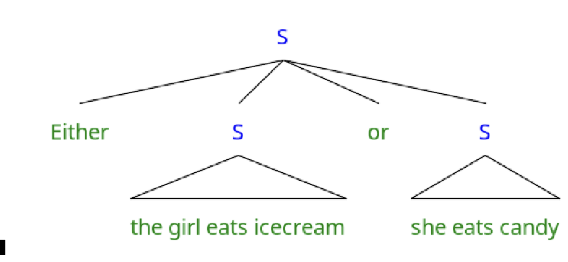
lexical ambiguity
comes from a single word having more than one meaning
ambiguity in the lexicon (homophony)
ex: she went to the bank, he’s looking for a match, the fisherman was cold
structural ambiguity
comes from the way words are grouped or attached in the syntax
multiple possible structures/trees for the same string of words
Ex: old men and women, visiting relatives can be annoying, i saw a man with a telescope
phrase
syntactic unit with internal structurese
sentence
a string of words that is grammatical in language
subject
the expression that comes before a verbo
object
the expression that comes after a verb
phrase structure grammars
hierarchical grammars that utilize syntactic categories
details the syntactic rules of a language
explains how phrase structures are built
explicitly and specifically describes the mental syntactic knowledge of the language’s speakers
X —> YZ
X is composed of the elements YZ
S
sentence
NP
noun phrase
VP
verb phrase
all sentences consist of
NP VP
proper noun
Ann, Tufts, France
pronoun
he, she, they
mass noun
water, sand, furniture
can be preceded by some but not a or number words
do not take plural suffix
usually things that can’t be easily counted, often substances
nouns must be preceded by
a determiner
count noun
waterbottle, chair, etc
can be preceded by a and number words
take the plural suffix when plural
usually things that can be counted
PP
prepositional phrase
ITV
intransitive verb
sleep, dream, look
TV
transitive verb
see kick want
DTV
ditransitive verb
ask, wish, prescribe
SV
sentential verb
believe, think, doubt
DET
determiners
the, a, an
how to parse a sentence
follow the rules in the grammar
don’t use your intuition
each rule (and the treelets it generates) must fit together like a puzzle from start to finish
steps for parsing sentence using PSG
label the POS of each word in the sentence
Place S —> NP VP at top of your tree
everything before the verb will be in the NP, the verb and everything to the right will be in the VP
build the np
build the vp
determine verb subcategorization frame and set the POS of the verb
determining POS of the verb
set verb POS based on the arguments in the sentence:
0 = ITV
1 NP = TV
2 NP = DTV
S = SV
some verbs can behave in more than one way - use the POS relevant to the sentence you’re analyzing
issues with PSGs as a theory of syntactic grammar
while they have the right syntactic properties, they are not well-integrated with cognition
cognition-based method
words are small pieces of syntactic structure
start with words and work up to structure
lexical items are selected based on how well they fit the meaning to be expressed
lexical items project syntactic structure (basic trees) - syntactic structure is stored and retrieved for each word
to build the sentence, merge the treelets appropriately
pros of cognition-based method
simplicity in mechanism: project and merge
more explicit means for lexical items to influence syntactic structure
X-bar theory
every phrase in every sentence in every language is organized the same way
sign language syntax
grammatical use of space
pronouns have fixed positions
spatial agreement
use of abstract space to indicate semantic roles
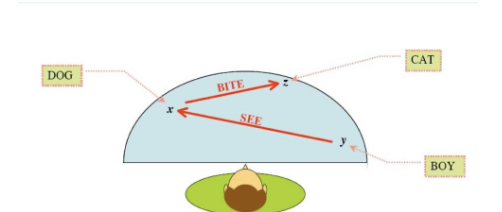
a directional verb’s starting and ending location agrees with the location of the agent and patient
spatial verb agreement
relatively free word order
how we know who the subject is and who the object is
available in a subset of signs “directional verbs”
establish location of referents
use locations in signs to refer to referents
ex: the boy saw the dog bite the cat —> see sign starts at location of boy and ends at location of dog, bite sign starts at location of dog and ends at location of cat
semantics
meaning expressed by linguistic utterances
focuses on literal meaning of words and phrases
heavily dependent on lexical meaning and syntax
lexical semantics
focuses on words
lexicalization, semantic relations among words, sense and reference
compositional semantics
focuses on how words combine
what does it mean for a concept to be lexicalized in a language
if a language has a word for the concept
synonyms
words that have the same meaning
antonyms
words that have opposite meanings
types of antonyms
complementary, gradable, reverses, converses
complementary antonyms
referents must be either picked out by one expression or the other (not both)
ex: married/single, visible/invisible
gradable antonyms
represent points on a continuum (something may be neither one nor the other)
ex: warm/cold, small/big
reverses
one undoes the other
ex: expand/contract, ascend/descend
converses
for one to occur, the other must occur as well
ex: lend/borrow, employer/employee
hypernym
a word whose meaning includes the meaning of a subordinate concept
ex: furniture is a hypernym of chair
hyponym
a word whose meaning is included or is a subset of the meaning of another concept
ex: chair is hyponym of furniture
meronym
a word that is a part of another word
ex: mast is a meronym of sailboat
holonym
a word that contains another word
ex: sailboat is a holonym of mast
polysemy
word that has several related meanings
paper = article and material for writing
chicken = domesticated bird and meat and coward
homophony
word that has several unrelated meanings
ex: light = not heavy and form of illumination
reference/denotation
the things in the world that words refer to
referent
a specific thing a word refers to
proper nouns - single referent
common nouns - many referents
things that do not exist - no referent
ex for referent
different words/linguistic expressions can refer to the same thing (they have the same reference)
ex: Lin Manuel Miranda is:
writer of Hamilton
star of Hamilton
winner of Pulitzer prize
husband
daddy
sense/connotation
mental representation of a linguistic expression’s meaning
definition, associations, experiences
ex: book
reference: set of all objects containing bound pages
sense: object collected in libraries, education, knowledge, etc
the same referent can be associated with diff senses
an expression can have a sense without any referent
thematic roles
the semantics of verbs
describe the roles that entities play in an action or relation
agent
the individual which performs an action; the doer of the action
patient
something which is acted upon as part of an action
theme
something which moves, literally or metaphorically, as a part of an action
source
the location/individual from which a movement occurs
goal
the location/individual to which movement occurs
location
the location at which something happens
experiencer
someone who experiences something
instrument
something an agent uses to make something happen
cause
something that causes something to happen
stimulus
something that causes an experience
talmy
primitive conceptual categories
manner
describes specific motion encoded by a verb
path
describes a physical or abstract trajectory
verbs encode manner or path info
manner: jump, hop, skip
path: enter, exit, ascend, descend
typology
languages tend to lexicalize either path or manner in verbs
manner of motion: english, greek, slavic languages
path: romance languages, turkish, hungarian
when a language lexicalizes one kind of info, that info is carried by the verb and the other kind of info is expressed by other means
english as a manner language
the manner of the motion is usually encoded in the meaning of the verb
path information is usually encoded in syntactic structures
ex: He [to walk/hop]manner [down/across/away ... X to Y]path
French as a path language
path info usually encoded in the meaning of verb, manner is encoded in syntactic structures
[monter/descendre/traverser/partir/revenir/entre/sortir]path [en marchant, à pied, en courant...]manner
English equivalent: [to ascend, descend, cross, leave, return, enter, exit]path [by walking, on foot, by running...]manner
principle of compositionality
the meaning of a linguistic expression is a systematic function of the meanings of its parts and their syntactic organization
non-compositionality
the meaning of some expressions is not compositional - the overall meaning is not a systematic meaning of its parts
ex: its raining cats and dogs
speakers have to memorize the holistic meaning rather than deriving it from its parts
sets
an orderless collection of entities, well-defined theoretical concepts
the reference of individual words = set of entities
set for proper nouns
reference of proper nouns is a set containing a single individual
set for common nouns
nouns refer to the set of all entities that have a particular property
ex: ice is the set of all things that are water and solid
set for verbs
refer to the set of all events in the world that have a particular property
Ex: to freeze: the set of occurrences where a liquid becomes a solid
NP VP - asserting
ordinary declarative sentences assert a proposition (truth values and conditions)
assert the set of referents of the NP is included int he set of referents of the VP
ex: Pedro Pascal acts asserts that Pedro Pascal is in the set of entities that act
propositions have
truth values and truth conditions
truth values
is the fact that is being asserted true
truth conditions
the conditions that must hold in the world for the proposition to be true
ADJ NP - specifying
adjectives specify some subset of the entities referred to by the NP
depends on type of adjective
ADJ NP - intersection
some adjectives specify a subset of the NP by intersecting 2 sets
the ADJ specifies a set of entities
the NP specifies a set of entities
ADJ NP = set of entities in both
Ex: NP = felon; NP = married; ADJ NP = married felon
independently specify a set of referents
ADJ NP - relative intersection, subsective intersection
some adjectives specify a subset of the NP by subsetting the NP’s entities
ex: skillful, big/small, exciting, beautiful
these adjectives do not independently pick out a set of referents; reference is not fixed but determined by the reference of the NP
oxymorons can come from treating a subsective adjective as if it were intersective
ADJ NP - non intersection
expression refers to individuals who may or may not be in the set referred to by the NP
ex: possible, alleged, likely, supposed
requires modal logic
ADJ NP - anti-intersection
expression refers to individuals that are not described by the NP
ex: fake, pretend, artificial, imaginary
ADJ entails entity is not in the set of items picked out by the NP
pragmatics
study of how we use language in context and how context contributes to meaning
context dependent
what a sentence means and what a sentence does depends on the context
deictic terms
linguistic expressions that by themselves don’t mean anything specific - their meaning is entirely dependent on the context in which they appear
ex: pronouns, temporal terms, directional terms
types of context
linguistic, extra-linguistic, situational, social
linguistic context
what has been said earlier in conversation
extralinguistic context
context outside of language
situational context
the local environment of the utterance
 Note
Note  Flashcards (30)