Lecture 2 - The Self
 Studied by 0 people
 Call Kai
 Learn
Learn Practice Test
 Spaced Repetition
 Match
Match Flashcards
 Knowt Play
1/55

There's no tags or description
Looks like no tags are added yet.
Name | Mastery | Learn | Test | Matching | Spaced | Call with Kai |
|---|
No analytics yet
Send a link to your students to track their progress
56 Terms
What are the 4 concepts of the self?
Self-concept (who am i)
Self-esteem (my sense of self-worth)
Self-knowledge (how i explain myself)
Social-self (my roles in society)
Define self-schema.
An organised framework that helps people process and organise information that is relevant to themselves.
What is an example of social comparison having positive and negative effects on us?
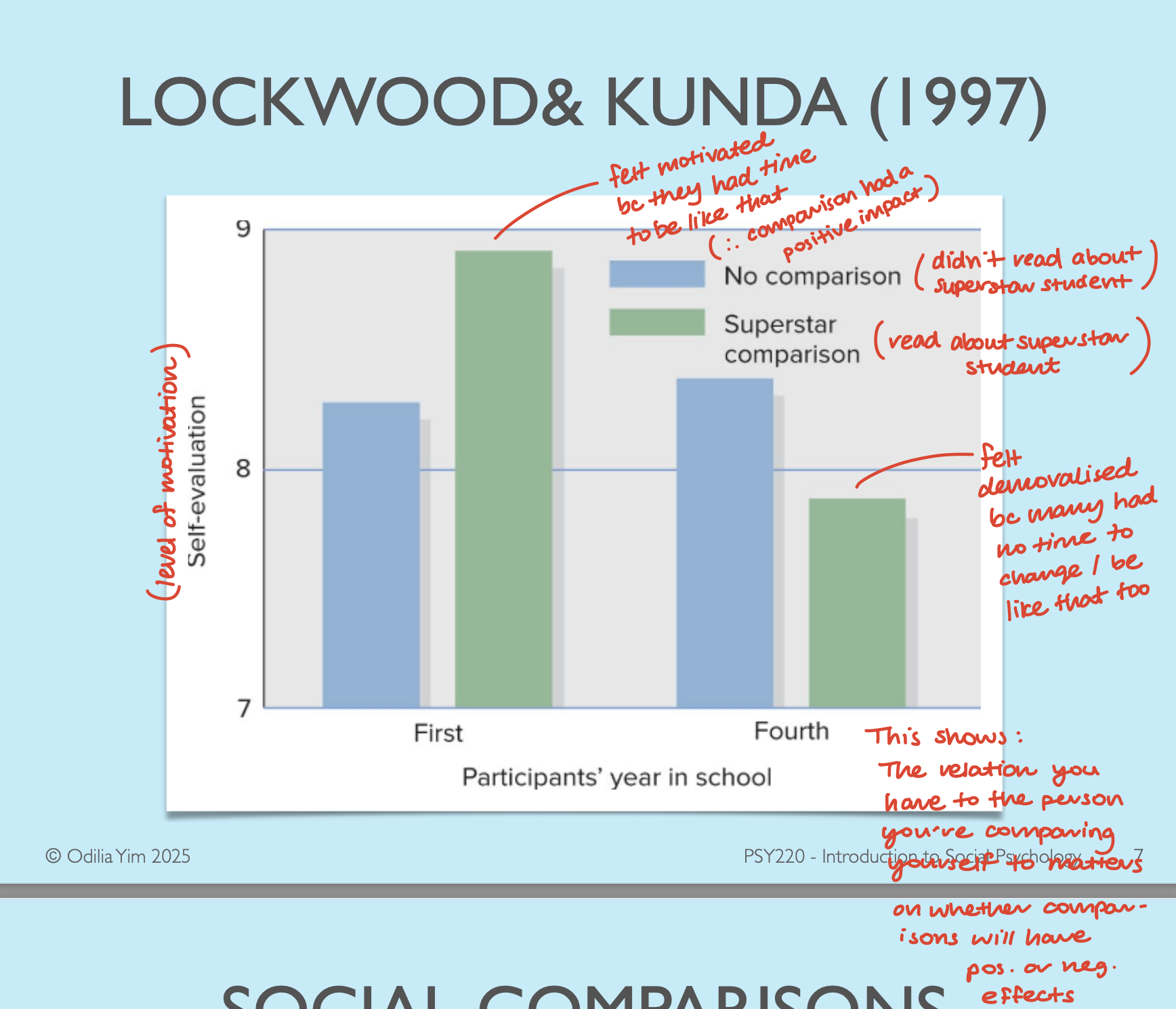
Lockwood and Kunda (1997)
First year students and fourth year students were given a bio of this ‘superstar student’ in fourth year.
First year students who read the bio became motivated to be like her and therefore felt really good about themselves after reading the bio.
Fourth year students who read the bio felt horrible after reading the bio because they felt that they lacked time and that such a goal was unattainable for them. Hence, compared to the first years, their self-esteem was much lower after reading the bio.
For the first and fourth years who did not read the bio, their self-esteems were quite similar.
This indicates that the relation one has to a figure of social comparison can impact the way they are affected by it.
How does social media affect us?
It creates a lot of opportunities for unrealistic social comparisons as social media usually only shows the best and most exciting parts of one’s life.
Hence, we may often feel worse after looking at social media.
Define the spotlight effect.
The idea of always seeing ourselves as the main character.
Define the illusion of transparency.
When we overestimate how much other people can see our emotions and thoughts.
What is an example of the illusion of transparency?
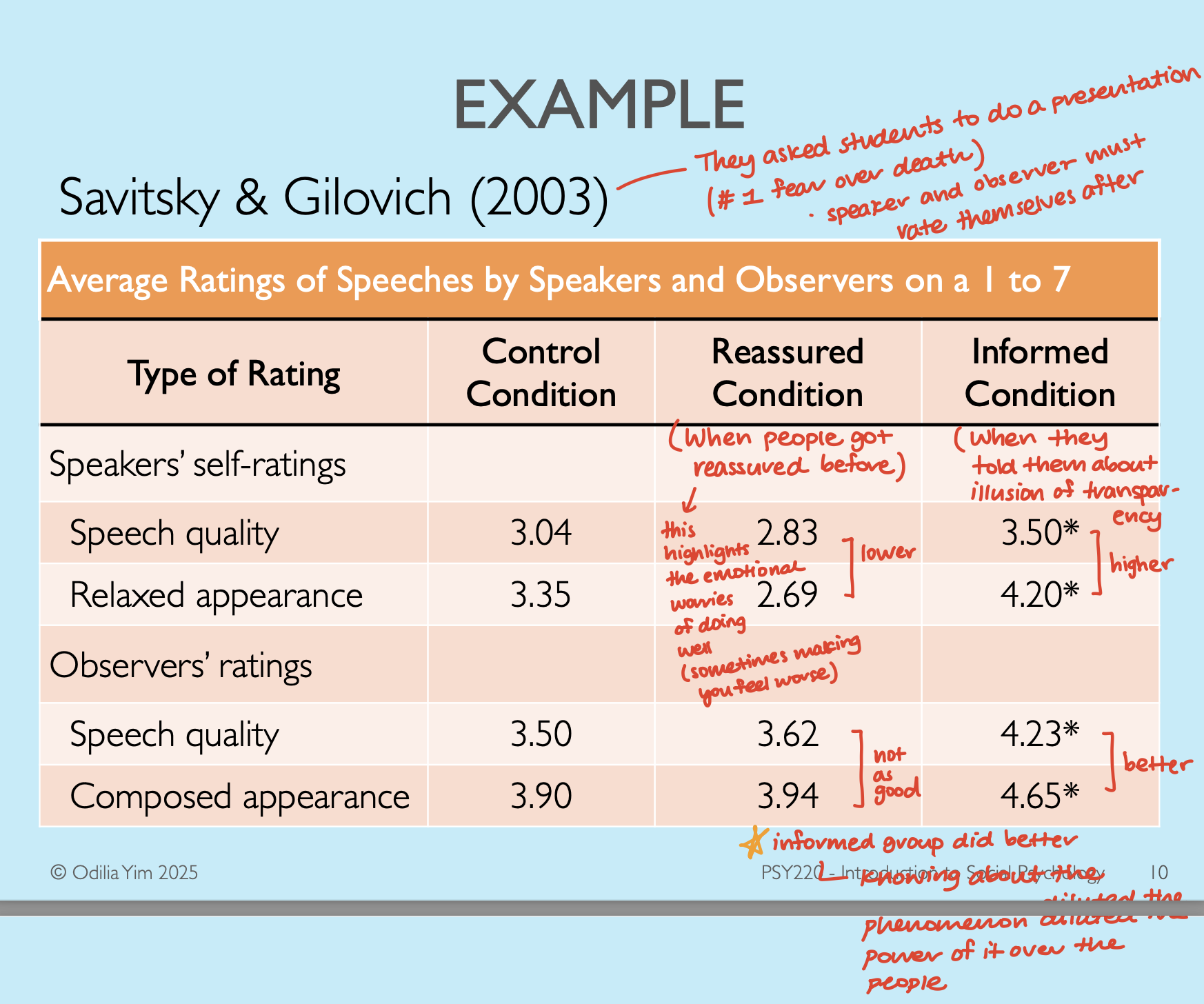
Savitsky and Gilovich (2003)
They made their participants do a presentation in front of some observers. Afterwards, each participant and observer were to rate the speaker’s presentation.
There were 2 groups; the reassured condition that was given reassurance before the presentation that they’ll do great, and the informed condition which was told about the illusion of transparency.
The speakers part of the reassured condition ranked their presentation significantly lower than those in the informed condition. Moreover, the observers ratings of the speakers presentations were significantly lower for the reassured condition vs. the informed condition.
This suggests that knowing about the illusion of transparency ‘diluted’ its power and made the speakers feel more confident about themselves, which became obvious to the observers.
What did Hofstede do?
He developed a framework called ‘Cultural Dimensions’ to describe how national cultures differ across various aspects of society, particularly in the workplace.
Explain cultural dimensions.
The 6 dimensions are:
Power Distance (the extent to which society accepts unequal power distributions)
Individualism vs. Collectivism (the degree of individual vs. group orientation)
Masculinity vs. Femininity (emphasis on assertiveness vs. nurturing values)
Uncertainty Avoidance (a trait that measures a group's tolerance for unpredictable situations)
Long-Term vs. Short-Term Orientation (Long-term orientation values long-term gains and is willing to give up short-term comforts. But, short-term orientation focuses on tradition and achieving immediate gratification.)
Indulgence vs. Restraint (enjoyment of life vs. societal control)
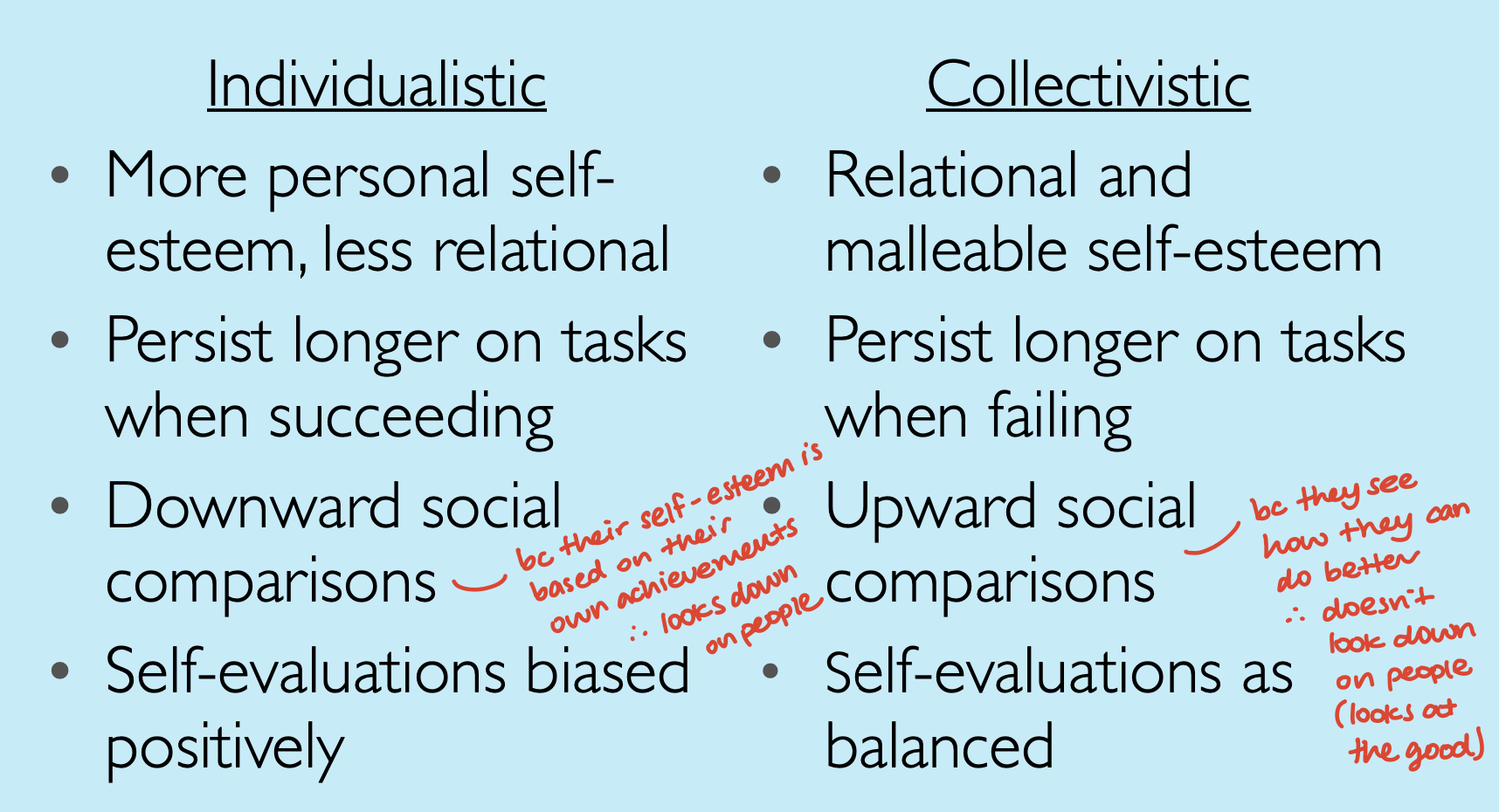
Explain individualism in more depth.
It’s about yourself and what’s best for you. Hence, your self-worth is derived by your own works, not by that of others.
Explain collectivism in more depth. How does it compare to individualism?
It is about your relationships with others where your self-worth can be boosted by your relationships with others.
Describe an example of culture and cognition being intertwined.
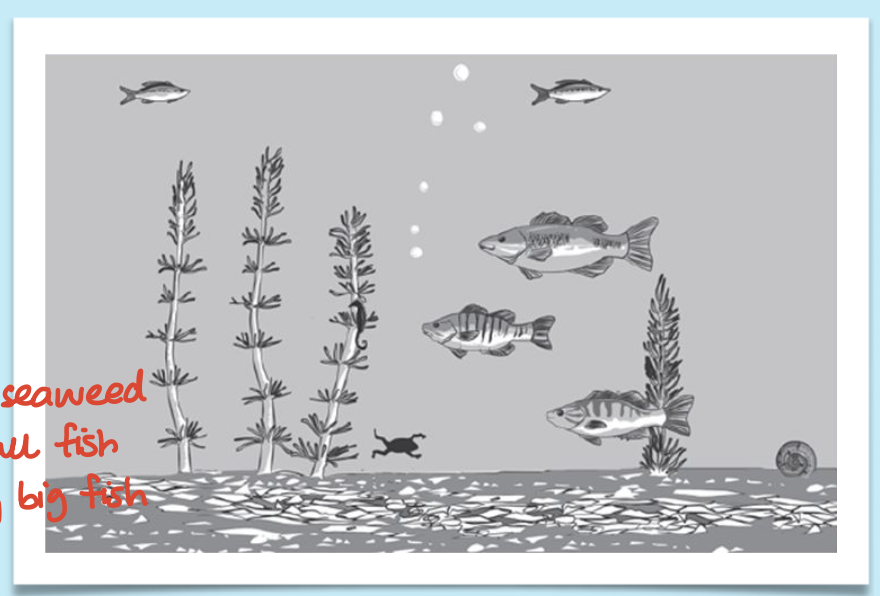
Masuda and Nisbett (2001)
When given an image, east asian people described the environment and the relationships among the fish. Like there’s seaweed and a big and small fish.
However, Americans tended to focus on the fact that there’s a big fish and that’s the leader.
This highlights how culture can affect the way we perceive certain situations, our cognition of the world.
What was the Kim and Markus example about? What did they conclude?
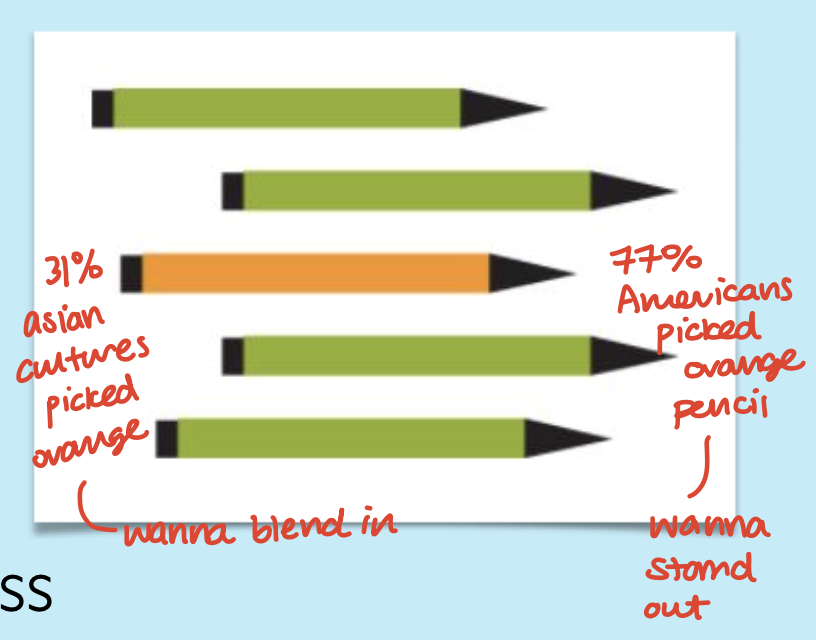
When asked which pencil they would choose, people from asian cultures said they’d pick the green pencil, to blend in. However, American’s picked the orange pencil in order to stand out.
Again, this example was about the affect of our culture on our cognition. Suggesting that asians have more collectivists pov and Americans have more individualistic pov’s.
Compare and contrast individualism and collectivism.
Define planning fallacy.
When we underestimate how long a task is going to take.
Define affective forecasting.
Predicting our own feelings.
Define impact bias.
When we overestimate the enduring impacts of an emotion causing effect.
(ie. overestimating how bad you will feel when you leave home to go to college)
Explain what an implicit attitude is.
An automatic response that develops slowly and is drawn from our past experiences.
This type of attitude is hard to stop because it is deeply rooted from our past.
Explain what an explicit attitude is.
An attitude that is consciously controlled and may change with education/persuasion.
Define self-esteem.
An individuals overall sense of self-worth.
What is low self-esteem associated with?
anxiety
loneliness
eating disorders
Can you have too much self-esteem? What is it called?
YES!
It is called Narcissism.
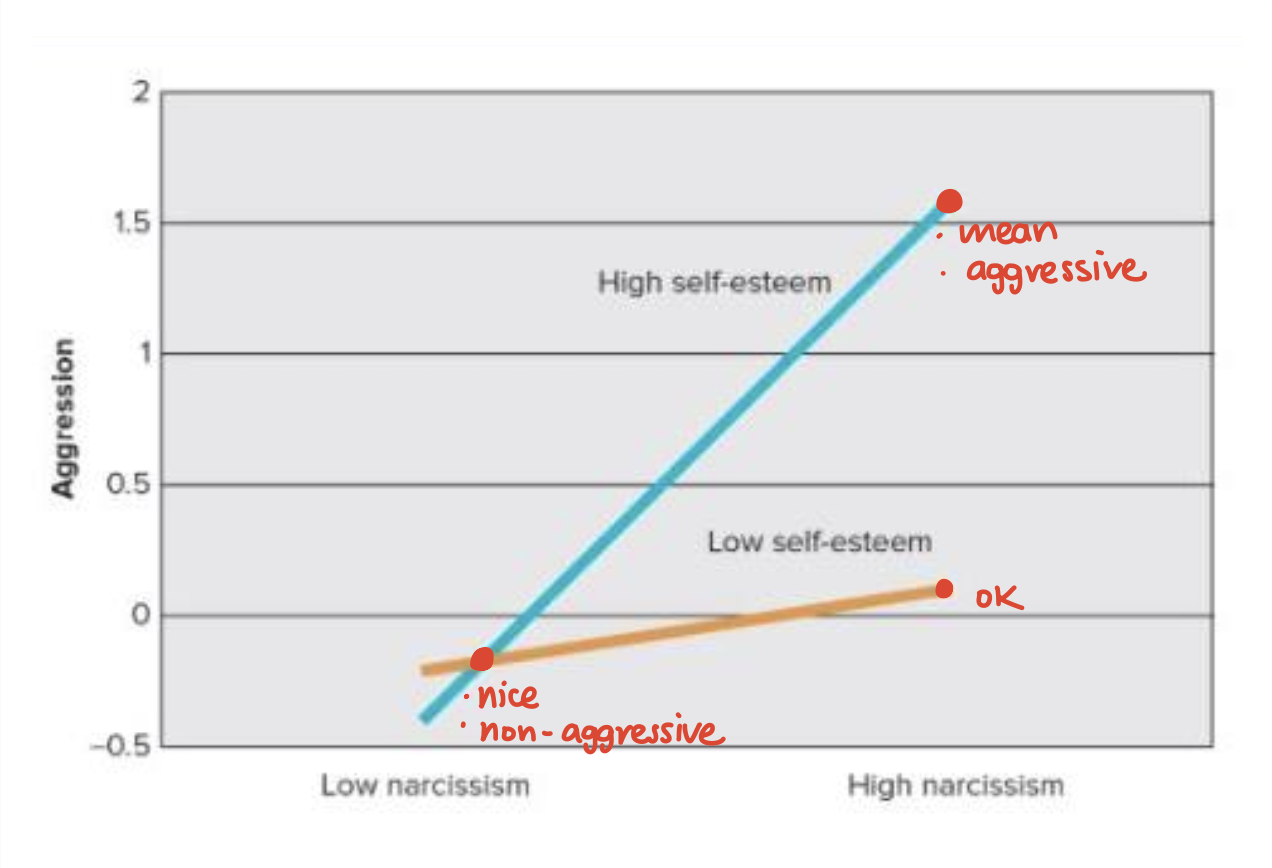
Define narcissism.
Thinking way too highly of oneself to the point that they think they are superior to everyone.
Explain Bushman’s graph.
Define self-efficacy.
Believing in one’s own competence (ie. they think if they work hard they can achieve their goals — high grit and perseverance).
What’s the difference between self-esteem and self-efficacy.
Self-esteem is about your sense of worth and value, while self-efficacy is a specific belief in your ability to successfully perform tasks/actions in particular situations.
Think of it this way: self-esteem is a broader "I like and value myself as a person," whereas self-efficacy is a specific "I believe I can do this particular thing".
Define self-serving bias.
The tendency to attribute personal failure to external forces, but personal success to internal forces.
Define self-serving attributions.
The tendency to attribute positive outcomes to yourself and negative outcomes to other factors.
What are the 4 different characteristics of attributions?
They are:
internal
external
stable
temporary
How do most people consider themselves?
Most people consider themselves better than average.
What is the rating people give themselves contingent on at times?
The subjectivity of the topic. Usually, the more subjective the topic, the more highly one will rate themself because it’s not as easily refuted.
ie. I am healthier than most people (but what does healthy mean in your definition?)
Define unrealistic optimism (aka. illusory optimism).
When someone is unrealistically optimistic because they have a pessimistic view on others future.
What’s an example of unrealistic optimism?
When Lucy graduates from UofT she thinks that she will find a job within 1 day of searching because she thinks she did so many things that her peers didn’t.
Therefore, her optimism is fueled by a pessimistic outlook on others.
Define defensive optimism.
A coping strategy where an anxious individual sets unrealistically low expectations for a situation, even when they have a history of success.
Is it good to have a balance of illusory and defensive optimism? Why?
Yes!
Because a bit of both keeps you motivated but also prepared in case things don’t go exactly in your favour.
Define the false consensus effect.
Overestimating the commonality of one’s opinions and one’s undesirable/unsuccessful behaviours.
ie. ‘everyone’ sleeps around so it’s fine
Define the false uniqueness effect.
Underestimating the commonality of one’s abilities and one’s desirable/successful behaviours.
Define self-presentation.
The desired image we want to present to our external audience and internal audience (ie. ourselves).
Why do we want to present our desired image to an internal audience?
Because we want the image we have of ourselves to match what our external audience sees.
Does our desired image of ourselves change according to who we are with and what situation we’re in?
Yes!
Define self-handicapping.
Partaking in certain behaviours to protect one’s self-image so that those behaviours can be used as an excuse for later failure.
Is self-handicapping a conscious decision or not?
It is an unconscious decision.
What is an example of self-handicapping?
when someone has a self-image that they are a good student
the night before an exam they go out partying because they know they aren’t ready for the test and want to be able to blame their bad grade on something other than themselves
this is because they don’t want to ruin the image of being a good student in their head
hence, when the person does not do well on the test, they attribute it to the fact that they got ‘dragged’ to go to a party rather than face the fact that they might not be such a good student (ie. ruin their self-image)
What umbrella term in self-presentation under?
Impression management.
Define self-monitoring.
Being attuned to the way one presents themselves in social situations and adjusting their behaviour to create a desired impression.
What is self-presentation theory?
The theory suggest that we are eager to present ourselves in a way that makes a good impression.
What are the possible implications of self-presentation theory?
Because of this pressure to impress, people can become paralysed with self-doubt and social anxiety.
Therefore, possibly leading them to over-personalise situations.
Who usually over-personalise’s situations?
Those who are shy, anxious or self-conscious.
Explain what over-personalising a situation means.
When people see incidental events as relevant to themselves.
What can over-personalising situations lead to?
stress
anxiety
paranoia
What’s an example of overpersonalising a situation?
Your boss walks past you a couple times while she tasked you to fold t-shirts. Due to this, you begin to think she’s monitoring you and disapproving of how you work, leading you to stress and paranoia. However, in reality, she was just called a couple times in the back to sort inventory.
Other than this pressure to impress, what other factor plays into us over-personalising situations? Why?
Spotlight effect
This is because by overestimating the extent to which people are watching them, people feel like incidental effects are relevant to them—which is over-personalising the situation.
Define learned helplessness.
Occurs when an individual feels like they have no control over negative events and therefore become passive (ie. they don’t try and prevent the neg. outcome — they just leave it).

What is the underlying root of learned helplessness?
Not believing in one’s own competence (abilities).
*low self-efficacy
Define self-efficacy.
A belief in one’s competence.
What are the cons of too much freedom and self-determination (ie. opposite of learned helplessness)? Explain.
It could result in decreased life satisfaction, depression and regret.
This is because when we have too many options it is easy for us to look back and wonder “what if I picked that instead?” This feeling of being unsure in the choice you made can be really difficult to manage, possibly leading to the above cons.
 Note
Note  Flashcards (421)