BIO 121
0.0(0)
 Studied by 4 people
 Call Kai
 Learn
Learn Practice Test
 Spaced Repetition
 Match
Match Flashcards
 Knowt Play
Card Sorting
1/125

There's no tags or description
Looks like no tags are added yet.
Last updated 3:51 AM on 6/7/23
Name | Mastery | Learn | Test | Matching | Spaced | Call with Kai |
|---|
No analytics yet
Send a link to your students to track their progress
126 Terms
1
New cards
What is gene?
A small section of DNA that codes for a protein
2
New cards
What is phenotypes?
Observable physical properties of an organism
3
New cards
What is alleles, why are they important and how to they occur?
Different versions of a gene
\
→ Responsible for variation in inherited traits
**→** They arise due to mutations in DNA
\
→ Responsible for variation in inherited traits
**→** They arise due to mutations in DNA
4
New cards
What is DNA?
A double-stranded molecule and is composed of nucleotides
5
New cards
What is mutation and how is it caused?
A change in sequence of nucleotides in DNA
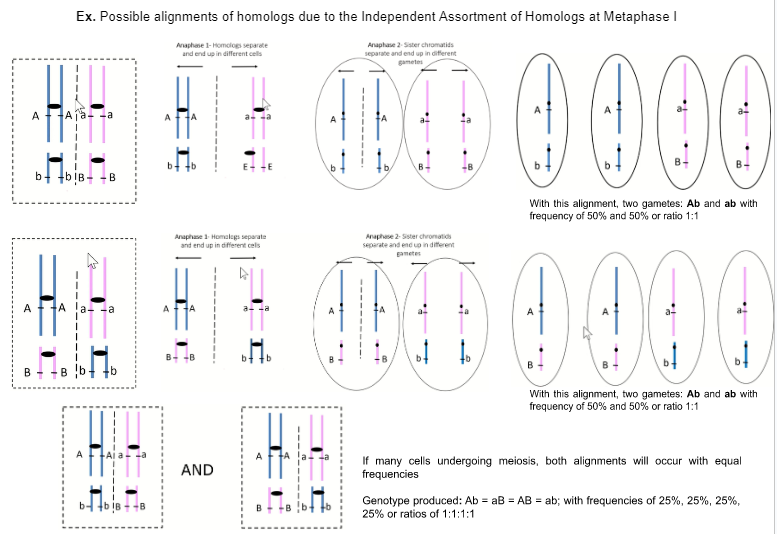
\
→ Can be a change of a single base or more in a nucleotide sequence; this can change amino acid sequence and function of protein
→ Caused by errors in DNA during replication and some environmental factors (**ex.** UV light)
\
→ Can be a change of a single base or more in a nucleotide sequence; this can change amino acid sequence and function of protein
→ Caused by errors in DNA during replication and some environmental factors (**ex.** UV light)
6
New cards
What is genome?
An organism’s complete set of DNA
7
New cards
What is chromosome?
Composed of DNA molecule + histone proteins
8
New cards
What is somatic cells, how many chromosomes are in each cell and what do they include?
All cells in the body other than eggs and sperm (diploid)
\
→ Each cell is composed of 46 chromosomes (23 pairs of chromones)
→ This includes **22 homologous pairs of autosomes** and **1 pair of sex chromosomes**
\
→ Each cell is composed of 46 chromosomes (23 pairs of chromones)
→ This includes **22 homologous pairs of autosomes** and **1 pair of sex chromosomes**
9
New cards
What is homologous chromosomes?
Matched pair of chromosomes
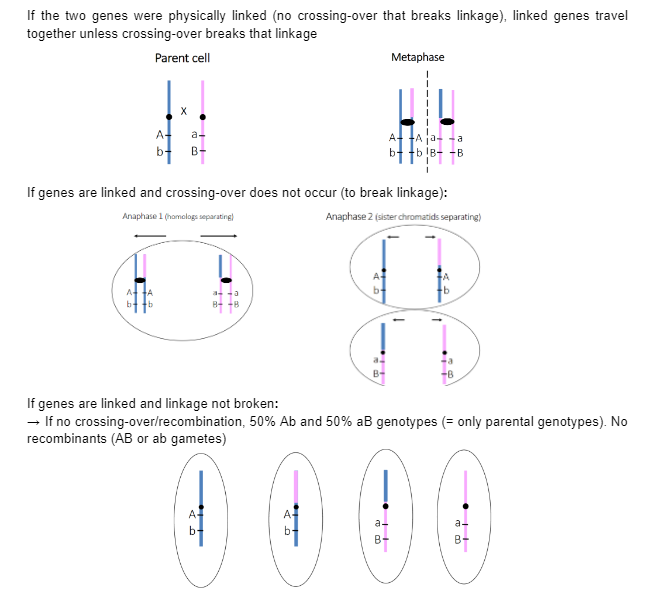
\
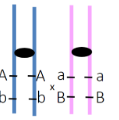
→ These chromosomes have similar sizes, locations of centromere and carry same sequence of genes but different alleles
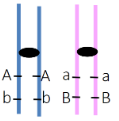
\
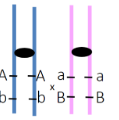
→ These chromosomes have similar sizes, locations of centromere and carry same sequence of genes but different alleles
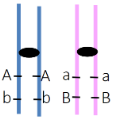
10
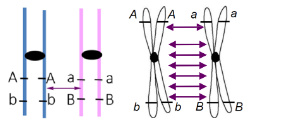
New cards
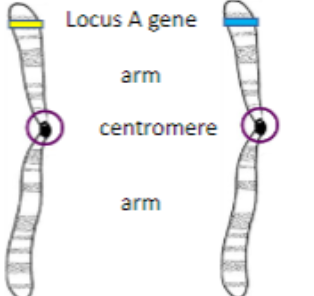
What is centromere?
The constriction point on a chromosome
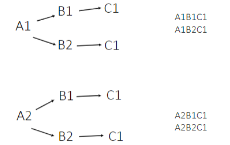
\
→ Divides chromosome into 2 arms
→ Each chromosome may carry hundreds of genes
→ Each gene has a specific location or **locus** on a chromosome (genetic street address)
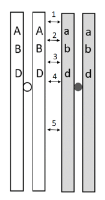
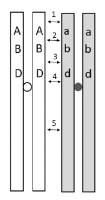
\
→ Divides chromosome into 2 arms
→ Each chromosome may carry hundreds of genes
→ Each gene has a specific location or **locus** on a chromosome (genetic street address)
11
New cards
What is ploidy?
Number of each type of chromosome present
\
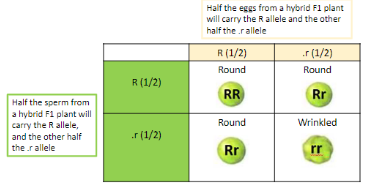
Haploid = 1 of each type of chromosome
Diploid = 2 of each type of chromosome
Polyploid = 3 or more of each type of chromosome
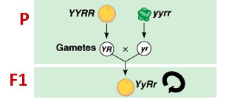
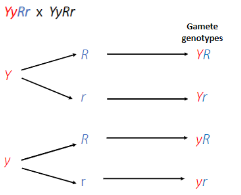
\
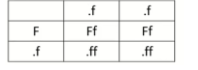
Haploid = 1 of each type of chromosome
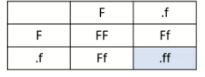
Diploid = 2 of each type of chromosome
Polyploid = 3 or more of each type of chromosome
12
New cards
What is haploid number (n)?
Refers to total # of chromosomes present in a gamete
\
2n
\
→ Haploid # for our cells will be **23** 2(23)=46
\
2n
\
→ Haploid # for our cells will be **23** 2(23)=46
13
New cards
What is gametes and what does it consist of?
Eggs and Sperm cells (haploid)
→ Have 23 chromosomes including **1 of each autosome** and **1 sex chromosome (X or Y)**
→ Have 23 chromosomes including **1 of each autosome** and **1 sex chromosome (X or Y)**
14
New cards
What is autosome?
All chromosomes in the body other than sex chromosomes (X or Y)
15
New cards
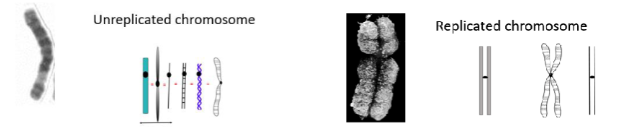
What is the difference between un-replicated DNA and replicated DNA?
Chromosomes can be replicated or un-replicated
\
DNA is packaged into thread-like structures in terms of chromosomes, an unreplicated chromosome has one double-stranded DNA molecule. However, a replicated chromosome has two identical double-stranded DNA molecules which are called chromatids and joined at the centromere
\
DNA is packaged into thread-like structures in terms of chromosomes, an unreplicated chromosome has one double-stranded DNA molecule. However, a replicated chromosome has two identical double-stranded DNA molecules which are called chromatids and joined at the centromere
16
New cards
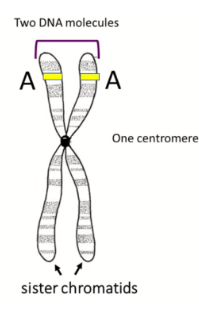
What are chromatids?
When DNA is replicated, it is composed of two sister **chromatids (sister chromatids)** that are joined at the centromere; both should carry the same alleles as they are copies of each other unless a mutation has occurred
\
**“chromatid” term only ever used for REPLICATED chromosomes**
\
→ Each chromatid = One DNA molecule
→ Two sister chromatids that are attached at centromere = One chromosome
\
**“chromatid” term only ever used for REPLICATED chromosomes**
\
→ Each chromatid = One DNA molecule
→ Two sister chromatids that are attached at centromere = One chromosome
17
New cards
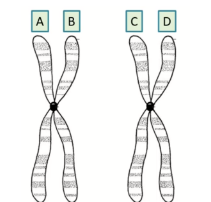
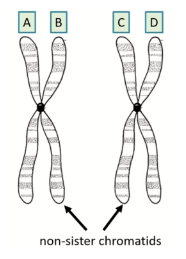
Which pair of letters are non-sister chromatids?
A & B are sister chromatids thus they are identical and will have identical sequence (same alleles)
\
C & D are sister chromatids thus they are identical and will have identical sequence (same alleles)
\
B & C are non-sister chromatids thus they are not identical and will **not** have similar alleles
\
C & D are sister chromatids thus they are identical and will have identical sequence (same alleles)
\
B & C are non-sister chromatids thus they are not identical and will **not** have similar alleles
18
New cards
What is genotype?
A **genotype** refers to the combination of alleles that an individual possesses for a specific gene/s
19
New cards
What is difference between homozygous and heterozygous (definition of each)?
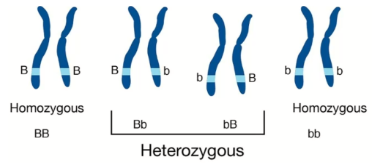
→ Individuals that carry the same alleles of a gene (**ex.**. BB or bb) are **HOMOZYGOUS** for that gene
\
**HOMO-** means the same
\
→ Individuals that carry two different alleles (**ex.** Bb) of a gene are **HETEROZYGOUS** or have a HETEROZYGOUS GENOTYPE
\
**HOMO-** means the same
\
→ Individuals that carry two different alleles (**ex.** Bb) of a gene are **HETEROZYGOUS** or have a HETEROZYGOUS GENOTYPE
20
New cards
**Q.** In mammals, the TYRP1 protein is a crucial enzyme required to synthesize eumelanin, the dark pigment found in hair/fur and skin. TYRP1 is found in melanocytes (the cells that produce eumelanin) and is encoded by the tyrp1 gene. In a bear, which of the following cells contain the tyrp1 gene?
**→ Gametes, melanocytes, and kidney cells. This is mainly due to how all somatic cells, with few exceptions, contain the same DNA. Gametes contain one set of DNA thus they would contain one allele of the TYRP 1 gene. This results in this gene being found in all bear cells.**
21
New cards
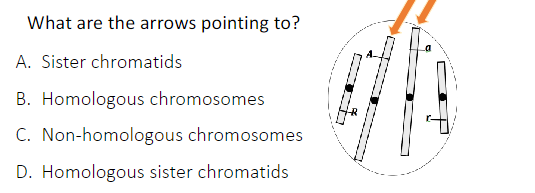
**Q.** What are the arrows pointing to?
→ Homologous chromosomes
22
New cards
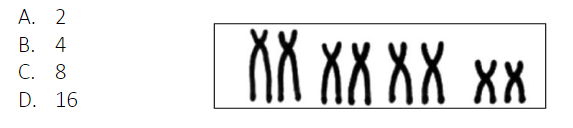
**Q.** How many chromosomes are shown?
→ 8
23
New cards
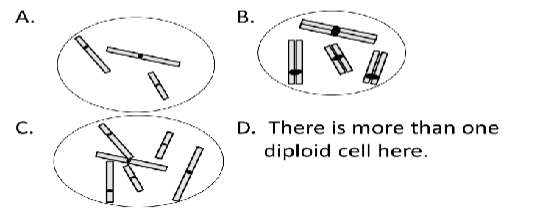
**Q.** Which cell is diploid?
→ **A & B are haploids as there’s only 1 type of each chromosome of the same size and location of centromere thus C is only diploid since there are 2 pairs of 2 types of chromosome**
24
New cards
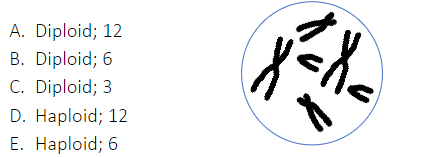
**Q.** What are the ploidy and haploid number of chromosomes in the cell shown below?
**→ Diploid; 3. This is b/c each replicated chromosome has an identical DNA molecule similar to its other replicated chromosome pair thus there can only be 3 DNA molecules in total**
25
New cards
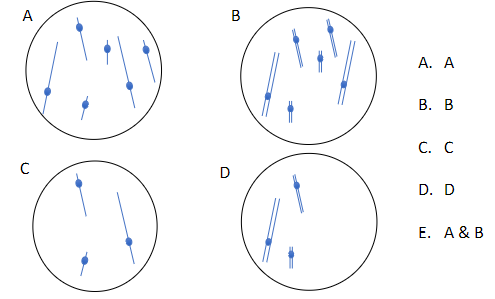
Which cell(s) are 2n=6?
**→ A & B**
26
New cards
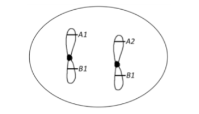
Is this cell homozygous or heterozygous for the A gene?
→ Heterozygous for the A gene and Homozygous for the B gene
27
New cards
What is the difference between normal cells and new cells?
All cells arise from pre-existing cells
\
New cells arise through cell division; there are two types
→ **Mitosis + cytokinesis**
**→ Meiosis + cytokinesis**
\
Mitosis and Meiosis refer to nuclear divisions (division of nucleus)
Cytokinesis refers to division of cytoplasm
\
New cells arise through cell division; there are two types
→ **Mitosis + cytokinesis**
**→ Meiosis + cytokinesis**
\
Mitosis and Meiosis refer to nuclear divisions (division of nucleus)
Cytokinesis refers to division of cytoplasm
28
New cards
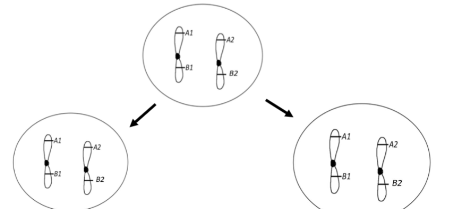
What is the goal of mitosis?
The goal of **mitosis** is for parent cell (a somatic cell) to produce **two** daughter cells that are **genetically identical** to parent cell and each other (mitosis occurs in somatic cells)
29
New cards
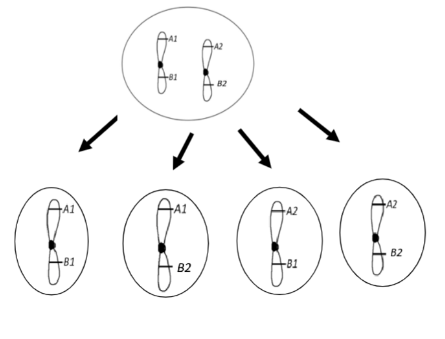
What is the goal of miosis?
The goal of **miosis** is for parent cell (germline cell) to produce **four** daughter cells or gametes (eggs and sperm) that are **genetically different** from each other the parent cell and each other (mitosis occurs in germline cells)
30
New cards
Mitosis is part of ___
**Mitosis** is a part of the **cell cycle** - An ordered sequence of events that a cell goes through from one cell division to the next
31
New cards
Why is mitosis (& cytokinesis) important?
→ All organisms (including humans) would be single-celled
→ Humans could not grow
→ Dead/damaged cells and worn-out cells couldn’t be replaced (damaged cells are replaced by mitosis)
→ Mitotic errors have been linked to cancer
→ Humans could not grow
→ Dead/damaged cells and worn-out cells couldn’t be replaced (damaged cells are replaced by mitosis)
→ Mitotic errors have been linked to cancer
32
New cards
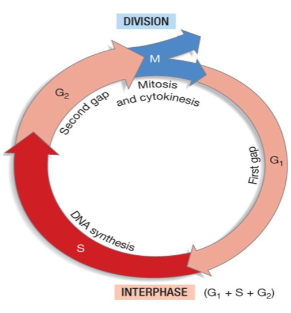
What are the two major phases of the cell cycle?
**1. Interphase**
→ Longest period of a cell’s life
→ Divided into 3 stages**: G1 Phase, S Phase, G2 Phase**
\
**2. M Phase (mitosis & cytokinesis)**
→ Mitosis is divided into 4-5 phases
1. Prophase
2. Prometaphase
3. Metaphase
4. Anaphase
5. Telophase
→ Longest period of a cell’s life
→ Divided into 3 stages**: G1 Phase, S Phase, G2 Phase**
\
**2. M Phase (mitosis & cytokinesis)**
→ Mitosis is divided into 4-5 phases
1. Prophase
2. Prometaphase
3. Metaphase
4. Anaphase
5. Telophase
33
New cards
What occurs during Interphase: G1 phase?
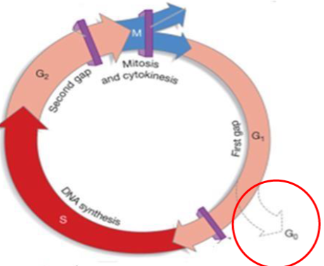
In G1 (longest) phase, cell is performing its functions (**ex.** being a liver cell or skin cell)
\
If cell is signalled to start dividing, cell begins to prepare by**:**
→ growing
→ duplicating organelles
→ accumulating nucleotides
→ obtaining energy reserves
\
If a cell is not going to divide it can enter Go phase
→ Performs main function indefinitely
**Ex.** neurons, muscles cells in your heart are in Go phase (they don't divide) and are in this phase for the duration of its life
\
If cell is signalled to start dividing, cell begins to prepare by**:**
→ growing
→ duplicating organelles
→ accumulating nucleotides
→ obtaining energy reserves
\
If a cell is not going to divide it can enter Go phase
→ Performs main function indefinitely
**Ex.** neurons, muscles cells in your heart are in Go phase (they don't divide) and are in this phase for the duration of its life
34
New cards
What occurs during Interphase: S phase?
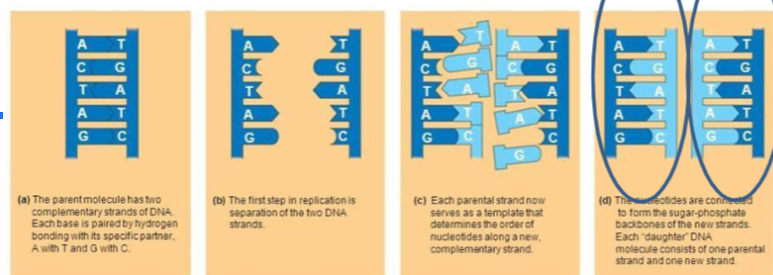
S stands for **synthesis;** this is when DNA replicates (sister chromatids are formed)
\
**Replicated chromosome** consist of two copies of the same chromosome
\
→ This is called semi-conservative DNA replication b/c each daughter DNA molecule consists of one **old strand and one new strand**
\
**Replicated chromosome** consist of two copies of the same chromosome
\
→ This is called semi-conservative DNA replication b/c each daughter DNA molecule consists of one **old strand and one new strand**
35
New cards
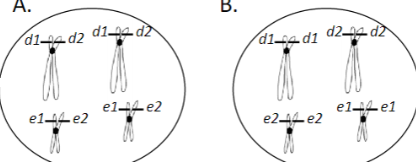
Suppose an individual has the genotype d1/d2; e1/e2. What should their chromosomes look like immediately after DNA replication?
**→ B as after DNA replication, chromatid chromosomes are identical**
36
New cards
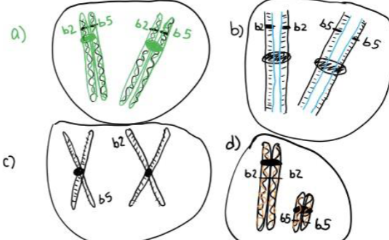
Students in Dr. Jennifer Klenz’s genetics class (Biol 234) were asked to draw two replicated homologous chromosomes just after DNA replication. One homolog carries the B2 gene and one homolog carries the B5 gene. Which diagram is correct?
**→ After DNA replication, chromosomes must be similar in length and location of centromere since we are talking about homologous chromosomes (homolog) thus B is correct**
37
New cards
What occurs during Interphase: G2 phase?
→ Shortest part of interphase (b/c the duplication of everything causes cell to want to replicate asap)
→ Final preparations are made before the cell divides
→ May be additional growth
→ More organelles may be duplicated
→ Final preparations are made before the cell divides
→ May be additional growth
→ More organelles may be duplicated
38
New cards
What occurs during Miosis & Cytokinesis?
\
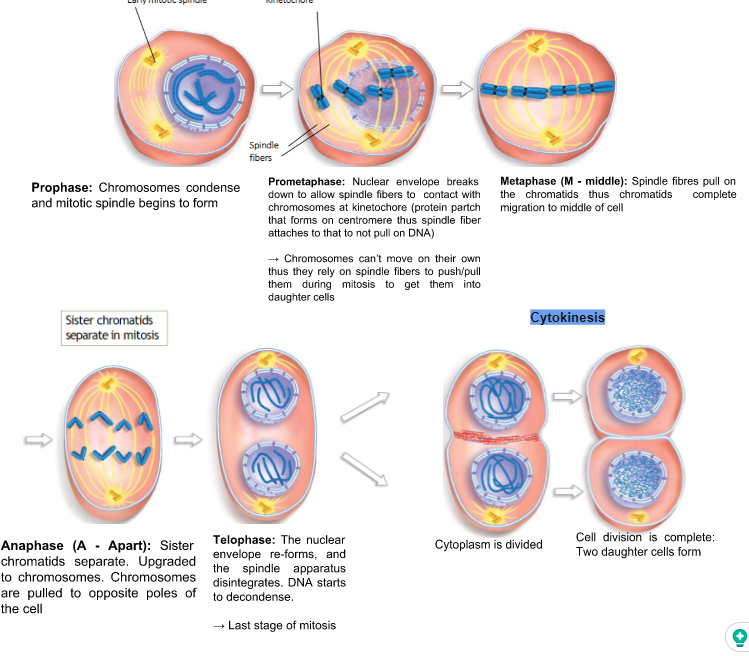
1. Prophase: Chromosomes condense and mitotic spindle begins to form
\
2. Prometaphase: Nuclear envelope breaks down to allow spindle fibers to contact with chromosomes at kinetochore (protein partch that forms on centromere thus spindle fiber attaches to that to not pull on DNA)
\
→ Chromosomes can’t move on their own thus they rely on spindle fibers to push/pull them during mitosis to get them into daughter cells
\
3. Metaphase: Spindle fibres pull on the chromatids thus chromatids complete migration to middle of cell
\
4. Anaphase: Sister chromatids separate. Upgraded to chromosomes. Chromosomes are pulled to opposite poles of the cell
\
5. Telophase: The nuclear envelope re-forms, and the spindle apparatus disintegrates. DNA starts to decondense.
\
→ Last stage of mitosis
\
6. Cytokinesis: Cytoplasm is divided
7. Cytokinesis: Cell division is complete; two daughter cells form
1. Prophase: Chromosomes condense and mitotic spindle begins to form
\
2. Prometaphase: Nuclear envelope breaks down to allow spindle fibers to contact with chromosomes at kinetochore (protein partch that forms on centromere thus spindle fiber attaches to that to not pull on DNA)
\
→ Chromosomes can’t move on their own thus they rely on spindle fibers to push/pull them during mitosis to get them into daughter cells
\
3. Metaphase: Spindle fibres pull on the chromatids thus chromatids complete migration to middle of cell
\
4. Anaphase: Sister chromatids separate. Upgraded to chromosomes. Chromosomes are pulled to opposite poles of the cell
\
5. Telophase: The nuclear envelope re-forms, and the spindle apparatus disintegrates. DNA starts to decondense.
\
→ Last stage of mitosis
\
6. Cytokinesis: Cytoplasm is divided
7. Cytokinesis: Cell division is complete; two daughter cells form
39
New cards
What cells are produced in miosis and why is it important?
**Meiosis** is a type of cell division that produces eggs and sperm
→ Important for producing **genetic variation** among individuals (thus different eggs and sperm)
→ Important for producing **genetic variation** among individuals (thus different eggs and sperm)
40
New cards
What are the two rounds of cell division in meiosis?
Meiosis involves two rounds of cell division:
\
**1. Meiosis I and Meiosis II**
→ M I = separation of homologous chromosomes
→ M II = separation os sister chromatids (similar to mitosis)
\
**2. Four Phases of Meiosis (PMAT x2)**
1. Prophase I and II
2. Metaphase I and II
3. Anaphase I and II
4. Telophase I and II
\
**1. Meiosis I and Meiosis II**
→ M I = separation of homologous chromosomes
→ M II = separation os sister chromatids (similar to mitosis)
\
**2. Four Phases of Meiosis (PMAT x2)**
1. Prophase I and II
2. Metaphase I and II
3. Anaphase I and II
4. Telophase I and II
41
New cards
What occurs during Miosis I: Interphase I?
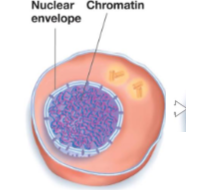
Prior to the start of meiosis, the cell goes through an interphase period, in which the DNA replicates, and the cell is checked to make sure that it is ready to divide. DNA is uncondensed
42
New cards
What occurs during Miosis I: Prophase I?
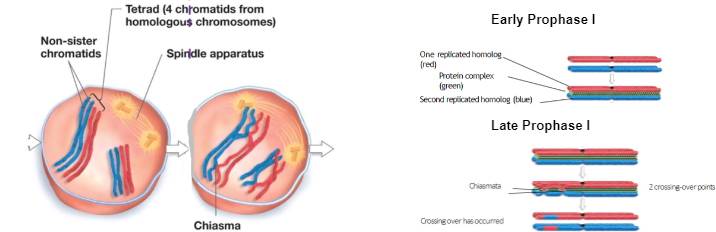
**Early Prophase I:** Chromosomes condense, nuclear envelope breaks up, spindle apparatus forms
→ Homologous chromosomes come together and become tightly held along their lengths (process called synapsis) to form a **tetrad**
\
\
**Late Prophase I:** Crossing over of non-sister chromatids
→ Contact points between non-sister chromatids occur
→ The name of these contact points are called chiasma (or chiasmata)
→ These are the sites of DNA breakage by specialized enzymes
→ Homologous chromosomes come together and become tightly held along their lengths (process called synapsis) to form a **tetrad**
\
\
**Late Prophase I:** Crossing over of non-sister chromatids
→ Contact points between non-sister chromatids occur
→ The name of these contact points are called chiasma (or chiasmata)
→ These are the sites of DNA breakage by specialized enzymes
43
New cards
What occurs during the Crossing-over & Recombination during late prophase I?
Crossing-over is a **process** - what happens**:**
\
→ specialized proteins break DNA molecules at the same location in __2 non-sister chromatids of homologous chromosomes__
\
→ During DNA repair, rather the joining the broken segment back to the chromatid to which it was originally attached, broken segment is joined to chromatid of the other homolog (i.e., non-sister chromatid) which results in exchange of genetic material between non-sister chromatids
\
→ Crossing-over leads to **recombination** (outcome) of genetic material = the production of new combinations of alleles (maternal and paternal) on a chromatid thus sister chromatids are no longer identical
\
→ specialized proteins break DNA molecules at the same location in __2 non-sister chromatids of homologous chromosomes__
\
→ During DNA repair, rather the joining the broken segment back to the chromatid to which it was originally attached, broken segment is joined to chromatid of the other homolog (i.e., non-sister chromatid) which results in exchange of genetic material between non-sister chromatids
\
→ Crossing-over leads to **recombination** (outcome) of genetic material = the production of new combinations of alleles (maternal and paternal) on a chromatid thus sister chromatids are no longer identical
44
New cards
Why is crossing over important?
→ Crossing-over creates __genetic variation__ amongst gametes (and offspring) because chromosomes have unique combinations of maternal and paternal alleles
45
New cards
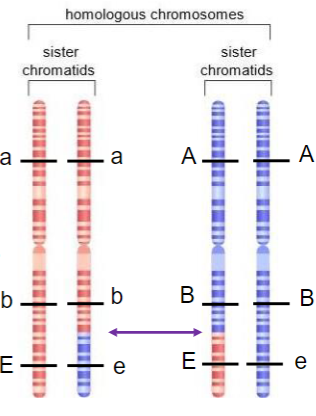
Use the picture provided, what are the chromosome genotype of the chromatids before and after crossing over and recombination?
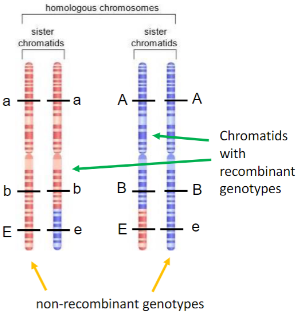
→ In this example, before crossing-over and recombination, chromosome genotypes of the chromatids are __**abE**__ and **Abe**
\
→ After crossing-over and recombination**:**
__**abE**__ and **ABe** = non-recombinant genotypes
__**ab**__**e** and **AB**__**E**__ = recombinant (new) genotypes
\
→ After crossing-over and recombination**:**
__**abE**__ and **ABe** = non-recombinant genotypes
__**ab**__**e** and **AB**__**E**__ = recombinant (new) genotypes
46
New cards
What occurs during Miosis I: Metaphase I?
M = chromosomes meet in the middle
\
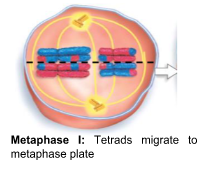
Homologs (tetrad) are on either side of the metaphase plate (unlike mitosis)
\
2nd source of genetic variation is: Independent Assortment of H**omologous Chromosomes**
→ Meaning homologous pairs align independently of each other thus there is no maternal side and paternal side against metaphase plate
\
Homologs (tetrad) are on either side of the metaphase plate (unlike mitosis)
\
2nd source of genetic variation is: Independent Assortment of H**omologous Chromosomes**
→ Meaning homologous pairs align independently of each other thus there is no maternal side and paternal side against metaphase plate
47
New cards
What is the outcome of Independent assortment of homologs and what can we predict from it?
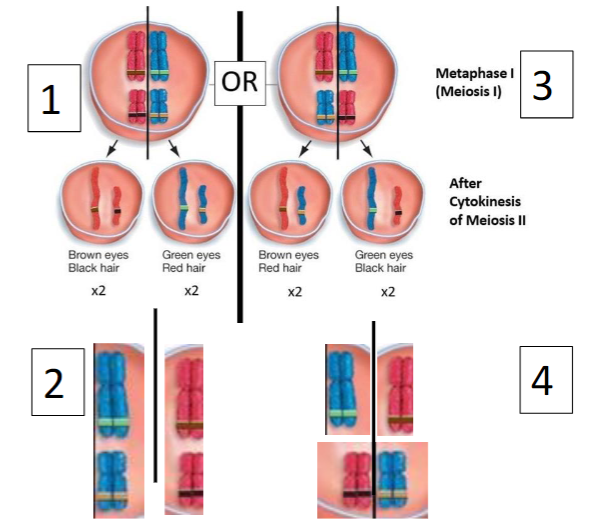
Outcome of independent assortment**:** Each gamete gets a random assortment of maternal and paternal chromosomes and their alleles
\
→ We can predict the possible # of alignments at metaphase plate using 2n where n is # of chromosomal/homologous pairs
\
→ Humans = 223 = potentially > 8,000,000 ways that chromosomes could independently orient themselves at metaphase plate; this # doesn’t include genetic variability produced by crossing-over
\
→ We can predict the possible # of alignments at metaphase plate using 2n where n is # of chromosomal/homologous pairs
\
→ Humans = 223 = potentially > 8,000,000 ways that chromosomes could independently orient themselves at metaphase plate; this # doesn’t include genetic variability produced by crossing-over
48
New cards
What occurs during Miosis I: Anaphase I?
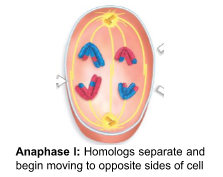
Spindle fibres (microtubules) contract
\
Homologous chromosomes separate
→ Move towards poles
\
Homologous chromosomes separate
→ Move towards poles
49
New cards
What occurs during Miosis I: Telophase I and Cytokinesis I?
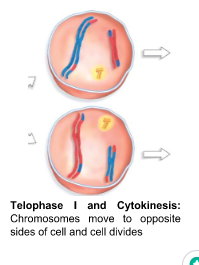
Nuclear envelope may reform forming 2 nuclei
\
Cytokinesis
→ creates __two HAPLOID cells__
\
__Sister chromatids still attached at centromere__
\
**Note:** At this point, Meiosis I is complete and daughter cells are haploid
\
Cytokinesis
→ creates __two HAPLOID cells__
\
__Sister chromatids still attached at centromere__
\
**Note:** At this point, Meiosis I is complete and daughter cells are haploid
50
New cards
What occurs during Miosis II?
Very similar to mitosis
→ sister chromatids will separate but now the cell is haploid (if parent cell was diploid)
→ sister chromatids will separate but now the cell is haploid (if parent cell was diploid)
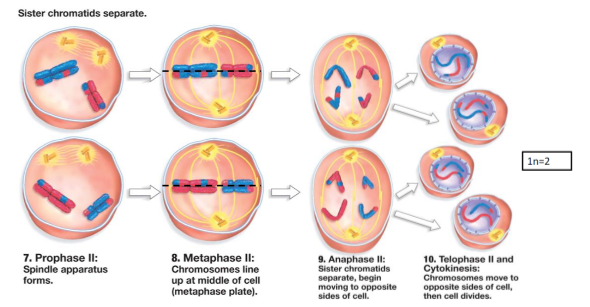
51
New cards
What is the end product of Miosis II?
End product is four haploid daughter cells
→ Half the genetic connection of the parent cell
→ Genetically different from each other
→ Half the genetic connection of the parent cell
→ Genetically different from each other
52
New cards
State Difference between Mitosis and Miosis
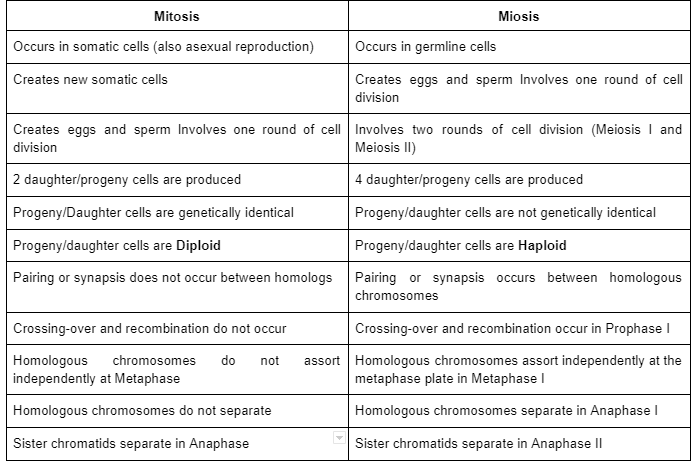
53
New cards
In mitosis, a parent cell divides to form two genetically identical daughter cells. For mitosis to take place:
→ the parent cell must first be fertilized.
→ the parent cell must reproduce its DNA during telophase.
→ the parent cell must divide its DNA in half so each daughter cell gets only the genes needed to carry out its functions. In this way, differentiation occurs.
→ the parent cell must replicate its entire genome prior to mitosis.
→ the parent cell must first be fertilized.
→ the parent cell must reproduce its DNA during telophase.
→ the parent cell must divide its DNA in half so each daughter cell gets only the genes needed to carry out its functions. In this way, differentiation occurs.
→ the parent cell must replicate its entire genome prior to mitosis.
the parent cell must replicate its entire genome prior to mitosis.
Correct. The parent cell must replicate its DNA in order to produce two genetically identical daughter cells.
Correct. The parent cell must replicate its DNA in order to produce two genetically identical daughter cells.
54
New cards
At the end of mitosis, each G1 daughter cell has
→twice the cytoplasm and the same amount of DNA as the G1 parent cell.
→ twice the DNA and half the cytoplasm of the G1 parent cell.
→ half the DNA and half the cytoplasm of the G1 parent cell.
→ identical DNA to that of the G1 parent cell.
→twice the cytoplasm and the same amount of DNA as the G1 parent cell.
→ twice the DNA and half the cytoplasm of the G1 parent cell.
→ half the DNA and half the cytoplasm of the G1 parent cell.
→ identical DNA to that of the G1 parent cell.
identical DNA to that of the G1 parent cell.
\
Correct, the daughter cells should be identical to the parent cell.
55
New cards
Metaphase occurs prior to the splitting of centromeres. It is characterized by
→ cytokinesis.
→ disassembly of the nuclear envelope.
→ duplication of centrioles.
→ aligning of chromosomes on the equator.
→ cytokinesis.
→ disassembly of the nuclear envelope.
→ duplication of centrioles.
→ aligning of chromosomes on the equator.
aligning of chromosomes on the equator.
56
New cards
A haploid (1N) cell undergoes a mitotic nuclear division followed by cytokinesis. This results in:
→ A single cell with a diploid nucleus.
→ A single cell with two genetically identical haploid nuclei.
→ Two genetically identical haploid cells.
→ Two genetically distinct diploid cells.
→ Four genetically identical haploid cells.
→ A single cell with a diploid nucleus.
→ A single cell with two genetically identical haploid nuclei.
→ Two genetically identical haploid cells.
→ Two genetically distinct diploid cells.
→ Four genetically identical haploid cells.
Two genetically identical haploid cells.
\
A mitotic nuclear division produces two nuclei identical to the original nucleus. During cytokinesis the nuclei are partitioned into separate cells. The result is two identical cells with the same number of chromosomes as the parent cell.
\
A mitotic nuclear division produces two nuclei identical to the original nucleus. During cytokinesis the nuclei are partitioned into separate cells. The result is two identical cells with the same number of chromosomes as the parent cell.
57
New cards
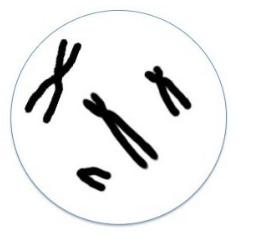
What is the ploidy and haploid number of chromosomes in the metaphase cell shown in the figure below?
\
Diploid; 4
Diploid; 2
Haploid; 4
Haploid; 2
Tetraploid; 1
\
Diploid; 4
Diploid; 2
Haploid; 4
Haploid; 2
Tetraploid; 1
Haploid; 4
\
The cell shown in the figure is haploid meaning it has one copy of each kind of chromosome (each chromosome is a different size and/or has a different shape or centromere location). The haploid number is 4, meaning there are four kinds of chromosomes.
\
The cell shown in the figure is haploid meaning it has one copy of each kind of chromosome (each chromosome is a different size and/or has a different shape or centromere location). The haploid number is 4, meaning there are four kinds of chromosomes.
58
New cards
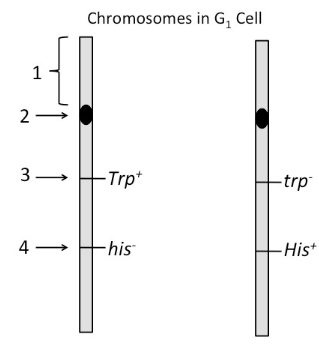
Label
1\. P arm
2\. Centromere
3\. Locus of Trp
4\. Locus of His
2\. Centromere
3\. Locus of Trp
4\. Locus of His
59
New cards
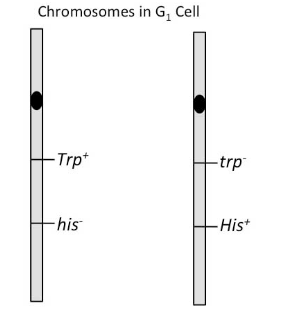
Given the image below of a cell in G1 phase, what do Trp+ and trp- represent?
Different alleles of the Trp gene.
Generally gene names are abbreviations of one or a few letters that relate to the gene function of the phenotype produced by a mutation in the gene. In the case of Trp, the gene is part of the pathway involved in biosynthesis of the amino acid tryptophan. Other symbols like "+" and "-", or lower and upper case abbreviations designate different alleles of the gene.
Generally gene names are abbreviations of one or a few letters that relate to the gene function of the phenotype produced by a mutation in the gene. In the case of Trp, the gene is part of the pathway involved in biosynthesis of the amino acid tryptophan. Other symbols like "+" and "-", or lower and upper case abbreviations designate different alleles of the gene.
60
New cards
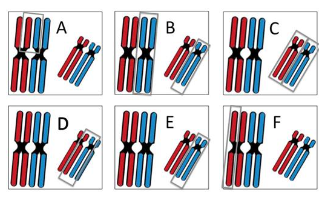
Which circled portion(s) of the diagrams represent **homologous chromosomes**?
C
61
New cards
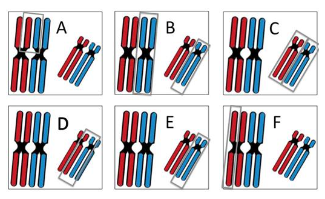
Which circled portion(s) of the diagrams represent **non-sister chromatids**?
D
62
New cards
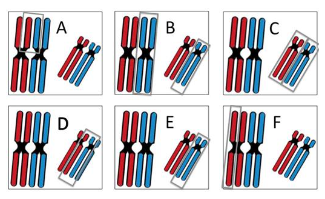
Which circled portion(s) of the diagrams represent **sister chromatids**?
E
63
New cards
A diploid (2N) cell undergoes a mitotic nuclear division followed by cytokinesis. This results in:
two genetically identical diploid cells
64
New cards
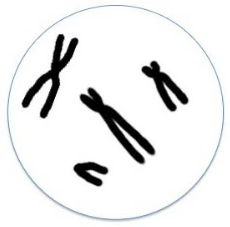
If the cell shown in the figure below undergoes mitosis, it would result in:
Two genetically identical cells each having four chromosomes.
65
New cards
A diploid (2N) cell from an individual that is heterozygous for alleles at many genetic loci undergoes meiosis followed by cytokinesis. This results in:
four genetically distinct haploid cells
66
New cards
A diploid cell 2N=12 undergoes meiosis. How many chromosomes are present in each of the resulting cells?
6
67
New cards
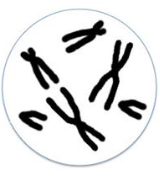
If the cell shown in the figure below undergoes meiosis, it would result in:
Four genetically distinct cells each having three chromosomes.
68
New cards
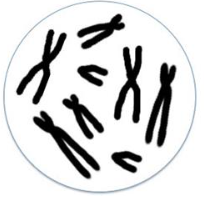
If the cell shown in the figure below undergoes meiosis, how many chromosomes would be present in each of the resulting cells?
4
69
New cards
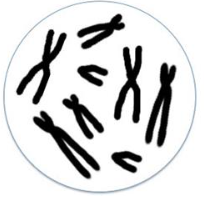
The cell in the figure undergoes a meiotic nuclear division followed by cytokinesis. This results in:
Four genetically distinct cells each having four chromosomes.
70
New cards
Chromosomes and their homologs align at the equator of the cell during which stage of meiosis?
metaphase I.
71
New cards
How can we predict gametes genotypes and their frequencies/ratio?
The gamete genotypes that can be produced (and their frequencies and/or ratios) depends upon whether:
\
1\. The genes on different chromosomes (not physically linked)
→ so, the alleles can sort into gametes independently of each other
\
2\. The genes are physically linked (on the same chromosome) with no crossing-over to break linkage (no recombination)
→ the alleles cannot sort independently from each other (they will travel together to gametes)
\
3\. The genes are physically linked (on the same chromosome) but crossing-over and recombination will break linkage in at least some cells undergoing meiosis
\
1\. The genes on different chromosomes (not physically linked)
→ so, the alleles can sort into gametes independently of each other
\
2\. The genes are physically linked (on the same chromosome) with no crossing-over to break linkage (no recombination)
→ the alleles cannot sort independently from each other (they will travel together to gametes)
\
3\. The genes are physically linked (on the same chromosome) but crossing-over and recombination will break linkage in at least some cells undergoing meiosis
72
New cards
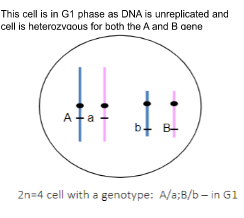
Predicting gamete genotypes(and their frequencies) if the genes are on separate chromosomes (so alleles can assort independently into gametes). If 1,000 cells with this genotype underwent meiosis, what gamete genotypes could be produced and with what frequency or ratio?
**→ Since there are 2 chromosomes, 22=4 genotypes which must be AB, Ab, aB, ab, and frequency are equal to 25% for each genotype and ratio will also be equal so 1:1:1:1**
73
New cards
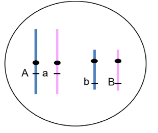
If the genes are on separate chromosomes, would crossing-over and recombination affect the gamete genotypes that were produced?
**→ No; with the different crossing-over and recombination, there will continue to be 4 different types of arrangements which produce the genotype: AB, ab, aB, bA**
74
New cards
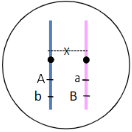
What gamete genotypes would be produced if the genes were linked, and there was no crossing over to break that linkage (i.e. no recombinant genotypes were produced)?
→ Ab and aB
75
New cards
If the 2 genes were linked, but there was crossing over at “X”, what gamete genotypes would be produced by this cell?
→Ab, AB, ab, aB; the linkage was broken between the two genes

76
New cards
If 1,000 cells with the genotype below underwent meiosis, and crossing-over could occur, would all four genotypes (Ab, aB, AB and ab) be produced with EQUAL frequency?
→ No
77
New cards
If 1,000 cells were undergoing meiosis and the genes were linked as shown below, would the DNA always break between the A and B genes?
→ No; where DNA breaks can be random and thus not predictable
78
New cards
If 1,000 cells were undergoing meiosis and the genes were linked as shown below, and
crossing-over could occur, which genotypes would be produced most frequently?
crossing-over could occur, which genotypes would be produced most frequently?
**→ Ab and aB as they are physically linked which results in more parental genotypes to be produced whether DNA breaks in different areas or between the two genes**
79
New cards
What can also affect the probability that crossing over will result in recombination?
**The physical distance between genes affects the probability that crossing over will result in recombination**
\
→ Genes that are close together/closely linked = the DNA needs to break in a small area for recombination to occur; so lower probability of recombination occurring for any one cell undergoing meiosis
→ For this example, I would expect far more non-recombinant (Ab, aB) gamete genotypes compared to recombinant (AB, ab) genotypes \n \n \n
→ Genes that are far apart = lots of opportunities for crossing-over and recombination
→ For this example, I would expect the frequency of non-recombinant and recombinant genotypes to be very close
\
→ Genes that are close together/closely linked = the DNA needs to break in a small area for recombination to occur; so lower probability of recombination occurring for any one cell undergoing meiosis
→ For this example, I would expect far more non-recombinant (Ab, aB) gamete genotypes compared to recombinant (AB, ab) genotypes \n \n \n
→ Genes that are far apart = lots of opportunities for crossing-over and recombination
→ For this example, I would expect the frequency of non-recombinant and recombinant genotypes to be very close
80
New cards
How can we determine the # of possible gametes genotypes?
We can calculate number of possible gamete genotypes if genes are not linked (different chromosomes), or if they are linked but crossing-over can occur
\
We use the equation 2n where n = # of genes that are heterozygous
\
**Note:** This formula looks the same as the formula that you used to calculate the number of possible alignments of homologous chromosomes. BUT, n = different
\
We use the equation 2n where n = # of genes that are heterozygous
\
**Note:** This formula looks the same as the formula that you used to calculate the number of possible alignments of homologous chromosomes. BUT, n = different
81
New cards
\
If an organism has the genotype A1/A1; B2/B2; C3/C3 (assume genes are on different chromosomes, or the genes are linked but crossing-over can occur); how many gamete genotypes are possible?
If an organism has the genotype A1/A1; B2/B2; C3/C3 (assume genes are on different chromosomes, or the genes are linked but crossing-over can occur); how many gamete genotypes are possible?
→ The A, B and C genes are not heterozygous (A1/A1 are homozygous) thus 2^0=1
82
New cards
If an organism has the genotype A1/A2; B1/B2; C1/C1 (assuming the genes are on different chromosomes, or the genes were linked but crossing-over could occur); how many gamete genotypes are possible?
→ The gene A and B are heterozygous whereas gene C is homozygous thus 2^2= 4
83
New cards
If an organism had the genotype A1/A2; B1/B2; C1/C2 (assuming the genes aren't physically linked or the genes are on different chromosomes); what is the maximum number of gamete genotypes that can be produced if one cell undergoes meiosis?
**→ The gene A, B and C are heterozygous but since one cell undergoes meiosis, it will only be 4**
84
New cards
If a parent cell had the genotype A1/A2; B1/B2; C1/C2 (assuming the genes are on different chromosomes ); and the cell underwent mitosis, how many daughter cell genotypes are possible?
→ The gene A, B and C are heterozygous but since this cell undergoes mitosis, the daughter cells are identical to parent cells and each other thus only 1 possible genotype is possible
85
New cards
What are the Sources of Genetic Variation?
**1. Crossing-over and Recombination**
→ Occurs during Late Prophase I
\
→ Outcome: Chromosomes contain a random assortment of paternal and maternal alleles (crossing-over happens between non-sister chromatids of homologous chromosomes)
\
\
\
\
**2. Independent assortment of homologous chromosomes**
→ Occurs during Metaphase I
\
→ Outcome: Gametes receive a random assortment of maternal and paternal chromosomes (and their alleles); 2n (n=number of homologous pairs)
\
\
\
\
**3. Random fusion of eggs & sperm**
→ Fertilization occurs when a male and female gamete fuse to form a zygote
\
→ It is a random event, meaning which sperm fertilizes which egg is a matter of chance
→ Occurs during Late Prophase I
\
→ Outcome: Chromosomes contain a random assortment of paternal and maternal alleles (crossing-over happens between non-sister chromatids of homologous chromosomes)
\
\
\
\
**2. Independent assortment of homologous chromosomes**
→ Occurs during Metaphase I
\
→ Outcome: Gametes receive a random assortment of maternal and paternal chromosomes (and their alleles); 2n (n=number of homologous pairs)
\
\
\
\
**3. Random fusion of eggs & sperm**
→ Fertilization occurs when a male and female gamete fuse to form a zygote
\
→ It is a random event, meaning which sperm fertilizes which egg is a matter of chance
86
New cards
Where would the DNA need to break to create a chromatid with the genotype Abd?
→ DNA must break at line 2 to produce Abd
87
New cards
Where would the DNA need to break to create a chromatid with the genotype AbD?
→ DNA must break at lines 2 and 3 to cut only the dominant B and receive b segment
88
New cards
What are the modes of inheritance?
**1. Autosomal dominant**
**2. Autosomal recessive**
**3. X-linked dominant**
**4. X-linked recessive**
**5. Non-dominance**
**2. Autosomal recessive**
**3. X-linked dominant**
**4. X-linked recessive**
**5. Non-dominance**
89
New cards
What is a trait?
Any observable characteristic of an organism
→ At any level: molecular, developmental, physiological, morphological, or behavioural
\
Rough-skinned newts have many observable traits**:**
→ Skin colour, Skin roughness, Body length, Sex, and Heartbeat rate
→ At any level: molecular, developmental, physiological, morphological, or behavioural
\
Rough-skinned newts have many observable traits**:**
→ Skin colour, Skin roughness, Body length, Sex, and Heartbeat rate
90
New cards
What is a phenotype?
The state of the trait
**Ex.** Red vs blue or 12.1cm vs 9.4cm
\
This particular rough-skinned newt has the following phenotypes**:**
→ Eye colour**:** **golden**, Skin roughness**:** **rough**, Body length**:** **short**, Poisonous**:** **YES, VERY!!!!!!**
\
An individual’s phenotype is determined by interaction between **genotype** and **environment (external and internal)**
**Ex.** Red vs blue or 12.1cm vs 9.4cm
\
This particular rough-skinned newt has the following phenotypes**:**
→ Eye colour**:** **golden**, Skin roughness**:** **rough**, Body length**:** **short**, Poisonous**:** **YES, VERY!!!!!!**
\
An individual’s phenotype is determined by interaction between **genotype** and **environment (external and internal)**
91
New cards
Explain mendel experiment with pees
He crossed two **pure-breeding** parents (P generation that differed for one trait (**ex.** seed shape)
→ The parent with round seeds only carried the allele for a round shape (RR)
→ The parent with wrinkled seeds only carried the allele for wrinkled shape (rr)
\
All F1 generations were heterozygous and had the dominant phenotype (**ex.** round seeds); the recessive phenotype was lost but not the allele; it was masked by dominant allele
\
When F1s were self-fertilize, Mendel observed a **3:1 phenotypic ratio (dominannt : recessive)** in F2 generation
\
Only the homozygous recessive seeds (rr) displayed the recessive phenotype
→ The parent with round seeds only carried the allele for a round shape (RR)
→ The parent with wrinkled seeds only carried the allele for wrinkled shape (rr)
\
All F1 generations were heterozygous and had the dominant phenotype (**ex.** round seeds); the recessive phenotype was lost but not the allele; it was masked by dominant allele
\
When F1s were self-fertilize, Mendel observed a **3:1 phenotypic ratio (dominannt : recessive)** in F2 generation
\
Only the homozygous recessive seeds (rr) displayed the recessive phenotype
92
New cards
What does pure breeding mean?
**Parent organism that is homozygous thus they carry same two alleles for a diploid organism**
93
New cards
What does dominant allele mean?
Determines the phenotype of a homozygous dominant (RR) and heterozygous (Rr) individual
\
→ Dominant alleles typically code for a functional protein. Can mask the presence of a recessive allele
\
→ Dominant alleles typically code for a functional protein. Can mask the presence of a recessive allele
94
New cards
What does recessive allele mean?
An allele that reveals itself in the phenotype only if an organism has two copies of the recessive allele (rr)
\
→ Recessive alleles typically code for a protein that is either non-functional or has reduced function
\
→ Recessive alleles typically code for a protein that is either non-functional or has reduced function
95
New cards
What are Punnett squares used for?
A tool that’s used to calculate predicted offspring genotypes and phenotypes when pattern of **inheritance is known** (or **hypothesized**)
96
New cards
What was the phenotypic and genotypic ratio for mendel experiments with round and rinkled pees?
The **phenotypic ratio** of round to wrinkled seeds will be **3:1**
The **genotypic ratio** will be **1(RR):2(Rr):1(rr)**
The **genotypic ratio** will be **1(RR):2(Rr):1(rr)**
97
New cards
When would we see a 9:3:3:1 phenotypic ratio?
This is the outcome we would expect for a cross between
→ 2 heterozygotes
→ Autosomal genes, not linked
→ Dominant/recessive relationship between alleles
→ 2 heterozygotes
→ Autosomal genes, not linked
→ Dominant/recessive relationship between alleles
98
New cards
Mendel allowed the F1 to self-pollinate (YyRr x YyRr). Question: How many gamete genotypes are possible from one YyRr parent? Note genes are not linked; so, can assort independently
→ One YyRr parent has two genes, one coding for seed colour while other for seed shape; these genes are heterozygous as the colours are Yellow or Green and the shapes are Round or Wrinkled thus there are 2 heterozygous genes (22=4) thus 4 gamete genotypes are possible
99
New cards
You cross a heterozygous black-furred dire wolf with white-furred dire wolf. Black fur (F) is dominant to white fur (f). They have one offspring. What is the probability that a dire wolf pup will have black fur?
**→ Since black-furred dire wolf is heterozygous, it must carry both dominant and recessive alleles (Ff) whereas white-furred dire wolf only carries the recessive allele (ff); by creating a Punnett square, 50% will be the probability that the dire wolf pup will have black fur**
100
New cards
If two heterozygous dire wolves (Ff) have mated for life and produced many offspring. The first five offspring were all black. What is the probability the next cub will be white?
**→ Since both parents are heterozygous, they both must carry both dominant and recessive alleles (Ff); after creating a Punnett square, there will be a ¼ probability that the next cub will have white fur. The fact that the previous cubs were black-furred doesn’t have an outcome of the fifth cub thus it is insignificant information**
 Note
Note  Flashcards (99)