ALL OB Medications
 Call Kai
 Learn
Learn Practice Test
 Spaced Repetition
 Match
Match Flashcards
 Knowt Play
1/95

There's no tags or description
Looks like no tags are added yet.
Name | Mastery | Learn | Test | Matching | Spaced | Call with Kai |
|---|
No analytics yet
Send a link to your students to track their progress
96 Terms
Ibuprofen (Oral: Motrin; IV: Caldolor)
(Postpartum)
Purpose
Mild pain (1-3/10)
Reduce inflammation
Fever
Barely enters breast milk
Contraindication
Pregnancy (r/t persistent pulmonary hypertension in infants)
Asthma (IV)
Preeclampsia
HELLP
Docusate sodium (Colace)
(Postpartum)
Purpose
Constipation (stool softener)
Draws water into stool to soften it
Prevents straining with bowel movements
Not prompt
Lactation safe
Avoid
Diarrhea
Acetaminophen (Tylenol)
(Postpartum)
Purpose
Mild (pain 1-3/10) to moderate pain (4-7/10)
Fever
Acetaminophen (Ofirmev)
(Postpartum)
Purpose
Mild (pain 1-3/10) to moderate pain (4-7/10)
Fever
Can be given during labor for maternal fever.
Given for post-cesarean patients
Avoid
Liver or kidney disease.
Malnourishment.
Hydrocodone/Acetaminophen (Norco)
(Postpartum)
Purpose
Moderate (pain 4-7/10) to severe pain (8-10/10)
Acetaminophen/Codeine (Tylenol #3)
(Postpartum)
Purpose:
Moderate pain (4-7/10)
Causes constipation (r/t
Caution
Hypothyroidism
Renal disease
Avoid
Lactation
Acetylcysteine (Mucomyst, Acetadote)
Antidote for Acetaminophen
Naloxone (Narcan)
Antidote
Hydrocodone/Acetaminophen (Norco)
Acetaminophen/Codeine (Tylenol w/ Codeine #3)
Darvocet N-100 (Propoxyphene Napsylate/Acetaminophen)
Lactation safe
Docusate sodium (Colace)
Ketorolac (Toradol) IV Push
(Postpartum)
Purpose
Short-term pain
<5 days
Post C-section
Can cause GI Bleeding
Enters breastmilk (low concentration)
Rapidly and completely absorbed following all routes of administration.
Enters breastmilk (low concentration)
Ketorolac (Toradol)
Darvocet N-100 (Propoxyphene Napsylate/Acetaminophen)
Bisacodyl Rectal (Dulcolax)
(Postpartum)
Purpose:
Constipation
Does not enter breastmilk
Avoid
Suppository on 4th-degree tear
Suppository on 4th degree extension (episiotomy)
Darvocet N-100 (Propoxyphene Napsylate/Acetaminophen)
(Postpartum)
Purpose:
Mild (pain 1-3/10) to moderate pain (4-7/10)
Enters breastmilk
Adverse Effects
Dizziness
Hypotension
Constipation
Misoprostol (Cytotec) (Rectal)
(Postpartum)
Purpose:
Postpartum hemorrhage / Uterine Atony
Stimulates uterine contractions
Prevents NSAID-induced gastric ulcers
Reduces stomach acid and increases mucus production
(Prostaglandin E analog)
Fever & Diarrhea (infant/mother)
Oxytocin (Pitocin) Postpartum
(Postpartum)
Purpose:
Postpartum hemorrhage
Uterine atony
Complications
Coma
Hypotension
Water intoxication
Vasopressor & Antidiuretic Effects
Iron FeSO4 (Ferrous Sulfate)
(Postpartum)
Purpose
Treats/prevents iron deficiency anemia
OJ for best absorption
Passes through breast milk
Complication
33-50% less absorption with food
Avoid antacids, dairy, tea, coffee within 2 hours before/after
Deferoxamine Mesylate (Desferal)
Antidote for Iron FeSO₄ (Ferrous Sulfate)
Depo-Provera (Medroxyprogesterone Acetate)
(Postpartum)
Purpose
Contraception
Doses: Every 6 weeks
Complications
Decreases breast milk supply
Wait 6 weeks before
Enters breast milk
But can receive prior to discharge
Enoxaparin Sodium (Lovenox)
(Postpartum)
Purpose
Prevention of DVTs in high-risk post-surgical patients
Complications
Risks small hematoma
Administer 24 hours after C/S
Avoid
Active bleeding
Protamine Sulfate
Antidote for Enoxaparin Sodium (Lovenox)
Methylergonovine Maleate (Methergine) IM
(Postpartum)
Purpose
Treats/prevents PP hemorrhage
Constricts blood vessels
Uterine atony / Sub-involution
Stimulates uterine contractions
(Ergot Alkaloid)
Complication
Causes pain:
Use with pain medication
Reduces breastmilk yield
Contraindication
Hypertension / Preeclamspia
Smoking
Breastfeeding (adverse effects to infant)
Wait at least 12 hours after last dose
Carboprost Tromethamine (Hemabate)
(Postpartum)
Purpose:
Controls PP hemorrhage
Synthetic Prostaglandin F2 or M that stimulates uterine smooth muscle contractions
Last effort before hysterectomy
Repeated Q15 (with total dose limit)
MAY pass through breastmilk
Complications
Severe abdominal cramps, n/v, diarrhea (body overreacts)
HYDRATE
Caution
Asthma (bronchospasm risk)
Heart disease
Liver disease
High or Low BP (Affects BP in general)
Epilepsy
Tranexamic Acid (Lysteda)
(Postpartum)
Purpose:
Treats/prevents PP hemorrhage:
Uterine atony
Sub-involution
Avoid
Active thromboembolic issues (DVT, PE, cerebral thrombosis)
Renal impairment
Color blindness
Diphenhydramine (Benadryl)
(Postpartum)
Purpose
Pruritus (itching)
Mild nighttime sedation
Adverse drug reactions
Avoid
Chamomile tea (increases CNS depression)
Lactation
Asthmatics
Physostigmine (Use with caution)
Antidote for Diphenhydramine (Benadryl)
Tucks Medicated Pads (Witch Hazel)
(Postpartum)
Purpose:
Dry, soothes, protects skin (lacerations, sutures, episiotomies, hemorrhoids)
Gently dry and clean skin before using
Applied after sitz bath
Used AFTER bowel movements
Can dry or tighten skin around anus
Dermoplast Spray (Benzocaine, Dibucaine, and Lidocaine)
(Postpartum)
Purpose:
Pain (numbs) & Itching
Sutures, episiotomies, hemorrhoids
Caution
Use occasionally in small amounts
RhoGAM (Rho (D) Immune Globulin)
(Immunizations)
Purpose
Prevents antibody response from Rh- mothers and hemolytic disease to Rh+ baby
Prevents Erythroblastosis Fetalis and Hydrops Fetalis for futurep regnancies
12-week Prophylactic @ 28 weeks, trauma, or abortion
1st Dose: 28 weeks; lasts 12 weeks
2nd Dose: MUST be given 72 hours after delivery
Caution
If Coombs (+), it is too late: will have problems with future pregnancies if Rh+ baby
When is the RhoGAM doses?
Two doses
28 weeks
up to 72 hours PP
Rubella Live Vaccine (Meruvax) (MMR - Measles, Mumps, Rubella Vaccine)
(Immunizations)
(Live Vaccine)
Purpose
Immunization against German measles
Prevent risk of congenital rubella syndrome in future pregnancies.
Given when titer <1:8
Contraindication
Pregnancy for 3 months after vaccination
Egg allergy
Varicella Zoster (VariZig, VZIG) Vaccine
(Immunizations)
Purpose:
Immunization against chickenpox virus
Avoid
Pregnancy for 3 months after vaccination
Influenza (FluMist) Vaccine
(Immunizations)
(Active Live Vaccine)
Purpose
Immunizes against A and B
Avoid
Allergic to eggs
Received another live vaccine w/in 1 month
Received inactivated vaccine w/in 2 weeks
Pneumococcal Conjugate Vaccine (PCV, Prevnar 13)
(Immunizations)
Purpose
Immunization against pneumococcal pneumonia.
Contraindication
DTaP allergy
DTaP Vaccine
(Immunizations)
Purpose
Immunization against diphtheria, tetanus, and atypical pertussis.
Individual components given for unusual reactions
Engerix-B
(Neonatal)
Purpose
Active immunization against infection caused by Hepatitis B virus.
BE RIGHT - Administer in the right thigh (vastus lateralis).
Given per doctor’s order (some prefer to postpone it until the first well-baby checkup).
Obtain consent before administering.
Check expiration date on the vial before use.
Monitor injection site for redness and swelling
Erythromycin Ointment (Ilotycin)
(Neonatal)
Purpose
Prophylaxis usually given to all babies for ophthalmia neonatorum
Blindness in newborns due to gonorrhea or chlamydia infections at births
Must be administered within 1 hour of birth.
If microbes are present, delaying administration could lead to infection.
Aqua Mephyton (Phytonadione)
(Neonatal)
Purpose
Prevention of bleeding
Due to the lack of intestinal bacteria needed to produce Vitamin K in newborns.
"Kick Left" – Administer in the left thigh (vastus lateralis).
Usually given within 1 hour of birth.
Surfactant (Lucinactant, Surfaxin)
(Neonatal)
Purpose
Prevention of Respiratory Distress Syndrome (RDS) in premature infants at high risk.
Adverse Reactions (suctioning or reintubation may be required)
Bradycardia (slow heart rate)
Oxygen desaturation
Reflux of drug into endotracheal tube
Airway or endotracheal tube obstruction
Continue therapy only when infant is stable
Indomethacin (Indocin) - NSAID
(Neonatal)
Purpose
Closure of patent ductus arteriosus (PDA)
Decreases prostaglandin production
Monitor RR, BP, HR, ECG, S1/S2, I&Os
Caution
Increased risk of:
Necrotizing enterocolitis
Bowel perforation
Caffeine Citrate (Cafcit)
(Neonatal)
Purpose
Respiratory stimulation in premature infants between 28-33 weeks.
Decreases periods of apnea.
Increased risk of toxicity in neonates with:
Impaired hepatic fx
Impaired renal fx
Gentamicin (Garamycin, G-mycin)
(Neonatal)
Purpose
Infection with gram-negative organisms and staphylococci.
Caution
Risk of neuromuscular blockade.
Difficulty in assessing auditory and vestibular function due to immature renal function.
Dose Adjustments Needed
Neonates on ECMO (Extracorporeal Membrane Oxygenation)
Ampicillin
(Neonatal)
Purpose
Bacterial infection
Complication
May cause a false-positive direct Coombs' test result.
Contraindication
Penicillin allergy
Clindamycin (Clinda-derm)
(Neonatal)
Purpose
Infection
Complication
Increases risk of pseudomembranous colitis
Report diarrhea, abdominal cramping, fever, and bloody stools (possible signs)
May appear weeks after cessation of therapy
Magnesium Sulfate (MgSO₄) IV
(High Risk Antepartum)
Purpose
Anticonvulsant (increases seizure threshold)
Includes seizures r/t Preeclampsia (PIH)
Neuroprotection in preterm labor
Caution
Impaired renal function (common in Pregnancy-Induced Hypertension).
May stop contractions & relax muscles (STOP or TURN DOWN if):
DTR (Deep Tendon Reflex) = 0 or 1
Fetus may have hypotonia or lethargy lasting 1-2 days.
Respiratory rate <12/min
Contraindication
Myasthenia gravis
Calcium Gluconate
Antidote for Magnesium Sulfate (MgSO₄)
Labetalol Hydrochloride (Normodyne)
(High Risk Antepartum)
Purpose:
Hypertension
160/105-110 diastolic for 15 minutes
Start with a low dose, increasing gradually if BP remains high.
Check BP every 5 minutes for 30 minutes.
Contraindication
Asthma
Heart Failure
Brethine (Terbutaline)
(High Risk Antepartum)
Purpose
Tachysystole (excessive uterine contractions).
Tocolytic/Bronchodilator
Delays preterm labor
Caution
Cardiac disease
Diabetics
Increases blood sugar
Contraindication
HR above 100
Nifedipine (Cardene)
(High Risk Antepartum)
Purpose
Calcium channel blocker
Smooth muscle relaxant
Antihypertensive
Adverse Effects
Severe hypotension
Pulmonary edema
Contraindication
BP below 100 sys (or 90/50)
Nifedipine (Adalat, Procardia)
(High Risk Antepartum)
Purpose
Calcium channel blocker (smooth muscle relaxant & antihypertension)
Preterm labor contractions
Preeclampsia
Contraindication
BP below 100 sys (or 90/50)
Betamethasone (Celestone) IM
(High Risk Antepartum)
Purpose
Prevents respiratory distress syndrome in preterm delivery
Increases surfactant
Both doses are required for full benefit.
Must be given 2 days before delivery for effectiveness.
Contraindications
MORE THAN 34 weeks gestation
Some hospitals extend to 37 weeks IF mother has infection
If mom is diabetic, given @ 37 weeks BUT INCREASE GLUCOSE
Hydralazine (Apresoline)
(High Risk Antepartum)
Purpose:
Moderate to severe hypertension
Preeclampsia.
Monitor BP every 5 minutes until stable.
Penicillin G (Na+ or K+ salt)
(High Risk Antepartum)
Purpose
Group Beta Strep (GBS) positive
Chorioamnionitis
Fever of unknown origin during labor.
Monitor for anaphylaxis
Rash, pruritus, wheezing, laryngeal edema
May cause a false-positive direct Coombs’ test.
Change IV site every 48 hours to prevent phlebitis.
Causes pain at the IV site
Contraindication
Penicillin allergy
Zovirax (Acyclovir)
(High Risk Antepartum)
Purpose
Prophylactic treatment for HSV+ mothers
Prevent an outbreak during delivery.
34-35 weeks gestation and continued until delivery.
Monitor for active Herpes infections throughout labor.
If lesions are present
C-section will be necessary
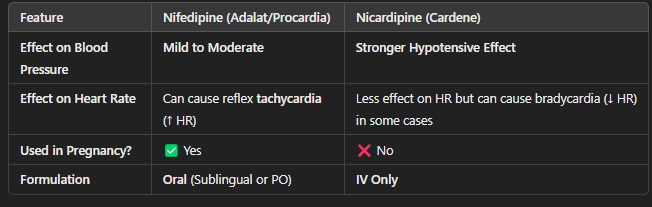
Nifedipine Comparisons
Mechanism of Action (How They Work)
Both drugs block calcium from entering the smooth muscle cells in blood vessels, causing vasodilation (widening of blood vessels) and reducing blood pressure.
However, Cardene (Nicardipine) has a stronger effect on blood pressure, while Adalat/Procardia (Nifedipine) is often preferred for pregnancy-related conditions.
Nifedipine (Adalat/Procardia) PO
Commonly used for hypertension in pregnancy (especially in preeclampsia).
Also used for preterm labor contractions to relax the uterus.
Nicardipine (Cardene) IV
Used for severe hypertension, especially in critical care settings.
NOT used for preterm labor due to its stronger cardiovascular effects.
Prostaglandin E (Cervidil, Cytotec, Prepidil, Prostin E2 gel)
(Intrapartum)
Purpose
Cervical ripening (softening)
At or near term when induction of labor is indicated.
Not given concurrently with oxytocin.
Wait at least 30 minutes
Monitor uterine contractions (UCs) and fetal heart rate (FHR) for 1 hour after
Have patient lie flat for 30 minutes to 2 hours after
Caution
Asthma
Misoprostol (Cytotec)(Vaginal/Oral)
(Intrapartum)
Cervical ripening (softening)
Labor induction.
(Prostaglandin E analog)
Assess dilation of cervix periodically during therapy.
Monitor for tachysystole (excessive contractions).
Adverse Effect
Fever & Diarrhea (infant/mother)
Contraindication
Patient has 3 or more contractions in a 10-minute period.
Oxytocin (Pitocin) Intrapartum
(Intrapartum)
Purpose
Stimulates uterine contractions.
Induction and augmentation of labor.
Control of postpartum bleeding after placental expulsion.
Turn down infusion if:
Contractions are closer than 2 minutes apart.
Last longer than 120 seconds each
No 60-second rest period between each
Significant change in FHR or fetal distress
Adverse Effects
Water intoxication
Listless, drowsiness, confusion, headache
Contraindication
Within 4 hours of Misoprostol administration
Terbutaline
Stop Infusion & Left Side positioning
Antidote for Oxytocin (Pitocin)
Fentanyl Citrate (Sublimaze)
(Intrapartum)
Purpose
Moderate to severe pain.
Fast-acting
Ideal in preventing opioid side effects in NBN
Concurrent use with Nubain / Stadol further decreases pain
Caution
Diabetes
Grape juice (increases blood levels)
Atropine
Antidote for Fentanyl Citrate (Sublimaze) induced Bradycardia
Nubain (Nalbuphine)
(Intrapartum)
Purpose
Moderate to severe pain.
Can cause a high-pitched “cat-like” cry if used near delivery
Phenergan (Promethazine)
(Intrapartum)
Purpose
Nausea
Caution
Hypertension
Zofran (Ondansetron)
(Intrapartum)
Purpose
Nausea
Post-anesthesia itching (off-label use)
Contraindication
Oral route with PKU (contains aspartame)
Dilaudid (Hydromorphone)
(Intrapartum)
Purpose
Moderate to severe pain
Opioid Side Effects
Antidote: Narcan (Naloxone) 0.4-2.0 mg IV/SC/IM
Butorphanol Tartrate (Stadol)
(Intrapartum)
Purpose
Moderate to severe pain relief
Opioid Side Effects
Antidote: Narcan (Naloxone) 0.4-2.0 mg IV/SC/IM
Contraindication
Opioid drug dependency (causes withdrawals)
Giving immediately before birth
Hydroxyzine (Vistaril)
(Intrapartum)
Purpose
Anxiety
Vomiting
Itching
(Often combined with opioid analgesics)
Use Z-Track technique
Safety precautions during administration
Adverse Effects
Drowsiness, dry mouth, pain at IM site
Contraindication
Pregnancy
Can be used safely in labor
Cefazolin (Ancef)
(Intrapartum)
Purpose
GBS prophylaxis
Chorioamnionitis
Pre-surgery prophylaxis
Caution
Penicillin allergy
Ephedrine Sulfate
(Antidote)
Purpose
Increases blood pressure
Usually from hypotension due to epidural or spinal anesthesia
MUST DILUTE
MUST PREPARE AT BEDSIDE (epidural)
Adverse Effects
Possible fetal tachycardia
Possible fetal decreased variability
Contraindication
BP above 130/80
Naloxone (Narcan)
(Antidote)
Purpose
Reversal of narcotic-induced respiratory depression.
Contraindication
Giving for respiratory depression NOT CAUSED BY OPIOIDS
Calcium Gluconate
(Antidote)
Purpose
Magnesium sulfate toxicity
DTR = 0-1 or respiratory rate <12
GIVE SLOWLY
Prevents cardiac arrest
Calcium Gluconate Antidote
Magnesium Sulfate
Neonatal Naloxone (Narcan)
(Antidote)
Purpose
Reversal of NEWBORN CNS and respiratory depression
Due to late administration of maternal narcotics during labor.
Contraindication
Respiratory depression NOT CAUSED BY OPIOIDS
Cefoxitin (Mefoxin)
(Anti-Infectives)
Purpose
Pelvic Inflammatory Disease (PID)
Educate patient to have partner treated
Caution
High PID Risk first 3 weeks after IUD placement
Contraindication
Sex until course completion
Ceftriaxone (Rocephin)
(Anti-Infectives)
Purpose
Gonorrhea
Educate patient to have partner treated
Contraindication
Sex until course completion
Flagyl (Metronidazole)
(Anti-Infectives)
Purpose
Bacterial Vaginosis
Vulvovaginal Candidiasis
Trichomonas Vaginalis
First Trimester
CANNOT BE TREATED
Educate patient to have partner treated
Contraindication
Sex until course completion
Penicillin (Amoxicillin)
(Anti-Infectives)
Purpose
Syphilis
Monitor for allergic reaction
Observe 15 minutes post-injection
Site: Deep IM in dorsolateral or ventrogluteal
Educate patient to have partner treated
Contraindication
Sex until course completion
Oral Acyclovir and Famciclovir
(Anti-Infectives)
Purpose
Herpes Genitalis
Breastfeeding SAFE
Educate patient to have partner treated
Contraindication
Sex until course completion
Azithromycin (Zithromax)
(Anti-Infectives)
Purpose
Chlamydia
Educate patient to have partner treated
Contraindication
Sex until course completion
Anticoagulants
Permethrin Cream 5% (Acticin, Elimite)
(Anti-Infectives)
Purpose
Pediculosis Pedis (Lice/Scabies Treatment)
Avoid contact with orifices
Wash after 8-14 hours
May cause itching (up to 4 weeks)
Clomid (Serophene, Clomiphene)
(Infertility)
Purpose
First line for infertility
Oral taken with prescribed intercourse
Male infertility
Menstrual abnormalities
Fibrocystic breasts
Abnormal milk production
Adverse Effects
Multiple pregnancy, bloating, pain, breat discomfort
n/v, visual disturbances, HA, dryness, hair loss
Intercourse must be timed
Danocrine
(Infertility)
Purpose
Infertility issues
Endometriosis treatment
Synthetic steroid
Androgen-like effects, similar to testosterone.
Must take consistently (3-9 months)
Metformin
(Infertility)
Purpose
Polycystic Ovary Syndrome (PCOS)
Contraindication
Alcohol
Parlodel (Bromocriptine, Cycloset)
(Infertility)
Purpose
Hyperprolactinemia (high prolactin levels)
Inhibits pituitary secretion of prolactin (milk production)
Contraindication
Breastfeeding
Fetal loss or stillbirth
Progesterone (Vaginal)
(Infertility)
Purpose
Luteal phase support (suppresses FSH & LH)
Restores menstruation & ovulation
Caution
Breastfeeding = Serious / Fatal Reactions
Medications for Postpartum Hemorrhage
Please Make Hemorrhage Cease Today
1) Pitocin (Oxytocin):
Induces labor, augments contractions, or controls postpartum bleeding.
Administered as an IV bolus after delivery to clamp the uterus.
Monitor for hypotension, water intoxication, or swelling.
2) Methergine (Methylergonovine):
Avoid in hypertensive or smoking patients due to vasoconstrictive properties.
3) Hemabate (Carboprost Tromethamine):
Last-resort medication due to side effects like severe diarrhea and cramping.
Avoid in asthma, cardiac, renal, or liver disease.
4) Cytotec (Misoprostol):
Uses: Cervical ripening, postpartum hemorrhage, uterine atony.
Administered rectally for hemorrhage (1,000 mcg) or vaginally/orally for induction (25–50 mcg).
5) Tranexamic Acid (Lysteda):
For hemorrhage or bleeding disorders.
Contraindicated in patients with a history of DVT, PE, or clotting disorders.
Medications for Constipation
Docusate Sodium (Colace):
Stool softener that draws water into the stool.
Bisacodyl (Dulcolax):
Suppository
Contraindication: 4th-degree tears (to avoid suture irritation)
Pain Management Medications
NSAIDs (e.g. Ibuprofen (Motrin)):
Used postpartum for mild pain
Avoid during pregnancy due to the risk of persistent pulmonary hypertension in the infant.
Increases mother’s BP and constricts newborn’s ductus arteriosus
Avoid in preeclampsia or HELLP syndrome due to increased bleeding risk.
Narcotics for Moderate to Severe Pain (Mnemonic: STOP Feeling Discomfort Now):
Stadol (Butorphanol Tartrate): Avoid in individuals with a history of drug dependency.
Fentanyl (Sublimaze): Fast-acting opioid for labor pain.
Dilaudid (Hydromorphone): Used for severe pain.
Nubain (Nalbuphine): Can cause a high-pitched “cat-like” cry in newborns if used near delivery.
Key Points:
Avoid administration close to delivery to prevent neonatal respiratory depression.
Antidote for opioids: Naloxone (Narcan).
Medications for Preterm Labor (Tocolytics)
Terbutaline (Brethine):
Fast-acting administered subcutaneously.
Avoid in patients with cardiac issues, HR >120, or diabetes due to increased heart rate and glucose levels.
CCB: Nifedipine (Procardia):
Use: Preterm labor and hypertension.
Avoid if BP <90/50.
Neonatal Medications
Vitamin K (Phytonadione):
Prevents neonatal bleeding due to a sterile gut lacking bacteria to produce Vitamin K.
Administered in the newborn’s left thigh (Kick Left).
Erythromycin Ointment:
Prevents neonatal eye infections caused by gonorrhea or chlamydia.
Hepatitis B Vaccine:
Given in the newborn’s right thigh (Be Right). Parental consent required.
Preterm and High-Risk Pregnancy Medications
Magnesium Sulfate:
Uses: Seizure prevention in preeclampsia and neuroprotection in preterm infants.
Monitor for toxicity (slurred speech, absent DTRs, respiratory depression).
Antidote: Calcium Gluconate.
Betamethasone (Celestone):
Action: Increases surfactant production.
Use: Promotes fetal lung maturity
Administered in two doses 24 hours apart if gestation is <34 weeks.
Labor Induction Medications
Cytotec (Misoprostol): Prostaglandin E for cervical ripening.
Cervidil (Dinoprostone):
Tampon-like insert placed near the cervix for 12 hours
Remove before starting Pitocin.
Use caution in asthma patients.
Oxytocin (Pitocin)
(Postpartum)
Purpose:
Postpartum hemorrhage
Uterine atony
Complications
Coma
Hypotension
Water intoxication
Vasopressor & Antidiuretic Effects
(Intrapartum)
Purpose
Stimulates uterine contractions.
Induction and augmentation of labor.
Control of postpartum bleeding after placental expulsion.
Turn down infusion if:
Contractions are closer than 2 minutes apart.
Last longer than 120 seconds each
No 60-second rest period between each
Significant change in FHR or fetal distress
Adverse Effects
Water intoxication
Listless, drowsiness, confusion, headache
Contraindication
Within 4 hours of Misoprostol administration
Misoprostol (Cytotec)
(Postpartum) - Rectal
Purpose:
Postpartum hemorrhage
Uterine atony
Reduces NSAID-induced gastric ulcers
Adverse Effects
Severe diarrhea (infants)
Fever and diarrhea (mother)
(Intrapartum) - Oral/Vaginal
Cervical ripening (softening) if no ROM
Labor induction.
Assess dilation of cervix periodically during therapy.
Monitor for tachysystole (excessive contractions).
Contraindication
Patient has 3 or more contractions in a 10-minute period.
Contraindication: Breastmilk
Methylergonovine Maleate (Methergine)
If a patient has asthma and is experiencing postpartum hemorrhage, would you give Carboprost (Hemabate)
NO! Choose a different medication like Methylergonovine (Methergine) or Misoprostol (Cytotec) instead.
If a patient is HYPERTENSIVE is experiencing postpartum hemorrhage, would you give Methylergonovine (Methergine)?
NO! Instead, give Oxytocin (Pitocin) or Carboprost (Hemabate) (if no asthma)

