Week 12 - learning, language use, and development
 Call Kai
 Learn
Learn Practice Test
 Spaced Repetition
 Match
Match Flashcards
 Knowt Play
1/48

There's no tags or description
Looks like no tags are added yet.
Name | Mastery | Learn | Test | Matching | Spaced | Call with Kai |
|---|
No analytics yet
Send a link to your students to track their progress
49 Terms
Nicaragua sign language development
1980s, deaf children were brought together in schools
- teachers couldn't teach them spanish
- students develped own set of hand gestures to commuicate, developing nicaraguan sign language
Common Ground in language
Set of knowledge that the speaker ad listener share and they think, assume, and or take for granted that they share
what does common ground help
helps people coordinate their language use
what happens to common ground as conversations progress
common ground shifts and changes as participants add NEW info and cooperate to help one another understand
Audience design
Speakers design their utterances for their audiences by taking into account the audiences' knowledge.
constructing utterances to suit the audiences knowledge
Crafting what you say based on the knowledge of the person you are speaking to
lexicon and syntax
lexicon - words and expressions
syntax - grammatical rules for arranging words and expressions together
what do people in conversation tend to exhibit with each other
similar accents and rates of speech
--> associated with social idetity
Situation models
A mental representation of an event, object, or situation constructed at the time of comprehending a linguistic description.
EXAMPLE:
- someone says they're gonna propose, you picture a proposal in your head
Priming
the activation, often unconsciously, of certain associations, thus predisposing one's perception, memory, or response
the activation of certain thoughts or feelings that make them easier to think of and act upon
EXAMPLE: think about a ring, remiding you about other related concepts like marriage and wedding ceremony
do people share situational models?
YES!
people likely construct shared situational models making use of our highly developed interpersonal ability to IMMITATE
what kind of conversation is most prominent?
convos about GOSSIP
60-70% are gossip related
-- GOSSIP: talking about themselves or others who they know
gossip
thinking and interacting and communicating about our social world
-->regulates our social world
ingroup and outgroup
ingroup - group to which a person belongs
outgroup - group to which a person does not belong
social brain hypothesis
The hypothesis that the human brain has evolved, so that humans can maintain larger ingroups.
-- max size is around 150 people
so what does everyday language do with our ingroups
MAINTAINS the existing structureof intergroup relationships
what language aspects convey permanence and particularity
verbs --> particularity
adjectives --> permanence
EX:
o He runs /he likes running- verb and action verb
o He is athletic - adjective
linguistic intergroup bias
A tendency for people to characterize positive things about their ingroup using more abstract expressions, but negative things about their outgroups using more abstract expressions.
social networks
networks of social relationships among individuals through which information can travel
what happens to stories when they travel through social networks
they become conventionalized
AKA: info transmitted multiple times was transformed to something that was easily understood by many
--> because of this, the info can be assimilated into the COMMON GROUND, shared by most people in linguistic communities
what social construct is more likely to be retained because they are a part of common ground shared by community
STEROTYPES
o Contribute to how conversational retellings are likely to reproduce convetipnal content
o Counter-sterotypical info (the man was vaccuming vs. the man was watching football on Sunday)
psychological consequences of language use
When people use language to describe an experience, their thoughts and feelings are profoundly shaped by the linguistic representation that they have produced rather than the original experience per se
o EX: in a study where they had people verbaly explain why a target person was expressing an emotion rather than just label it, they tended to remember the person as feeling that emotion more intensely than when they simply labeled the emotion
how is a linguistic representatio of another persons emotions sometimes biased by the speakers memory of that person
when we linguistically label a person's emotional experience --> it alters neural processes
EX: labeling negative emotions, the amygdala was activated less than when they were not given a chance to label them
--> signs that verbalizing emotional experiences can have therapeutic effects on those who suffer traumatic experiences
Sapir-Whorf Hypothesis
the idea that language structures thought and that ways of looking at the world are embedded in language
that the language we use determines our thoughts
--> PROBABLY WRONG, because our thoughts are too flexible for that
EX: People who live in countries where pronoun drops languages are used tend to have more collectivistic values like in JAPANESE as compared to non-pronoun drop languages like English
Theory of mind
The human capacity to understand minds, a capacity that is made up of a collection of concepts and processes
Concepts --> agent and intentionality
Processes --> goal detection, imitation, empathy, and perspective taking
what is the role of theory of mind in social life
Frames and interprets perception of human behaviour in a particular way
o Perceptions of agents who can act intentionally and who have desires, beliefs and other mental states that guide their actions
need it to egage in complex interactions
what are the 5 social interactions that rely deeply on TOM
o Teaching another person new actions or rules by taking into account what the learner knows or doesn’t know, and how one miht best make him understand
o Learning the words of a language by monitoring what other people attend to and are trying to do when they use certain words
o Figuring out our social standing by trying to guess what others think and feel about us
o Sharing experiences by telling a friend how much we liked a movie or by showing her something beautiful
o Collaborating on a task by signaling to one another that we share a goal and understand and trust the other’s intetipon to pursue this joint goal
autism and theory of mind
children with autism have special trouble mastering theory of mind tasks - suggest that impaired social interaction seen in autism may be partly due to an inability to "get inside someone else's head" --> inability to ingage
o They struggle to use theory of mind and tend to approach individuals I a more analytical way in which they can't fully grasp how someone feels but can understand their visible appearance and scruitinize and fixate on small things
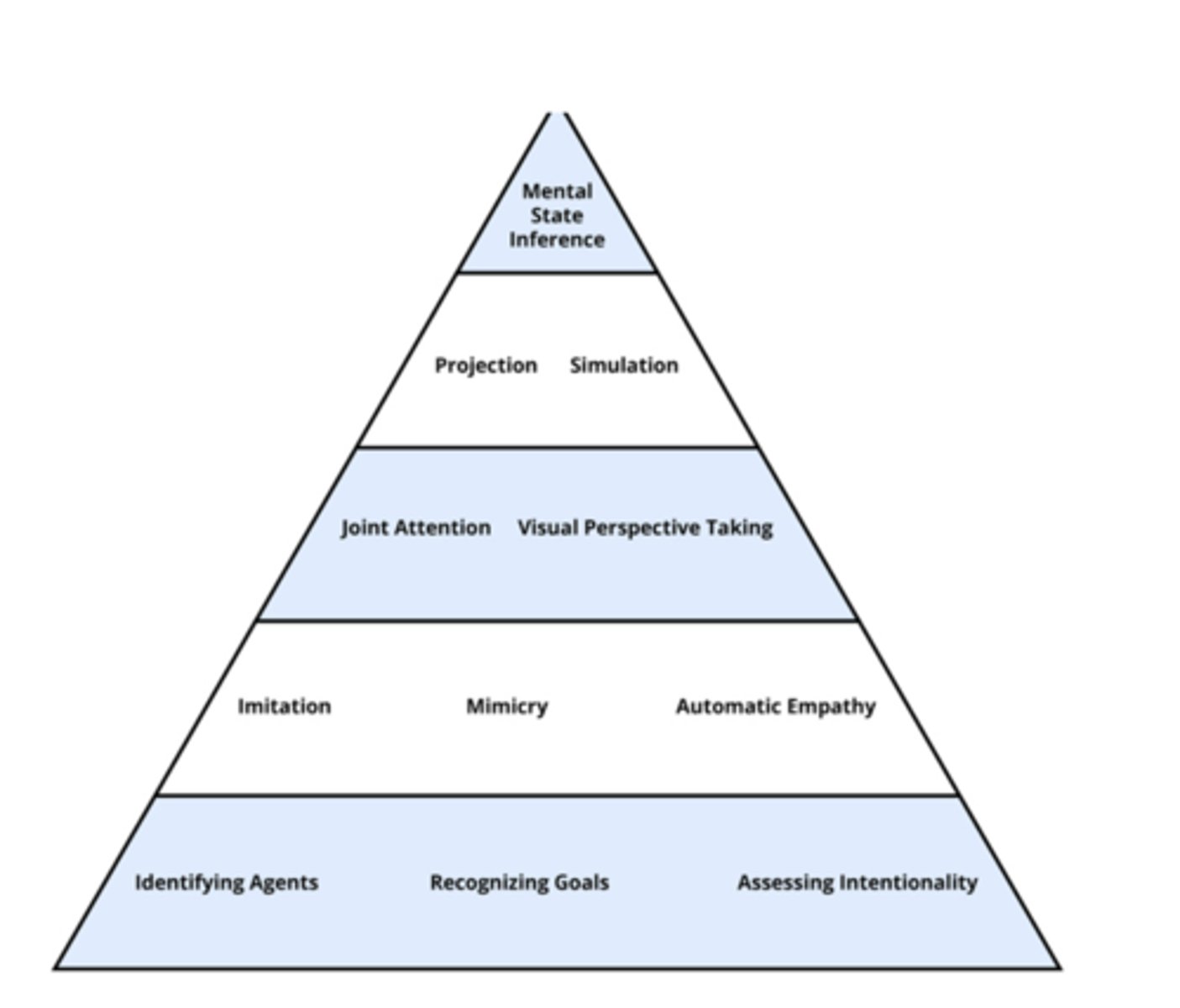
concepts of theory of mind triangle
bottom to top: simple to complex
1st row:
- identifying agetns
- recognizing goals
- assessing intentionality
2nd row
- imitation
- mimicry
- automatic empathy
3rd row
- joint attention
- visual perspective taking
4th row:
- projection
- simulation
TOP:
- Mental state inference
1st row:
- identifying agents
agent - allows humans to identify moving objects in the world that can act on their own
Features of being an agent:
- having eyes
being self-propelled
reacting systematically to the interaction partners behaviour
first row - recognizing goals
To recognize goals --> is to see the systematic and predictable relationships between a particular agent pursuing a particular object across various circumstances
first row - assessing intentionality
to pursue goals, you have to have intentional behaviour
o Intentionality: the quality of an agents performing a bahviour intentionally: that is with skill and awareness and executing an intention based on a desire and relevant beliefs
o Some behaviours are Unintentional even if they are goal-directed
example: embarrassing yourself on a date accidently, when you want to impress
row 2 - imitation
human tendency to carefully observe others behaviours and do as they do --> even if its their first time experienceing that behaviour
row 2 - mimicry
copying others behaviours, often without awareness
row 2 - synchrony
two people displaying the same behaviours or having the same internal states --> BECAUSE OF MIMICRY
o If two people mimic the same body posture and gestures they "synchronize" their behvaiours by way of largely unconscious imitation
o People who enjoy an interaction synchronize their behaviours more, and increased synchrony makes people enjoy their interaction more
mirror neurons
Frontal lobe neurons that fire when performing certain actions or when observing another doing so. The brain's mirroring of another's action may enable imitation, language learning, and empathy.
human mirroring and imitation
is selective --> triggering actions that are relevant to the perceivers current state or aim
Automatic empathy
A social perceiver unwittingly taking on the internal state of another person, usually because of mimicking the person's expressive behavior and thereby feeling the expressed emotion.
row 3 - joint attention
Two people attending to the same object and being aware that they are both attending to it.
--> Shared engagement is critical for children to learn the meaning of objects
row 3 - visual perspective taking
Percieving something from another person's spatial vantage point OR more generally to effortful mental state inference
--> how they are feeling, their thoughts, and desires
row 4 - simulation
process of representing the other persons mental state
--> helps us understand the other thoughts or feelings by using one's own mental state as a model for other mental states
row 4 - social projection
a social perceivers assumption that the other person wants, knows, or feels the same as the perceiver wants, knows, or feels
--> assuming its equal to our own
--> egocentric thought
what happens if common ground is lacking regarding social projection
people use their OWN current state of knowledge concern of perception, to grasp other people's mental states
- need to recognize our egocentricism and actively take other people's perspective
- grasping mental states even if they are different from our own
false-belief test
An experimental procedure that assesses whether a perceiver recognizes that another person has a false belief—a belief that contradicts reality.
example of false belief task
(a) An adult shows a child the contents of a Band-Aid box and of an unmarked box. The Band-Aids are in the unmarked container. (b) The adult introduces the child to a hand puppet named Pam and asks the child to predict where Pam would look for the Band-Aids and to explain Pam's behavior. The task reveals whether children understand that without having seen that the Band-Aids are in the unmarked container, Pam will hold a false belief.
what is the false belief test used to determine?
explicit mental state inference
--> see what the kid has developed in the triangle
what age is false belief difficult for?
before age of 4
how do people explain other's behaviours
By referring to their beliefs, and desires, and the specific reasons for which they acted
TOM gives INTENTION AND MEANING behind inexplicable motions
at what age do most people develop theory of mind
in first year of life
what tool of theory of mind develops in early childhood and is AUTOMATIC
Assessing intentionality
specifically the capacity to interpret agents as having goals.

