Inferential Statistics I-II
 Studied by 1 person
 Call Kai
 Learn
Learn Practice Test
 Spaced Repetition
 Match
Match Flashcards
 Knowt Play
1/28

There's no tags or description
Looks like no tags are added yet.
Name | Mastery | Learn | Test | Matching | Spaced | Call with Kai |
|---|
No analytics yet
Send a link to your students to track their progress
29 Terms
What is the purpose of inferential statistics?
To use a sample to make generalizations about a population, determining whether observed effects are likely due to chance or reflect real population effects.
What is the null hypothesis (H₀)?
A conservative baseline assumption stating no relationship between IV and DV; the IV does not affect the DV.
(Always assumed true at the start.)
What is the research/alternative hypothesis (H₁ or H_A)?
The hypothesis the researcher hopes is true; states that there is a relationship or effect of the IV on the DV.
What makes H₀ and H₁ “mutually exclusive and exhaustive”?
Mutually exclusive: Both cannot be true at the same time.
Exhaustive: They cover all logical possibilities—there is an effect or there is not.
What is the p-value?
The probability of obtaining the observed data (or more extreme data) if the null hypothesis is true.
What does a low vs high p-value mean?
High p-value (> 0.05) → Results likely due to chance → retain H₀
Low p-value (≤ 0.05) → Results unlikely due to chance → reject H₀ (significant effect)
What is alpha (α)?
The threshold for statistical significance; typically 0.05.
If α = 0.05, we accept a 5% chance of committing a Type I error.
What is a Type I error?
Rejecting H₀ when H₀ is actually true (false alarm).
Example: Saying there is an effect when there is none.
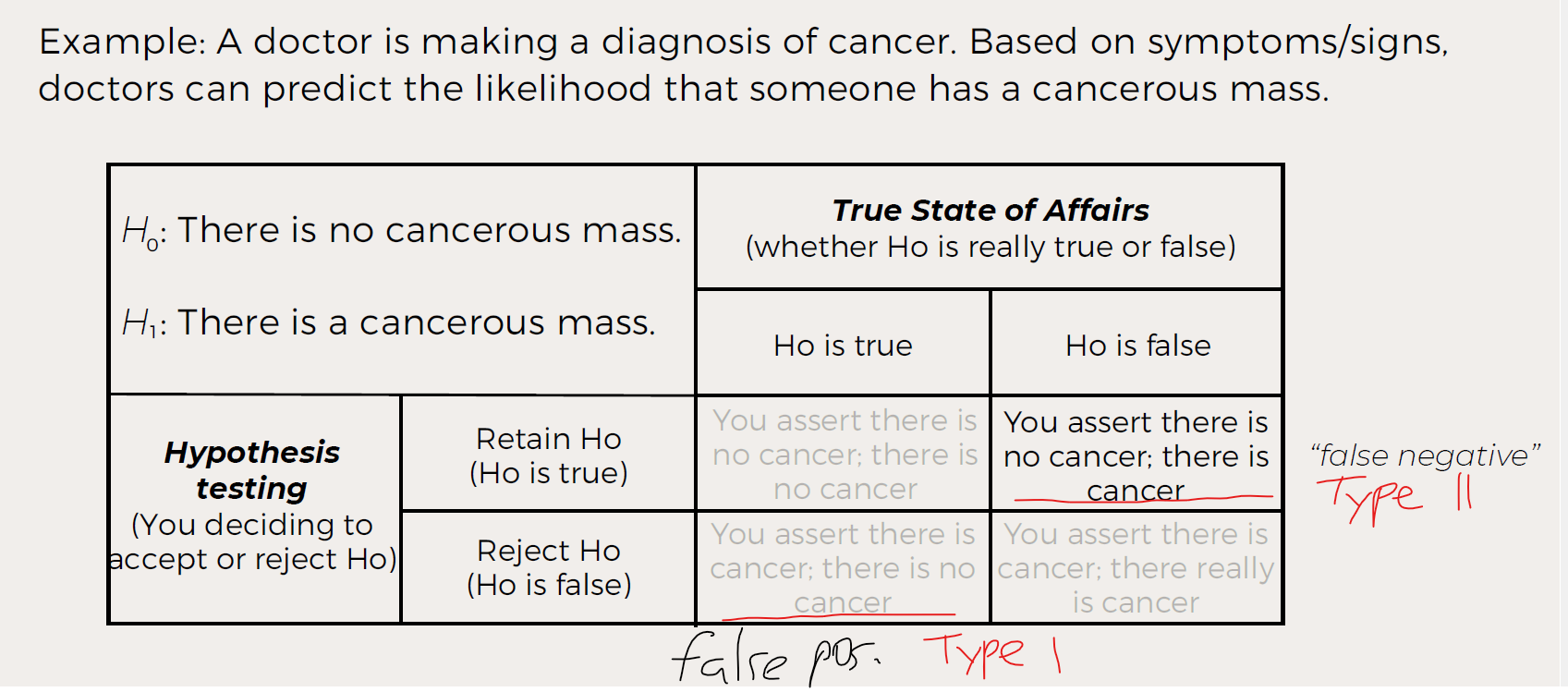
What is a Type II error?
Retaining H₀ when H₀ is actually false (miss).
Example: Failing to detect a real effect.

How are Type I errors related to alpha (α)?
Alpha sets the probability of a Type I error.
If α = 0.05 → expect 5 false rejections per 100 experiments (assuming H₀ is true).
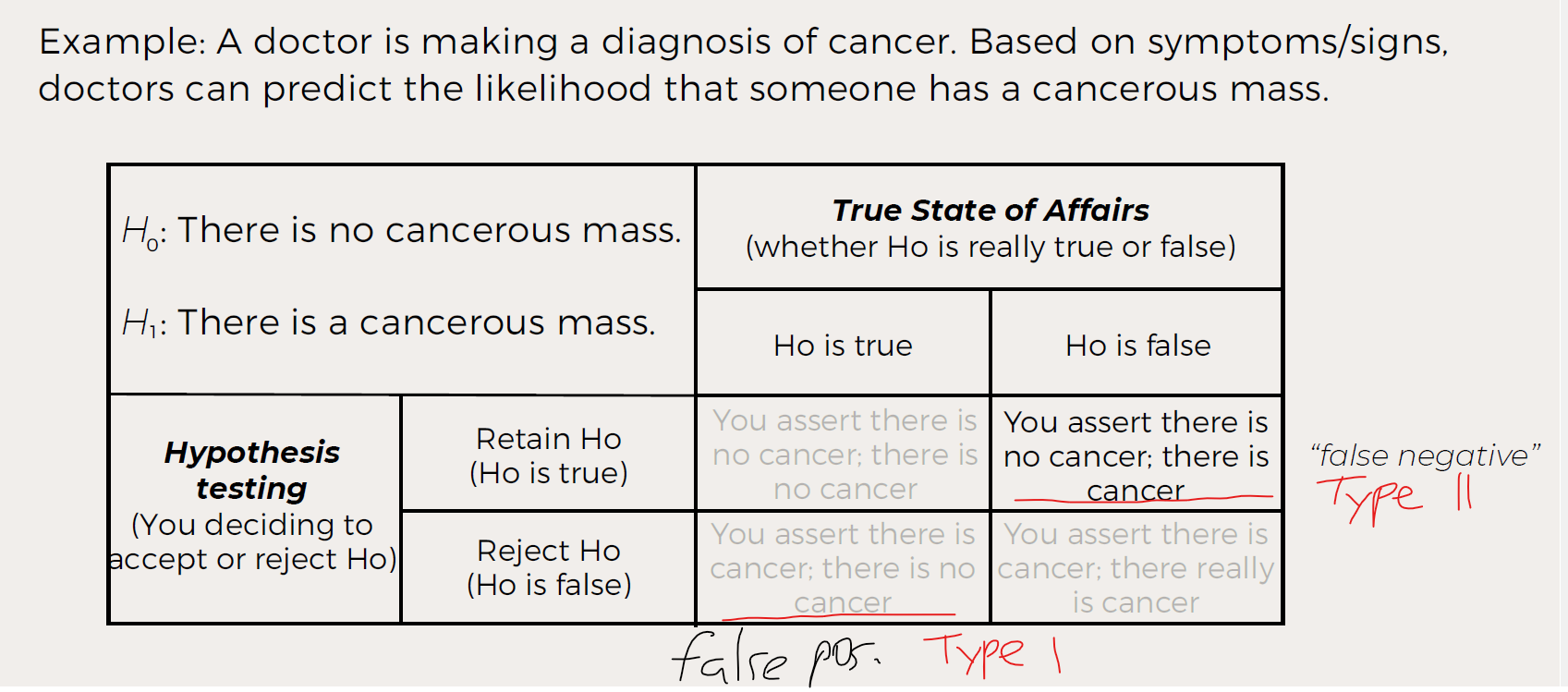
What is the doctor/cancer example illustrating?
Type I error: Saying “cancer” when there is none (false positive).
Type II error: Saying “no cancer” when it exists (false negative).
What is statistical power?
The probability of correctly rejecting H₀ when H₀ is false (detecting a true effect).
Power = 1 – β.
What does low power mean?
A higher chance of Type II errors (missing real effects).
What 3 factors influence statistical power?
Sample size (larger → more power)
Effect size (larger effects are easier to detect)
Alpha level (α) (larger α → higher power)
How does increasing sample size affect power?
A larger sample yields more precise estimates → more power, especially helpful when effect sizes are small.
How does effect size influence power?
Larger population differences are easier to detect → higher power.
How does alpha (α) influence power and errors?
Higher α (e.g., 0.25) → easier to reject H₀ → higher power but more Type I errors
Lower α (e.g., 0.05) → harder to reject H₀ → lower power but fewer Type I errors
What happens when α = 0.05 in the camera example?
Very strict; only detects strong movement
Low Type I error (few false alarms)
High Type II error (misses burglars)
Low power
What happens when α = 0.25 in the camera example?
Very sensitive; detects lots of movement
High Type I error (false alarms from bugs/shadows)
Low Type II error
Higher power (better at catching burglars)
What are the 4 steps of NHST?
State hypotheses and assume H₀ is true
Collect data
Calculate p-value given H₀
Decide to retain or reject H₀
What does it mean to “reject the null hypothesis”?
The data were unlikely under H₀ (p ≤ 0.05), suggesting a significant IV → DV effect.
What does it mean to “retain the null hypothesis”?
The data were common under H₀ (p > 0.05), so insufficient evidence to say there is an effect.
(Not proving H₀ true—just not enough evidence to reject it.)
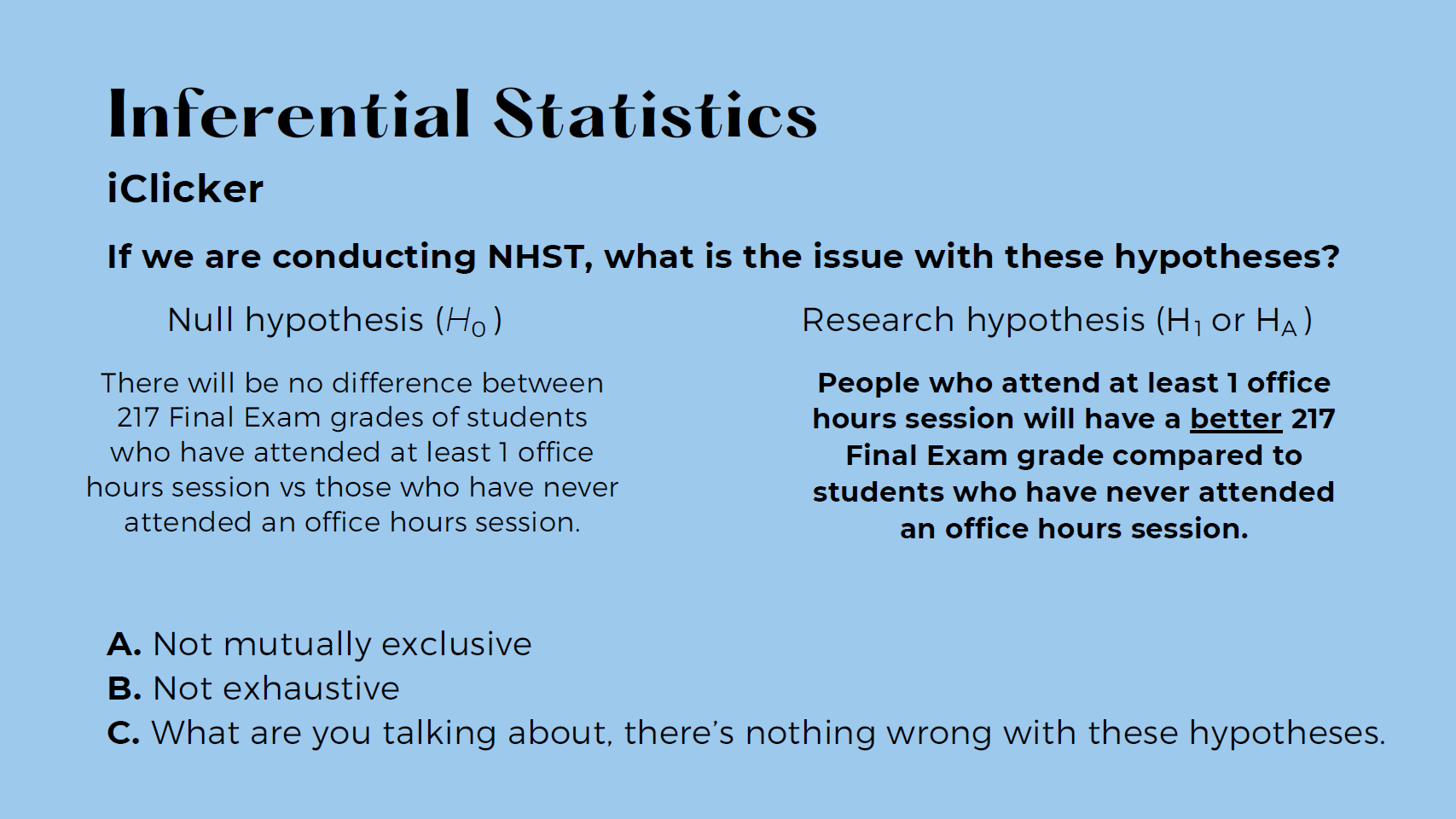
B) is correct → what if people get worse after going to office hours? etc. (Possible other outcomes we don’t contest for)
Yes mutually exclusive (contradict each other)
Better exhaustive hypothesis: There will be A DIFFERENCE/CHANGE vs directly saying they will do better (change research hypothesis)
“People who attend at least 1 office hours session will have a difference in their 217 Final Exam grade compared to students who have never attended an office hours session”.
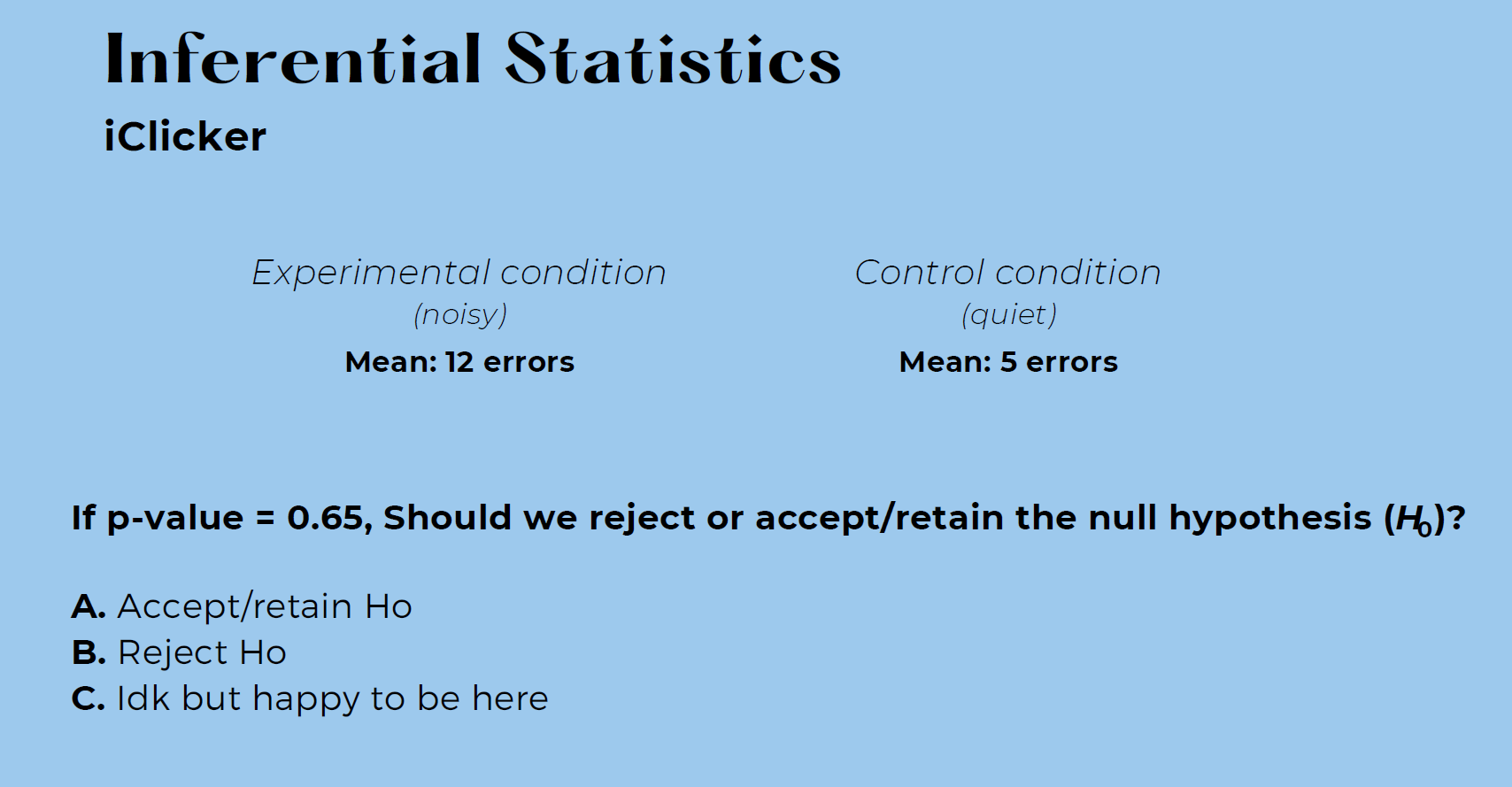
A) is correct because p-value > 0.05
Could be completely due to chance

B) is correct
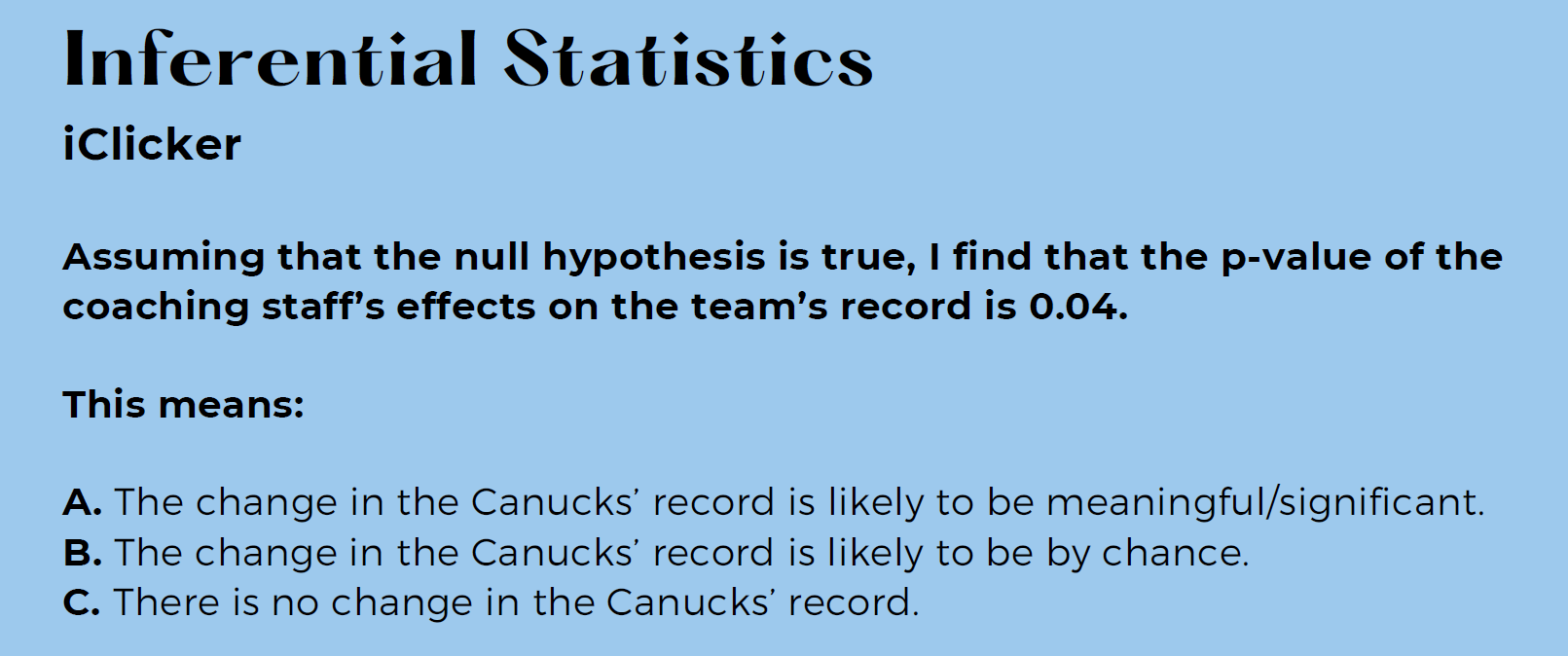
A) is correct
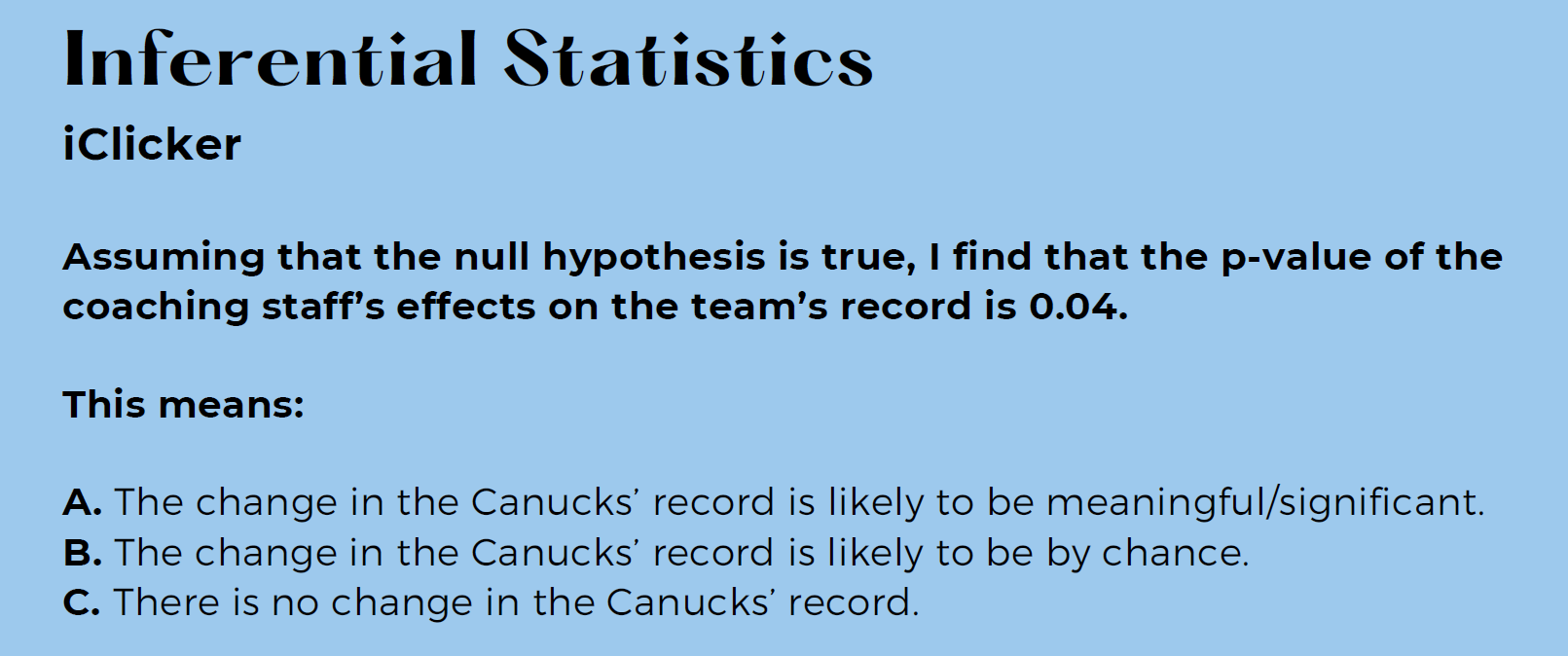
What would a Type II error mean in this scenario? Express this in everyday language.
Accepting the null hypothesis but it’s actually false
Say Canucks record is the same but it actually changes due to coaching staff
New coaching staff made a difference when we say they didn’t
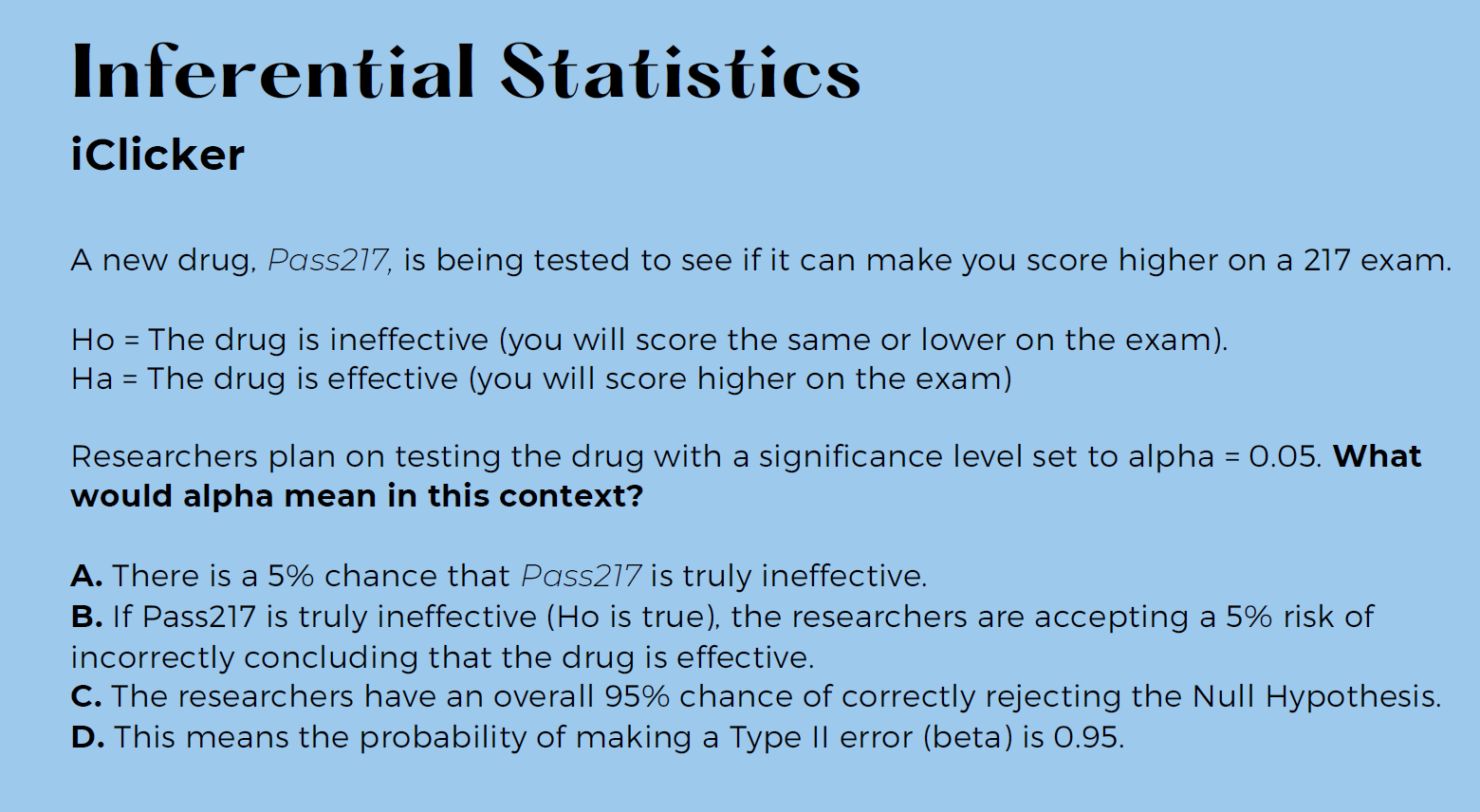
B) is correct

C) is correct
 Note
Note  Flashcards (88)