19: Electric Potential and Electric Energy
 Studied by 0 people
 Call Kai
 Learn
Learn Practice Test
 Spaced Repetition
 Match
Match Flashcards
 Knowt Play
1/19

There's no tags or description
Looks like no tags are added yet.
Name | Mastery | Learn | Test | Matching | Spaced | Call with Kai |
|---|
No analytics yet
Send a link to your students to track their progress
20 Terms
What is work (PE)?
W = - PE
How are F, q, and E related?
F = qE
What is electric potential? Symbol, units
V
1 V = 1 J/C
Volts
How are V, PE, and q related?
V = PE/q
What are electric kinetic and potential energy?
-PEelec = KEelec = qV
What is 1 electron volt?
1 eV = (1.6 × 10⁻¹⁹ C) (1V)
In Joules
How are work, 1 and V related?
W = qVAB
What is electric field? Symbol, units
E (vector)
In N/C
1 N/C = 1 V/m
How are E, d, and V related?
VAB = Ed
E = VAB/d
How are V, K, Q, and R related?
V = KQ/R
Where K is constant, Q is point charge, and r is distance from point charge
What is K?
Constant 9.0 × 10⁹ Nm²/C²
How are E, K, Q, and R related?
E = KQ/R²
Where E is electric field, K is constant, Q is a point charge, and R is distance from Q
How are Q, C, and V related?
Q = CV
Q is charge stored, C is capacitance value, V is voltage
What is capacitance? Symbol, unit
F = 1C/1V
Farad
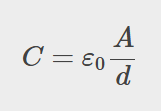
How are C, epsilon, A, and d related?
Use when no dielectric
C = (epsilon nought) A/d
Where epsilon is constant, A is area, and d is distance between the capacitor’s plates
What is epsilon nought? Value
8.85 × 10⁻¹² F/m
F/m = C²/Nm²
How are c, K, epsilon, A, and d related?
Use when dielectric is present
C = (epsilon)(K) A/d
Where epsilon is constant, K is dielectric constant, A is area, and d is distance between the plates
How are Ecap, C, Q, and V related?
Ecap = ½ QV = ½ CV² = ½ Q²/C
Where Ecap is the electric field of the capacitor, C is capacitance, Q is charge, and V is voltage
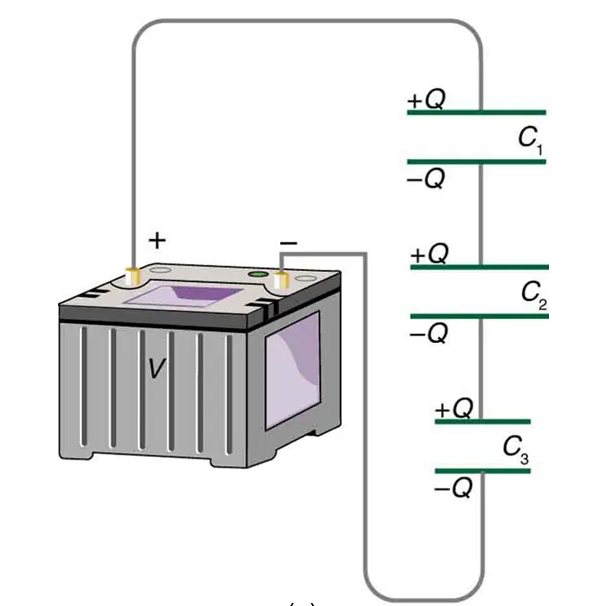
How do you find Cseries?
Cs = 1/C1 + 1/C2 +…+ 1/Cn
Where C is capacitance
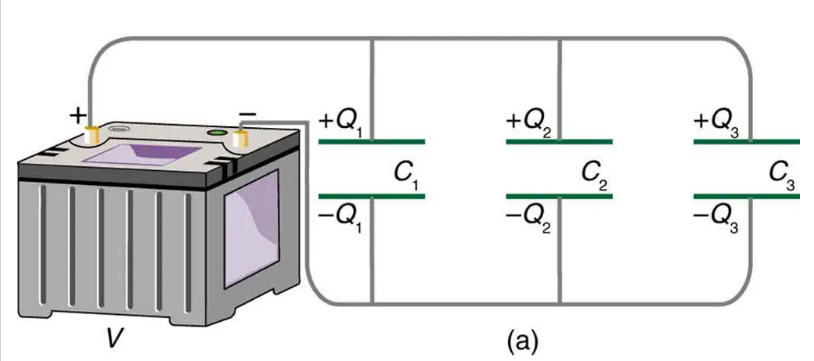
How do you find Cparallel?
Cparallel = C1 + C2 +…+ Cn
Where C is capacitance
 Note
Note  Flashcards (129)