Chapter 2: Choices in the World of Scarcity
 Call Kai
 Learn
Learn Practice Test
 Spaced Repetition
 Match
Match Flashcards
 Knowt Play
1/13

Earn XP
Description and Tags
How individuals make choices based on their budget constraint; The production possibilities frontier and social; Confronting objections to the Economic Approach
Name | Mastery | Learn | Test | Matching | Spaced | Call with Kai |
|---|
No analytics yet
Send a link to your students to track their progress
14 Terms
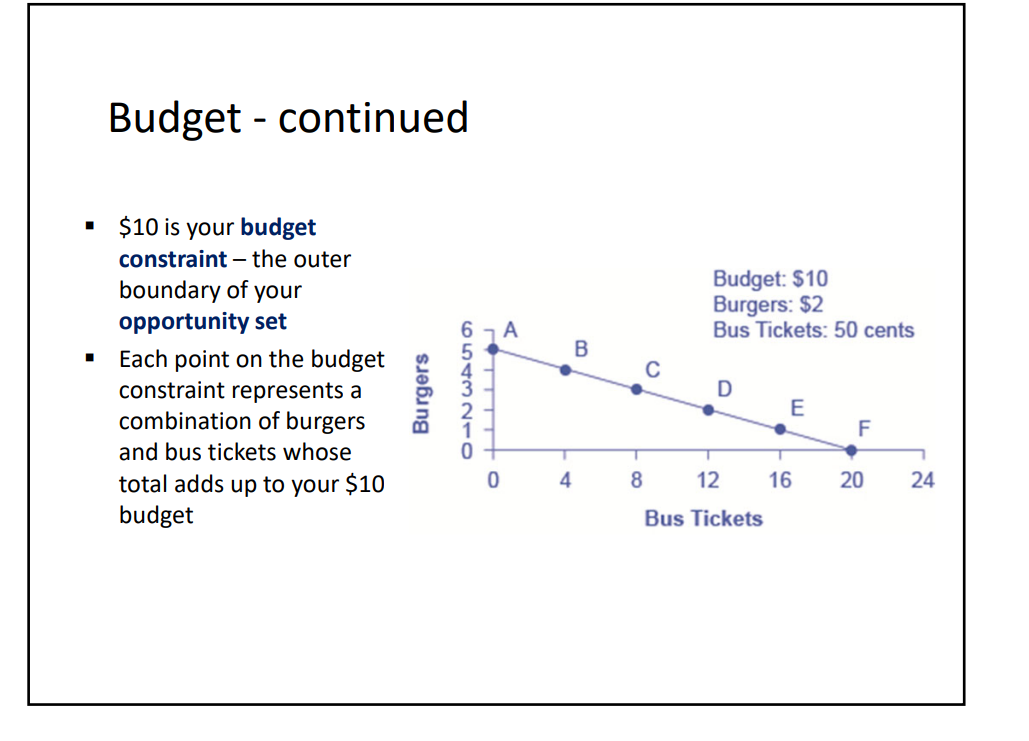
Explain how much tasty burgers would Josh get if he paid 8 for tickets
3 Burgers
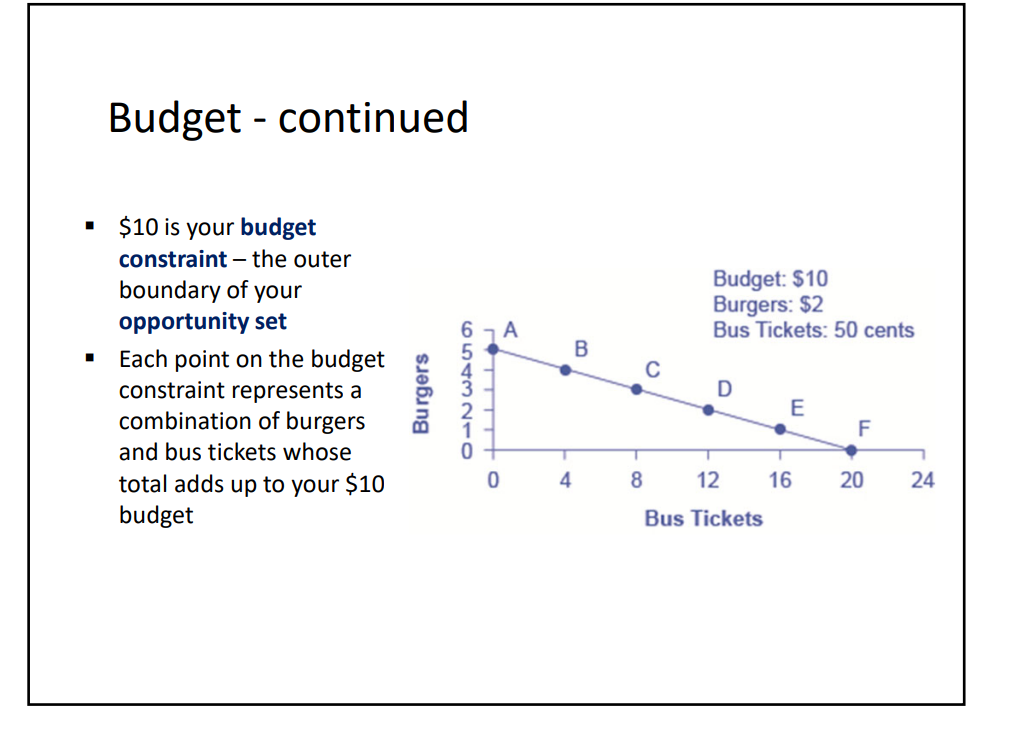
_________ measures the cost by what is given up in exchange; the value of the next best alternative
Opportunity Cost
_______satisfaction, usefulness, or value one obtains from consuming goods and services
Utility
_______ analysis examination of decisions on the margin, meaning a little more or a little less from the status quo; analyzing what happens with one additional unit
Marginal
Law of __________ utility as we consume more of a good or service, the utility we get from additional units of the good or service tend to become smaller than what we received from earlier units
diminishing marginal
________costs that are made in the past and cannot be recovered
Sunk costs
According to the textbook, what is the definiton if all of society branches for one career? HINT: Budget constraint -> ______________ (___)
Production Possibilities Frontier (PPF)
__
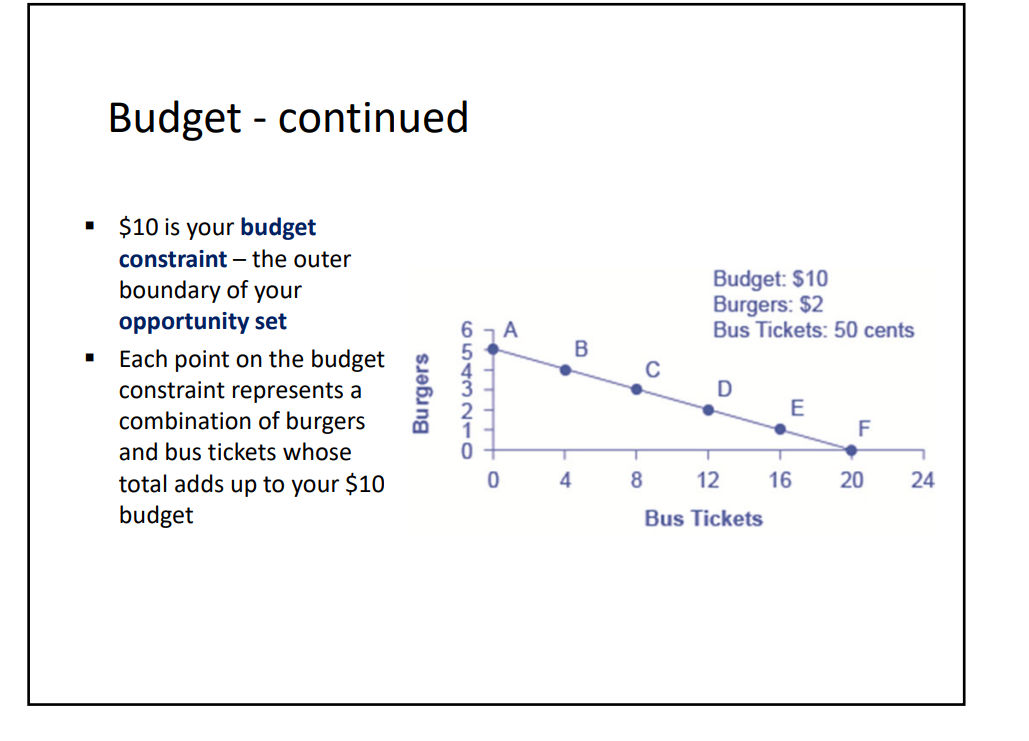
Explain what is the differences between a budget constraint and a PPF
The budget constraint is a STRAIGHT LINE because its slope is given by the relative prices of the two goods.
The PPF, on the other hand, has a CURVED shape because of the law of diminishing returns.
In this imaginary economy, there are no specific NUMBERS on the axes of a PPF – we do not know the exact amount of resources this imaginary economy has, nor do we know how many resources it takes to produce healthcare and how many resources it takes to produce education. If this were a real-world example, we’d have some data…
Law of ___________as additional increments of resources are added to producing a good or service, the marginal benefit from those additional increments will decline
diminishing returns
__________ when it's impossible to produce one more good (or service) without decreasing the quantity produced of another good (or service); all points on the PPF are productively efficient (note: points inside the PPF are inefficient/wasteful)
Productive efficiency
___________when the mix of goods being produced represents the mix that society most desires
Allocative efficiency
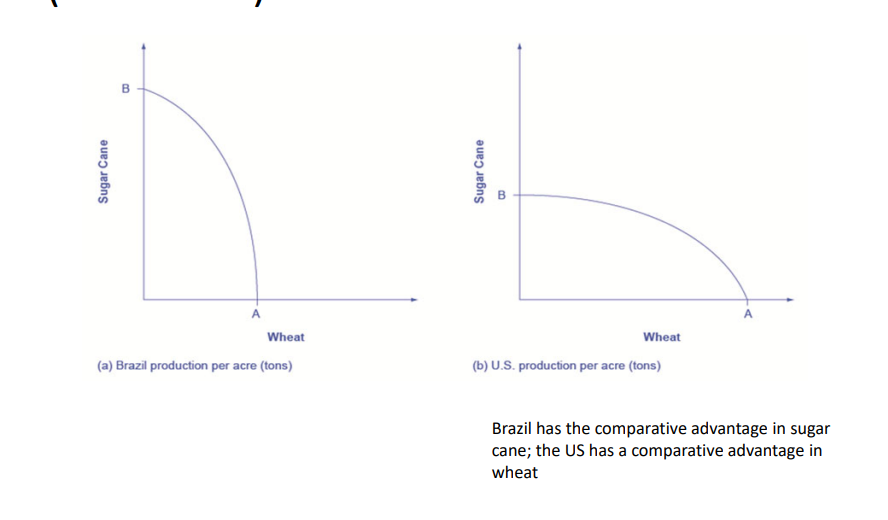
______________advantage when a country can produce a good at a lower cost in terms of other goods; or, when a country has a lower opportunity cost of production
Comparative
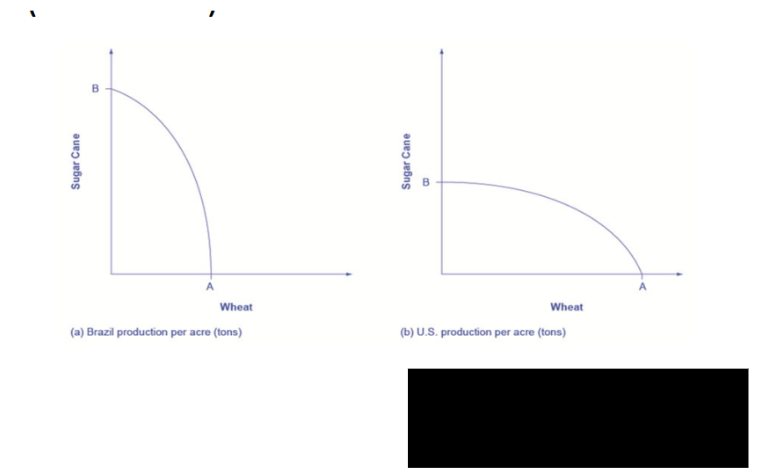
According to The PPF and Comparative Advantage, why must a country not try to produce say US for sugar?
Often how much of a good a country decides to produce depends on how expensive it is to produce it versus buying it from a different country.