1. coding, capacity and duration of the memory
 Studied by 0 people
 Call Kai
 Learn
Learn Practice Test
 Spaced Repetition
 Match
Match Flashcards
 Knowt Play
1/30

There's no tags or description
Looks like no tags are added yet.
Name | Mastery | Learn | Test | Matching | Spaced | Call with Kai |
|---|
No study sessions yet.
31 Terms
Aim of Jacobs’ study?
To investigate the capacity of short-term memory.
How did Jacobs test STM capacity?
Participants were given sequences of digits or letters which increased in length and were asked to recall them in the correct order, immediately
What did Jacobs find?
The mean STM span was:
9.3 digits
7.3 letters
What did Jacobs conclude about STM capacity?
STM has a limited capacity, and capacity is greater for digits than letters.
One strength of Jacobs’ study
it was a highly controlled laboratory experiment, increasing reliability.
One limitation of Jacobs’ study
Recalling digits and letters is artificial, lacks mundane realism, can’t be generalised
Aim of Miller’s study?
To investigate the capacity of short-term memory.
What is chunking? (Millers)
Organising information into meaningful units to increase STM capacity (grouping information together)
What did Jacob’s and Millers conclude?
STM can hold about 7 ± 2 items and can be increased by chunking
How does chunking increase STM capacity?
Each chunk counts as one item, allowing more information to be stored.
What is the capacity of LTM?
Unlimited
What was the aim of Peterson & Peterson’s study?
To investigate the duration of short-term memory without rehearsal.
How did Peterson & Peterson test STM duration?
Participants were given consonant trigrams (YCG) and asked to count backwards in threes to prevent mental rehearsal before recalling the trigram. Were told to stop after varying period of time:3,6,9,12,15,18.
What did Peterson & Peterson find?
-Recall after 3 sec was 80% accurate
-Recall after 18 sec was 3% accurate
What did Peterson & Peterson conclude?
STM has a very limited duration unless rehearsal takes place
One strength of Peterson & Peterson’s study
Highly controlled (extraneous variables) laboratory experiment, increasing internal validity(nonsense triagrams, counting backwards)
One limitation of Peterson & Peterson’s study
The task is artificial, lacks mundane realism, low external validity (not info that people normally try to remember, such as phone number)
What was the aim of Bahrick et al.’s study?
To investigate the duration of long-term memory.
How did Bahrick et al. test LTM duration?
Participants aged 17–74 were asked to recall former classmates using free recall (recall names from their class with no prompt) and photo recognition (pick names that match photos)
What did Bahrick et al. find?
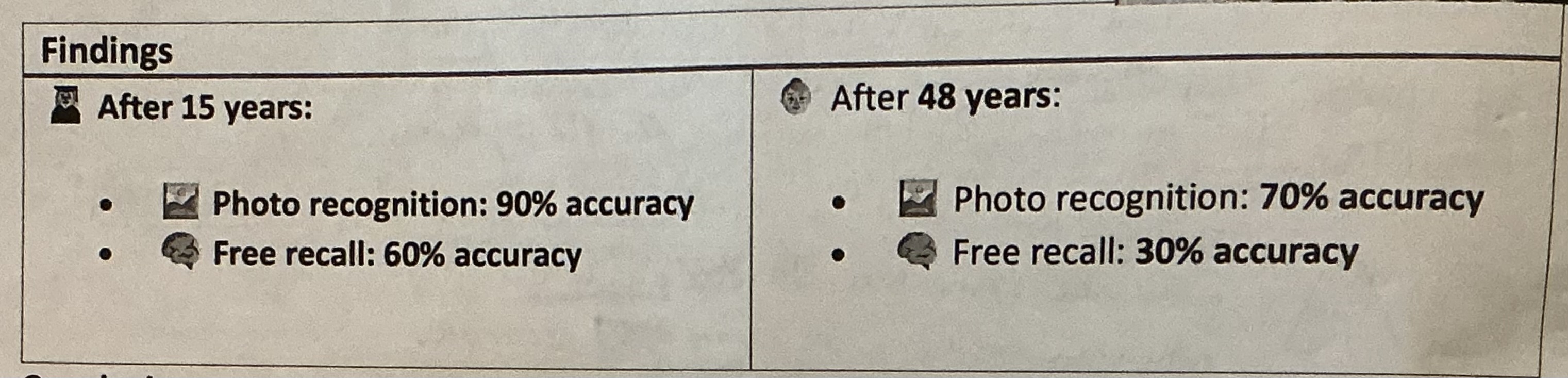
What did Bahrick et al. conclude?
LTM can last a lifetime, unlimited
Strengths of Bahrick et al.’s study
Used real life memories (people’s names and faces)- high external validity
Recalling former classmates is a real-life task, so the study has high mundane realism.
The study used a large sample aged 17–74, meaning the findings can be generalised to a wide population, higher populations validity
Limitation of Bahrick et al.’s study
Participants may have rehearsed the information over time, reducing internal validity
Participants were mainly American high-school graduates, so the findings may not fully generalise to other cultures or education systems.
What was the aim of Baddeley’s study?
To investigate how information is coded in STM and LTM
What is Baddeleys procedure
→ Participants were given four word lists:
Acoustically similar (sound)
Acoustically dissimilar
Semantically similar (meaning)
Semantically dissimilar
They recalled the lists immediately (STM) or after a delay (LTM).
What did Baddeley find about coding in STM?
Participants made more errors with acoustically similar words, showing STM is mainly acoustically coded.
What did Baddeley find about coding in LTM?
Participants made more errors with semantically similar words, showing LTM is mainly semantically coded.
What did Baddeley conclude?
STM and LTM use different types of coding, supporting the idea of separate memory stores.
Strengths of Baddeley study
Standardised procedure was used, making the study easy to replicate and increasing reliability
Theoretical value, research paved the way for the MSM, showing that STM and LTM are 2 separate stores
One Weakness of Baddeley study
Recalling word lists is artificial, giving the study low mundane realism (don’t reflect the type of meaningful information people typically try to remember, such as names, directions) therefore, can’t be generalised outside of the lab
 Note
Note  Flashcards (40)