PSY 209 EXAM 1
0.0(0)
 Studied by 0 people
 Call Kai
 Learn
Learn Practice Test
 Spaced Repetition
 Match
Match Flashcards
 Knowt Play
Card Sorting
1/106

Earn XP
Description and Tags
Last updated 8:04 PM on 2/12/23
Name | Mastery | Learn | Test | Matching | Spaced | Call with Kai |
|---|
No analytics yet
Send a link to your students to track their progress
107 Terms
1
New cards
biological psychology
a branch of psychology concerned with the links between biology and behavior
2
New cards
what are 5 major perspectives to explore the biology of behavior?
1. Describing behavior
2. Studying the evolution of behavior
3. Observing the development of behavior and its biological characteristics over the life span
4. Studying the biological mechanisms of behavior
5. Studying applications of behavioral neuroscience
2. Studying the evolution of behavior
3. Observing the development of behavior and its biological characteristics over the life span
4. Studying the biological mechanisms of behavior
5. Studying applications of behavioral neuroscience
3
New cards
What are the 3 main approaches tp the study of brain and behavior?
1. Somatic intervention
2. Behavioral intervention
3. Correlation
Each approach enriches and informs the others
2. Behavioral intervention
3. Correlation
Each approach enriches and informs the others
4
New cards
somatic intervention
an approach to finding relations between body variables and behavioral variables that involves manipulating body structure or function and looking for resultant changes in behavior
Ex: mild electric shock to one part of brain → patient laugh
Ex: mild electric shock to one part of brain → patient laugh
5
New cards
behavioral intervention
an approach to finding relations between body variables and behavioral variables that involves intervening in the behavior of an organism and looking for resultant changes in body structure or function
Ex: Putting two adults of opposite sex together may lead to increased secretion of certain hormones
Ex: Putting two adults of opposite sex together may lead to increased secretion of certain hormones
6
New cards
Correlation
A measure of the extent to which two factors vary together
7
New cards
confounding variable
a factor other than the independent variable that might produce an effect in an experiment
8
New cards
Neuroplasticity
the ability of the nervous system to change in response to experience or the environment
9
New cards
What types of variables are included in experiment design?
Independent (controlled by experimenter), dependent, confounding
10
New cards
What are the parts of the central nervous system?
brain and spinal cord
11
New cards
How is the brain protected?
The brain is protected by bone, meninges, cerebrospinal fluid, and the blood-brain barrier
12
New cards
What are the parts of the peripheral nervous system?
autonomic nervous system & somatic nervous system
13
New cards
autonomic nervous system
the part of the nervous system responsible for indirect bodily functions such as breathing
14
New cards
somatic nervous system
the division of the peripheral nervous system that controls the body's skeletal muscles
15
New cards
Gyri (gyrus)
Large folds of tissue covering the surface of the cerebrum
16
New cards
Sulci (sulcus)
~shallow grooves separating the gyri
~ Divides the cerebral hemispheres into lobes
~ Divides the cerebral hemispheres into lobes
17
New cards
Lobes of the cerebrum
* frontal (movement and high-level cognition)
* parietal (receive sensory information from body and spatial cognition)
* temporal (auditory information)
* - occipital (receive and process information from eyes)
* parietal (receive sensory information from body and spatial cognition)
* temporal (auditory information)
* - occipital (receive and process information from eyes)
18
New cards
basal ganglia
a set of subcortical structures that directs intentional movements
19
New cards
caudate nucleus
One of the basal ganglia- it has a long extension or tail
20
New cards
globus pallidus
component of the basal ganglia that connects to the thalamus which relays information to the motor areas and the prefrontal cortex
21
New cards
Putamen
one of the basal ganglia
22
New cards
limbic system
neural system (including the hippocampus. associated with emotions and drives.)
23
New cards
Amygdala
A limbic system structure involved in memory and emotion
24
New cards
Diencephalon
thalamus
25
New cards
Thalamus
the brain's sensory switchboard- it directs messages to the sensory receiving areas in the cortex and transmits replies to the cerebellum and medulla
26
New cards
Hypothalamus
A neural structure lying below the thalamus- it directs several maintenance activities (eating, drinking)
27
New cards
midbrain (mesencephalon)
part of the brainstem that connects the brainstem to the cerebellum- controls sensory processes
28
New cards
colliculi
two structures in the midbrain involved in sensorimotor reflexes- the superior colliculus receives visual sensory input- and the inferior colliculus receives auditory sensory input
29
New cards
Hindbrain
medulla
30
New cards
Medulla
the base of the brainstem- controls heartbeat and breathing
31
New cards
Cerebellum
the "little brain" at the rear of the brainstem- functions include processing sensory input and coordinating movement output and balance
32
New cards
Pons
A brain structure that relays information from the cerebellum to the rest of the brain
33
New cards
What different techniques can be used to visualize neurons?
immunocytochemistry, immunohistochemistry, DAPI, Nissl, In Situ, Ca+
34
New cards
DAPI stain
a fluorescent stain that binds strongly to DNA in a cell
- how many and where are cells located
- how many and where are cells located
35
New cards
Nissl stain
fills out the cell bodies of the neuron dye bonds to any RNA in the cell
* used to measure size and density of cells
* used to measure size and density of cells
36
New cards
Immunocytochemistry
uses antibodies attached to a dye to identify cellular components such as receptors
37
New cards
Immunohistochemistry
localizing antigens or proteins in tissues using labeled (colored or fluorescent) antibodies
-uses sections of tissue
-uses sections of tissue
38
New cards
In Situ Hybridization
A technique using nucleic acid hybridization with a labeled probe to detect the location of a specific mRNA in an intact organism
- results in clear expression of cell type
- results in clear expression of cell type
39
New cards
calcium imaging
A method of measuring receptor activity by using fluorescence to measure the concentration of calcium inside the receptor. This technique has been used to measure the activation of olfactory receptor neurons.
40
New cards
How are neurons classified?
structurally and functionally
41
New cards
Parts of a neuron
cell body, axon , dendrites
42
New cards
cell body (soma)
contains the nucleus and other parts of the cell needed to sustain its life
43
New cards
Axon
A threadlike extension of a neuron that carries nerve impulses away from the cell body.
44
New cards
Dendrites
Branchlike parts of a neuron that are specialized to receive information.
45
New cards
Anterograde vs retrograde transport
anterograde: moves material toward axon terminals
retrograde: moves used materials back to cell body for recycling
retrograde: moves used materials back to cell body for recycling
46
New cards
Neurotransmitters in autonomic nervous system
sympathetic nervous system: norepinephrine (accelerates activity)
parasympathetic nervous system: acetylcholine (slows down activity)
parasympathetic nervous system: acetylcholine (slows down activity)
47
New cards
enteric nervous system
key role in maintaining fluid and nutrient balances in the body (controls functioning of gut)
48
New cards
Camilo Golgi
Invented Golgi stain- reticular theory
49
New cards
Reticular Theory
nerves communicate through a continuous nerve network
50
New cards
Santiago Ramon y Cajal
Cajal proposed that although neurons come very close to one another (i.e. neuron doctrine)
51
New cards
Neuron Doctrine
cells of the brain are independent from one another structurally
52
New cards
Synapse
Gap between neurons
53
New cards
Which type of synapse is most common in the nervous system?
chemical synapse
54
New cards
electrical synapse
Occurs when large ions alone freely pass from one neuron to the next
-very quick and bidirectional
-regulation of slow-wave sleep
-very quick and bidirectional
-regulation of slow-wave sleep
55
New cards
pre-synaptic neuron
a neuron that delivers a signal to a synapse
(releases neurotransmitter)
(releases neurotransmitter)
56
New cards
post-synaptic neuron
the neuron on the receiving end of the synapse
(receives and responds to neurotransmitter)
(receives and responds to neurotransmitter)
57
New cards
Components of a synapse
presynaptic membrane, synaptic cleft, postsynaptic membrane
58
New cards
synaptic cleft
The narrow gap that separates the presynaptic neuron from the postsynaptic cell, synaptic vesicles
59
New cards
synaptic vesicles
a small, spherical structure that contains molecules of neurotransmitter
60
New cards
presynaptic membrane
the specialized membrane of the axon terminal of the neuron that transmits information by releasing neurotransmitter
61
New cards
postsynaptic membrane
the specialized membrane on the surface of the cell that receives information by responding to neurotransmitter from a presynaptic neuron
62
New cards
Myelin
a fatty substance that helps insulate neurons and speeds the transmission of nerve impulses
63
New cards
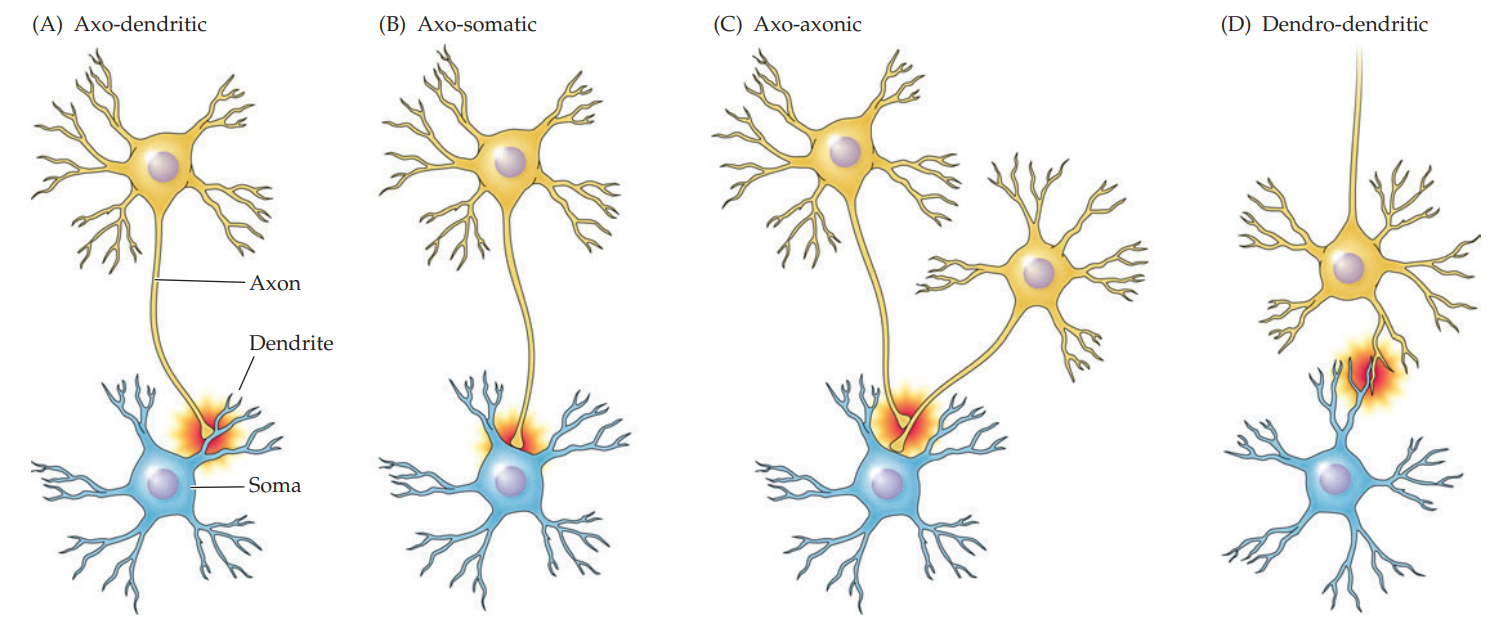
ways synapses can connect
* axo-dendritic
* axo-somatic
* axo-axonic
* dendro-dendritic
* axo-somatic
* axo-axonic
* dendro-dendritic
64
New cards
Transmission in the CNS
Not all transmission in the CNS occurs neuron-to-neuron
-volume transmission(slow)
-volume transmission(slow)
65
New cards
Key differences between chemical and volume transmission
chemical (synaptic) transmission:
* high speed
* high energy cost
* chemical and electrical signals
* quick temporal dynamics
volume transmission:
* low speed
* low energy cost
* chemical and electrical signals
* slow temporal dynamics
* high speed
* high energy cost
* chemical and electrical signals
* quick temporal dynamics
volume transmission:
* low speed
* low energy cost
* chemical and electrical signals
* slow temporal dynamics
66
New cards
GABA and schizophrenia
loss of inhibitory GABA --\> causes increased activity of dopamine systems (excess dopamine \= schizophrenia)
Test this with DAPI stain (quantify GABA cells)
Test this with DAPI stain (quantify GABA cells)
67
New cards
What is the resting membrane potential?
Difference in electrical charge across the membrane at rest
~65 mV
~65 mV
68
New cards
How do we measure resting membrane potential?
inserting a fine microelectrode inside a neuron and using a voltmeter to compare the cell's interior with the extracellular fluid surrounding it
69
New cards
How do ions contribute to resting potential?
positive potassium channels and positive sodium ion channels move in and out to maintain a balanced system
70
New cards
Diffusion
the spontaneous spread of molecules of one substance among molecules of another substance until a uniform concentration is achieved
71
New cards
electrostatic force
The force between electrically charged objects (like charges repel and opposite charges attract each other).
72
New cards
Na+ pump as bouncer
the cell is Harp's and Jose is only allowing two K+ for ever Na+ that leave, he maintains and equilibrium
73
New cards
If no other activity occurs,
what is the result of the Na+ pump inside and outside the cell?
what is the result of the Na+ pump inside and outside the cell?
\
74
New cards
What is action potential?
a neural impulse- a brief electrical charge that travels down an axon
75
New cards
What happens before action potential?
the cell membrane of the neuron allows certain ions to pass through while preventing or restricting other ions from moving
-sodium and potassium ions cannot easily pass through the membrane
-Chloride ions are able to freely cross the membrane
-sodium and potassium ions cannot easily pass through the membrane
-Chloride ions are able to freely cross the membrane
76
New cards
What happens during action potential?
there's a sudden reversal of charge, carrying a message down the axis (depolarization)
77
New cards
What happens after action potential?
refractory period- the inside of the cell membrane returns to very negative charge and K+ enters the membrane again
78
New cards
How are neurons like batteries?
they separate electrical charges, creating energy that can be tapped into at any time
79
New cards
Why do we need appropriate amounts of ions in our bodies?
We need appropriate amounts of ions in our bodies because without them we could never get action potential (excess cations= very positive, constant action potential) (excess anions= very negative, will never reach action potential)
80
New cards
Depolarization
The process during the action potential when sodium is rushing into the cell causing the interior to become more positive
81
New cards
Hyperpolarization
The movement of the membrane potential of a cell away from rest potential in a more negative direction.
82
New cards
Where are sodium and potassium ions relative to cell membrane during depolarization?
sodium and potassium rushes into the cell
83
New cards
Where are sodium and potassium ions relative to cell membrane during hyperpolarization?
sodium and potassium is pushed out and chloride rushes in
84
New cards
saltatory conduction
Rapid transmission of a nerve impulse along an axon, resulting from the action potential jumping from one node of Ranvier to another, skipping the myelin-sheathed regions of membrane
85
New cards
What are the nodes of Ranvier?
gaps in the myelin sheath
86
New cards
Where are nodes of Ranvier located?
between myelins
87
New cards
How does conduction differ between myelinated and unmyelinated axons?
Moves faster on myelinated axons
88
New cards
What is the most common excitatory neurotransmitter?
Glutamate
89
New cards
What happens when glutamate binds to post-synaptic cell?
glutamatergic transmission uses particular receptors which when activated leads to NA+ entering the post-synaptic cleft
90
New cards
What is the most common inhibitory neurotransmitter?
GABA
91
New cards
What happens when GABA binds to the post-synaptic cell?
GABAergic transmission uses particular receptors which when activated lead to Cl- entering the post-synaptic cell
92
New cards
What is EPSP?
excitatory post synaptic potential
- pre-synaptic cells releases glutamate into synaptic cleft
- Na+ channels open in response to glutamate binding
- more Na+ outside cell than inside
- pre-synaptic cells releases glutamate into synaptic cleft
- Na+ channels open in response to glutamate binding
- more Na+ outside cell than inside
93
New cards
What is IPSP?
inhibitory post synaptic potential
- presynaptic cell releases GABA into synaptic cleft
- GABA binds to receptor and immediately opens Cl- channel
- Cl- enters and cell is hyperpolarized
- presynaptic cell releases GABA into synaptic cleft
- GABA binds to receptor and immediately opens Cl- channel
- Cl- enters and cell is hyperpolarized
94
New cards
What is the axon hillock?
This is a part of the neuron, between the cell body and the axon, that controls traffic down the axon through summation of excitatory and inhibitory postsynaptic potentials.
95
New cards
temporal summation
Summation by a postsynaptic cell of input (EPSPs or IPSPs) from a single source over time.
96
New cards
spatial summation
Integration by a postsynaptic neuron of inputs (EPSPs and IPSPs) from multiple sources.
97
New cards
How is summation involved in action potential?
if the ESPS depolarizes the postsynaptic neuron enough, it can produce an action potential
98
New cards
What is an ionotropic receptor?
ion channels
99
New cards
What is a metabotropic receptor?
a second messenger that activates other channels downstream with G-protein activation
100
New cards
What is a neurotransmitter?
chemical messenger
criteria:
-exists in presynaptic terminals
-synthesized in presynaptic cells
-released when action potential reaches axon terminals
-receptors on postsynaptic membrane
-produces changes in post-synaptic potential
-blocking release prevents changes in postsynaptic cell
criteria:
-exists in presynaptic terminals
-synthesized in presynaptic cells
-released when action potential reaches axon terminals
-receptors on postsynaptic membrane
-produces changes in post-synaptic potential
-blocking release prevents changes in postsynaptic cell
 Note
Note  Flashcards (99)