Cognitive week 4
 Studied by 0 people
 Call Kai
 Learn
Learn Practice Test
 Spaced Repetition
 Match
Match Flashcards
 Knowt Play
1/8

Earn XP
Description and Tags
Cognitive enhancement-> non-invasive stimulation
Name | Mastery | Learn | Test | Matching | Spaced | Call with Kai |
|---|
No analytics yet
Send a link to your students to track their progress
9 Terms
How do neurons communicate?
Neurons, and communication/information transmission in brain, is electrochemical process.→ Both electrical current and chemicals involved (chemicals have electrical charge).
If area of membrane become depolarised to -55mV, series of events takes place leading to generation of ‘action potential’- that is neuron ‘fires’ or ‘activates’.
Neurons are both speakers, transmitting info, and listeners- having info transmitted to them.
to speak as well( increasing chance of listening neuron to generate action potential by depolarising part of its membrane)
or to shut up( decreasing chance of listening neuron to generate action potential by hyperpolarising part of its membrane)When neuron ‘fires’ (speaks: activates- generates an action potential), it tells listening neurons:
What is the history into how brain stimulation was used?
Scribonius Largus (43 CE): used (electrical) torpedo fish to treat headache, gout and haemorrhoids.
Victorians created all sorts of self-stimulation electrical devices for use at home that were sold at department stores, seaside resorts, etc.
In the 1940s ECT was developed, which uses strong electrical currents to generate epileptogenic activity, which can provide long term improvement in psychiatric conditions.
Now, we use stimulation in a much more scientific way. Supra and sub-threshold medical and research uses. For example, DBS for Parkinson’s.
What is TMS and how can it be used?
Transcranial Magnetic Stimulation (TMS)- Electromagnetic Induction→ Michael Faraday discovered electromagnetic induction.
Changes in magnetic flux can induce a current… but the current is very small compared to energy required to make magnetic flux.
TMS can be used to directly activate (or deactivate) areas of the brain.
Including motor cortex→ Using TMS, we can make you move by activating the area of brain that is responsible for telling muscles to move, whether you want them to or not.
Would attach EMG (electromyography) electrodes to your finger, and stimulate contralateral finger spot of motor cortex. We can measure the movement of finger- the MEP- for given strength of stimulation.
What is tES and what are the sub-thresholds?
Redfearn et al (1964) found that 0.5mA of transcranial direct current stimulation could improve mood in severe depression. But, pharmaceutics took over instead…
In 2000, Nitsche and Paulus showed clear effects of tDCS on the human motor cortex. Huge resurgence in electrical stimulation research since.
Sub-threshold stuff, hence the lowercase ‘t’
Direct current stimulation (tDCS)→ Manipulates membrane polarisation, thus manipulating excitability of areas of brain- can make areas more or less likely to activate.
Alternating current stimulation (tACS)→modulate the frequencies that we already suspect are related to some function (movement, vision, memory, etc)→ enhance or disrupt the communication of brain networks and determine causality.
Random noise stimulation (tRNS)→ Increases excitability under both electrodes (overcoming an issue with tDCS, if it is an issue for you).
What are some positives about used Tes methodologies?
Uses weak currents- non-invasive, tolerable (not like ECT).
Influences spontaneous and task-related neural activity.
There are established safety guidelines.
Two (or more) sponge electrodes (often saline soaked) are applied to scalp.
A precision generator delivers the electrical current.
What are some further knowledge of the three sub-thresholds?
tDCS:
Can produce excitability changes of up to 40%.
Can last hours after stimulation.
Not exactly focal.
Cannot go deep.
Limited time of use
Can be felt by participants, but can also be shammed for control groups.
Electrode polarisation may be an issue.
tRNS:
Delivers bidirectional alternating current (anode and cathode switching).
Random amplitudes, random frequencies.
tACS:
Bidirectional, alternating current.
Ramps up, then down, then switches polarity, repeats.
Does not modulate cortical excitability … rather modulates intrinsic neural oscillations
What is Oscillations?
The phase of local oscillations influences the excitability of neurons in that area, increasing sensitivity (‘listening’) and making them more or less likely to activate (‘speak’).
Oscillations can also be likened to the conductor of an orchestra: can exert influence over the timing and magnitude of activity.
How do neurons polarisation cause communication in the brain, and how can synchronised neural activity be achieved?
Polarity of the local area influences the excitability of neurons in that area.→ Neural activity in an area contributes to the polarity of the local area.
If a neuron is receiving information from another neuron, it becomes slightly depolarised. But it will revert back to its resting state – it takes temporal coincidence of input activity to make a neuron active.
Changes in the polarisation of the local area influence their sensitivity to inputs (listening) and their likelihood to activate (speak).
Synchronised neural activity: Oscillations
Optimal communication between different brain areas by aligning their oscillatory phases.
Synchronisation of neural activity is not limited to facilitating information transfer within an area of the brain, but also across more distant regions (such as for the integration of sensory information from different sensory cortices, or coordinating and executing movement).
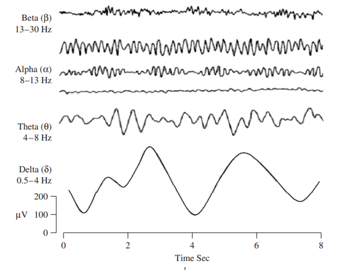
What are the main frequency bands to classify oscillations?
Delta: 1-4Hz: (potentially some reward, motivation, and decision-making processes)
Theta: 4-8Hz: Working memory, long-term memory, often couples with gamma
Alpha: 8-12Hz: Attentional suppression
Beta: 12-30Hz: Motor activity and learning, providing carrying capacity
Gamma: 30-100Hz: Selective attention, sensory integration for further processing by other cognitive domains
 Note
Note  Flashcards (25)