Cognitive tasks in VR - done but go over
 Call Kai
 Learn
Learn Practice Test
 Spaced Repetition
 Match
Match Flashcards
 Knowt Play
1/15

There's no tags or description
Looks like no tags are added yet.
Name | Mastery | Learn | Test | Matching | Spaced | Call with Kai |
|---|
No analytics yet
Send a link to your students to track their progress
16 Terms
Theory of mind (ToM) (Baron-cohen)
ability to understand others’ mental states
Sally Anne false beleif task
Identification of non-verbal behaviours
attribution of social behaviours are issue in autism
Heider & Simmel (1944)
different geometric shapes moving around
demonstrated the human tendency to attribute human-like intentions, emotions, and narratives to simple moving geometric shapes
Animacy
ability to attribute human characteristics & mental states to shapes
Abel et al (2000) & White et al (2011)
Theory of mind (coxing, mocking)
Random (star, drifting)
Gold directed (chasing, leading)
Animacy perception in VR (Savickaite et al 2021)
created 2D animations & 3D animations
followed the animations → random, chase, dance
used autsitms coefficent
Animacy perception in VR (Savickaite et al 2021) Procedure
No interaction
no obvious interaction between the triangles, and movement appears random.
Physical interaction
An interaction between the triangles in which actions are directed toward each other in order to achieve specific goals.
Mental interaction
An interaction between the triangles involving the manipulation of the emotions and thoughts of one triangle by the other
Animacy perception in VR (Savickaite et al 2021) findings
inaccurate interpretations of animation
difficulty deciding on interactions on whether they are mental or physical
very immersive so improves on ecological validity
Visual search in 3D
locating a target within clutter
used in everyday & highstake tasks
influenced by target saliency, task relevant and cognitive traits
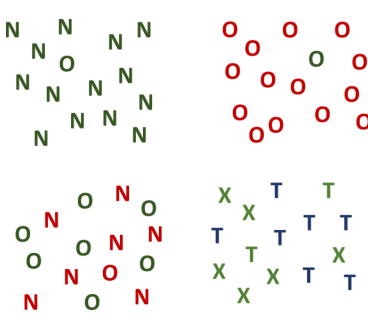
VR & visual search task (Savickaite & Parker, 2025)
Visual search task in three conditions:
2D desktop, 2D displayed in VR, 3D VR
VR offers immersion & controlled enviroments
20 trials
Select a target shape among distractors
Order counterbalanced
Measures: accuracy & completion time
results of VR & visual search task
2D = easiest, most efficient, highest accuracy
VR3D = most cognitively demanding
Engages visuospatial memory strongly
Requires navigation + attention
quickest completion
VR2D = intermediate demands
significant differences between groups
key points of cognitive task in VR
Performance declines as tasks become more immersive
VR3D introduces greater variability in behaviour
RT differ significantly across conditions
Accuracy differences trend toward significance
Immersive VR likely reflects true real-world search complexity better than 2D tasks
Cognitive load, spatial memory, & attentional allocation differ between modalities
Immersion affects multiple things
increases cognitive load
reduce VWM efficiency
Increase predictor error
flatterns priors
predicitive processing language
describing cognition in terms of the brain as a prediction machine, using terms like priors (expectations), sensory evidence, prediction error (mismatch between expected and actual input), and precision (how much weight a signal gets), instead of just saying “expectations”, “surprise”, “attention”, and “learning”.
Explore top notes

Explore top flashcards
