Cognition and development
 Studied by 0 people
 Call Kai
 Learn
Learn Practice Test
 Spaced Repetition
 Match
Match Flashcards
 Knowt Play
1/33

There's no tags or description
Looks like no tags are added yet.
Name | Mastery | Learn | Test | Matching | Spaced | Call with Kai |
|---|
No analytics yet
Send a link to your students to track their progress
34 Terms
Piaget’s theory of cognitive development overview and schema
focused on how thinking develops across childhood as Piaget believed children don’t just know less than adults but think in different ways.
schema- mental framework of beliefs and expectations that influence cognitive processing (developed through experience)
children are born with a small number of schema e.g. sucking, grasping and then construct more detailed schema for ourselves, others, objects, and abstract ideas.
Piaget’s theory of cognitive development: motivation to learn
disequilibrium
equilibration
pushed to learn when our existing schema struggle to make sense of something new disequilibrium (unpleasant state)
to achieve equilibration we adapt to new situations through exploring and developing understanding.
assimilation and accommodation
assimilation- understand a new experience by adding new information to our existing schema e.g. having a dog and then being exposed to more dog breeds same schema
accommodation- radical change in current schema or a formation of new ones e.g. creating a new cat schema rather than adding to dog schema change and create
evaluating Piaget’s theory of cognitive development
research support, HOWE
studied 9-12 year olds in groups discussing and watching objects move down a slope.
all increased their knowledge and understanding but did not come to the same conclusions despite seeing the same motions.
each child formed individual mental representation.
Revolutionised teaching: in the 1950s children sat in rows and had formal teaching usually copying from a blackboard. Classrooms are now more activity orientated so children construct their own understandings of the curriculum through active engagement.
early years learning focus on play, a-level ‘flipped’ lessons where students read up on the content.
positive impact on education leading to more effective ways for children to learn.
May have underestimated the role of other people in learning. Focused on learning that happens in the mind where adults and peers are important sources of information.
Vygotsky: other people are essential to the process of learning as it is a social process and children will achieve more advanced learning when supported by others.
overlooked key aspect.
Based on an unrepresentative sample as children were from predominantly white middle class well educated families. not all children want to complete mae sense of new situations and achieve equilibration. so lacks ecological validity as some children from poorer backgrounds have fewer educational opportunities and may display different levels of intellectual curiosity.
cannot be generalised especially if equilibration is not essential for everyone.
Piaget’s stages of intellectual development: sensorimotor
(0-2)
baby’s early focus is on physical sensations and developing physical coordination. They learn through trial and error to deliberately move body in specific ways e.g. crawling. also acquire some basic language e.g ‘mummy’
object permanence (8 months): ability to realise objects still exist when they are out of sight.
observed babies looking at objects and watched as objects were moved from sight.
pre 8 months: attention moved away
8 months+: continue to look for it
Piaget’s stages of intellectual development:
preoperational stage
(2-7)
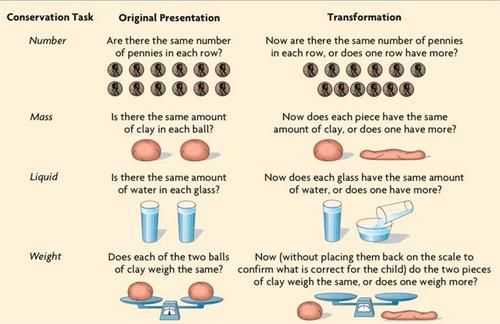
conservation: quantity remains constant even when appearance of object changes. (preoperational children can’t conserve)
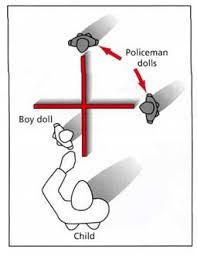
egocentrism: child’s tendency to only see things from their point of view. (3 mountains task)
doll was placed at side of the model to face scene from a different angle than the child.
child then asked to choose what the doll would ‘see’ from a range of pictures.
(preoperational children select their own POV)
class inclusion: ability to recognise that subsets are part of broader categories e.g dogs and cats are also both animals (cannot see that dog is part of dog class and animal class)
Piaget’s stages of intellectual development:
concrete operations
(7-11)
now have reasoning abilities but these are limited to only concrete e.g. physical objects in child’s presence
struggle to reason about abstract ideas and imagine situations they cannot see
Piaget’s stages of intellectual development:
formal operations
(11+)
children become capable of formal reasoning so can focus on form of arguments and not be distracted by the content of arguments.
syllogism: all yellow cats have 2 heads. I have a yellow cat called Charlie. How many heads does Charlie have? → 2
once children can reason formally they are capable of scientific reasoning and can appreciate abstract ideas.
Evaluating Piaget’s stages of intellectual development
Piaget’s theory is able to be tested due to tasks like the 3 mountains or conservation tasks. These can be repeated many times to test various cognitive abilities increasing reliability and validity.
Refuting evidence for egocentrism. HUGHES: tested ability of child to see situation from 2 people’s viewpoint. asked to position doll so police couldn’t see them.
children aged 3.5 could do with 1 man 90% of the time and age 4 could do with 2 men 90% of time.
more child friendly task, Piaget underestimated the age of egocentrism.
Refuting evidence for conservation. original questioning about whether objects were the same led children to believe something had changed.
McGARRIGLE + DONALDSON: set up study where counters were knocked together by ‘naughty teddy’ and 72% conserved.
Piaget underestimated, children can conserve if the questions are not flawed.
→ criticisms of age Piaget identified was not of the stages themselves so principles were unchallenged e.g. Hughes, ability for egocentrism does improve with age so just Piaget’s timing of stage wrong.
Assumed intellectual development was domain general (singular process, all develop together) e.g. language and reasoning. research of autism shows they develop separately e.g. high functioning ASD are egocentric but have normal logic and reasoning. But some autistic children do have an issue with logical and language.
cognitive development, Vygotsky
cognitive development is a social process of learning from more experienced others ‘experts’
intermental (between child and expert)
intramental (within mind)
cultural differences, Vygotsky
children learn mental tools from others in their environment which help in the physical and social environments of their culture which is why there are cultural differences in cognitive development.
e.g. mongolian children use bow and arrow and british children learn to ride a bike
scaffolding
support and prompting usually provided by an adult which helps child reach potential
gradually withdraw as child’s knowledge and confidence increases
most → least
demonstration- draws shape
preparation- help child hold pencil
indication- points to pencil
instruction- ‘draw shape
general- now draw
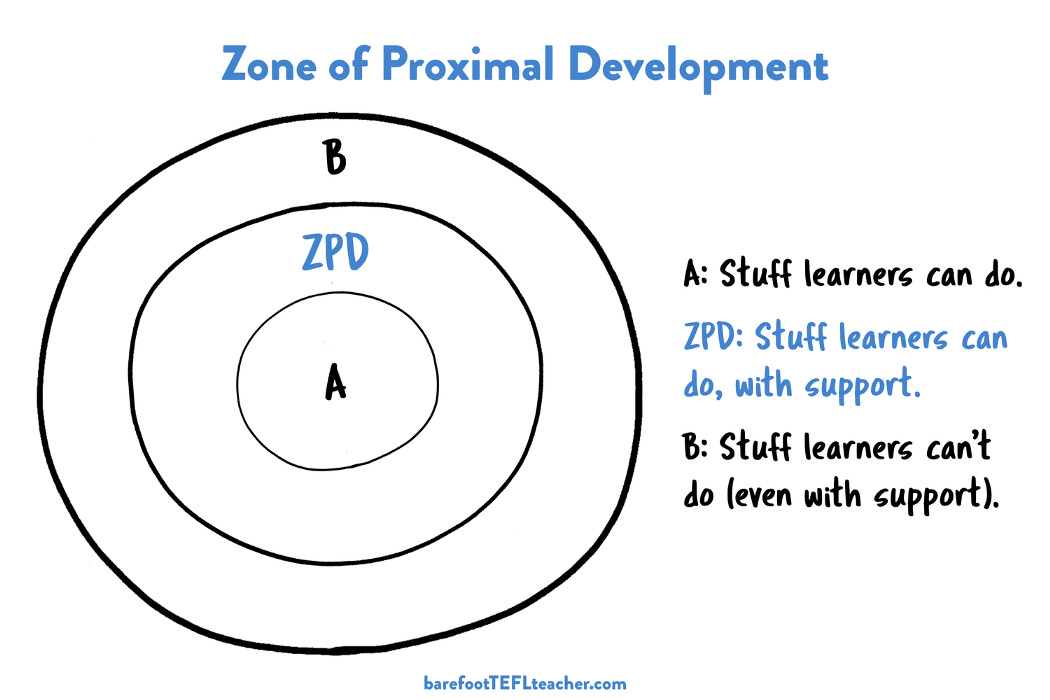
zone of proximal development
expert assistance allows a child to cross ZPD and understand as much as possible (still limited on developmental stage)
increased understanding and advanced reasoning abilities.
evaluating vygotsky’s theory of cognitive development
research support, Roazzi and Bryant: 4 year olds had to guess how many sweets in the box
working alone they struggled to produce estimate
when paired with expert child, gave prompts and guidance to help younger child work out the correct answer
→ demonstrates the importance of expert assistance to help with tasks a child can’t do independently
research support, Connor: level of support changes as child develops. studies mothers helping children (aged 1-5) with problem solving tasks.
as children grow older mothers provide less direct assistance and offered more subtle prompts
adults naturally adjust amount of support they give depending on child’s ability and then withdraw as child becomes more competent → support for scaffolding
real world application, particularly in education
influenced classroom practice through group work, peer tutoring and teaching assistants who scaffold children’s learning
e.g. 7 year olds tutored by 10 year olds made greater progress in reading than those without tutoring
shows social interaction and guided help enable children to perform tasks (have a positive impact)
may overlook important individual differences: assumes social interaction and guidance are key drivers of learning for all children. not true for every child as differ in personality, learning style and social cues.
this influences how people benefit from scaffolding (prefer to work independently, may feel anxious or not respond to guidance)
so theory is not universally applicable
procedure and results of Baillergeon’s violation of expectation research
procedure: showed 24 babies aged 6 months a tall and short rabbit passing behind a screen with a window.
first showed them both disappearing behind a screen fitting with object permanence.
short rabbit passes screen with window and not seen in window.
tall rabbit not seen through window in screen - UNEXPECTED
results: babies looked for 33s at unexpected event and 25s at expected. interpreted as babies surprised at unexpected condition as would expect tall rabbit to appear in window- so have object permanence.
→ infants also paid more attention to impossible/ unexpected events like an object disappearing from a container or not falling from air when unsupported.
physical reasoning system, baillargeon
hardwired with a basic understanding of the physical world so are aware of the physical properties of the world.
this becomes more sophisticated with experience.
babies predisposed to learn so are surprised at unexpected events because they want to develop understanding of physical world and how objects interact.
object persistence, baillargeon
knowledge that even when not in view an object remains in existence and does not spontaneously alter in structure.
evaluating baillargeon’s explanation of infant abilities and violation of expectation
the physical reasoning system accounts for why the basic physical principles are understood universally. for example, infants across all cultures know an object falls when dropped. suggests physical reasoning system is innate and that some cognitive knowledge is present from birth rather than learned through experience. good explanation of early cognitive abilities.
violation of expectation findings have been replicated. wang also found 4 month infants looked longer at impossible events. shows results are reliable and supports object permanence from a young age.
violation of expectation technique provides a more valid measure of infant understanding than piaget.
he assumed that if infants failed to search for a hidden object then they lacked object permanence (but could be due to limited motor skills, low motivation or boredom)
measures how infants look so removes confoundings variables and gives a more accurate measure of cognitive understanding so findings stronger and more reliable.
hard to know exactly what infants understand from watching their behaviour.
violation of expectation relies on measuring time looked but could reflect novelty rather than recognition of an impossible event
questions validity of interpreting VOE results as evidence of object permanence so method not completely conclusive.
Basic outline of Selman’s theory of social cognition
concerned with how children develop social perspective taking: understanding how someone else feels or thinks.
he believed this was domain specific meaning social perspective taking develops separately to physical perspective taking.
Selman’s research and finding on perspective taking
30 boys and 30 girls aged 4-6
individually given a task to measure perspective taking abilities by asking how each person felt in various scenarios
e.g. Holly promised her father not to climb trees after almost hurting herself but comes across a tree with a kitten stuck in it. How would each person feel is she climbs it?
distinct levels of perspective taking identified which correlated with age suggesting a clear developmental sequence.
selman’s additions to his theory
interpersonal understanding- take on roles to understand thoughts, feels and intentions of others
interpersonal negotiation strategies- being able to assert your viewpoint, compromise and manage conflict so responding appropriately
awareness of personal meaning of relationships- able to reflect on past, shared experiences and maintain relationships
selman’s stages of development of perspective taking
explorers see islands sparkling rivers mountains sandy coasts
0 egocentric (3-6): cannot reliably distinguish between their emotions and those of others. can identify emotional states in others but not understand what social behaviour may have caused it.
1 social information (6-8): assumes differences in perspectives are due to lack of information rather than different viewpoints
2 self reflective (8-10): child can put themselves in position of another and appreciate their perspective but can only take on board one point of view at a time.
3 mutual (10-12): child can look at situation from their own and another’s at the same time.
4 social and conventional system (12+): know that understanding other’’ viewpoints is not enough to reach agreements hence social conventions to regulate behaviour and maintain social order.
evaluating selman’s theory of social cognition
supported by research evidence
selman used cross sectional studies (lots of ages of people) and found positive correlation between age and perspective taking as older children show more advanced perspective taking.
supports that perspective taking develops in stages as children mature and gain cognitive ability.
→ evidence is correlational so age does not directly cause perspective development but may be other factors.
helps explain atypical social development
research comparing children with adhd to control groups has shown children with adhd perform worse on perspective taking tasks such as understanding other’s emotions and consequences of actions.
difficulties in perspective taking may contribute to social and behavioural problems often seen in children with adhd.
practical applications- interventions to improve perspective taking skills in individuals with atypical development
support for the importance of perspective taking in social development
observational study of child parent interaction in toyshops and supermarkets. observed interactions of parents refusing to buy things their child wanted. coercive behaviour in children (force parents to buy) is an example of a unhealthy social behaviour
assessed by interview and found negative correlations between coercive behaviour and perspective taking abilities
healthy social behaviour is therefore perspective taking
→ other research assessed perspective taking in bullies and found that they had no difficulty in perspective taking yet unhealthy social development.
reductionist explanation- mainly focuses on cognitive development. may also be influenced by family, environment, biology. more of a combination and selman oversimplifies it.
Theory of mind
each of us have a personal theory of what others know or are thinking and feeling. suggested as explanation for autism as can’t understand other’s mental processes or behaviours.
intentional reasoning tasks
18 month olds watched adults putting beads in a jar
experimental condition- child sees adult struggle to get beads in a jar.
control condition- child see adults put bead in easily.
both conditions, child then puts beds in easily suggesting they are imitating what the adult intended to do rather than what they actually did.
→ shows young children have a simple theory of mind
the eyes task
reading complex emotions in pictures of faces showing just small area around eyes. many autistic adults struggled with eyes task supporting idea of theory of mind deficits being cause of autism. false
false belief tasks, maxi and the chocolate
story told to 3 and 4 year olds. Maxi puts chocolate in blue cupboard and then goes out. Mum uses the chocolate to cook then puts the rest of the bar in the green cupboard.
where does maxi look for the chocolate?
3 year olds: green cupboard as child assumes Maxi knows what they know.
4 year olds: blue cupboard as understands Maxi’s mind.
→ theory of mind develops between 3 and 4
false belief tasks, Sally- Anne study (Baron-Cohen)
child is told a study involving 2 dolls. Sally puts marble in her basket then goes out, and Anne moves the marble to her box then sally comes back. where will sally look for marble?
experimental group: 20 children with autism spectrum disorder → 20% correct
control group: 27 not autistic, 14 with down’s syndrome → 85% correct
significant difference
→ suggests asd involves a theory of mind deficit
evaluating theory of mind
reliance on false belief tasks to test theory.
tasks have low validity as require other cognitive abilities like visual memory meaning failing at these tasks may be due to deficit in memory not theory of mind.
when provided with visual memory aid children performed better
some children can engage in pretend play which requires theory of mind but then find false belief tasks difficult.
→ may not really measure theory of mind so theory of mind lacks key research evidence.
research techniques fail to distinguish theory of mind from perspective taking.
cognitive ability to view social situations from another person’s pov and theory of mind to understand mental states in others closely related.
difficult to be sure we are measuring one and not the other e.g. child may be visualising beads tasks from adult perspective rather than expressing a conscious understanding of their intentions. sally anne: seeing things from sally’s perspective.
tasks may actually be measuring perspective taking which is especially problematic as both ways of distinguishing between asd and neurotypical children. also challenges validity.
eyes task is criticised as looking at a static pair of eyes is different from seeing real life faces in a dynamic interaction. conclusion about theory resulting from study lack validity as unrealistic procedure.
application to theory of understanding autism
people with asd have more difficulty with theory of mind tasks as struggle to fully understand what other people are thinking.
explains why some find social interaction difficult as had to interact if you don’t get the sense of what they are thinking or feeling so can’t understand.
→ not complete explanation. not every autistic person struggles and neurotypical people may also struggle. does not explain why those with asd have cognitive strengths like visual attention. not as closely linked as thought.
Mirror neurons and discovery
fire both in response to personal action and in response to action on the part of others
discovery, Rizzolatti studied electrical activity in the brain of monkeys. their motor cortex became activated when they reached for food and when the researcher reached for lunch. same brain cells fired so mirroring motor activity.
Evolution, Ramachandran (mirror neurons)
complex social interactions we have as humans require brain system that can understand emotions, intentions and perspectives. without this we could not live in large groups with complex social roles and rules.
Understanding intentions and perspectives, mirror neurons
mirror neurons also fire is response to understanding people’s intentions not just people’s actions. we imitate their actions in motor systems to experience intentions.
important in responding to and understanding people’s perspectives and developing theory of mind. if neurons fire in response to other’s actions this makes a neural mechanism in understanding other’’ perspectives and emotions.
Broken mirror theory
autism is linked to problems with social cognitive abilities as children may have dysfunctional mirror system. prevents child imitating and understanding social behaviour in others leading to challenges in social communication as children do not fully develop activity to read intention and emotion.
evaluating mirror neurons
support for explaining autism.
Hadjikhani: evidence supporting link between autism and dysfunctions in mirror neuron system
brain scans have shown smaller average thickness of the pars opercularis in autistic people compared to neurotypical people.
this is an area thought to be especially rich in mirror neurons and perspective taking.
also found lower activity levels in autistic people in brain areas believed to be associated with higher concentrations of mirror neurons.
→ review of 25 studies found this to be highly inconsistent and lacking reliability so may not be linked to autism.
existence of supporting evidence.
Haker scanned the brains of people as they watched a film of people yawning. levels of activity in brodmann’s area increased when ps yawned in response.
usually out of empathy.
Mauras found when men watched porn the pars opercularis (rich in mirror neurons) was active immediately before sexual arousal- perspective taking.
shows importance of mirror neurons.
difficulties in measuring neuron activity. evidence from brain scans can identify activity levels in region of the brain but not individual cells. implanting electrodes does but is not ethically possible in humans and animal studies tell us little about human cognition. mirror neuron research is based on inferences from general brain activity so no direct evidence.
inability to isolate these specialist skills as only know them by function. have not identified individual cells and point out the difference to other neurons. challenges the existence of specialist neurons carrying out mirroring.
 Note
Note  Flashcards (46)