M1- Animal Phys
 Studied by 0 people
 Call Kai
 Learn
Learn Practice Test
 Spaced Repetition
 Match
Match Flashcards
 Knowt Play
1/70

There's no tags or description
Looks like no tags are added yet.
Name | Mastery | Learn | Test | Matching | Spaced | Call with Kai |
|---|
No analytics yet
Send a link to your students to track their progress
71 Terms
DORC
D ynamic
allostasis vs homeostasis
allostasis= ur body reacting to external environment in normal way
homeostasis= state of balance, maintaining relatively constant environment
O rganized
compartments, movements of fluids, nutrients, hormones are predictable
R equire energy
exogenous material necessary
C hange
changes over their lifetime
what makes an animal an animal?
multicellularity
heterotrophic (need to bring food in, cant synthesize own)
internal digestion
movements (some extreme)
tissue layers
endoderm
digestive + respiratory tracts, pancreas, liver
mesoderm
organs, blood, muscle + bone
only in triploblastic organisms
ectoderm
nervous system, eyes, skin
circulatory system properties
muscular pump (heart)
conduits/network
fluid that transports respiratory gases +/or hormones + nutrients
functions of circulatory systems
O2 + CO2 transport
nutrient + waste pdt transport
disease protection + healing
hormone delivery
body temp regulation
some might not have bc of high SA:V ratio
if v small + thin walls they can just exchange fluid w/ the outside environment
open circulatory system
open to body cavity of animal (hemoseal)
has no arteries
has more blood @ low pressure
requires less energy for distributing blood
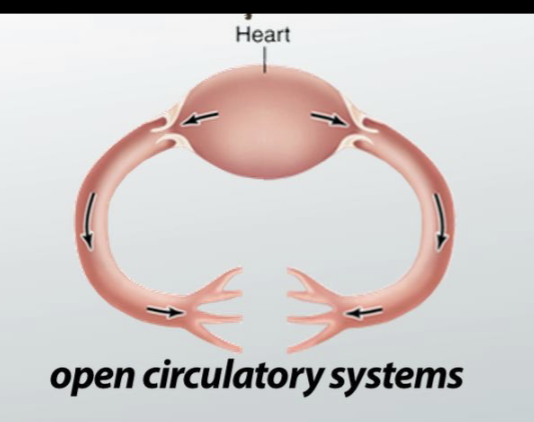
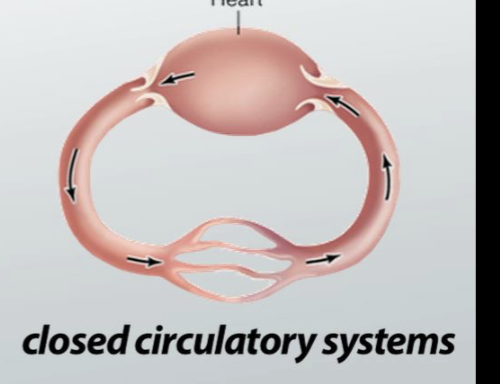
closed circulatory system
fluid kept w/in conduits/pipes of circulatory system, bulk of fluids maintained in circuits
has arteries (endothelial cells)
carries blood @ high pressure + delivers blood quickly (elastic- can stretch + rebound)
movement, digestion, + waste removal is quick
incomplete circulatory system
in between open + closed systems
has properties of both
arteries present (lack endothelial cells + no muscle surrounding them)
no smooth muscle/endothelial lining
arteries contract + control fluid through valves
fluids in a closed circulatory system
intracellular fluid- 40%
in cytosol of our cells
extracellular fluid- 60%
blood, lymphatic fluid
interstitial
intravascular
transcellular
lymphovascular (intravascular fluid?)
interstitial spaces → fluid from blood
surrounds our arteries + veins, type of conduit system
accessory route for fluids in our bodies
larges pores- fenestrations- allow for fluid + macromolecules to be released
drains from all tissues
lymph nodes
burst activity
able to release lots of energy in a very short period of time
sustained energy
lots of energy being dissipated over a really long period of time
ATP needed for this
rigor mortis
“stiff death”
muscles become stiff b/c we need energy (ATP) to contract + extend them
when body no longer generating any more ATP to relax muscles so body remains stiff
ATP
adenosine triphosphate
source of energy for the cell
3 things to remember:
each cell makes its own ATP
ATP is not stored in any appreciable amount (always need to make it)
rate of ATP production dependent on individual cell (not all cells have same mechanism for generating ATP)
metabolism=
catabolism/anabolism
how much energy you are using
catabolism
= aerobic + anaerobic
converting chemical energy into usable energy like ATP, maintenance, physiological work
aerobic → CO2 + H2O (2 main byproducts)
glycolysis
kreb’s cycle
electron transport chain
oxidative phosphorylation (loads of ATP generated)
anabolism
building up tissue, tissue growth + mineralization of bone, tissue repair (biosynthesis)
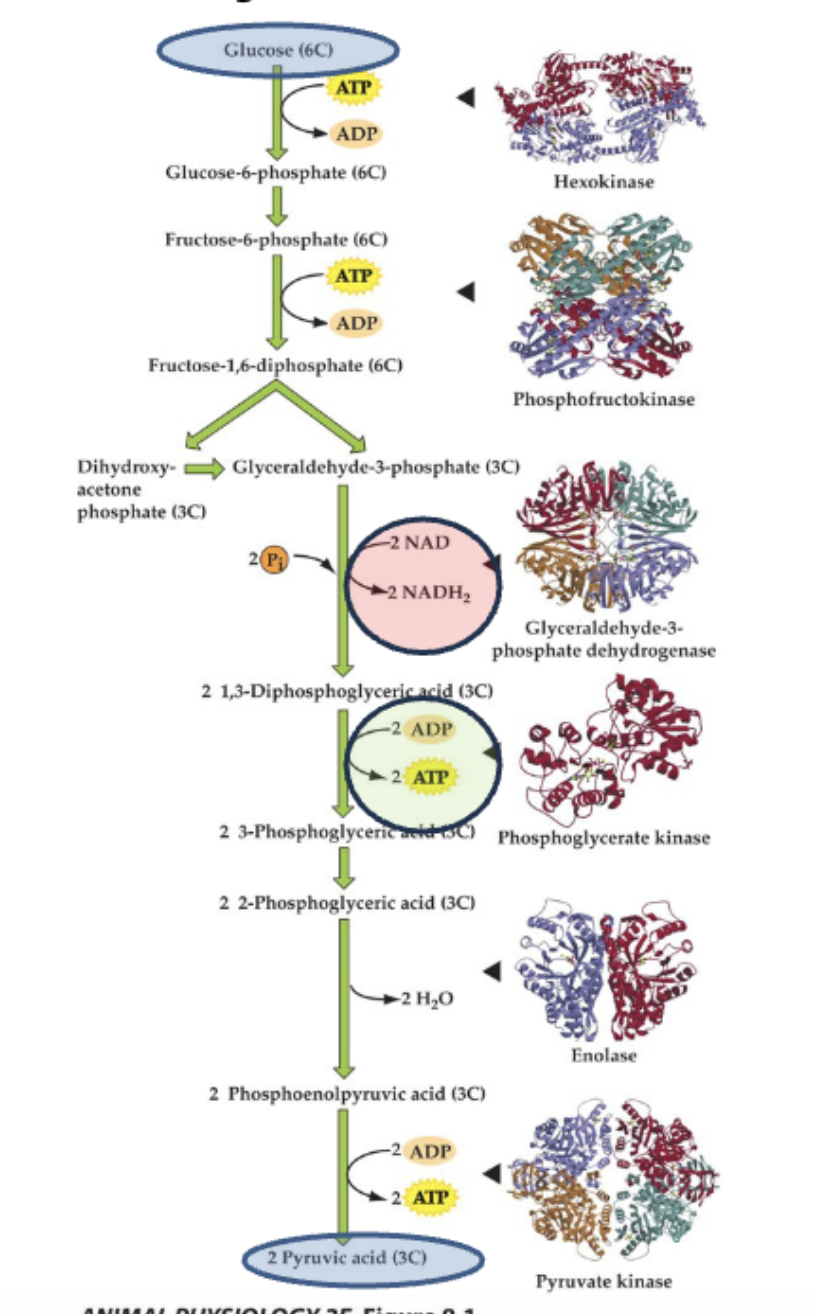
glycolysis
happens in cytosol of cell
1 molecule glucose → 2x pyruvic acid
2 molecules NAD reduced (redox rxn)
2 ATP used, 4 formed
net= 2 ATP (+ 2NADH2)
6 enzymes involved:
hexokinase
glucose (6C)→ glucose-6-phosphate (6C)
adds phosphate groups
irreversible
uses ATP
phosphofructokinase (PFK)
fructose-6-phosphate (6C) → fructose-1,6-diphosphate (6C)
rate limiting enzyme (relies on amt of substrate)
requires ATP
glyceraldehyde-3-phosphate dehydrogenase
x2 glyceraldehyde-3-phosphate (3C) → x2 1,3-diphosphoglyceric acid (3C)
helps important redox rxn: 2 NAD+ → 2 NADH2
NAD+ gains e- (gets reduced)
G3P loses e- (is oxidized)
phosphoglycerate kinase
x2 1,3-diphosphoglyceric acid (3C) → x2 3-phosphoglyceric acid (3C)
2 ATP generated
adds phosphate group to ADP
enolase
x2 2-phosphoglyceric acid (3C) → x2 phosphoenolpyruvic acid (3C)
dehydration rxn, loss of H2O x2 (bc 2 molecules go through it)
pyruvate kinase
x2 phosphoenolpyruvic acid (3C) → x2 pyruvic acid (3C)
2 ATP generated
adds phosphate group to ADP
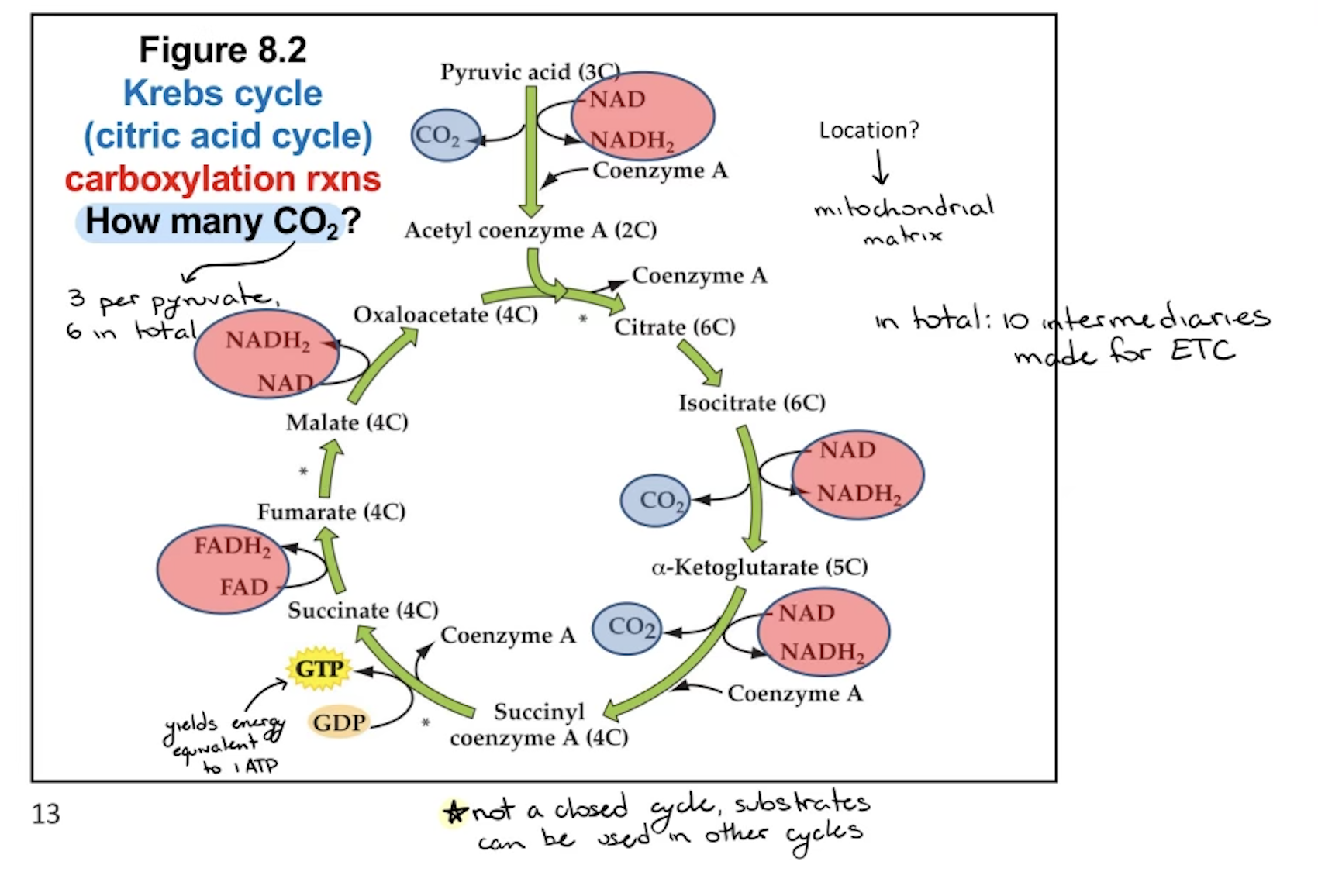
kreb’s cycle (citric acid cycle, TCA)
happens in mitochondrial matrix
carboxylation reactions
how many CO2? → 6CO2 (3/pyruvate)
intermediates used to make fat + generate carbohydrates
b/c not closed system (open) so can be used in other pathways
5e- acceptors/pyruvate/cycle x2 = 10e- acceptors → go into ETC + oxidative phosphorylation
6CO2 released (3 per pyruvate)
8NADH2 + 2FADH2 (for each glucose molecule)
net= 2 ATP
** total from glycolysis + kreb’s cycle= 4 ATP **
(no O2 needed yet)
electron transport chain
happens in mitochondrial inner membrane
membrane spanning proteins remove e- from NADH2 + FADH2 through them to O2 (the final e- acceptor)
series of handoffs of e- along inner mitochondrial membrane
FINISH!!!- need to know complexes/order of operations?????????
malate-aspartate shuttle
glycerol-phosphate shuttle
0.8 L of water generated by removing e- form cells (water is produced)
O2 = final e- acceptor
coupled w/ oxidative phosphorylation
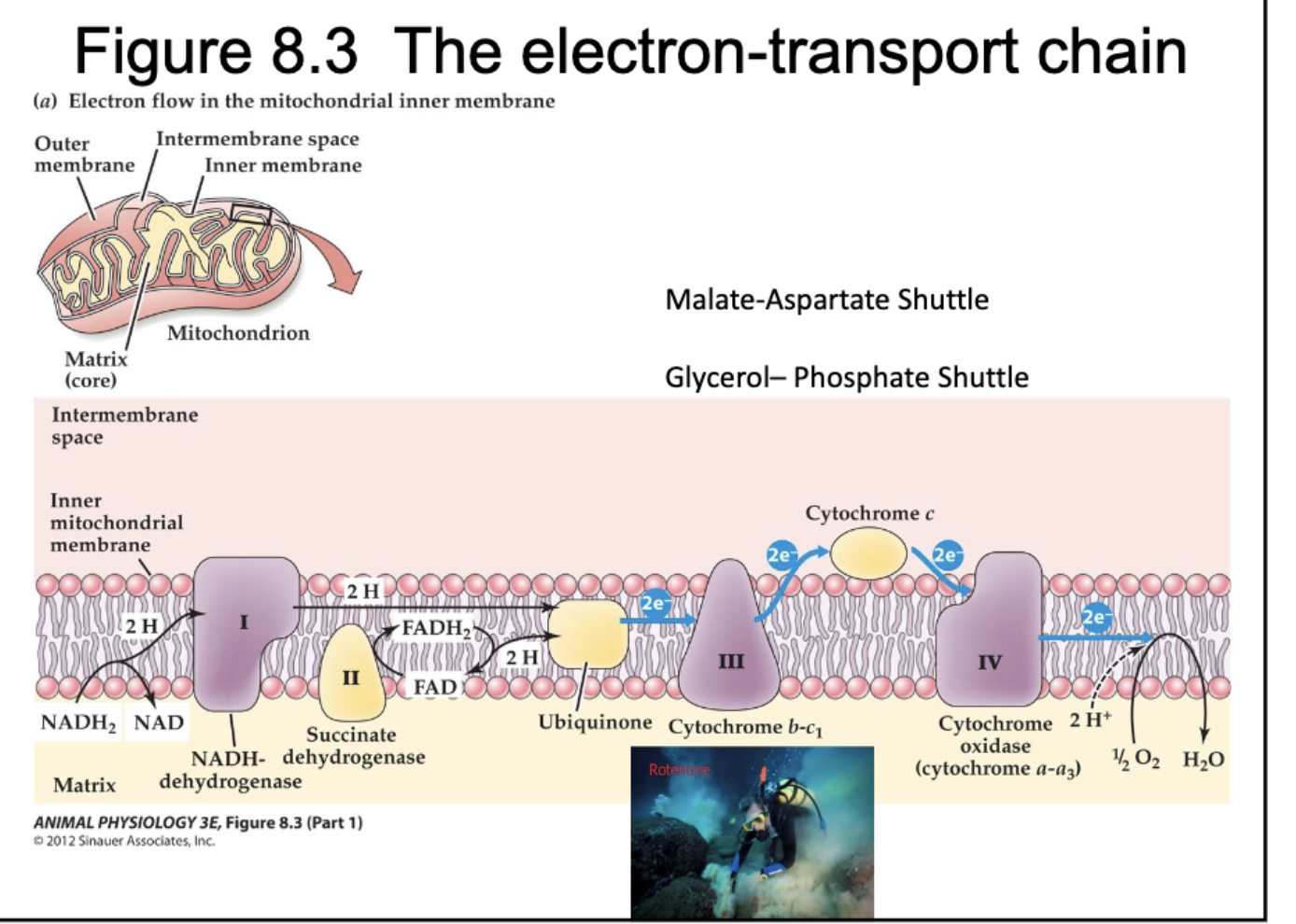
ETC + oxidative phosphorylation
ATP synthase pumps H+ back into cell + uses that energy to convert ADP → ATP
membrane spanning protein, couples P with ADP to form ATP)
ATP producing stage
net yield= 25 ATP
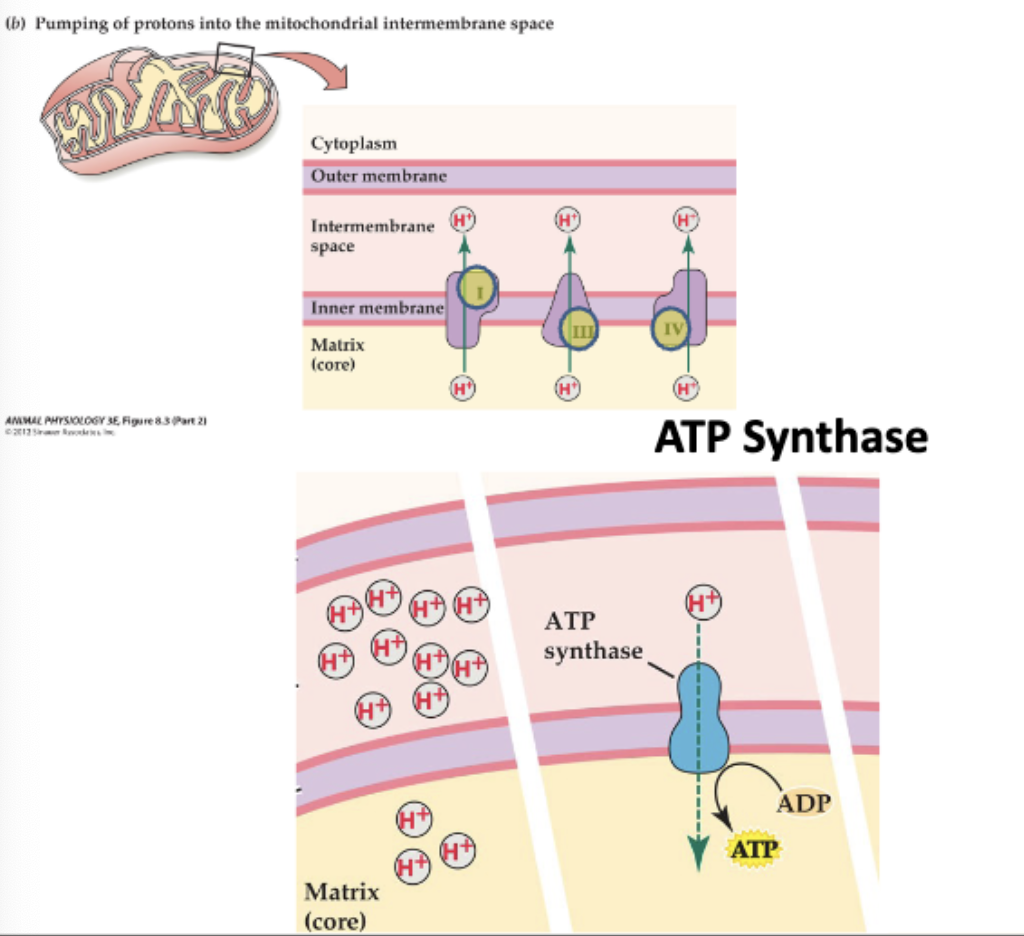
oxidative phosphorylation efficiency
P/O ratio (phosphate/oxygen) = # ATP molecules
as 10 H+ (per pair of e-) combine with 1 O2 molecule → 2.3 ATP produced
(highest efficiency per NAD; 2 ATP per FAD)
graded P/O: min 0 → 2.3 ATP max
. (uncoupled → tightly coupled)
net yield: 25 ATP
total yield (glycolysis → oxidative phosphorylation): 29 ATP
brown adipose (“fat”)
transfer chemical energy (~60-70% into ATP, rest lost as heat) + lose it to heat (no ATP made)
lacks ATP synthase, instead uses uncoupling protein 1
allows H+ to leak back into matrix which generates heat
interscapular
paravertebral
pararenal
cervical spine
supraclavicular
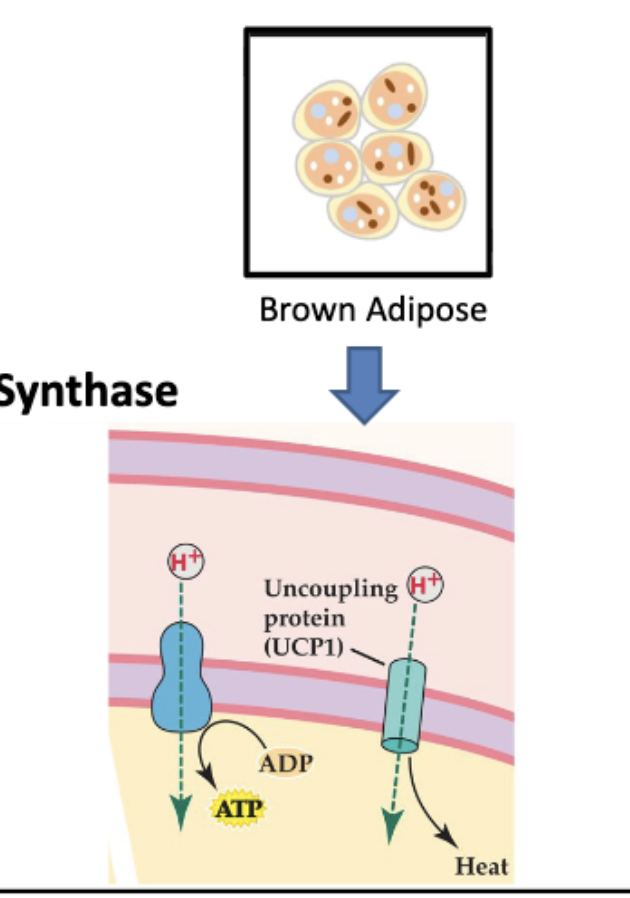
uncoupling protein 1 (UCP1)
transmembrane protein in mitochondrial matrix present in brown adipose cells
non-shivering thermogenesis
no energy is captured as ATP, only as heat
leakage in ions across the inner mitochondrial membrane (through this protein)
small mammals in cold areas, babies
catabolic end products
CO2 + H2O → exhaled + voided
assuming 60-70% efficiency is captured as chemical bond ATP
reactive oxygen species (ROS)
aging, contributes to muscle fatigue
oxidative stress
can take antioxidants to help reduce?
short lived, product of aerobic metabolism, can damage cells along etc, but our cells have ways to make these less reactive in our bodies
what happens if we do not have O2?
impaired ATP synthesis- FADH + NADH can’t get properly recycled?
redox imbalance- transferring e- but have no where to go bc O2 is not present to be final e- acceptor
anaerobic glycolysis
principle anaerobic catabolic pathway of vertebrates
1 pyruvic acid → 1 molecule lactic acid
no ATP generated w/ lactic acid, creating intermediate so that glycolysis can continue
if lactic acid accumulates- damages our muscle cells/tissue so need to get rid of it (shuttled to liver)
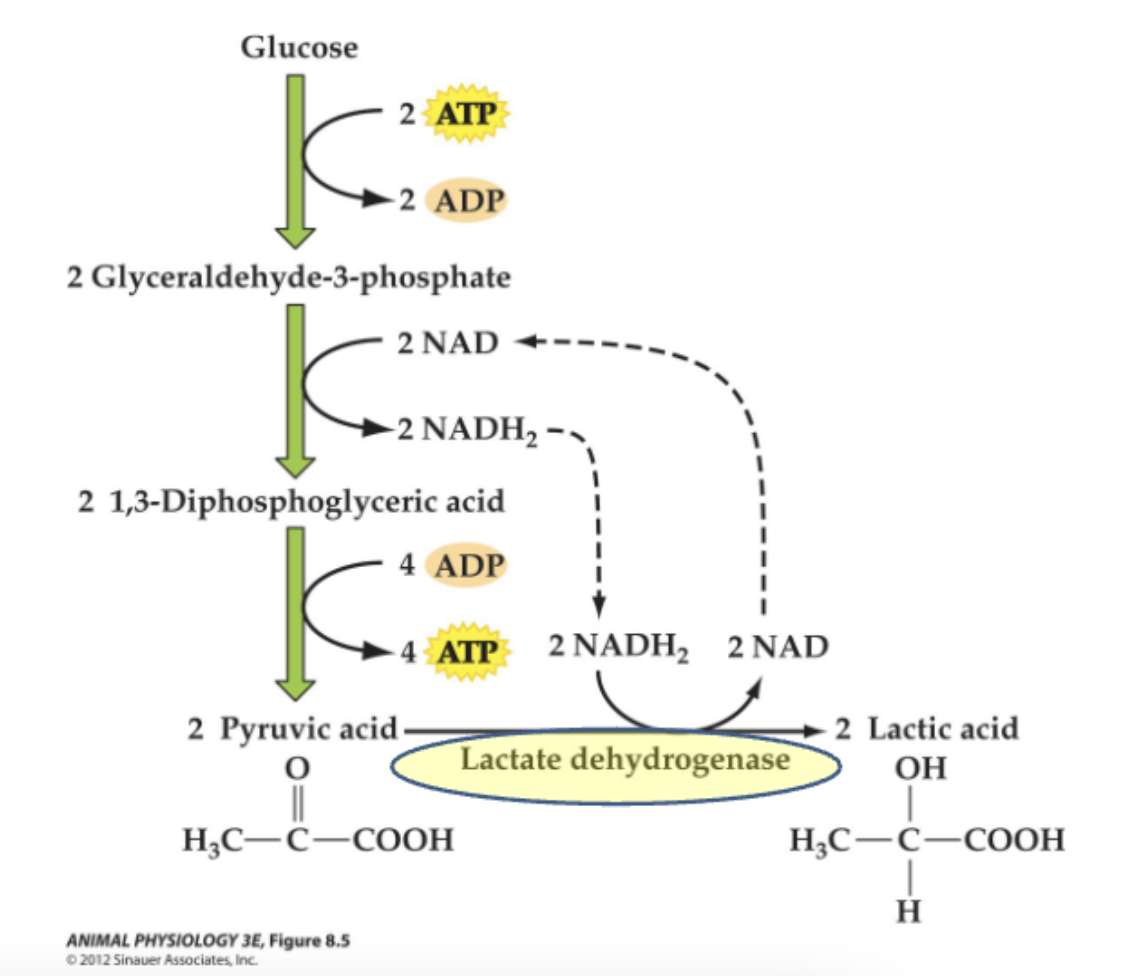
main way lactic acid metabolized when O2 is available
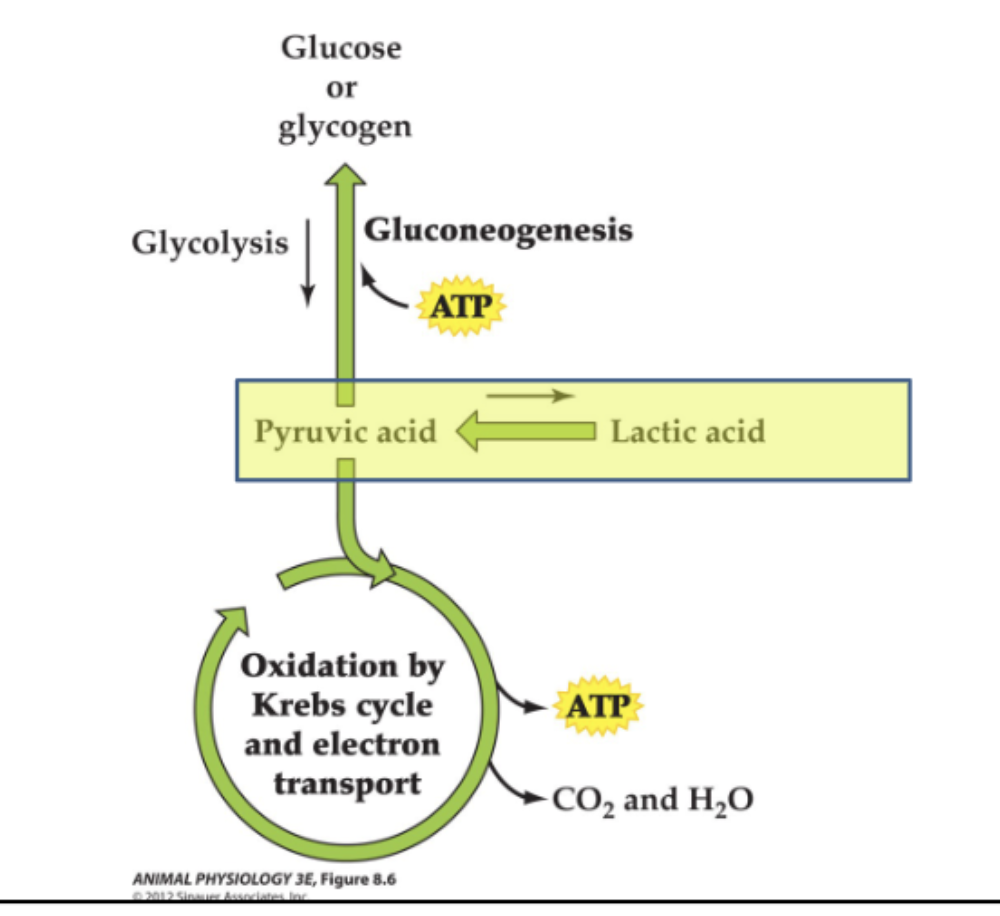
lactic acid can be converted back to pyruvic acid when O2 is present
what do we do w/o oxygen for short period of time?
anaerobic glycolysis
fuel: pyruvic acid → lactic acid
lactate dehydrogenase (LDH)
net yield: 2 ATP
but now have lactic acid….
cori cycle
lactic acid needs to get converted back to pyruvate to shuttle to liver where there is a lot of lactate dehydrogenase
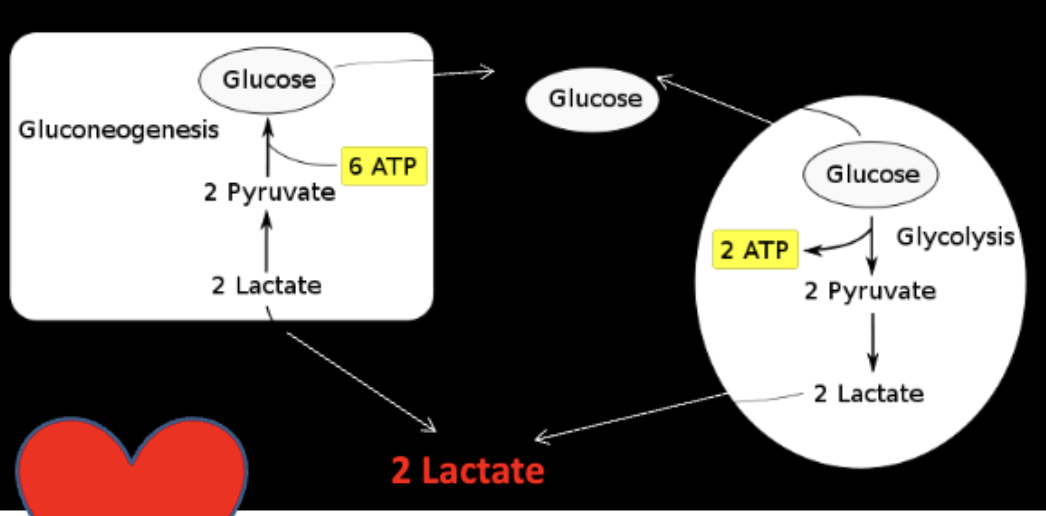
lactic acid metabolism
lactic acid is a dead end so convert back to → pyruvic acid
O2 is necessary for 2 pathways:
gluconeogenesis (-6 ATP)
krebs/etc (27 ATP)
as animals, we need both aerobic + anaerobic pathways
rate of ATP production is dynamic
it changes:
steady state (aerobic?)
production + use is balanced
raw materials used + replenished in balance
byproducts made + destroyed
no disruption in cell function
non-steady state (anaerobic?)
self-limiting/self-terminating (can’t go on forever, shuts off at some point)
3 mechanisms: (for getting ATP w/o O2)
anaerobic glycolysis
phosphagen productions
myoglobin
phosphagens
mechanism for ATP production without O2
phosphagens (skeletal muscle) + enzymes (vertebrates: creatine phosphate, invertebrates: arginine phosphate)
shifting rxn → phosphagen or ATP (reversible rxn if too much ATP)
creatine phosphate + ADP ←→ creatine + ATP
, creatine kinase
all animals w/ muscles (mesoderm) have some form of phosphagen to quickly generate ATP
myoglobin
mechanism for ATP production w/o O2
how we store O2 in our muscles
non-steady state b/c we only store so much of this in our muscles
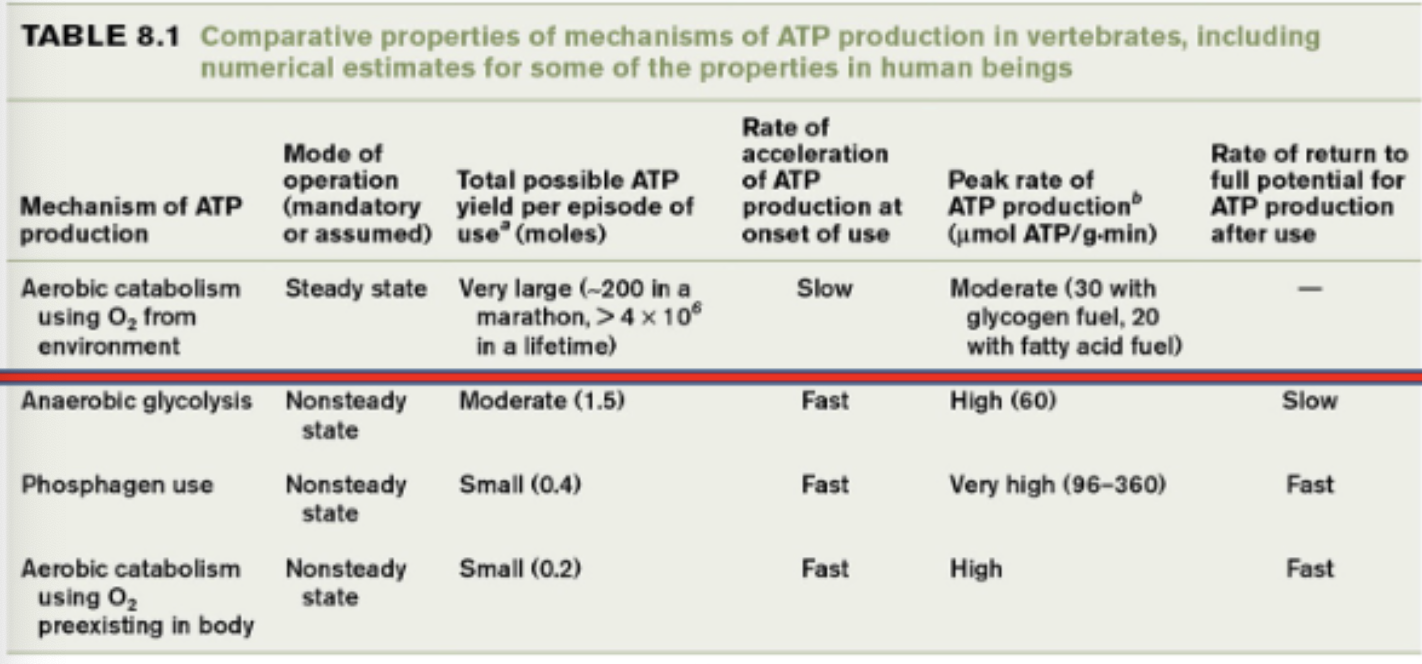
aerobic catabolism
steady state
very large yield ATP
slow
moderate peak rate ATP production
anaerobic glycolysis
nonsteady state
moderate yield ATP
fast
high peak rate ATP production
slow rate of return to full potential after use
phosphagen use
nonsteady state
small yield ATP
fast
v high peak rate ATP production
fast rate of return to full potential after use
myoglobin
nonsteady state
small yield ATP
fast
high peak rate ATP production
fast rate of return to full potential after use
reinitialization
how rapidly can each mechanism be restored (nonsteady state)
phosphagen, O2 store, anaerobic glycolysis
anaerobic glycolysis takes the longest to reinitialize
endotherms will do so quicker than ectotherms
pros | cons | |
|
| |
|
|
uses for anaerobic metabolism
high capacity
eutrophication- organism might be in environment that is hypoxic (lower O2)
secondary evolution to aquatic lifestyle
other uses of anaerobic pathway:
anoxia (w/o O2) + hypoxia (low O2)
metabolic depression
reduces rate at which animals need ATP
brain really need O2
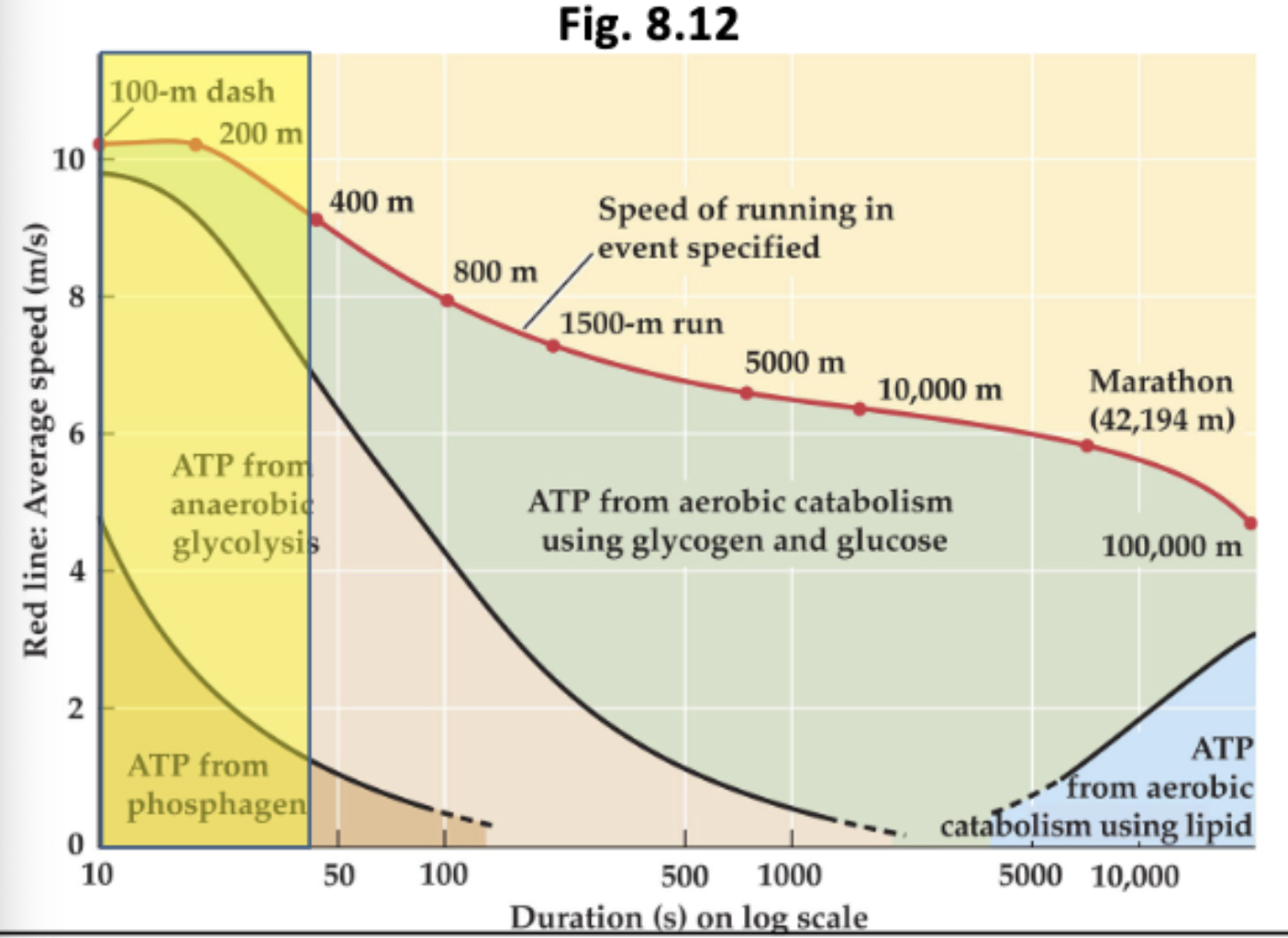
100m dash use phosphagens
200m use anaerobic + aerobic + phosphagens
1500m use aerobic + anaerobic glycolysis
understand the base idea→ longer you are running, the more likely you rely on the steady state mechanisms (aerobic)
“with increasing duration, ATP production shifts from being principally anaerobic (based on phosphagen and anaerobic glycolysis) to being chiefly aerobic."
preserving the brain during dives
brain needs O2
resident neuroglobins
like myoglobins in muscle cells, but in brain, hold deposits of O2
marine mammals have lots of these in brain so when under water for long periods, their brain still gets O2
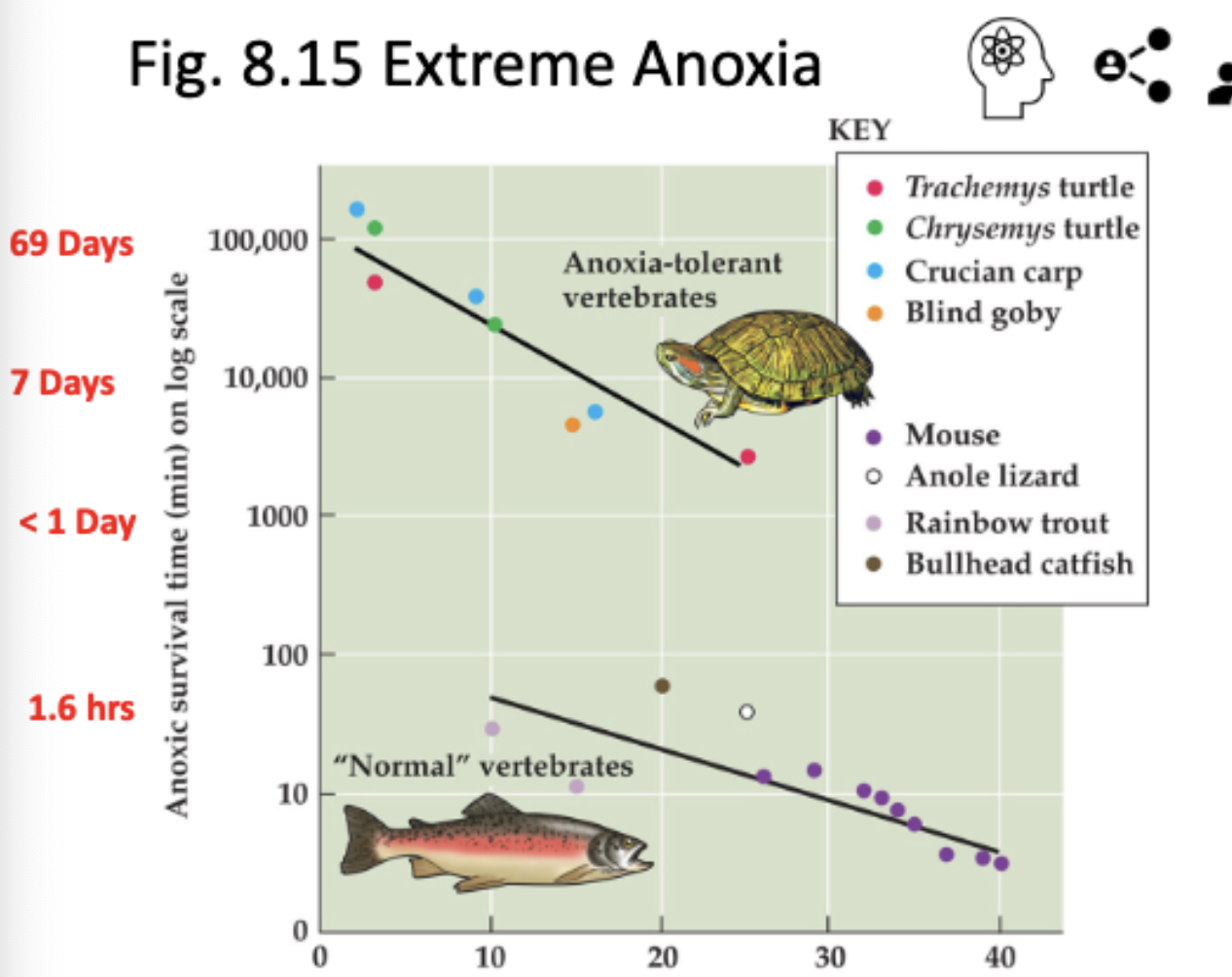
some turtles can tolerate brain anoxia by employing metabolic depression of their brain
general muscle types
slow oxidative (SO)
aerobic catabolism
mitochondrial density high (oxidative)
develop tension slowly
rich in myoglobin (gives them red color)
resistant to fatigue (b/c develops tension slow)
fast glycolytic (FG)
anaerobic catabolism (anaerobic glycolysis, myoglobins, phosphagens)
glucose (primary substrate this muscle fiber relies on)
high power output
fatigue quickly (^ tradeoff), non-steady state
7 functions of muscle in animals
stabilize/control
movement, motion
thermoregulation, creating heat
controlling passage of materials (digestion)
acting on viscera (general organ systems + surrounding tissue)
producing noise
producing electricity
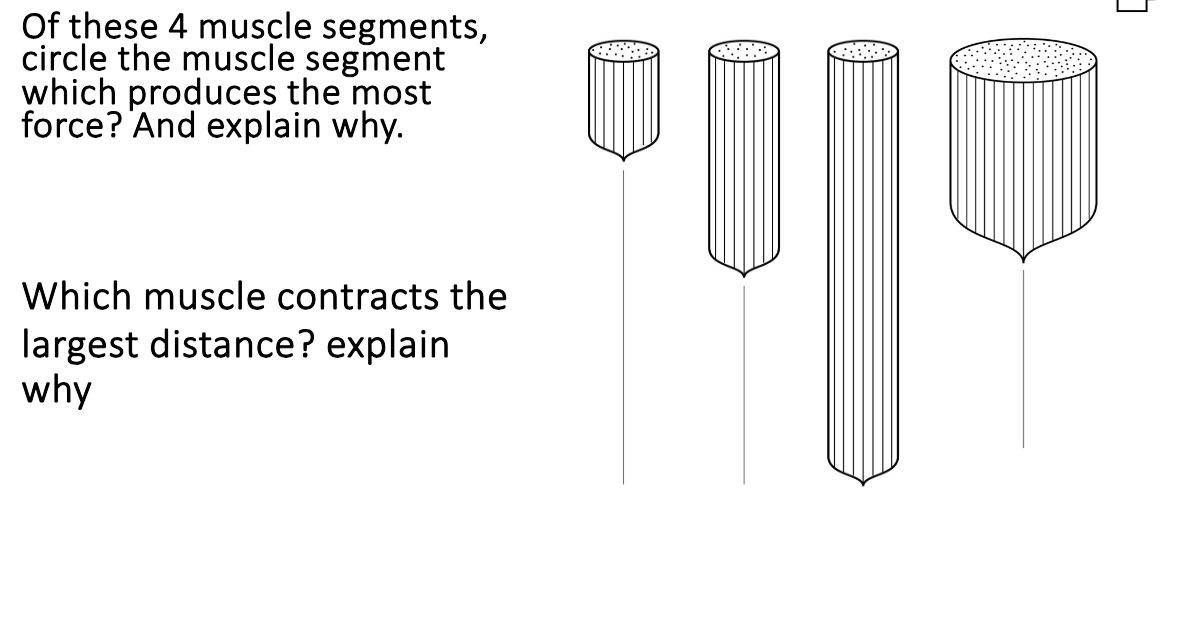
. 1 2 3 4
4 produces the most force because it has the biggest cross sectional area of muscle
3 contracts the largest distance, the longer the muscle the longer distance it can contract (muscles contract ~1/3 of its length)
muscle cells
muscle cells (muscle fibers)- bundled into tubes (myofibrils)
myofibrils are bundled tg and surrounded by mitochondria + sarcoplasmic reticulum
^ releases Ca2+ into myofibrils, allows them to contract
plasma membrane = sarcolemma (fully surrounds all myofibrils)
in some cells, sarcoplasmic reticulum less dense, in others more dense
differs in what type of muscle
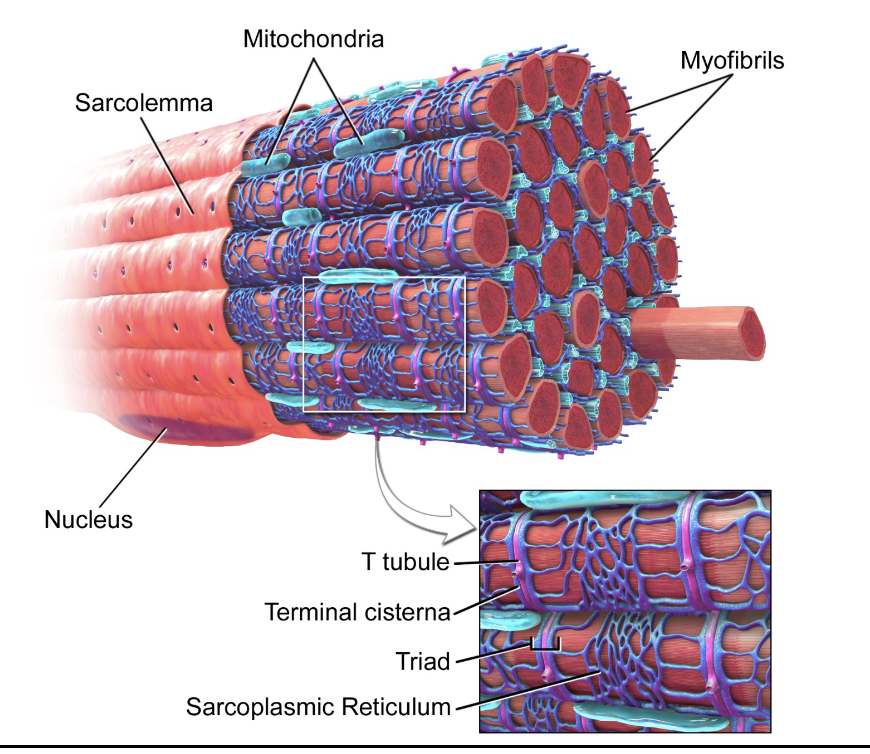
force production (high): short bursts- muscle fiber comp
high myofibrils
low mitochondria
low sarcoplasmic reticulum/sarcolemma
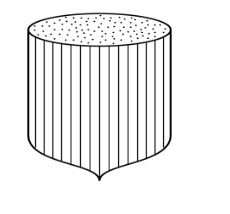
force production (low): longer activity- muscle fiber comp
low myofibrils
high mitochondria (keeps muscle going for longer time)
low sarcoplasmic reticulum/sarcolemma
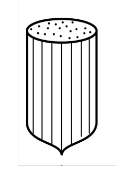
muscle fiber comp for v fast movements
v fast cyclic movements: rattlesnake tail shaker muscles + hummingbird wings
low for production- longer activity
low muscle fiber
high mt- enhanced (has double inner membrane)
high sarcoplasmic reticulum- enhanced
vertebrate capacity for storage of potential energy
we store energy in our tendons
if town takes a while to heal b/c small blood supply
good for burst + cyclic movements
vertebrates limited in speed which energy transfer can happen
limitations on fastest vertebrate movements
rattlesnake tail shaker muscles- muscle contractile speed
hummingbird wings- animal size (smaller animal=faster movements)
ultrafast movement
power amplification
power= work/time
stored potential energy w/ a quick release
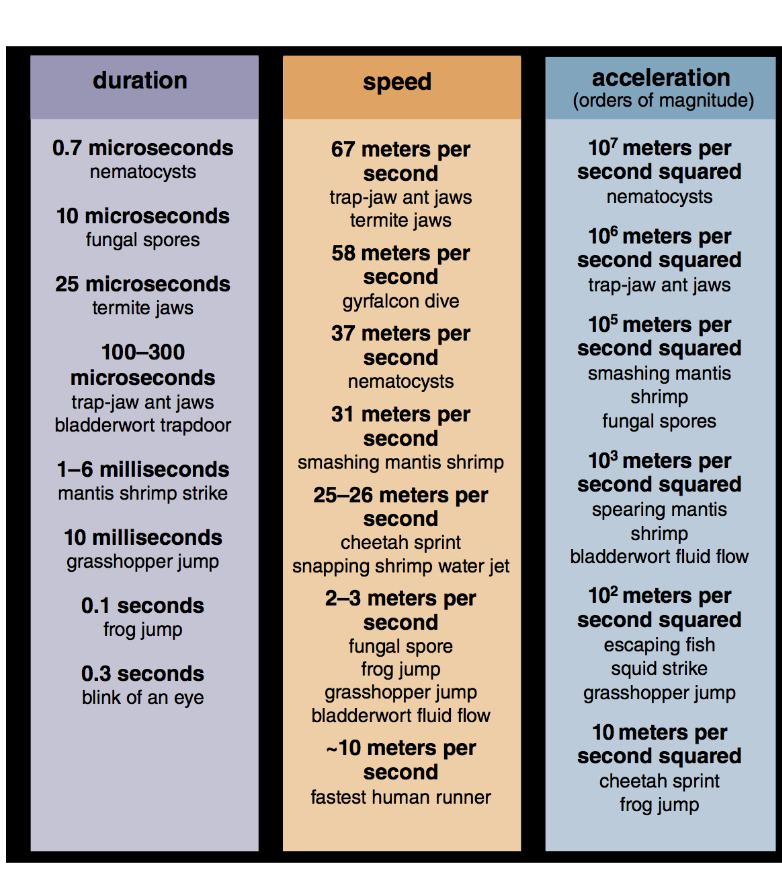
duration, speed/rate/frequency, acceleration
defining ultrafast movements
duration= how long the movement lasts
speed/rate/frequency= measure of movement/time
acceleration= change in velocity
mantis shrimp
smashers- smash prey to open, eating hard things
spearers- spear prey, eat fish/soft bodied animals
dactyl= strongest/fastest arm in animal kingdom
their striking is ultrafast
5000 frames/s
speed= 31m/s= 69 mi/hr
force= ~1500N (~337 lbs, 2500x animal’s body mass)
cavitation forces- intense shockwaves generated by the rapid collapse of vapor bubbles created by their fast punch
latch mediated strike- an ultra-fast, power-amplified strike where muscles load a spring-like structure, head by a latch, then released to produce acceleration
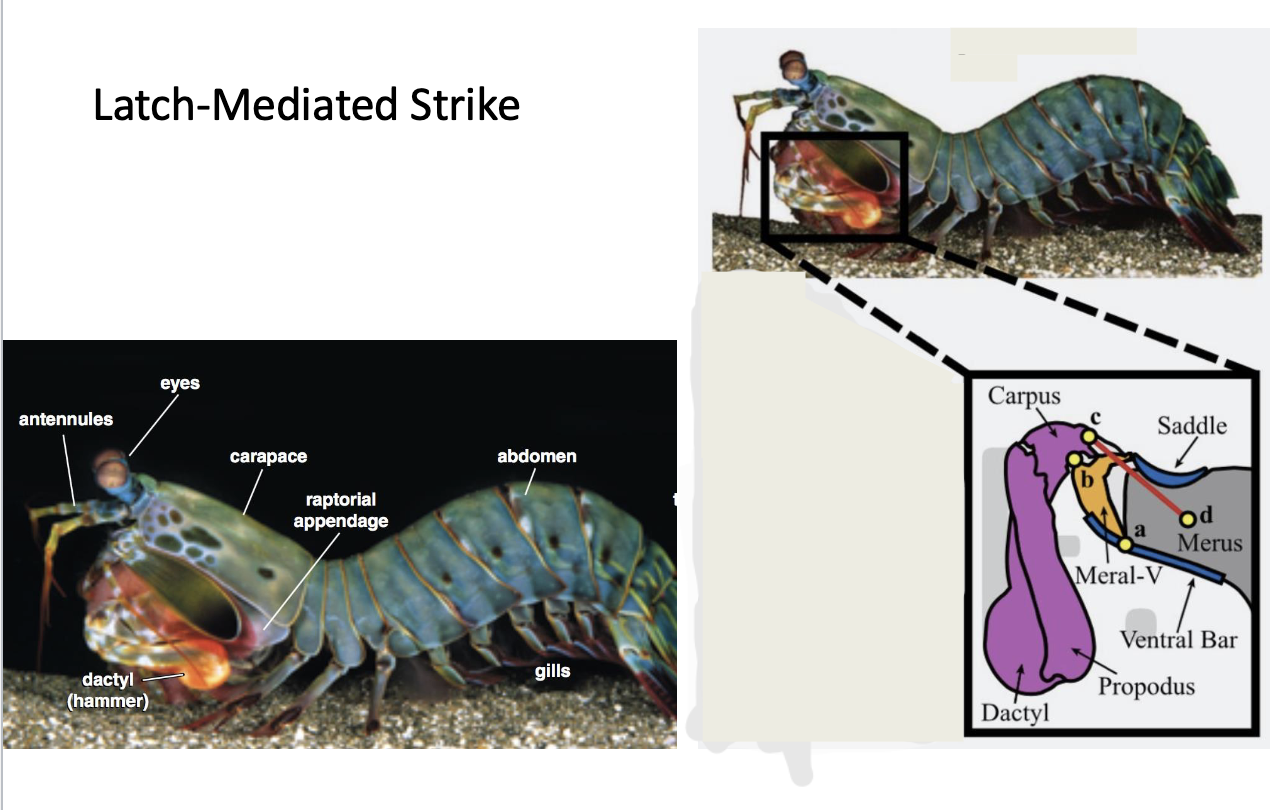
how does the mantis shrimp exert such high forces?
power amplification
separation of slow loading energy, storage
rapid release of energy (like bow + arrow?)
animal energetic background
forms of energy:
chemical- eating food (breaking/rearranging bonds)
electrical- separation of + and - charges (transfer of ions)
mechanical- energy of organized motion, external work
molecular kinetic- heat
not all are equal
physiological work- processes increasing order
(high grade= chemical, electrical, mechanical)
(low grade= molecular kinetic)
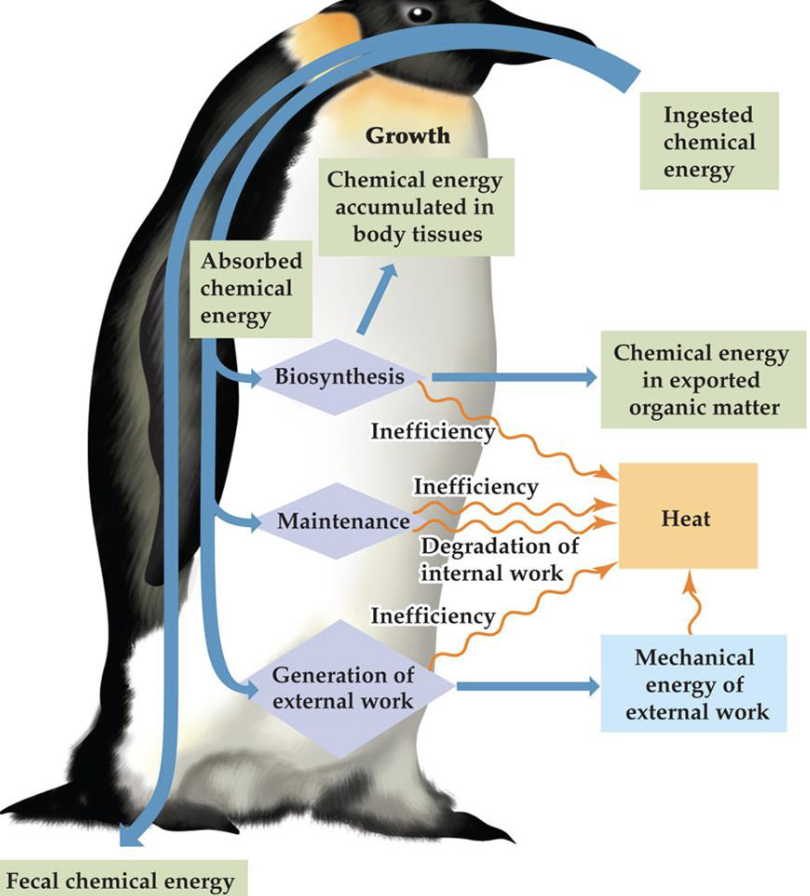
ingested chemical energy
energy in : energy out
energy flow in the system is not unidirectional
Fig 2.7- energy use:
DORC= dynamic organized require energy change
depends if baby or adult where energy will go
human growth differential
v large
form 0-1 yrs old u grow 10 inches, 3x mass, 2x brain mass
crabs go through several molts: 6 times/year in ages 1-2
lizard can drop tail- can grow back but won’t be same and requires lots of energy to do so
metabolic rate (MR)
rate at which animals consume energy
eating chem energy → [catabolic + anabolic] + losing energy as heat
basal metabolic rate (BMR)
resting metabolic rate
applies to homeotherms (animals that physiologically regulate their body temps- mammals + birds)
animal’s MR when it is:
in its thermoneutral zone
fasting
resting
standard metabolic rate (SMR)
applies to ectotherms (animals that allow their body temps to fluctuate freely w/ variations in environmental temps- amphibians, fish)
animal’s MR when it is:
fasting
resting
routine metabolic rate (RMR)
applies to fish exerting only small, spontaneous movements
exhibiting v minimal levels of activity
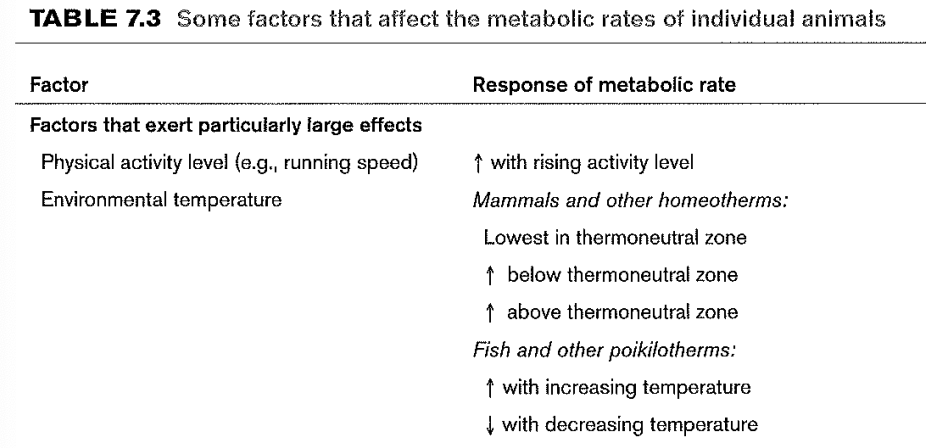
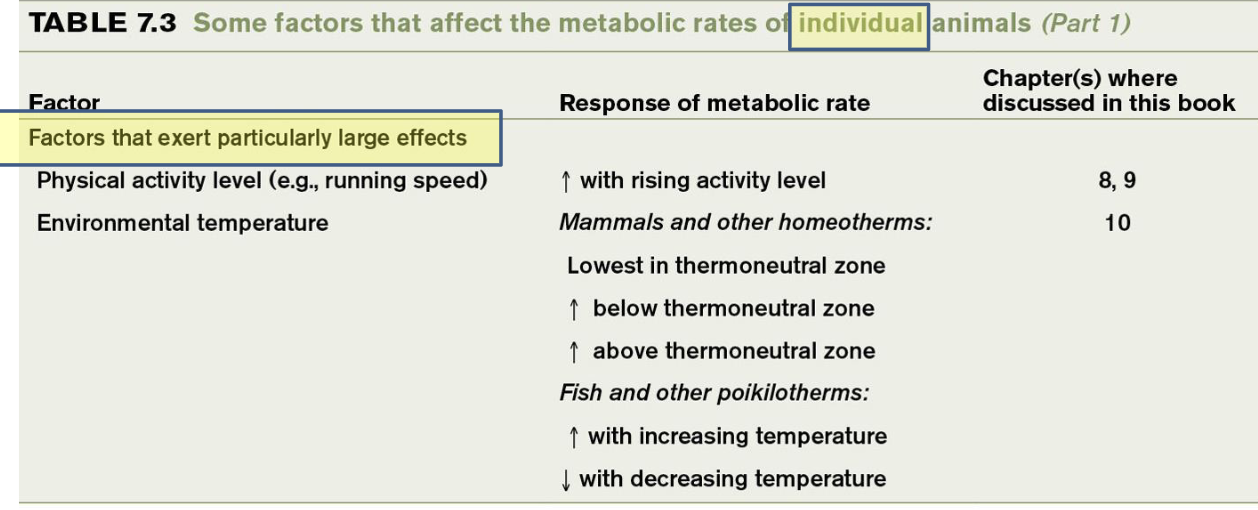
factors that affect MR of individual animals- large effects
physical activity
MR increase w/ rising activity levels
environmental temperature
mammals + homeotherms:
MR increases when both above + below thermoneutral zone
MR lowest in thermoneutral zone
fish + ectotherms:
MR increase w/ increasing temp
MR decrease w/ decreasing temp
factors that affect MR of individual animals- smaller effects
ingestion of a meal (particularly protein rich)- MR inc following ingestion
body size- weight-specific MR rate inc as size dec?
age-
gender
environmental O2 level
hormona status
time of day
salinity of water (aquatic mammals)
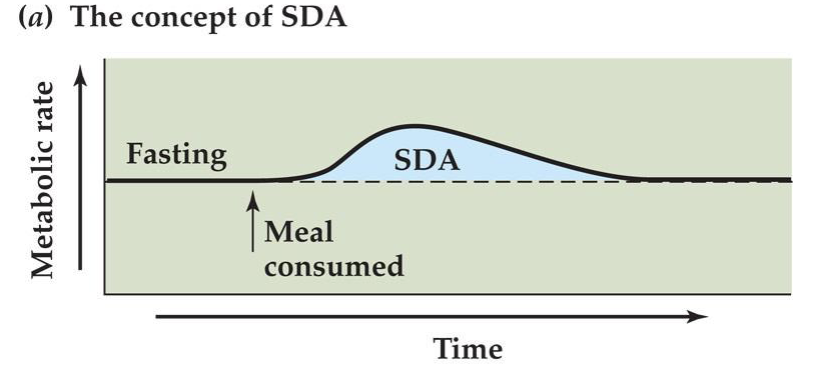
specific dynamic action (SDA)
(ingestion of a meal (particularly protein rich)- MR inc following ingestion)
calorigenic effect of ingested food
heat increment of feeding
the bigger the protein meal, the larger the spike in SDA + the longer it takes for MR to go back to baseline
body size
does not affect MR too much
b/c we can calc MR by controlling for size- weight specific metabolic rate
patterns of scaling (understanding changes in size)
isometry= changes in size, no changes in proportions
allometry= changes in size are associated w/ changes in shape (disproportional)
positive allometry= trait increasing disproportionally to body size
negative allometry= disproportional decrease in size
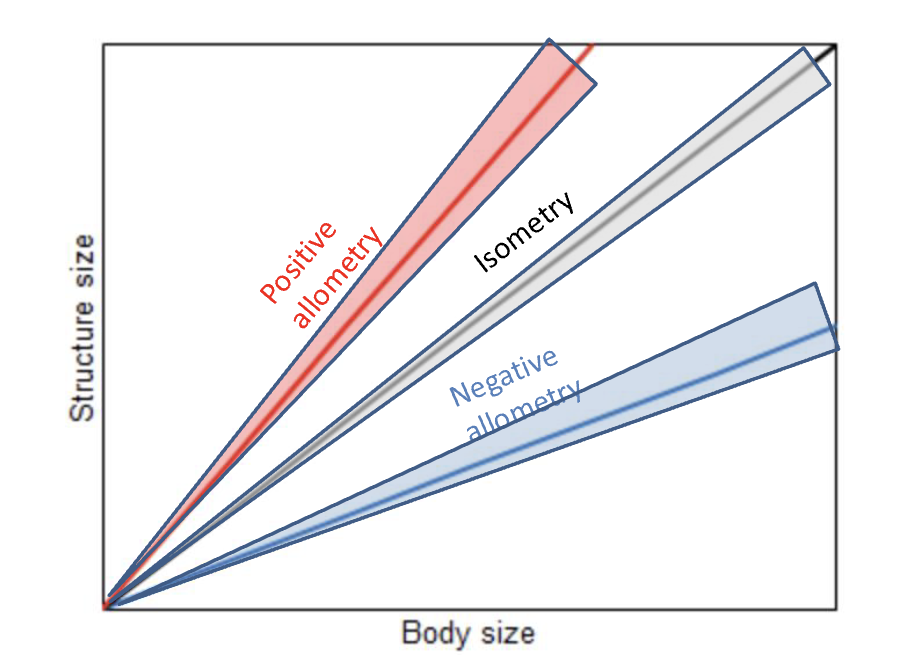
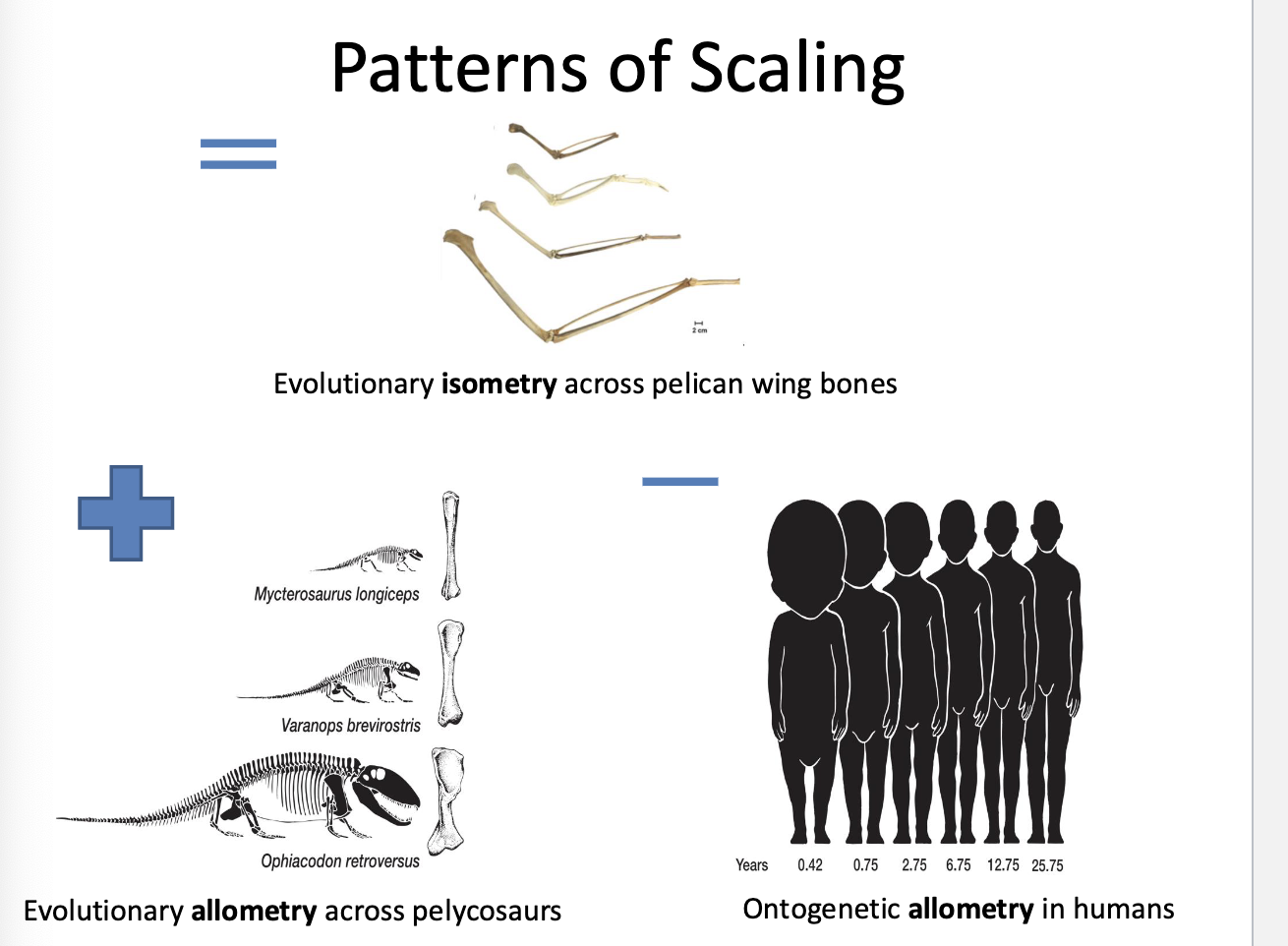
scaling patterns
as length (L) of organism increases:
linear measurements proportional to L1
surface area proportional to L2 (allometric)
volume proportional to L3 (increase the fastest, disproportional)
can combine/extend to other properties:
force production in muscles proportional to L2
mass proportional to L3
generalized scaling equation
“allometric equation” or “power law equation”
y=Bx^A
y= biological variable
x= measure of body size
A= “scaling exponent”
B= constant
equation for metabolic scaling
M=aW^b
b= 0.67 or 2/3
W= mass
rubner’s surface law:
SA proportional to r² but V proportional to r³ → SA proportional to V²/3
 Note
Note  Flashcards (29)