Ethics Midterms
 Studied by 13 people
 Call Kai
 Learn
Learn Practice Test
 Spaced Repetition
 Match
Match Flashcards
 Knowt Play
1/144

There's no tags or description
Looks like no tags are added yet.
Name | Mastery | Learn | Test | Matching | Spaced |
|---|
No study sessions yet.
145 Terms
Moral Norm
-It is a common awareness that only human speaks of and behave according to what they know as right or wrong, good or bad
Morally Good Person
-If he correctly distinguishes what is right from what is wrong not only in knowledge but also in practice.
Immoral Person
-If he does not act or behave in conformity with practiced moral principles or norms.
Amoral Person
-If he does not have the ability to distinguish between what is morally good act and what is morally evil one, one who cannot identify and accept moral norms, resulting into some sort of “abnormality” or deviancy
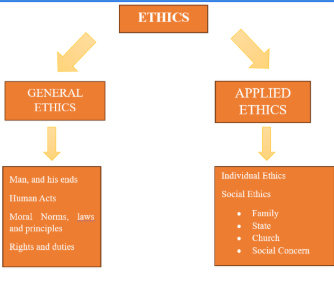
Ethics
-Practical and philosophical science of the morality of human acts or human conduct
-Is said to be science insofar as it is a body of systematized knowledge arranged with its accompanying explanation.
-As a practical science means it consists of principles and laws that are not applied in daily living accompanying explanation.
-As a philosophical science, it is not a technical course nor a laboratory study
Morality
-The implementation of ethical principles and laws.
Material Object
Formal Object
Formula Object Quo
The objectives of ethics:
Material Object
-It refers to the subject matter to be studied, namely, the human act.
Formal Object
-It refers to the morality of the human act. It is which is learned and to be applied
Formula Object Quo
-It refers to the human reason employed in the study of the course.
1. To sharpen the moral nature of the learners by inculcating the moral norms.
2. To make them aware of the moral principles and law governing man’s action.
3. To help the students become aware of the intimate relation between their moral nature and laws
4. To show to the learners that acting in accordance with his rational and moral nature could lead them to their supernatural destiny – God.
5. To develop in the students a morally upright living
6. To let the students realize that people cannot live together harmoniously in society without the ethical norms and laws applied or followed
Importance of the Study of Ethics:
THE DIVISION OF ETHICS
Socrates
Plato
Aristotle
3 Greek Thinkers:
Socrates (469 - 399 BC)
- man is made of body and soul.
-The soul is distinct from the body, and is likened to God in memory, understanding, indivisibility and immortality
Happiness
the highest value of man. it is attained only by man’s intellectual virtue according to the Greek thinkers.
Plato (427 - 347 BC)
- viewed that the soul of man is the immediate product of God’s action.
-The soul is spiritual, rational, autonomous and immortal. Souls are encarnated into bodies as a consequence of sin which is committed by coming in contact with matter.
-The first human body was a male body from which emerged a female.
-The spiritual soul is the thinking principle of man. If the man lives well on earth, his soul will go to Place of Happiness.
Death
-It liberates the soul from the prison of the body
Aristotle (384 - 322 BC)
- posited the soul as the substantial form of the human body. The soul, which is created by God, is spiritual and immortal according to him
- Man is vegetal, animal and rational.
Rationality
is man’s proper function of man differentiating him from plants and animals.
St. Augustine of Hippo
St. Anselm of Italy
St. Thomas of Aquinas
3 Christian Thinkers:
Lao-Tse (born 604 BC)
Kung-fu-tse or Confucius (551-479 BC)
Gautama Buddha (563-483 BC)
3 Oriental Thinkers:
Lao-Tse (born 604 BC)
-simply encourages man to be virtuous in order to attain “Tao” (God)
Kung-fu-tse or Confucius (551-479 BC)
- taught men with his “Golden Rule” in order to attain happiness and self-protection.
“Do not do unto others what you do not want others to do unto you”
What is the Golden Rule?
Gautama Buddha (563-483 BC)
-the “Enlightened One”; man strives for happiness
Oriental thinkers
hold the doctrine that the only way for man to reach happiness is to liberate himself from the slavery of sensual pleasures of this world and form selfishness.
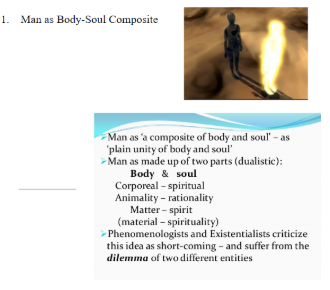
Man as Body-soul composite
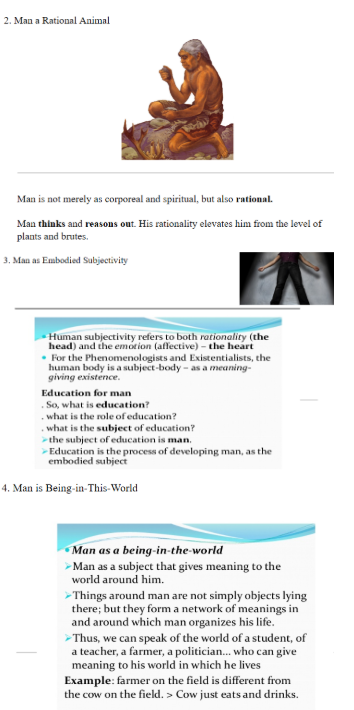
Man as Rational Animal
Man as Embodied Subjectivity
Man is Being-in-this-world
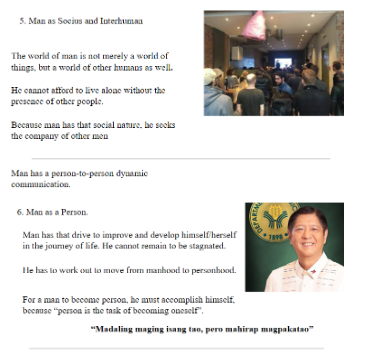
Man as socius and interhuman
Man as a Person
Man as an Absulote value
VARIOUS NOTIONS OF MAN
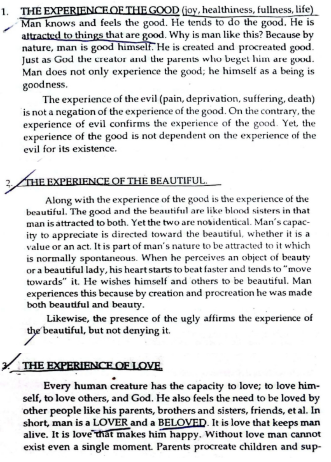
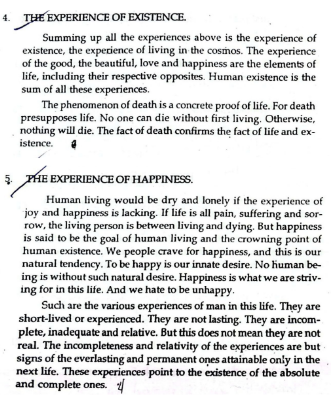
The experience of Good
The experience of the Beautiful
The experience of Love
The experience of Existence
The experience of Happiness
SOME HUMAN EXISTENTIAL EXPERIENCES:
Various Notions of Man
Various Notions of Man
Various Notions of Man
SOME HUMAN EXISTENTIAL EXPERIENCES:
SOME HUMAN EXISTENTIAL EXPERIENCES:
Ignacio (1985)
All acts tend toward an end.
But human existence is an act.
Therefore, human existence tends toward and end
End
- Is the very cause of human acting. it is the very reason why an act is performed, the very reason for its existence
- is both a termination of an act and a goal thereof (Glenn:48) End is that which completes an act. It is also that for which an act is performed.
THE END OF HUMAN ACT IS GOOD
THE END OF HUMAN ACT IS?
GOOD AS TO UTILITY
GOOD AS TO BEAUTY
GOOD AS TO NATURE OR REALITY
Three modes of perceiving and using the good:
GOOD AS TO UTILITY
An object or act is perceived as good when it is useful for one's purpose and satisfaction.
GOOD AS TO BEAUTY
People consider an object or act as a thing of beauty when it satisfies their aesthetic appetite. The beauty of a person, physical or social, is synonymous to goodness. But, judgement of beauty is both subjective and objective.
GOOD AS TO NATURE OR REALITY
In this context a thing is seen as good, not because of usefulness or aesthetic value, but because it is its nature and reality
AS END OF THE ACT
AS END OF THE AGENT
TEMPORAL ENDS, INTERMEDIATE ENDS
THE ULTIMATE END
4 CLASSIFICATION OF ENDS
AS END OF THE ACT
it is the direct object of the act.
AS END OF THE AGENT
can be different or the same as the end of the act depending upon the agent.
TEMPORAL ENDS, INTERMEDIATE ENDS
When an end is subject to time and place, it is classified as _____ (doesn't last forever, or good for a certain space or place). ______ because they are used to obtain other ends.
THE ULTIMATE END
is the last and final goal of human act and the human agent. It is called the end-of-all-ends since this cannot be used to attain any higher ends.
SUBJECTIVE ULTIMATE END
OBJECTIVE ULTIMATE END
TWO TYPES OF ULTIMATE ENDS
SUBJECTIVE ULTIMATE END
this is the aspect of the ultimate end which is the subjective possession of the objective ultimate end of the person. The possession results to enjoyment or happiness
OBJECTIVE ULTIMATE END
This is the aspect of the ultimate end is inseparable from the subjective ultimate end. When combined with the perceived objectively by the agent outside himself.
SUMMUM BONUM
it is the Supreme Good, the highest of all goods
MATERIALISTIC ETHICS
ULTRA-SPIRITUALISM
PROGRESSIVE ETHICS
Ethical Views According to Di Napoli
MATERIALISTIC ETHICS
This tendency holds that the supreme good of human life are human pleasures and satisfaction.
Hedonism
Utilitarianism
Two types of Materialistic Ethics
Hedonism
teaches that highest end of human life is found in sensual pleasures and satisfaction man can enjoy in this world.
Utilitarianism
holds that the ultimate end of man is the possession of political power through conquest of other nations.
Social Utilitarianism
teaches that the greatest value of man is maximum welfare in society.
ULTRA-SPIRITUALISM
this type of ethics takes spiritual matters and virtues in this life as ultimate end of man
Greco-Roman Stoicism
Humanistic Personalism
Two Types of Ultra-Spiritualism
Greco-Roman Stoicism
this ethics takes virtue and abstinence from sensual pleasures as the highest end of man.
Humanistic Personalism
hold that the ultimate end consists of human perfection through knowledge, virtue, honor which must be acquired
PROGRESSIVE ETHICS
the ethics of progress takes indefinite progress, material or spiritual, as the ultimate end of man.
CHRISTIAN ETHICS
Emanates from the teaching of Jesus Christ and His Church, embodied in the Holy Scriptures and church doctrine (teaching)
It is two-faced; GOD'S GLORY and SALVATION OF MANKIND.
What is the ultimate goal of Christianity?
HUMAN ACT
This is referred to as the human activity of man by which he attains an end he wants to obtain.
ACTS OF MAN
refers to activities in common with brutes like beating of heart, feeling, hearing, eating, taste and smell, and such animal activities
The act must be deliberate
The act must be free
The act must be voluntary
ESSENTIAL QUALITIES OF HUMAN ACT
Elicited Acts and Commanded Acts
CLASSIFICATION OF HUMAN ACTS
WISH
INTENTION
CONSENT
ELECTION
USE
FRUITION
Six Elicited Acts
Elicited Acts
Emanate from the will of the agent. It is a will-act begun and completed in the will of the agent
WISH
It is a natural inclination of the will towards an object. The wishing of the will includes objects that are possible or impossible to be realized by the wishing subject.
INTENTION
This is the will's tendency towards something attainable but not obligatory, however.
CONSENT
Is the acceptance of the will to implement the agent's intention.
ELECTION
The agent chooses from among a variety of means what he believes to be the most effective to carry out an intention
USE
This is the will's command to make use of the selected means in carrying out the intention.
FRUITION
This is the enjoyment of he will as a result of the attainment of the object desired earlier.
COMMANDED ACTS
are those acts involving body and mind, necessary to carry out the elicited acts.
INTERNAL ACTS
EXTERNAL ACTS
MIXED
THREE COMMANDED ACTS
INTERNAL ACTS
These acts refer to the purely mental faculties under the command of the will. e.g. meditation, rationalization, strategizing etc.
EXTERNAL ACTS
These acts are done by the body as commanded by the will. Illustrative examples are talking, deliberate motion like running, walking, hand gestures writing or eating. (becomes human acts when done with the advertence and with the will).
Mixed Acts
As term connotes, mixed acts are those done by both bodily and mental powers. E.g. studying, sharp shooting, playing chess etc. These acts employ both body and mind.
for every act that is done, there is always a corresponding end, or a goal.
What causes human act to exist? What motivates it to be performed? What is in the mind of the agent in doing the act?
Responsibility
is the ability of a person to respond to a need or problem in a given situation. Always entails with the word "Accountability"
HUMAN FREE WILL (KAGUSTUHAN)
is man's natural tendency of being attracted to what is good and beautiful and to be repulsed from what is evil and ugly, after they have been presented by intellect. (elicited)
FREEDOM (KALAYAAN)
Negatively defined, _____ is the absence of constriction. Positively, it is the power to be and to act under free will and choice. (action, commanded act)
Accountability
Willingness to take credit and blame for actions.
IGNORANCE
CONSCUPISENCE
FEAR
VIOLENCE
HABIT
THE MODIFIERS OF HUMAN ACT
Ignorance
- is the lack of knowledge in man of a certain thing expected to have been known by him.
Intellectual Ignorance
is more than just negation, it also means the presence of what is falsely supposed to be knowledge.
Ignorance in its object
refers to subject's ignorance of the law, fact, or corresponding penalty.
Ignorance of Law
Ignorance of Fact
Ignorance of Penalty
THREE IGNORANCE IN ITS OBJECT
Ignorance of Law
is the absence of knowledge a person ought to possess. (e.g. moral practices)
Ignorance of Fact
- is ignorance of the nature or circumstances of an act that is generally forbidden in the community. (e.g. unknown orgy)
Ignorance of Penalty
is lack of knowledge of the sanction imposed by the law to violators. (e.g. death penalty)
Ignorance in its Subject
This aspect of ignorance lies in the agent who has no knowledge of the law, fact, or penalty. This ignorance is either "vincible" or "invincible".
Vincible Ignorance
Easily overcome through diligence and exertion of efforts of the subject. (e.g. asks about something he doesn't know)
Invincible Ignorance
Cannot possibly overcome due to lack of means, other factors. (e.g. illiterate beggar doesn't have means for education)
Affected Ignorance
Refuse to acquire knowledge of a certain thing they are expected to know. (e.g. refuses to read the gc so he doesn't have to help classmates)
Ignorance in its Result
refers to relation of ignorance to act done out of ignorance (result).
Antecedent Ignorance
Concomitant Ignorance
Consequent Ignorance
THREE FORMS OF IGNORANCE IN ITS RESULT
Antecedent Ignorance
precedes the consent of the will. (e.g. American lover and Filipina live-ins)
Concomitant Ignorance
Accompanies act would be performed if there was no ignorance. (e.g. Christian uninterested in holy mass on Sundays because he is ignorant of the spiritual value)
 Note
Note  Flashcards (22)