JOURN 560 Primary & Secondary Sources
 Studied by 0 people
 Call Kai
 Learn
Learn Practice Test
 Spaced Repetition
 Match
Match Flashcards
 Knowt Play
1/17

There's no tags or description
Looks like no tags are added yet.
Name | Mastery | Learn | Test | Matching | Spaced | Call with Kai |
|---|
No analytics yet
Send a link to your students to track their progress
18 Terms
Petticoat Medics
Article about black female medics. Trying to promote black beauty is a positive story that challenges prior assumptions about black women in the medical field, from a black magazine with black editors.
Still slightly derogatory - lines emphasizing attractions, weird phrasing, and racism is still shown
Conforms to stereotypes regarding socialization.
Related to idea of women taking up workplace positions especially black women. Countered some female stereotypes, yet alligned with others by still projecting a particular image of beauty
Newsweek
Date:11/1967
Author: Osbron Elliot -> Newsweek editor
About: Newsweek will no longer just report CRM activities and leaders but advocate so they can fulfill their duties as journalists. Arises from the violence toward black Americans that was being broadcasted, which led to Newsweeks orientation towards advocacy. Argue that America has failed black citizens by what it stands for and what has been happening, but the article separates African Americans from job categories.
Gould Interview
Transcript of an interview with Jack Gould from the New York Herald-Tribune (most influential newspaper critic). Sponsors at the time had a lot of power over programs and whether networks could conceive them. A sponsors decision to purchase or not purchase was based on potential viewers. Minnow’s critique of televisions (vast wasteland) caused changes in the network schedules and made people realize the need for reorganization. TV doesnt want to offend anyone so they dont portray things very candidly. For example, Emmitt Till’s story was highly sanatized and not covered properly.
Ms. Magazine - We’ve had abortions
Awareness campaign - Famous women mobilizing others to sign a petition for abortion rights. Movement for equal health rights and autonomy for women. Argued that illegal abortions were dangerous and anti-abortion laws were archaic and inhumane. Wanted to destigmatize abortion. ¼ of women who wrote in had an abortion. Featured in Ms. Magazine, a feminist magazine that outwardly named oppression towards women
New York Times Memo and Article
Harrison E. Salisbury was an American journalist who got into North Vietnam, but dug up too much. He was criticized by the government for giving comfort to North Vietnam by affording an outlet for its propaganda and point of view as well as depicting the country’s strong will to fight. He shared that Washington had destroyed more than they let on, sharing about bombings of civilians in N. Vietnam. Harrison’s reporting made Washington unhappy, but readers were in favor of it. And, in the end, the government had vindicated him. Private memo from a newsman to a general in Vietnam about Salisbury’s pieces. Tells the general of the tension and how they had forwarded Salisbury questions to ask N. Vietnamese officials, highlighting how, despite tensions, they were still utilizing his position. agrees that Harrison has betrayed the tendency of correspondents, culminating in the final decision to have him leave Hanoi and stop in Hong Kong.
Nixon three White House Memos
1st memo: Nixon is writing about restricting the NYT and requiring express permission for anyone to talk to them. Nixon does not want anyone in the White House talking to the NYT. Mentions that this is done in the interest of the nation.
2nd memo: June 1971, a diplomat's opinion on Vietnam papers overseas. The Memo writer thinks that Nixon is making the U.S. look bad and threatening press freedom. Ed Coat (the writer) thinks that papers should be able to be printed and thinks that this may get the U.S. out of the war sooner.
3rd memo: A discussion going through the papers and finding people to blame. It is for Chet Colson’s eye only. Details plans to dig up stuff on Ellsberg and lean into the idea of a “liberal conspiracy.” Tries to expose elite foreign policy entities (democrats) who have been running the government.
Herblock Cartoons
The cartoons follow Watergate over the years. Jokes about how everything is obvious it’s comical, people should be able to see the connection between all the corruption. The cartoons highlight how Nixon has had a clear pattern of cheating, lying, and committing crimes, yet people have been ignorant to it. Implying the absurdity of how much he has gotten away with. One cartoon features an allegory between nixon and jesus with people saying he can walk on water. However, his success was not because of merit, and rather his tricky, illegal activities. Another cartoon highlights how while he could not directly limit the press, Nixon and the White house would bombard the press with other things to cover so that Watergate would not be the primary source material.
Times Person of the Year is You!
Discusses a new form of individual communication. Has a positive outlook on the internet and highlights the individual’s ability to share information. The article is poppy and positive, with many references to pop culture. At the time, each person could report things on the internet, and it was individual-centric. Big businesses and corporations had not yet entered, so Times’s Person of the Year being “you” represents how important the internet was becoming to individual expression and communication. Also signals this new online community
Meyerowitz, “Beyond the Feminine Mystique”
Essay reexamines the middle-class discourse on women by surveying mass-circulated magazines to test postwar generalizations. Found that domestic ideals coexisted with non-domestic. And, there were many stories of non-domestic activities that focused on the work ethic of women separate from their mother & wife roles. Meyerowitz read almost 500 nonfiction articles from 1946 to 1958
Brodrognkozy, “Chosen Instrument of Revolution”
Television is the chosen instrument and was an agent for change in racial integration and justice. This source argued that southern blacks typically appeared as sympathetic but objectified figures rather than subjects in their own empowerment struggle. Highlighted how it was more complex than just TV being a driver for change. Often presented the “worthy black victim” as being an articulate, thoughtful man who was a good image to represent the population. The image of the worthy black victim was used to gain sympathy as well as reassure white southerners on the worthiness of southern black people.
Carroll, Race News
black journalists did not have to disguise themselves as often and their coverage was able to undermine white supremacy. They provided consistent and detailed coverage of boycotts. However, there was still black activists who felt black publishers were abandoning racial protests and were not doing enough. Black press emerged in 1960 to oppose Vietnam, support civil rights, build support for non conventional views. They felt they could better portray black viewpoints. Highlighted how the black press was not homogenous and even within the civil rights movement, there were differences
The “Uncensored War
Ärgued that television news is fundamentally different from print reporting, especially in the context of the Vietnam war. television generates more reaction form the public because of unsubtle presentation and thematic simplicity.
Good Girls Revolt
Women were kept our of journalism spaces. people only advocated for pretty women, and told them to use their sexuality to their advantage. The book was the first full account of the landmark newsweek case and how they became the first women in media to sue for sex discrimination. Female reporters werent given assignments, adequate wages, or job opportunities and they were lefr our of even feminist pieces. the lawsuit occured because they wanted to make newsweek better.
Campbell, “Its All About the Media”
Heroic journalism myth is a misunderstanding and is indulgent of the media myth. Because of it, journalist role in Watergate is overstated, while congresses is understated. the “Deep Throat” character had a big role in keeping watergate at the top of peoples minds. This character was an unknown source who would not be quoted, but would confirm information. His unknown identity added mystery to the Watergate journalist narrative. “All the Presidents Men” was highly successful and because of this, it solidified the heroic journalist interpretation. The book/movie, though, was an oversimplified account the ensured the lasting effect of the myth. In reality, Watergate was a complex web of criminality and the press even acknowledges that they did not bring down Nixon.
Bill Clinton on Arsenio Hall Show
Bill Clinton appeared on the Arsenio Hall talk show when he is the democratic presidential candidate. Begins with him playing the saxophone, talking about Elvis, and then answering questions. In the interview, he portrays himself as likeable, caring, and tries to make himself relatable, talking about pop culture and going to church. Being on the show can be advantageous to his campaign because it gives him an audience (of young people or poc) that he may not get otherwise. And, he is trying to appeal to this audience to gain their support. Arsenio Hall benefits because having a potential future president in the show can make it more profitable, and increase their legitimacy and prestige

Herblock cartoon about the McCarthy-Army hearings. arguing that McCarthy’s claims are baseless (doctored photo and fake letter) and that he is a liar
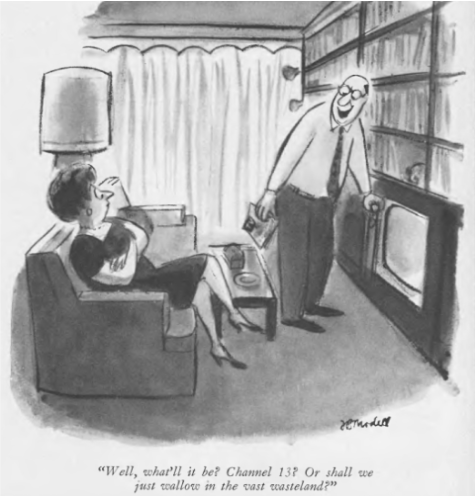
Cartoon referring to Newton Minow’s critique of TV calling it a vast wasteland. His critique said that tv with its sea of talk shows, quiz shows, and mindless entertainment was virtually useless, offered no information and left people bored.
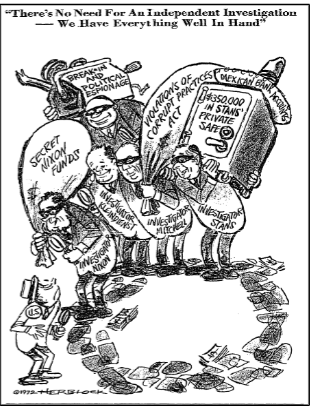
Nixon and his men are crooks, who cheat, lie, and steal to get what they want. Tell the public to turn a blind eye, despite it being blatantly obvious what was happening.
 Note
Note  Flashcards (92)