the firm and profit max
 Studied by 0 people
 Call Kai
 Learn
Learn Practice Test
 Spaced Repetition
 Match
Match Flashcards
 Knowt Play
1/23

There's no tags or description
Looks like no tags are added yet.
Name | Mastery | Learn | Test | Matching | Spaced | Call with Kai |
|---|
No analytics yet
Send a link to your students to track their progress
24 Terms
total cost function
relationship of a firms total costs and quantity of output
includes → fixed cost, variable cost and opportunity cost
increasing and convex function (marginal cost rises with output)
exogenous variables/shocks
‘generated outside the model’
variable is exogenous when its value is set by the modeller rather than being determined by the model itself
exogenous shock = a change in exogenous variables in a model (variables that are otherwise held constant by the modeller)
endogenous variable
‘generated by the model’
value is determined by the working of the model (rather than being set by the modeller)
the market for a differentiated product (monopoly)
differentiated product = lack of substitutes
demand curve reflects consumers willingness to pay but demand is inelastic due to lack of available substitutes
firm has market power and acts as a price setter in the market
isoprofit curve
curve that joins together the combinations of prices and quantities of a good that provide equal profits to a firm
equivalent to the firms indifference curve → want to produce on the highest isoprofit curve
same shape as the AC curve (if firm produces on an isoprofit curve above AC curve its making profit)
slope of isoprofit curve = (P - MC) / Q
equation for isoprofit curve in (Q, P) plane is P = C(Q)/Q + k/Q
where k is a constant level of profiit
scale of production
economies of scale → when a firm is experiencing increasing returns to scale when it increases output (increase in output is proportionally greater than increase in inputs)
diseconomies of scale → when a firm is experiences decreasing returns to scale when it increases output (increase in output is proportionally less than increase in inputs)
consumer surplus
surplus equal to willingness to pay - the price
consumer surpluses is the sum across all consumers
producers surplus
producer receives a surplus on each unit = price - marginal cost of producing it
producer surplus refers to the sum across all units sold
profit = producer surplus - fixed costs
gains from trade
producer surplus + consumer surplus
gains from trade are maximsied when there is no DWL
highest gains from trade is where demand curve intersects the highest isopofit curve
deadweight welfare loss calculation
measurement of the total loss of surplus (gains from trade not exploited) relative to the maximum available in the market
derive P*, Q* from profit max problem
compute MC(Q*)
base of triangle = P* - MC(Q*)
find Pareto efficient point by solving P(Q) = MC(Q)
height of triangle = Pareto efficient point - Q*
work out triangle
price markup
price - MC / price
proportion of the price
markup is inversely proportional to the elasticity of demand for the good at that price
profit maximisation calculation for price setting firms
firms wants to reach highest isoprofit curve whilst being limited by demand (feasible frontier)
define TR as TR = P(Q) x Q
substitute the inverse demand expression P(Q) into R(Q)
differentiate with respect to Q to get MR
differentiate TC with respect to Q to get MC
set MR = MC to find Q*
substitute Q* into P(Q) to find P*
verify profit is maximised by checking second order condition → negative second order derivative shows that profit function is concave
point of profit max is MR = MC which is TR’ = TC’
market with homogenous products (perfect competition)
elastic demand curve as there are lots of substitutes available
competitive equilibirum → firms are price takers as there are many buyers and sellers with perfect information
Pareto efficient if there are no externalities
demand and marginal revenue
change in total revenue from selling one more unit of output
gain from selling one more unit at a new price
loss from lowering the price of the intra-marginal units
PED
% change in demand / % change in price
the higher the slope of the inverse demand, the lower the elasticity of demand
PED and MR
if demand is elastic → reducing price will lead to a large rise in quantity and total revenue will increase
if demand is inelastic → reducing price will lead to a small rise in quantity and total revenue will fall
profit maximisation for price taking firm
P* = MC
firms supply curve = MC curve (market supply is the sum of all the MC curves)
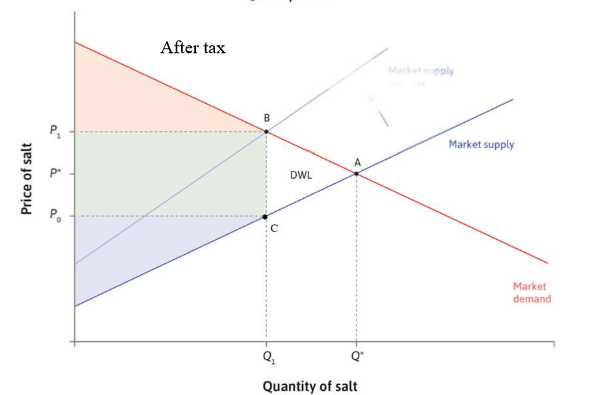
effects of taxes in price taking market
supply curve shifts upwards
consumers pay more (P* to P1)
producers recieve less (P* to P0)
quantity falls (Q* to Q1)
total surplus = consumer surplus + producer surplus + government revenue
model with externalities
MPC → producers cost of producing one more unit
MEC → the extra cost of producing one more nit borne by others
MSC → MPC + MEC
power rule
nx^n-1
function for total revenue
inverse demand function x Q
how to compute profit margin
base of the triangle for DWL (gap between MC(Q*) and P*
profit margin = P* - MC (Q*)
quantity efficiency gap
gap between Pareto efficient output point and Q*
how to get market supply from MC
add Q/number of firms to q in MC function
then divide number attached to q by number of firms
eg MC = 2 + 16q and number of firms is 20
Ps = 2 + 16(Q/20)
Ps = 2 + 0.8Q
 Note
Note  Flashcards (21)