Op Amps
 Call Kai
 Learn
Learn Practice Test
 Spaced Repetition
 Match
Match Flashcards
 Knowt Play
1/9

There's no tags or description
Looks like no tags are added yet.
Name | Mastery | Learn | Test | Matching | Spaced | Call with Kai |
|---|
No analytics yet
Send a link to your students to track their progress
10 Terms
Operational Amplifier Definitions
An operational amplifier (op-amp) is a high-gain differential amplifier that amplifies the difference between two input voltages.
Properties of an ideal op-amp:
Infinite input impedance
→ No current flows into either input terminal
→ Iin = 0Infinite open-loop gain
→ The output voltage is extremely large for even a tiny difference between inputs
→ Vout = A(V+ - V-) where A is infiniteZero output impedance
→ The output voltage is not affected by the load connected
→ Maximum power transfer without voltage drop
Real vs Ideal Operational Amplifier
Input impedance
Ideal: infinite (takes nothing)
Real: very high (but finite)
Gain
Ideal: infinite (boosts forever)
Real: very large, but limited (e.g. 105 - 106
Output impedance
Ideal: zero (perfect output)
Real: small, but not zero
Op-Amp as a Comparator: Operation
If V+ > V- —> Vout = +Vmax (maximum positive voltage, positive saturation)
If V+ < V- —> Vout = -Vmax (maximum negative voltage, negative saturation)
Op-Amp as a Comparator: Applications
Sine → Square wave
A sine wave goes up and down smoothly
The op-amp says:
Above 0 → HIGH
Below 0 → LOW
👉 Result: a square wave (sharp jumps)
Example 2: Temperature alarm
Set a reference temperature
If temperature:
goes above → alarm ON
stays below → alarm OFF
👉 Like a “too hot!” warning system
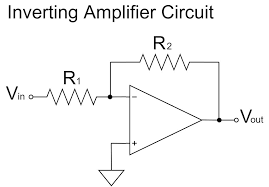
Inverting Op Amp
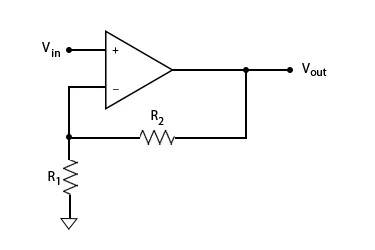
Non Inverting Op Amp
Closed loop voltage gain (inverting circuit)
= -Rf / Rin
Open loop gain (non inverting circuit)
Rf / Rin + 1

