TAMU HORT 201 Exam 4
0.0(0)
 Studied by 0 people
 Call Kai
 Learn
Learn Practice Test
 Spaced Repetition
 Match
Match Flashcards
 Knowt Play
Card Sorting
1/237

There's no tags or description
Looks like no tags are added yet.
Last updated 3:38 AM on 4/27/23
Name | Mastery | Learn | Test | Matching | Spaced | Call with Kai |
|---|
No analytics yet
Send a link to your students to track their progress
238 Terms
1
New cards
Chimera
a plant or plant part composed of genetically different layers
2
New cards
What is the most common example of a chimera plant?*
variegated plants
3
New cards
variegated plants*
where different regions or layers of the leaf are yellow or white due to no chlorophyll development
4
New cards
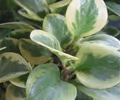
Example of variegation
5
New cards
Why can you not propagate a chimera through a cutting that needs to form shoots (leaf and root cuttings)?
because they will never come out looking like the original chimera
6
New cards
If you want to propagate a chimera plant, what type of cutting do you have to take?
Any cutting that only needs to form adventitious roots
7
New cards
If you have a variegated leaf cutting where the edges are mutated and do not have chlorophyll, and a shoot forms from the edge of that leaf, what will the shoot look like?
It will be fully mutated, and all of the leaf will be pale because it will have no chlorophyll
8
New cards
If you have a variegated leaf cutting where the edges are mutated and do not have chlorophyll, and a shoot forms from the center of that leaf, what will the shoot look like?
It will not have any mutation and will lack variegation in the rest of the plant
9
New cards
Grafting
combining diff parts of plants into 1
10
New cards
Scion
the upper part of the graft that becomes the shoot system of the new plant
11
New cards
Stock
the lower part of the graft that becomes the root system of the new plant
12
New cards
Budding
a type of graft where the scion is just a bud piece or small chip of wood with a bud attached
13
New cards
Why do we graft/bud plants?
1. used for plants that cannot be propagated by other means (Ex: plants in adult phase)
2. decrease time for flowering and fruiting
3. Obtain desirable characteristics of the rootstock like disease resistance, adaptation to climate, and dwarfing
4. change variety: make better fruit/flower
5. special forms (ex: tree roses)
6. Repair damage
7. virus indexing: test plants for virus
14
New cards
How do we use grafting to index viruses?
test plants for disease by grafting a part of a plant onto a plant that is known to be sensitive to a virus. If the plant that is sensitive begins showing signs of disease, we know the new plant is infected.
15
New cards
For a graft to be successful, the plants must be...
alike, you can only graft things of a similar species onto each other
16
New cards
For a graft to be successful, the scion and the stock must both possess what?
a cambium
17
New cards
For a graft to be successful, what part of the two plants must be firmly connected?
the cambium of the scion and stock
18
New cards
How do we ensure the cambia of a stock and scion match up?
make sure they are roughly the same size and we make specific cuts to make sure they line up.
19
New cards
What types of grafts are used to repair damage?
Inarching, Bridge graft, and Brace graft
20
New cards
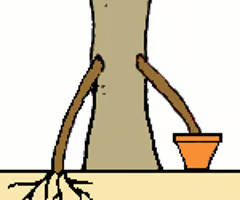
Inarching graft diagram
21
New cards
Inarching grafting is used...
to replace damaged root system
22
New cards
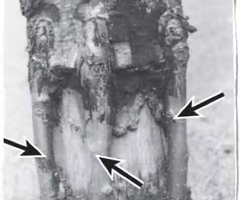
Bridge graft diagram
23
New cards
Bridge grafting is used...
to repair damaged trunk
24
New cards
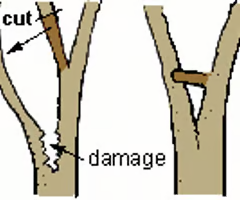
Brace graft diagram
25
New cards
Brace grafting is used...
to support weak branches
26
New cards
What kinds of grafting are used when the scion and stock are approximately the same size?
Whip/tongue graft, splice graft, and saddle graft
27
New cards
Whip or tongue graft
cut like splice but make an additional cut down middle before connecting both
28
New cards
What is the most common graft when the stock and scion are approximately the same size?
Whip or tongue graft
29
New cards
Why is the whip/tongue graft the most commonly used?
because if it's done right the graft will hold itself together
30
New cards
Splice graft
graft method of matching angle cuts to the scion and the stock
31
New cards
Saddle graft
horse shoe shape, or U shape graft through stem
32
New cards
Types of grafts used when scion is smaller than stock
Side graft, Cleft graft, wedge/notch/saw-ferf graft, Bark inlay graft, Approach graft, and Topworking
33
New cards
Side graft
cut into side of stock and shove smaller scion into cut
34
New cards
Cleft graft
Cut made into a large branch and a twig is inserted
35
New cards
Wedge/notch graft
make cuts on side edge of stock and insert scion into the cuts - like cleft but around the edges
36
New cards
Bark inlay graft
grafting the scion by pealing back the bark of the stock
37
New cards
When can we do a bark inlay graft?
when the bark is slipping
38
New cards
What does it mean when the bark of a tree is slipping?
the vascular cambium is actively growing, and the bark can be peeled easily from the stock piece with little damage
39
New cards
When does bark slip?
in Spring
40
New cards
Approach graft
slice off a small piece from the side of both stocks and graft them together to make one plant
41
New cards
What are the benefits of an approach graft?
prevents the scions and stocks from drying out
42
New cards
Top working graft
grafting where all of the limbs have a graft
43
New cards
When do we use budding most frequently?
When the bark is slipping (spring)
44
New cards
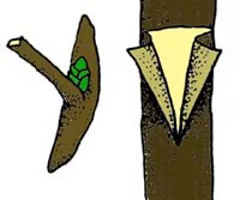
T-bud diagram
Make a T shaped cut in the middle of the new stock and insert the bud
45
New cards
Inverted T-bud
remove the bud from stock, make an upside down T shape in the middle of the new stock and insert bud into upside down T
46
New cards
I-bud graft
Make a cut in the shape of a capital i
47
New cards
Patch bud
remove the bud from stock in an rectangular shape, cut a rectangle in the new stock, and insert the rectangle bud into the new rectangle in the new stock
48
New cards
Ring bud
cut all the way around the stock (just the bark), take the ring off the old stock and insert the ring around the new stock
49
New cards
Flute bud
cut almost all the way around the stock (just the bark), take the almost full ring off the old stock and insert the almost full ring around the new stock
50
New cards
What kind of budding do we use when bark is not slipping?
Chip bud
51
New cards
Chip bud
take bud piece from one stem and cut out piece of stock and discard, replace with bud piece
\--*used when bark is NOT slipping*
\--*used when bark is NOT slipping*
52
New cards
Layering
a propagation technique where roots are formed prior to the stem being removed from the parent plant
53
New cards
What form of propagation is most likely to produce a successful plant?
Layering
54
New cards
Where is the phloem located?
between the wood and the bark on a stem of a plant
55
New cards
What is the principle of layering?
Make a part of the plant think it has been removed from the plant by disrupting the phloem (but not the xylem) so that roots will form
56
New cards
What dictates the type of cut made on a plant for layering?
The internal anatomy of a plant
57
New cards
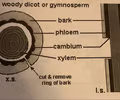
How do we layer on a woody dicot or gymnosperm stem?
By removing a ring of bark around the stem, disrupting the phloem and leaving the xylem unaffected.
58
New cards
Why do we need to remove a ring of bark on a woody dicot or gymnosperm for layering?
So the tree forms roots and doesn't just try and heal the wound in the bark.
59
New cards
How do we layer on a monocot stem?
cut a slit around 1/3 of the way into the stem to disrupt the phloem enough that the plant will form roots at the site of the cut.
60
New cards
Why do we cut 1/3 of the way through a monocot stem to layer?
Because monocots have scattered vascular bundles it isn't possible to just disrupt the phloem like we can for dicots and gymnosperms
61
New cards
Diagram of Layering in Dicots or Gymnosperms
62
New cards
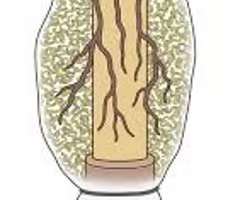
Layering in Monocots
63
New cards
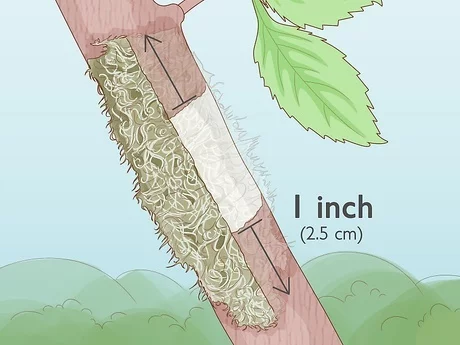
Air layering is done by...
removing a ring of bark on a stem, and packing soil around the new wound and securing it to the branch to allow roots to form into the soil.
* most common layering
* most common layering
64
New cards
Air layering diagram
65
New cards
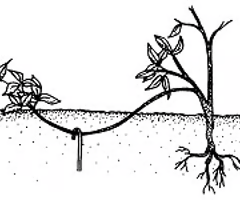
Simple layering is done by...
bending a stem to bury a part of it
66
New cards
what kinds of plants do we use simple layering on?
plants with flexible stems or vines
67
New cards
Simple layering diagram
68
New cards
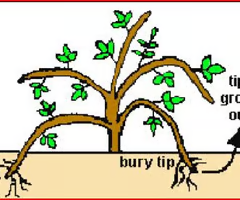
Tip layering is done by...
taking the tips of stems and burying them in the ground
69
New cards
Tip layering diagram
70
New cards
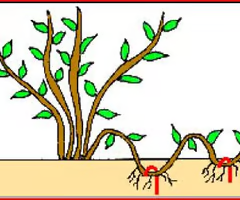
Serpentine layering is done by...
A propagation method where the stem of a plant is gently curved at several locations, nicked at each bend, buried in soil, and the terminal end of the shoot being buried is left exposed
71
New cards
Serpentine layering
72
New cards
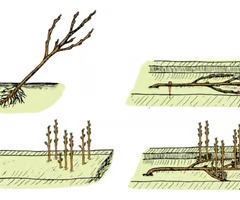
Trench layering diagram
73
New cards
Trench layering is done by...
placing a plant horizontally after pruning it to be fan-like and covering it in soil to allow new stems to form while still attached to the parent plant.
74
New cards
Mound or stool layering is done by...
mounding soil around the bases of new shoots, excluding light and enhancing root formation.
75
New cards
Mound or stool layering diagram
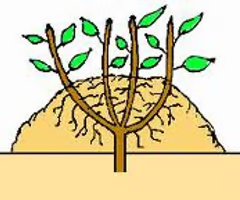
76
New cards
What is the most common form of layering?
Air Layering
77
New cards
Cutting
a plant part that when removed from the parent plant and placed under the proper environmental conditions forms adventitious roots and/or shoots
78
New cards
What is the most common method of asexual propagation?
Cuttings
79
New cards
What is the main reason cuttings may fail to propagate?
water loss - the cutting dries out before it can propagate into a new plant
80
New cards
How do we minimize water loss in cuttings?
Putting cuttings in a cool humid area, in a humidity chamber, under an intermittent mist system, or using an anti-transpirant on the cutting.
81
New cards
Anti-transpirants
chemicals tha decrease transpiration by forming a film on the leaf surface or by physiologically closing stomata
82
New cards
Intermittent mist system
a propagation system that periodically (every 5 to 30 minutes) sprays a fine mist of water on the cuttings to keep the foliage moist and minimize water loss.
83
New cards
What are the two main hormones that are used on cuttings?
Auxin and Cytokinin
84
New cards
Use of auxin on cuttings stimulates...
adventitious root formation on stem cuttings
85
New cards
What kinds of auxin do we use on plant cuttings?
IBA (most commonly used), NAA (most frequently used), 2 4-D (less used)
86
New cards
Use of cytokinin on cuttings stimulates...
adventitious shoot formation on leaf or root cuttings
87
New cards
What kinds of cytokinin do we use on plant cuttings?
kinetin (commonly used), benzyladenine (BA) (commonly used), Zeatin (rarely used), and pyranylbenzyladenine (PBA) (used in research)
88
New cards
Where do we take plant cuttings from?
any part of the plant (stem, leaf, and root) excluding flowers
89
New cards
What are the types of leaf cuttings?
Leaf bud, Leaf petiole, Leaf blade, and Leaf section
90
New cards
What does a leaf bud cutting need to form?
roots
91
New cards
What does a leaf petiole cutting need to form?
roots and shoots
92
New cards
What does a leaf blade cutting need to form?
roots and shoots
93
New cards
What does a leaf section cutting need to form?
roots and shoots
94
New cards
What are the types of Stem cuttings?
Hardwood, Semi-hardwood, soft/greenwood, Herbaceous, Cane, Rhizome, and Tuber
95
New cards
When do we often take hardwood cuttings?
in the winter
96
New cards
soft wood is...
new growth that is still herbaceous
97
New cards
What is a tuber?
Underground storage stem (Ex. potatoes)
98
New cards
What does every stem cutting have?
a bud - meaning it only needs to form adventitious roots
99
New cards
Where can we take root cuttings from?
Root sections and tuberous roots
100
New cards
What do all stem cuttings need to form?
Roots only
 Note
Note  Flashcards (127)