8.1 Matrices and systems of equations SOLVING THEM First 12 flashcards are like an introduction LOTS OF FLASHCARDS BUT IT IS AN INTRODUCTION
 Call Kai
 Learn
Learn Practice Test
 Spaced Repetition
 Match
Match Flashcards
 Knowt Play
1/39

There's no tags or description
Looks like no tags are added yet.
Name | Mastery | Learn | Test | Matching | Spaced | Call with Kai |
|---|
No analytics yet
Send a link to your students to track their progress
40 Terms
Good overview video
and video about the elementary row operations
Video about order that he usually gets the numbers for
Key
Formula Super important =This
important thing = This
Definition/ Introduction=THIS
Example=This
Super important one of =THIS
ONE OF TOP __=
First 12 flashcards are like an introduction
1,14? 17,18,21,23
Definition of a MATRIX
Matrices are a streamlined technique for solving systems of linear equations. This technique involves the use of a rectangular array of real numbers called a matrix.
The entry in the xth row and yth column is denoted by the double subscript notation axy
Example : a23 = the entry in the 2nd row and 3rd column
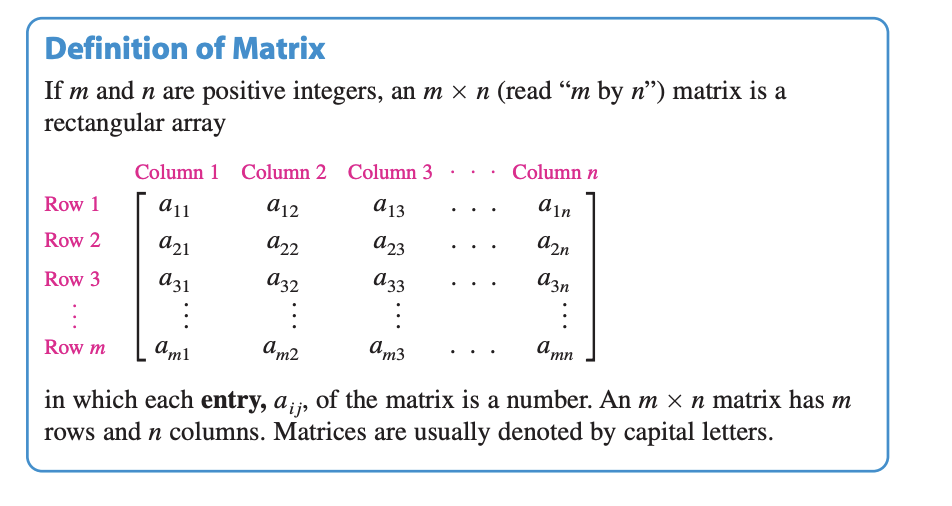
Why use matrice
dont always want to put variables
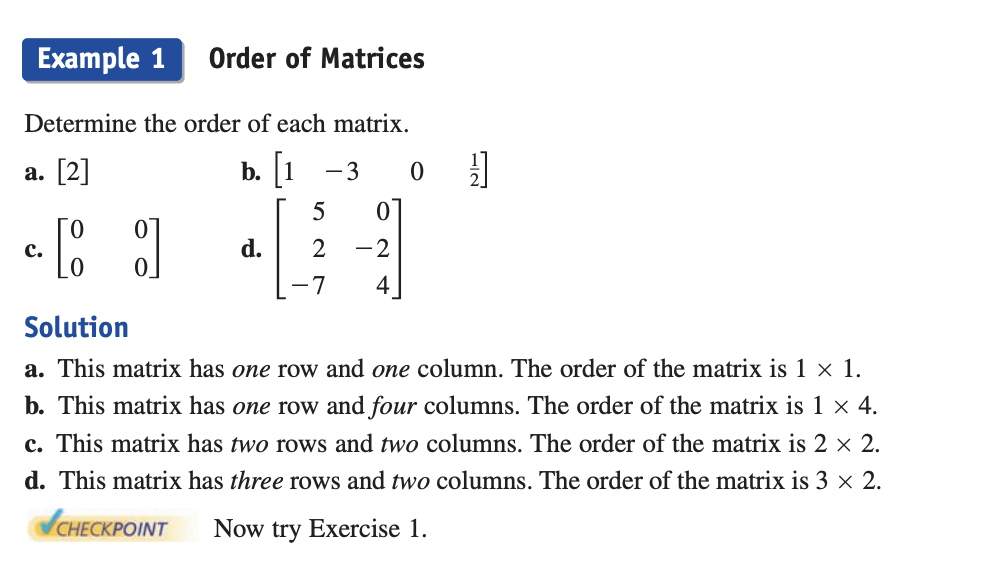
Order of a Matrice
Matrix has M rows and N columns said to be in order MxN
Square Matrix definition
if matrix is mxn and m=n
for a square matrix, the entries a11, a22, a33, axx are the Main diagonal entries
Main diagonal/ Principal Diagonal definition
set of entries running from top left corner to bottom right corner. happens when m=n (square matrix. So 3×3 or 2×2 or 4×4 matrix would work It runs diagonally from the top left corner to the bottom right corner.
Identity Matrix definition
Special diagonal matrix where all entries 1 on the main diagonal and all the others 0 always square and serves as the Multiplicative identity.
Row matrix and Column matrix definition
row matrix- Matrix with only one row
Column matrix- Matrix that has only one column
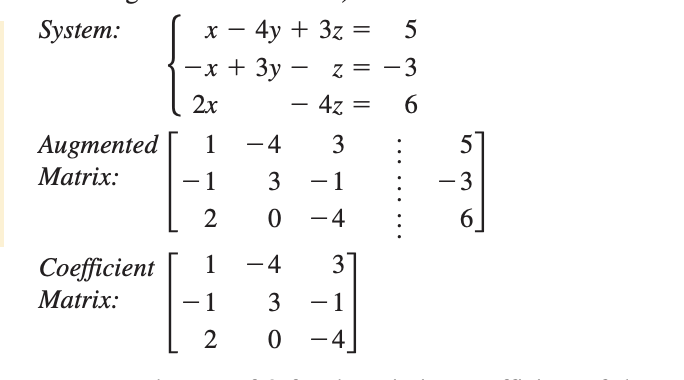
Coefficient Matrix and Augmented Matrix Definition. Part of Steps
Augmented Matrix- Matrix derived from system of linear equations each written in standard form with the constant term on the right. You add the numbers in that the variables are equal too. Equivalence for each row
Coefficient Matrix- Matrix derived from the coefficients of the system But not including the constant/ equivalence terms.
Picture is examples of both
Example 1 in book Order of Matrices
Example 2 in book Writing an Augmented Matrix
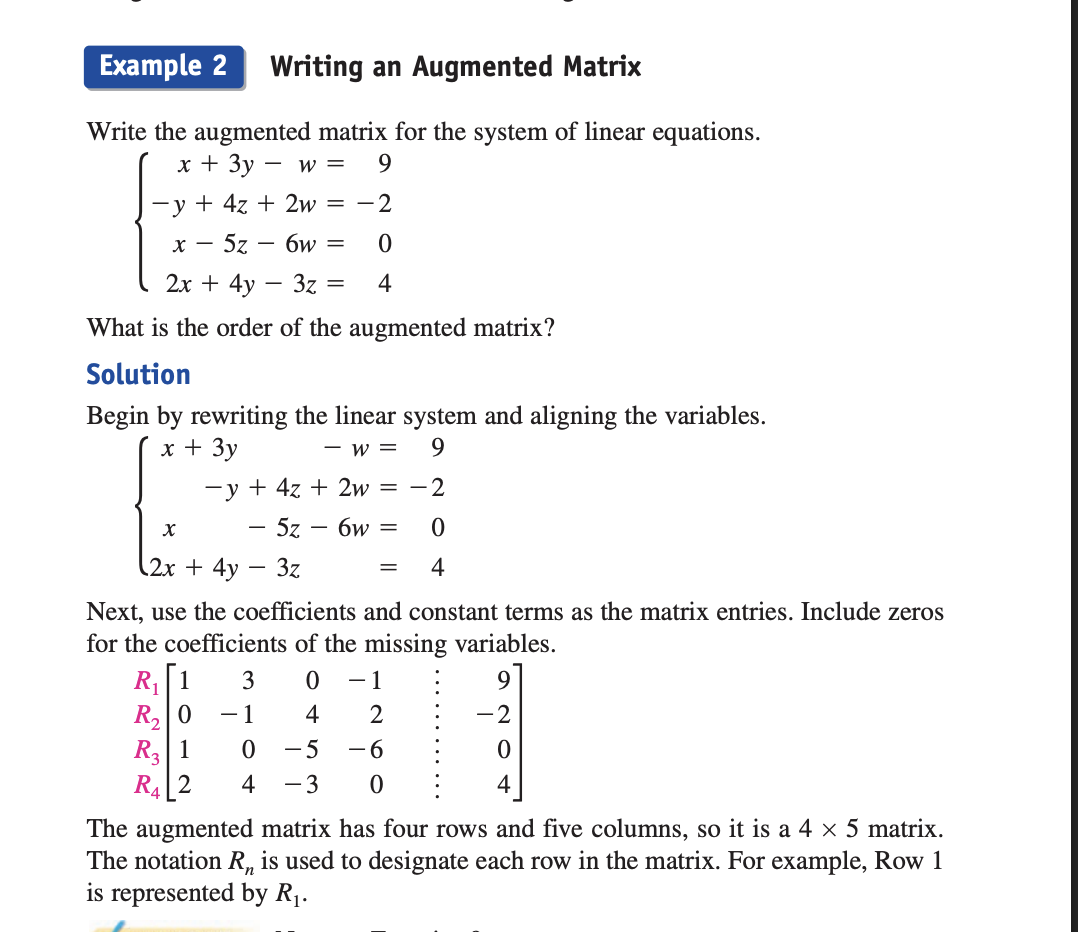
Steps For writing coefficient or Augmented Matrix
Begin by vertically aligning the variables in the equations (by rewriting the linear system and aligning the variables)
Use zeros for the coefficients of the missing variables.
Elementary row operations with MATRICES and what they do
In matrix terminology, these three operations correspond to elementary row operations.
An elementary row operation on an augmented matrix of a given system of linear equations produces a new augmented matrix corresponding to a new (but equivalent) system of linear equations.
Row- Equivalent: Two matrices are row-equivalent if one can be obtained from the other by a sequence of elementary row operations.
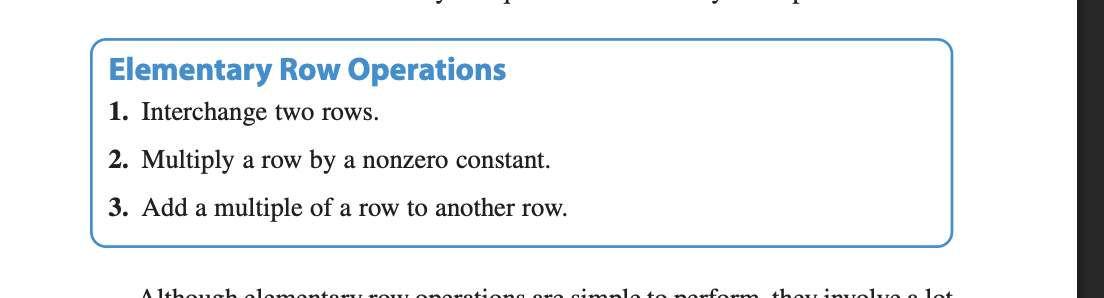
Example 3 in bookElementary Row Operations
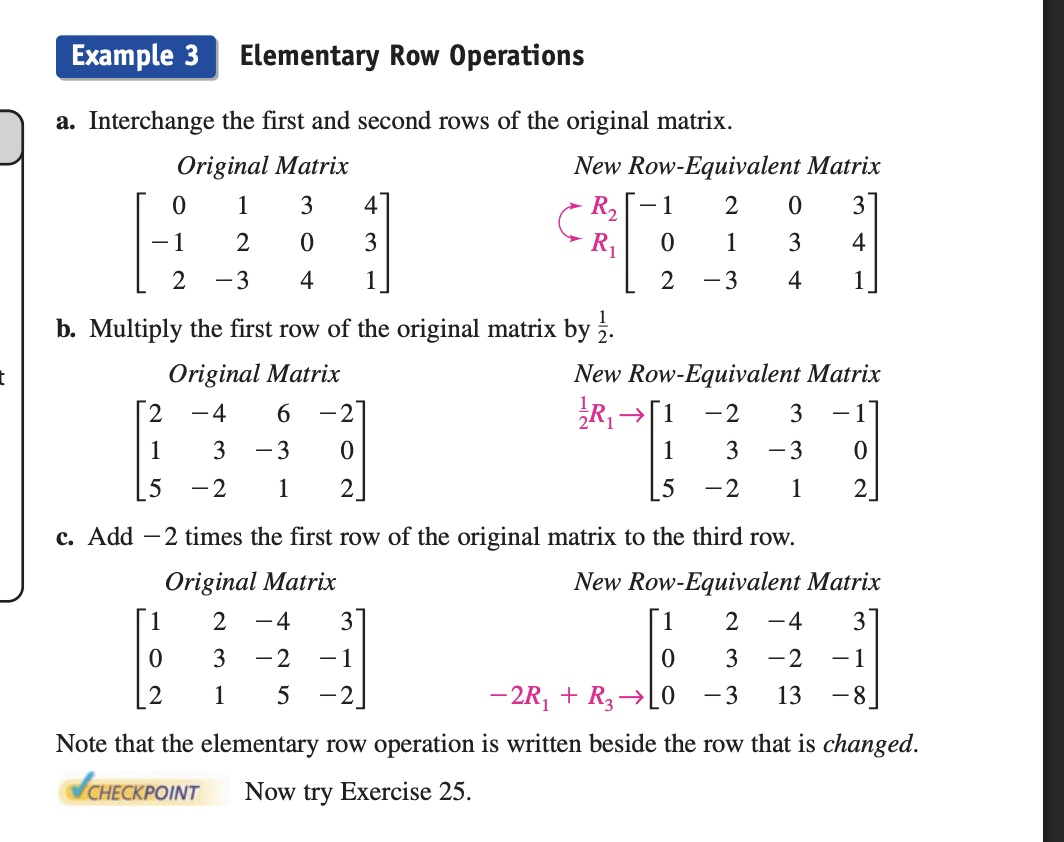
Example 4 in book GAUSSIAN ELIMINATION WITH BACK SUBSTITUTION
REDUCED ROW ECHELON FORM vs. ROW ECHELON FORM
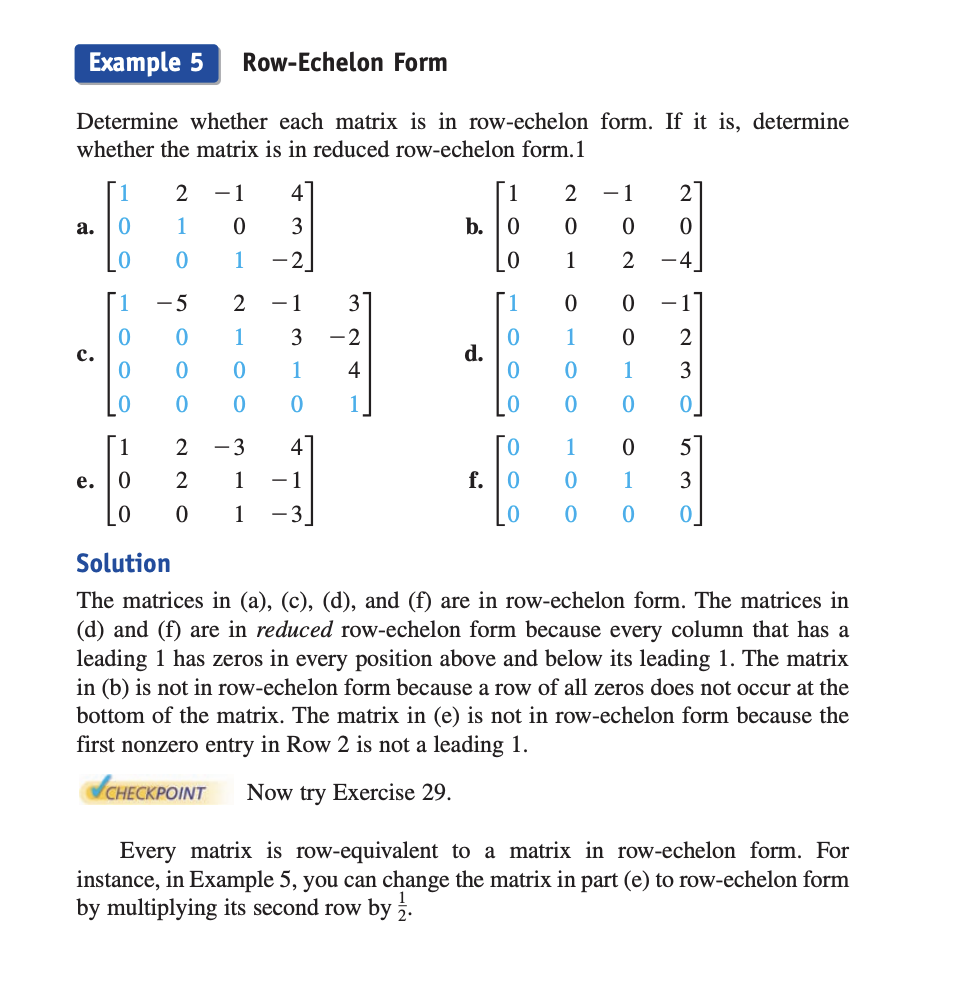
Echelon refers to the stair-step pattern formed by the nonzero elements of the matrix. To be in this form, a matrix must have the following properties.
Row-echelon form
Any rows consisting entirely of zeros occur at the bottom of the matrix.
For each row that does not consist entirely of zeros, the first nonzero entry is 1 (called a leading 1).
Basically has to be a 1 as the first coefficient for all rows
In subsequent rows, the 1 is indented. (Each leading one is to the right of the leading 1 in the row above
Basically saying it is a diagonal row of 1’s
For two successive (nonzero) rows, the leading 1 in the higher row is farther to the left than the leading 1 in the lower row.
REDUCED- Row-echelon form
All of Row-echelon form characteristics 1-3 +
ALL DIGITS ABOVE AND BELOW A 1 are zeroes
A matrix in row-echelon form is in reduced row-echelon form if every column that has a leading 1 has zeros in every position above and below its leading 1.
can also say each leading 1 is the only non-zero entry in its column
REDUCED ROW ECHELON FORM vs. ROW ECHELON FORM: WHAT METHOD USES WHAT
Gaussian elimination with back substitution just uses row-echelon form, then back substitution
Gauss Jordan Elimination turns it into Reduced- Row - Echelon Form
Example 5 in book What form is the matrice in?
PROCEDURES FOR SOLVING MATRICES IS THE REST OF THESE FLASHCARDS
One of 2 ways to SOLVE MATRICES. OLD WAY NOT WHAT DR. STUDEVENT WANTS
GAUSSIAN ELIMINATION WITH BACK SUBSTITUTION FOR SOLVING MATRICES
SO FOR THIS ONE YOU PUT IT IN ROW- ECHELON FORM
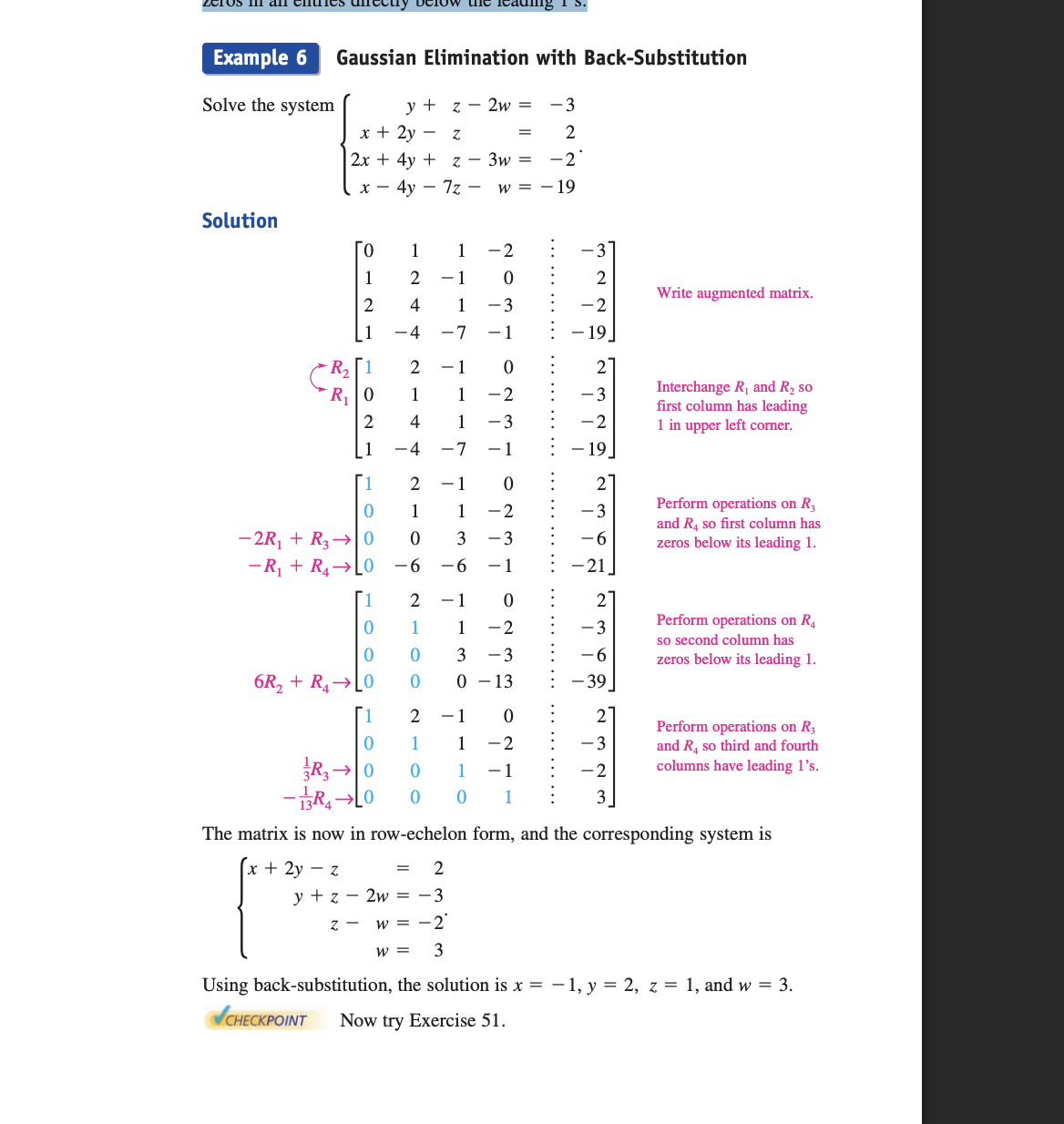
In Example 3 in Section 7.3, you used Gaussian elimination with back substitution to solve a system of linear equations. The two methods are essentially the same. The basic difference is that with matrices you do not need to keep writing the variables.
Gaussian elimination with back-substitution works well for solving systems of linear equations with matrices.
For this algorithm, the order in which the elementary row operations are performed is important. You should operate from left to right by columns, using elementary row operations to obtain zeros in all entries directly below the leading 1’s.
Example 6 in book GAUSSIAN ELIMINATION WITH BACK SUBSTITUTION
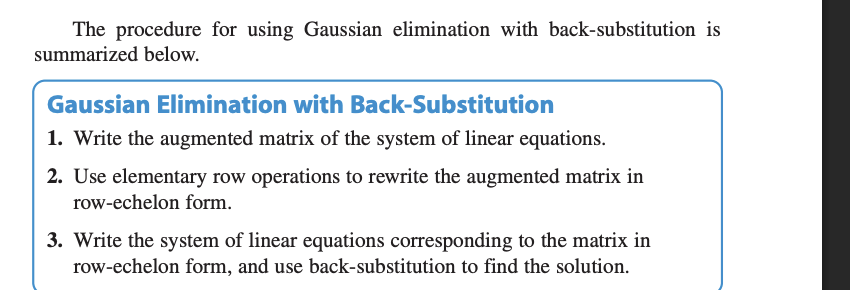
Steps for solving matrices with gaussian elimination by back substitution
Write the augmented matrix of the system of linear equations.
Use elementary row operations to rewrite the augmented matrix in row-echelon form.
Write the system of linear equations corresponding to the matrix in row-echelon form, and use back-substitution to find the solution.
Important thing to note. Inconsistant (NO SOLUTION MATRICES) appeared on HOMEWORK
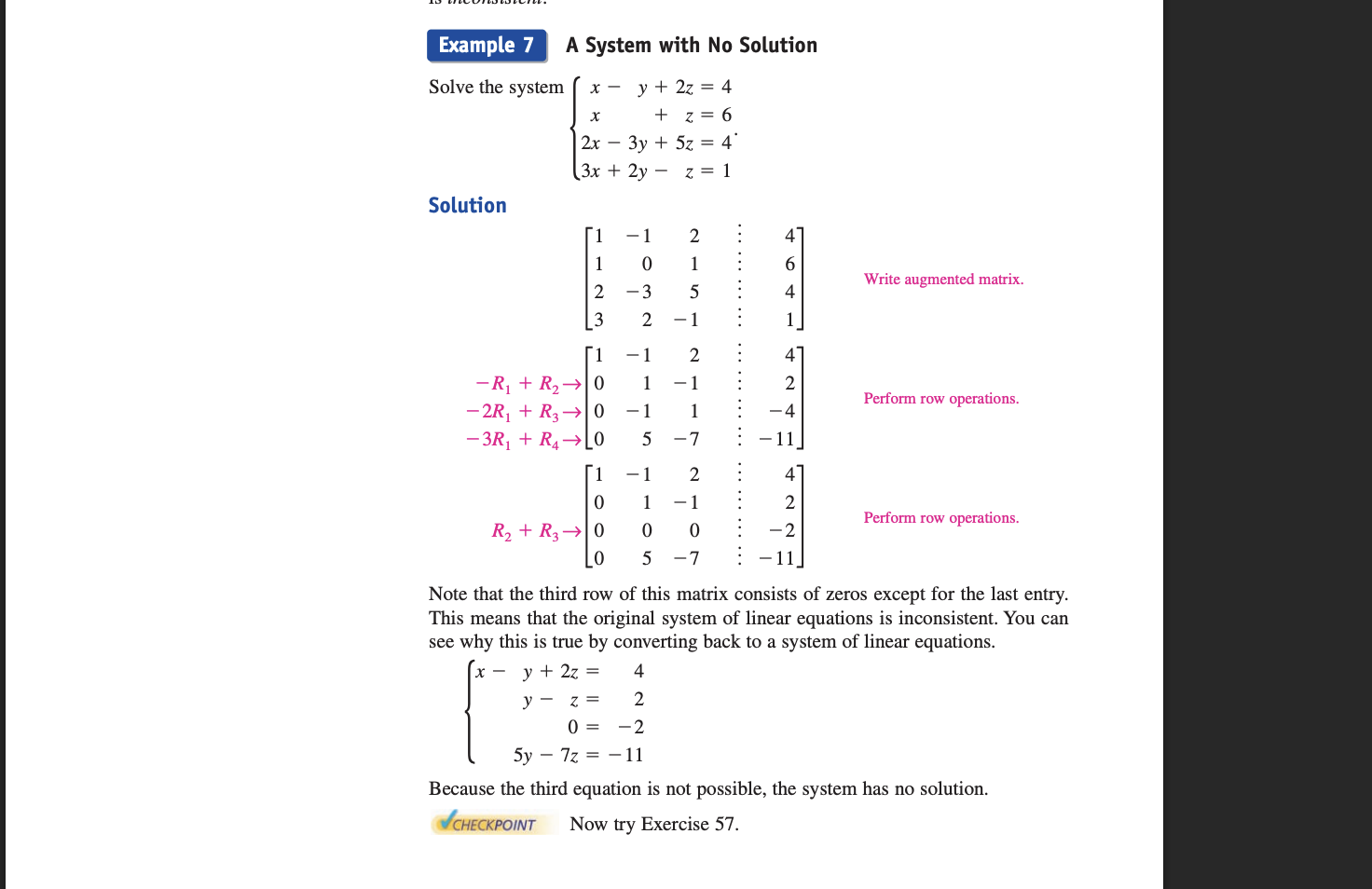
When solving a system of linear equations, remember that it is possible for the system to have no solution.
If, in the elimination process, you obtain a row with zeros except for the last entry, it is unnecessary to continue the elimination process. You can simply conclude that the system has no solution, or is inconsistent.
Example 7 in book A system with no solution
Note that the third row of this matrix consists of zeros except for the last entry. This means that the original system of linear equations is inconsistent. You can see why this is true by converting back to a system of linear equations.
One of 2 ways to SOLVE MATRICES. NEW WAY WE DO!!!!!!
GAUSS- JORDAN ELIMINATION!!!!!! WHAT IT DOES
With Gaussian elimination, elementary row operations are applied to a matrix to obtain a (row-equivalent) row-echelon form of the matrix.
A second method of elimination, called Gauss-Jordan elimination, continues the reduction process until a reduced row-echelon form is obtained.
With Gauss-Jordan elimination, you are trying to get the top right to all be zeros too, that is the goal.
All this does is turn a row-echelon form matrix into reduced row-echelon form. And you want to put the matrix in row echelon form into a matrix where every column with a leading 1 has zeros in every position above and below it.

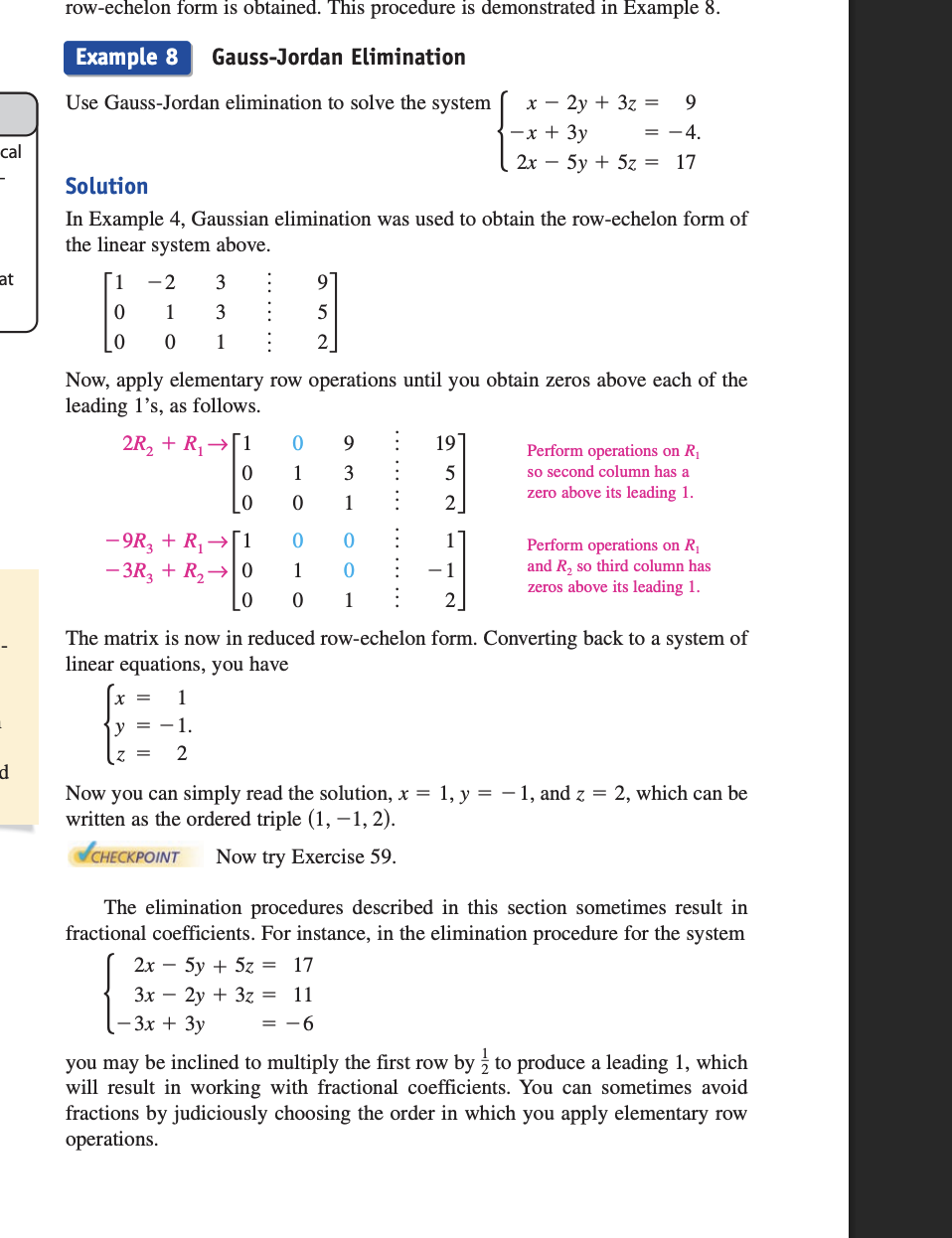
Example 8 in book Gauss- Jordan Elimination
x-2y+3z=9, -x+3y=-4 , 2x-5y+5z=17
STEPS FOR GAUSS- JORDAN ELIMINATION
After you get row-echelon form. trying to get the top right triangle that has numbers to all be 0.
FOR 3×3 matrix
Use the leading 1 in row 2 (would be column 2)
to eliminate the number in row 1 above it. above it which is (row 1 column 2)
Use the leading 1 in row 3 (column 3
( to eliminate the number in row 1 column 3 and number in row 2 column 3.
FOR 4×4 matrix
Use the leading 1 in row 2 (would be column 2)
to eliminate the number in row 1 above it. above it which is (row 1 column 2)
Use the leading 1 in row 3 (column 3
( to eliminate the number in row 1 column 3 and number in row 2 column 3.
Use the leading 1 in row 4 (column 4
( to eliminate the number in row 1 column 4 and number in row 2 column 4 and row 3 column 4
Quik tip for fractions
you may be inclined to multiply the first row by to produce a leading 1, which will result in working with fractional coefficients. You can sometimes avoid fractions by choosing the order in which you apply elementary row operations.
Reminder of Non Square Systems but for Matrices
Remember when there were non-square systems with more variables than equations. Then systems has either infinite solutions or no solution.
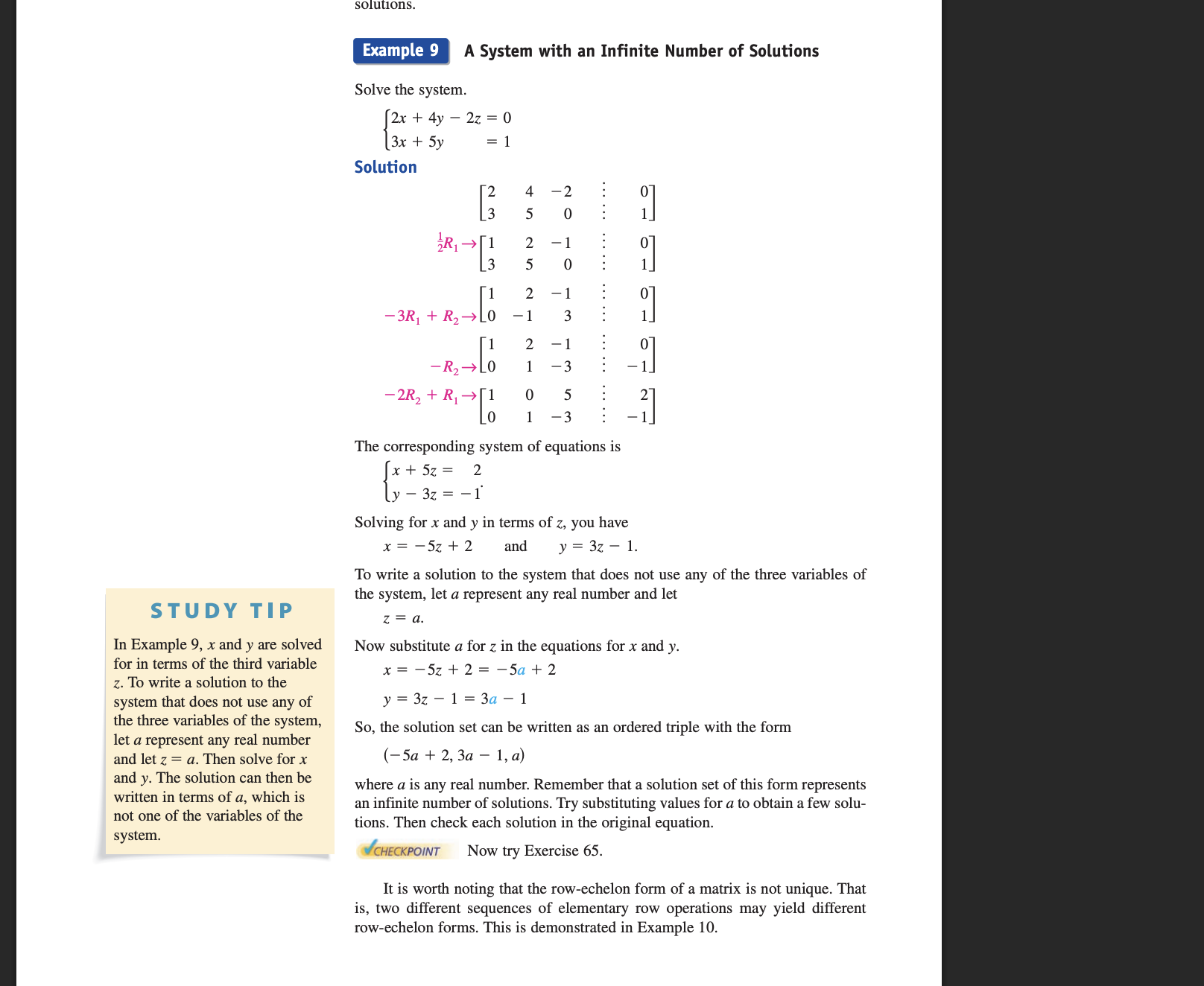
For matrices and like other unit set the last variable = to c if infinite solutions
If no solutions like something like x+y+z=1, x+y+z=2 then see there are no solutions
Example 9 in book A System with an Infinite Number of Solutions
2x+4y-2z=0, 3x+5y=1
make z=c
Which one is unique or not Row-echelon form versus reduced row echelon form
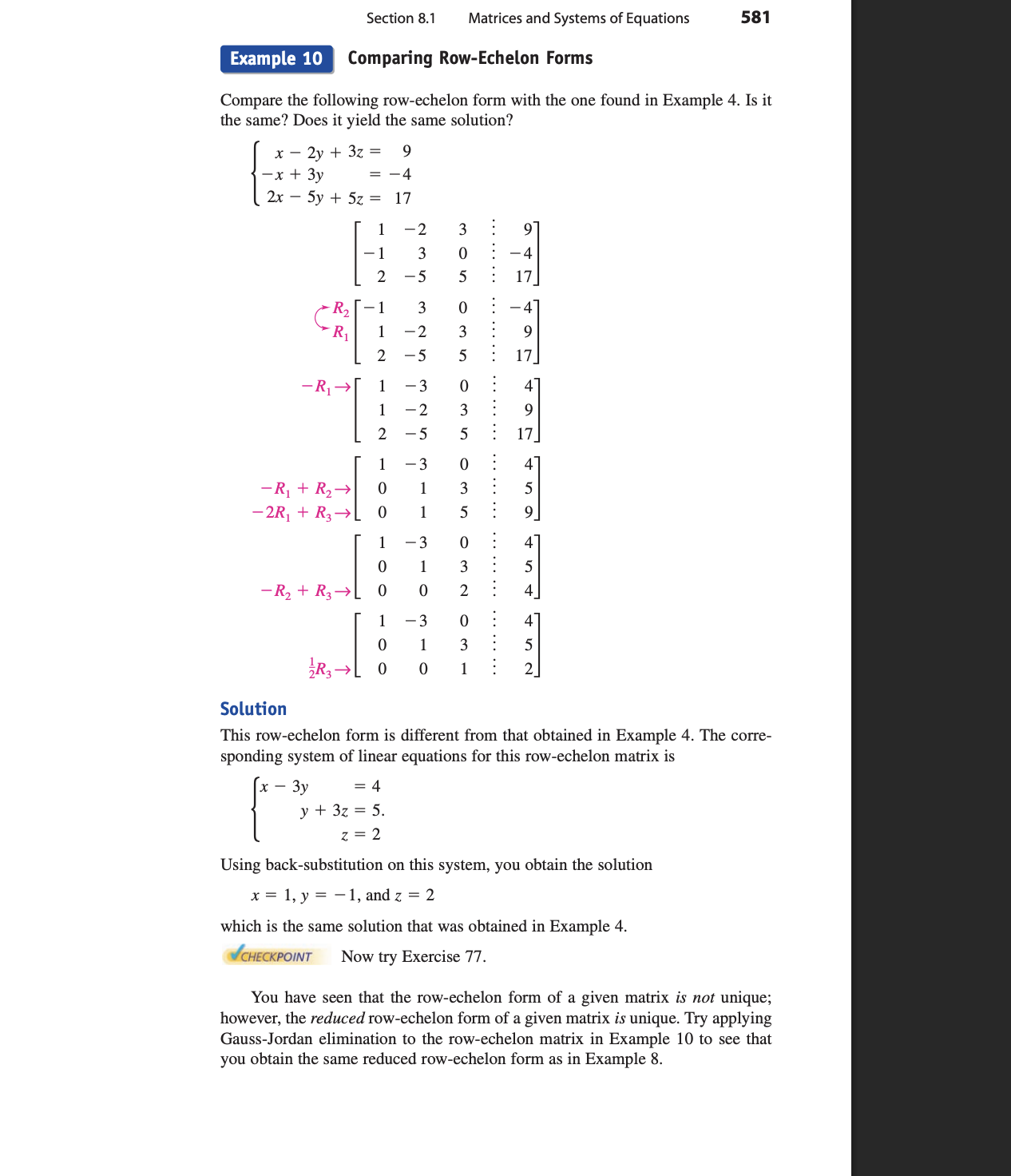
It is worth noting that the row-echelon form of a matrix is not unique. That is, two different sequences of elementary row operations may yield different row-echelon forms. This is demonstrated in Example 10.
Reduced row echelon form is unique
Example 10 in book Comparing Row-Echelon Forms
Important note about solutions PIVOTS
You must have as many pivots as variables for unique solution.
Pivots are the ones in Reduced row echelon form that are indented.
Important note about Solving these problems about doing these operations with little example
Always multiply by lower term because 0 will not change when multiply. Top will always remain 1
Example
1 0 0
0 1 0
0 0 1
(0 0 0) still have unique solutions because 3 pivots and 3 variables
NOW IN CLASS STUFF
Steps overall for solving the system!! using Gauss- Jordan
Take all the coefficients from the system. turn into COEFFICIENT MATRIX
Add in the constants (numbers) and turn into an Augmented Matrix
include constants/ equivalence for each row!!!!
Turn into Row-Echelon form using Gaussian Elimination
Turn into reduced row echelon form using Gaussian- Jordan Elimination
Check into original equation
In class worked example!!! basically all of the notes
-x+y-z=-14
2x-y+z=21
3x+2y+z
-x+y-z=-14
2x-y+z=21
3x+2y+z
DO it exactly the same way. Gaussian Elimination, then do REDUCED ROW ECHELON FORM
Into coefficient matrix [ -1 1 -1, 2 -1 1, 3 2 1 ]
Turn into augmented matrix. [ -1 1 -1:-14 , 2 -1 1: 21 , 3 2 1: 19]
Turn into row echelon form using Gaussian elimination
2xR1+R2=new R2
3xR1+R3=new R3
-5xR2+R3=new R3
Multiply R1 by -1
Get [ 1 -1 1:14 , 0 1 -1: -7 , 0 0 1: 4]
WE WANT THE TOP RIGHT TO ALL BE ZEROES TOO
Turn into Reduced Row-Echelon form using Gaussian Jordan Elimination
Use R1 and R2 to eliminate the second number in the first term
Use R2 and R3 to eliminate the third number in the 2nd term and 3rd number in the first term
[ 1 0 0:7, 0 1 -1: -7, 0 0 1 : 4]
Check into the original Equation
In class Example 2
x-3z=-2
x+y-2z=5
2x+2y+z=4
Augmented matrix [1 0 -3: -2, 1 1 -2:5, 2 2 1:4]
Turn into row echelon form using Gaussian elimination
get [1 0 -3 : -2 , 0 1 1: 7 , 0 0 1: -6/5 ]
Turn into reduced- row echelon form
[1 0 0 : -28/5, 0 1 0: 41/5, 0 0 1: -6/5]
Hw problems 69-75 odds page 603 I HAVE HOMEWORK REVIEW NOTES