Physics - Waves 1
 Call Kai
 Learn
Learn Practice Test
 Spaced Repetition
 Match
Match Flashcards
 Knowt Play
1/28

Earn XP
Description and Tags
29 Terms
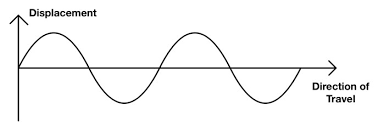
Transverse waves
The particles vibrate at a right angle to the direction the wave travels in. E.g. light waves, water surface waves
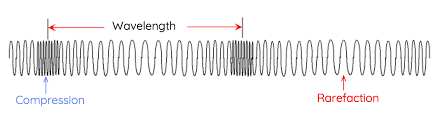
Longitudinal waves
The particles vibrate to and fro in the same direction the wave travels. The wave contains compressions, where particles move together, and refractions, where particles move apart. e.g. sound waves
Oscillation
A vibration i.e a movement back and forth about a fixed point (the rest or equilibrium position)
Displacement
Distance with direction. Measure in metres
Amplitude
The maximum displacement from the rest position of the oscillation. Measure in metres. Symbol a
Time Period
The time taken for one complete cycle. This is when it has reached the same displacement AND is going in the same direction as it was 1 cycle ago. Measured in seconds. Symbol T
Freuqency
How fast an object is vibrating (how many cycles are completed each second). Measure in Hertz (1Hz). Symbol f
Wavelength
The distance between one point on one wave and the same point on the next wave. Measure in metres. Symbol is λ (lambda)
What do waves transfer?
They transfer energy and information without transferring matter
Equation for speed, frequency and wavelength
speed = frequency x wavelength
Equation for frequency and time period
frequency = 1 / time period
Can all waves be reflected?
Yes
What is the electromagnetic spectrum in order?
Radio, microwave, infrared, visible light, ultraviolet, x-ray, gamma ray
What do all the waves in the electromagnetic spectrum have in common?
They all travel at the same speed in free space.
What are some difference in the waves in the electromagnetic spectrum?
They have different wavelengths and frequencies
What is the pattern in wavelengths and frequencies in the electromagnetic spectrum?
From radio → gamma ray: wavelength decreases and frequency increase. Smaller wavelength = higher frequency
Use of radio waves
Broadcasting and communications
Use of microwaves
Cooking and satellite transmissions
Use of infrared
Heaters and night vision equipment
Use of visible light
Optical fibres and photography
Use of ultraviolet
Fluorescent lamps
Use of x-rays
Observing the internal structure of objects and materials, including for medical applications
Use of gamma rays
Sterilising food and medical equipment
Detrimental effect of excessive exposure of microwaves
Internal heating of body tissue
Detrimental effect of excessive exposure of infrared
Skin burns
Detrimental effect of excessive exposure of ultraviolet
Damage to surface cells and blindness
Detrimental effect of excessive exposure of gamma rays
Cancer and mutation
Properties of Light Rays
Light rays are transverse waves and they can be reflected
Law of reflection
The angle of incidence = the angle of reflection