Powders and Granulation
 Call Kai
 Learn
Learn Practice Test
 Spaced Repetition
 Match
Match Flashcards
 Knowt Play
1/43

There's no tags or description
Looks like no tags are added yet.
Name | Mastery | Learn | Test | Matching | Spaced | Call with Kai |
|---|
No analytics yet
Send a link to your students to track their progress
44 Terms
Define a pharmaceutical powder.
A dosage form in which a drug is mixed with powdered excipients to produce a homogeneous formulation (final product).
Define a granule.
granules (when used as a dosage form) consist of
powder particles that have been aggregated to form
a larger particle
What is the key structural difference between powders and granules?
Powders consist of individual particles, whereas granules are aggregated clusters of particles.
Differentiate powders for internal and external use.
Internal: oral powders
External: dusting powders
What does angle of repose measure?
AND
What is the equation for angle of repose?
Powder flowability.
tan θ = h / r
Interpret angle of repose values.
θ > 50° ‘unsatisfactory flow
25 < θ < 50 ‘satisfactory flow’
What is bulk density?
The density of powder, including
interparticle void spaces(air).
What is tapped density?
Density after mechanical tapping reduces void spaces.
Flashcard 12
Q: Define Carr’s Compressibility Index (CCI).
CCI = [(Tapped density − Poured density) / Tapped density] × 100
Define Hausner’s ratio.
Hausner’s ratio = tapped density / poured density
What does a high Hausner’s ratio indicate?
AND
picture of summary
Poor powder flow due to high interparticle friction/cohesion.
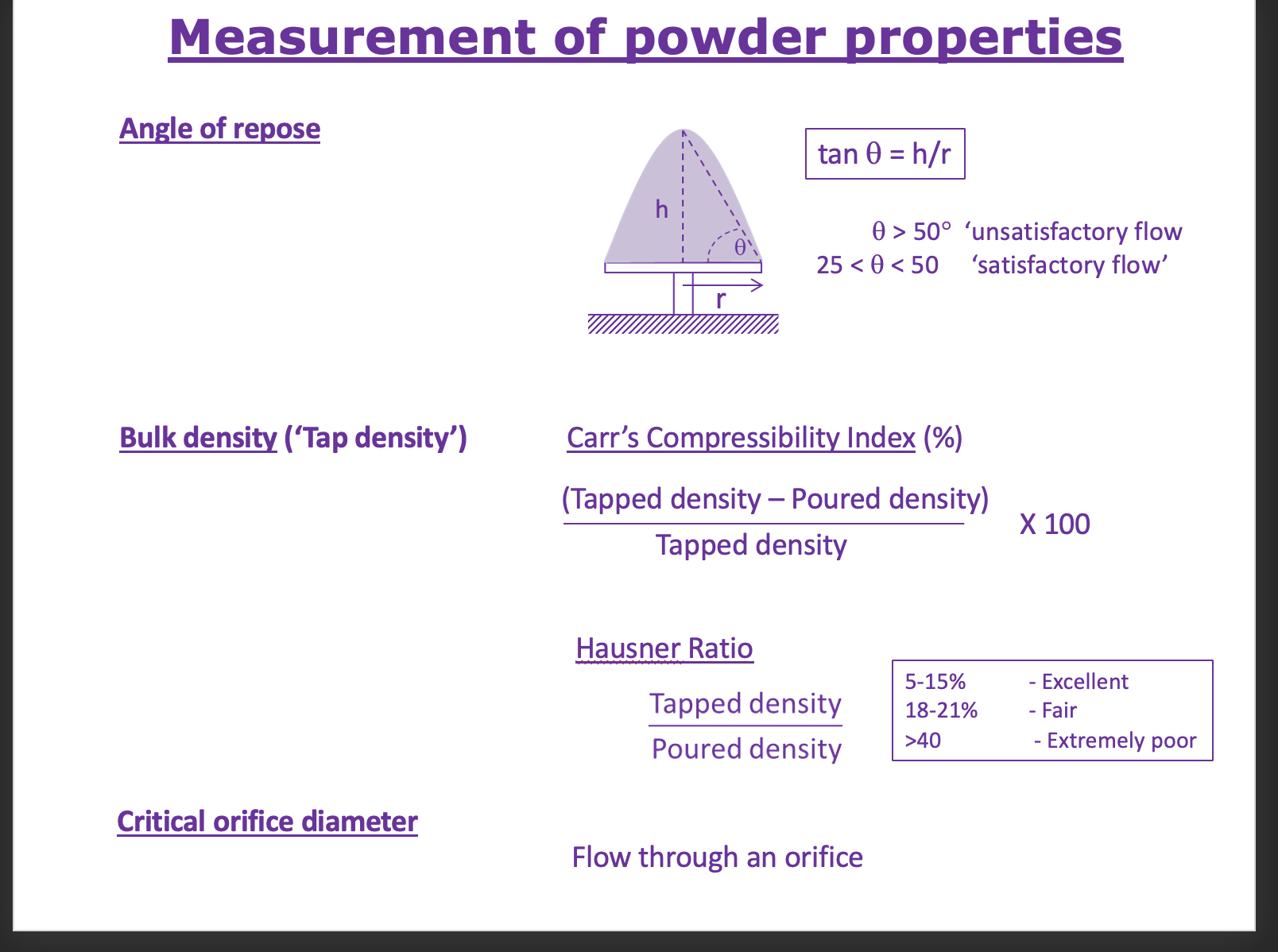
Why are granulate powders required in pharmaceutical processing? (3)
Prevent segregation
Improve flow
Improve compaction properties
What are the two main granulation methods?
Wet granulation
Dry granulation
Describe wet granulation.
•Powders are dry blended and a granulating fluid (normally
containing an adhesive binder) is added.
What is the role of the granulating fluid in wet granulation?
Forms liquid bridges between particles, promoting aggregation.
Describe dry granulation.
Powders are compressed into slugs, then milled and sieved into granules.
When is dry granulation preferred?
For drugs that are sensitive to moisture or heat.
Explain adhesive and cohesive forces in granulation.
Adhesive: attraction between different materials
Cohesive: attraction between similar particles
List the five bonding mechanisms in granules.
Adhesive/cohesive forces in immobile liquid film
Interfacial forces in mobile liquid film
Solid bridges
Attractive forces between solid particles
Mechanical interlocking
How are solid bridges formed in granules?(3)
Through solvent evaporation, crystallisation, or binder hardening.
What attractive forces act in dry granulation?
In the absence of a granulating fluid, two attractive forces operate:
Electrostatic forces
Van der Waals forces
What is mechanical interlocking?
Physical interlocking of particles based on shape and size.
What is a high-speed mixer/granulator? (3)
powders are mixed in a bowl by the impeller
• granulating fluid is added via a port,
• The chopper is switched on once the moist mass
is formed to break up the mass into granules.
Describe a fluidised-bed granulator.
Heated air fluidises powder while granulating fluid is sprayed, forming and drying granules.
Define pellets.
Small, spherical multiparticulate dosage forms (0.7–2.0 mm).
What are key physical properties of pellets? (4)
Spherical shape gives good flow
Narrow size distribution
Low friability
High surface area/volume ratio
Why do pellets have high surface area-to-volume ratio?
Due to small radius, increasing dissolution and coating efficiency.
State the surface area-to-volume relationship for spheres.
SA:V ratio = 3 / r
What are the advantages of pellets in the GI tract? (4)
Uniform distribution
Reduced irregular dosing
Reduced ulcer risk
No dose dumping
What formulation advantages do pellets offer? (3)
Multiple APIs possible
Different release profiles—immediate release or controlled release possible,
Reduced incompatibility issues —incompatible actives can be manufactured
as separate pellets
What processing advantages do pellets have? (6)
increased bulk density,
-
- improved flow properties,
- reduced dust production (low friability),
- increased strength,
- smooth surface (for coating)
- regular shape for packing (capsules, tablets)
Disadvantages of pellets in processing?
manufacture is more labour/energy intensive
than other granulation methods mainly due to
the high levels of solvent (water) required.
List stages of extrusion–spheronisation.
Dry blending → Wet granulation → extrusion → spheronisation → drying → coating
What happens during extrusion?
Wet mass forms rod-shaped particles of uniform diameter
What happens during spheronisation?
rod-shaped particles are converted into spherical particles via frictional forces.
What happens if water content is too low in granulation? (2)
Dust formation
Poor pellet yield
What happens if water content is too high in granulation? (2)
Over-wetting
Agglomeration into large spheres
How does extruder type affect pellet quality?
Extruder types dictate how materials are melted, mixed, and compacted. The mechanical shear and compression profiles of the machine directly Influences density, shear stress, and temperature.
What is “shark-skinning”?
Surface roughness defect on extrudates.
What factors influence extrudate properties? (3)
Extrusion speed—•surface ‘roughness’ and ‘shark-skinning’
may (or may not!) become more
pronounced with increased speeds
Temperature—•increased temperatures causes evaporation of granulation fluid
Screen size/thickness—•diameter of perforations effects pellet size,
— screen thickness effects densification of mass
How does spheronisation speed affect pellets?
Influences size, hardness, porosity, and shape.
What is the effect of spheronisation time?
No clear correlation, typically 2–10 minutes.
Why should spheroniser loading be controlled?
Overloading reduces process efficiency and uniformity.
Why is wet mass composition critical?
Determines granulation behaviour and pellet quality.