4.1.4.5 - Economies & Diseconomies of Scale
 Call Kai
 Learn
Learn Practice Test
 Spaced Repetition
 Match
Match Flashcards
 Knowt Play
1/10

There's no tags or description
Looks like no tags are added yet.
Name | Mastery | Learn | Test | Matching | Spaced | Call with Kai |
|---|
No analytics yet
Send a link to your students to track their progress
11 Terms
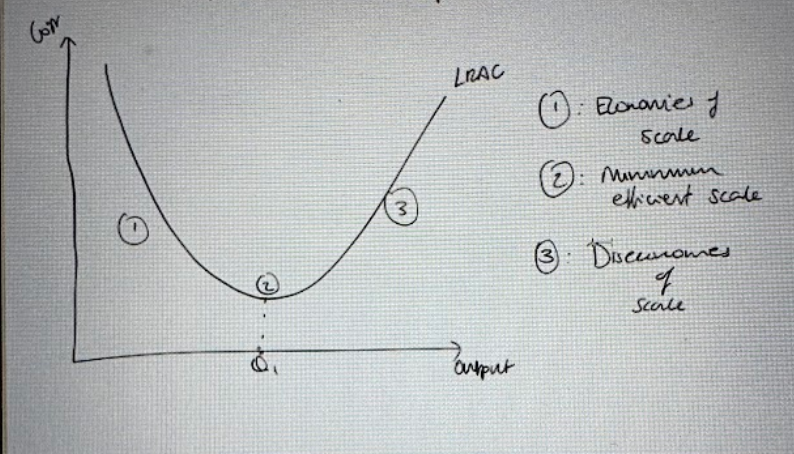
Economies of Scale =
Cost savings that arise because producing more output reduces average cost.
Internal Economies of Scale =
Cost savings that result from the growth of the firm itself.
Types of Internal EOS
Please Try Find Money
Purchasing - As firm increases output, it buys more inputs. Buying at higher quantity allows firm to access bulk-buying discounts.
e.g. cotton for clothing manufacturer
Technical - Larger firms can afford to invest in more & better capital.
e.g. Industrial dishwashers are 2x more energy efficient.
Financial - Larger firms can borrow more funds and on more preferable terms because lender perceives lower risk for larger firms
e.g. Lower interest rates on loans, longer repayment time
Managerial - Larger firms can employ more specialist managers who can raise the productivity of other workers
e.g. Experienced football manager
External Economies of Scale =
Cost savings that result from growth in the industry in which the firm operates.
Types of External EOS
Better or closer Supply Chains - Suppliers may open locations that serve clusters of firms in a particular industry → lower costs of delivery.
Better Transport or Communication Infrastructure - Better infrastructure in the area where firms of a particular industry cluster.
e.g. more car parking, wider roads → lower transport costs
Local pool of Trained Labour - Education or training related to an industry may occur intensively in one particular area → firms can focus their recruiting efforts to just that area → lower recruitment & training costs
Diseconomies of Scale =
When producing more output increases average cost
Types of Diseconomies of Scale
Communication - More difficult & costly to communicate effectively with all workers in large firms. Messages can get distorted/lost as they are passed down → worsens productivity
e.g. Messages from HQ to individual stores get changed → workers do wrong thing → worsens productivity
Coordination - Harder to coordinate and supervise tasks of each worker
e.g. Workers may duplicate tasks or do wrong tasks
Motivation - As firms increase in size, workers feel more distant from owners. Lack of incentive to help the business grow → less productive
e.g. Running a family-owned coffee shop with only one branch means workers are closer to the owners so feel more motivated to help the business grow
LRAC Diagram (showing E/DOS & MES)
L-Shaped Average Cost Diagram
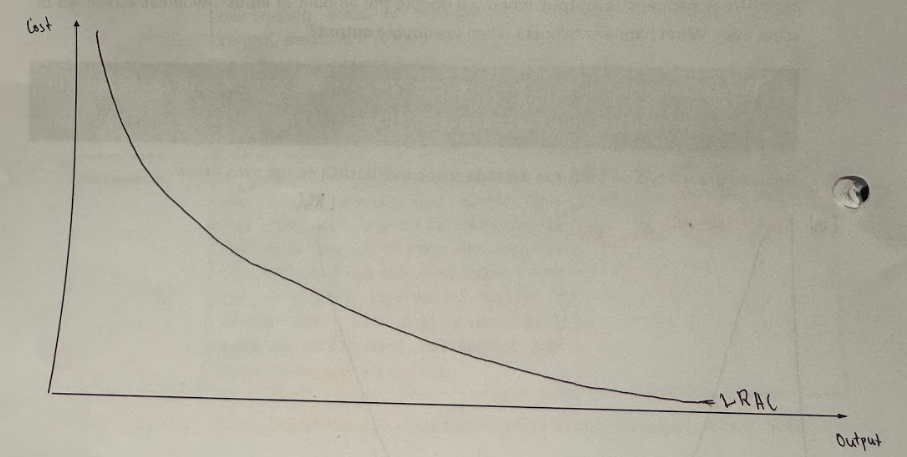
Why do some firms have an L-Shaped LRAC
Firms with very large startup costs (e.g. licences, infrastructure like train tracks) means that average costs always fall as output rises, even in the LR.
Minimum Efficient Scale =
The lowest level of output at which the long-run average cost is at its lowest.
minimum point on LRAC curve

